Showing posts with label Oakland Athletics. Show all posts

Sunday, September 13, 2020

The Trading Post #149: Dime Boxes

Mystery PWEs usually contain a little bit of everything. They're fun to get, but it can be difficult to weave all the cards in a post together. I told a friend once that I felt like what I wrote were little more than "glorified captions". But every so often, the contents of a PWE can be easily sorted into categories and pairings. A shipment from Brian some years ago (post #90) came to mind as I started putting this post together.

This PWE in particular came from Nick at Dime Boxes, and his Free Card Friday offerings earlier this year lead us to our first category. I mean, I guess these were all free. But I only selected two in particular. The rest were graciously included at no extra charge.

Category 1: Free Card Friday Oakland A's

2017 Topps Throwback Thursday #96 Yoenis Cespedes /1118

Of all the numerous cards that Nick offered, this is the one that caught my eye. It's modeled after a 1996 Topps subset called Star Power, which I could have sworn I've had on the blog before. I can't seem to find such a post, but it pretty much looks like this. The original is glossy on white card stock, while this is thicker and printed on actual cardboard. I think the typeface on the right side is a little different here, too.

The set itself is an online exclusive called Throwback Thursday, where Topps released one themed set a week using various past Topps designs. According to Beckett, this has a print run of 1,118. There isn't much on the card back about Yoenis Cespedes himself, but there are a couple paragraphs explaining what the Throwback Thursday set is, which design they picked for this weekly set, and yes, #TBT is there too.

This is from the sixteenth weekly set, featuring top Home Run Derby performers, and the card design changes the words "Star Power" to "Derby Legends". Also in this weekly set are names you might expect: Aaron Judge, Giancarlo Stanton, Mark McGwire, and more, Home Run Derby winners all. This photo is from Cespedes's second of two consecutive Derby wins, 2014's contest in Minnesota. The team logo and photo on the back have him as an Oakland Athletic, but he was traded to Boston mere weeks after becoming just the third repeat winner in Derby history, and only the second besides Griffey, Jr. to do it consecutively.

2006 Topps Chrome X-Fractors #155 Eric Chavez

The other Free Card Friday selection I made in those early days of the theme was another Athletic, Eric Chavez in shiny X-Fractor form. This one certainly looks like a proper Oakland card, containing plenty of yellow and green on the border and in the photo.

The first time I ever saw an X-Fractor was in the 2003 Chrome set. I found a couple at a card show still in their uncirculated Topps case, and they were numbered to a little over 50 copies. That's pretty much what got me back into the hobby. Just a few years later, the background pattern remained, but it simply evolved into yet another parallel without any particular scarcity. 

Serial numbered or not, I've continued to collect these, and a glance at some past posts led me to a rookie year Nolan Arenado X-Fractor sent by The Junior Junkie (post #30). It's certainly not one of the bank vault-worthy Griffey specials he has in his collection, but five years on, I should probably consider getting that one graded. Or at least put it in a toploader.

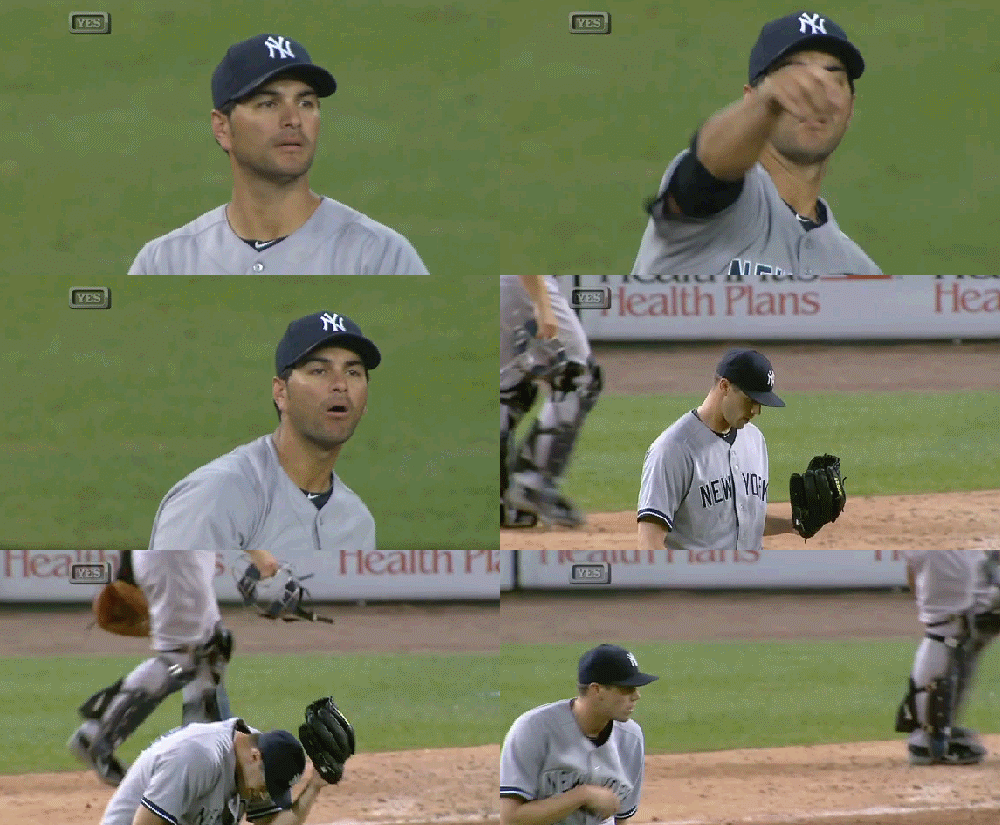
Though he spent most of his Gold Glove-caliber career in Oakland, Eric Chavez later became a Yankee, and it was there that he found himself involved in an all-time great blooper. I speak, of course, of the noggin incident, which gave us one of the best-ever baseball gifs. Just a simple groundout followed by an around-the-horn toss, after which Chavez accidentally hit pitcher Cody Eppley in the head with his toss back.

Category 2: Shiny

2016 Bowman's Best '96 Bowman's Best #96BB-NA Nolan Arenado

Speaking of Nolan Arenado, as I often do, here's a shiny card of him on the 1996 Bowman's Best design. Topps has quite the archive of past designs to use in reprints and reproductions, and that archive exploded in the mid-90s. Post #90 from Highly Subjective and Completely Arbitrary shows us what the contemporary 2016 set looked like, and this 1996 throwback was an insert set that year. It's faithful to the original, perhaps even a bit thicker, which is never a bad thing.

Even the stat categories on the back haven't changed. In an early attempt at advanced statistics, Topps included analytics like At Bats per Extra Base Hit, Games per RBI, and others. These aren't true Sabermetrics like we know them today, but certainly an attempt at trying to measure actual production beyond just counting. Interestingly, Games per Stolen Base is still on here as it was in 1996, and Nolan's rate is up in the mid-sixties. The game has certainly changed since that was a meaningful statistic for most players. Few players are still swiping bags these days. Nolan has more career triples than stolen bases, and triples are still somewhat rare even in the hitter's paradise that is Coors Field.

Below the Bowman Best Stat-Scan, as the analytics are officially called, the card back mentions Arenado's defensive wizardry, as cards usually do, stating that his Super Skills are his "astonishing reactions and short-area quickness at 3rd base".

2018 Topps Allen & Ginter Glossy Silver #36 Trevor Story

Compared to X-Fractors and Bowman's Best, Allen & Ginter really doesn't play in the shiny space. But this is a glossy parallel, so for A&G, this is about as shiny as it gets.

Specifically, this Trevor Story card is a Glossy Silver parallel, not to be confused with just the Glossy parallel, which Beckett has listed as a 1/1. I'm not sure how you'd tell the difference between those two, especially since I once saw an A&G mini (also from Nick, post #22) that was simply serial numbered with a blue ballpoint pen.

Cards like these were found in certain "hot boxes", Hobby boxes where all the base cards looked like this instead of the usual matte finish. A&G did something similar in 2017 with foil parallels, and Nick found those for me too.

As usual with Allen & Ginter, there isn't much on the back other than statistics verbosely spelled out. Batting average of Two Hundred Fifty Three, Drafted in June Two Thousand Eleven, and so on.

Category 3: My Friday Night

2019 Topps Utz #86 Charlie Blackmon

I'm breaking my own rules already by putting just a single card in this category. But follow my lead.

Last year, I searched high and low for Topps Utz cards, an oddball food issue set found in packages of Utz potato chips. I was never able to find any, though I did end up with numerous bags of delicious, crunchy potato chips as a consolation prize. I may have been looking in the wrong place, as even though the Utz bags I found last year had MLB team logos all over them, these cards were only offered in the mini snack-sized multi-packs, or so I've read.

I still don't know what I did wrong. The 10-ounce bags are basically a snack size for me.

It's true. I'm not making that up. I'm not proud to admit it, but once a bag of chips enters my kitchen, its lifespan is usually measured in minutes. Hours if I can tap into a supply of willpower.

I did a grocery run on Friday and got a bag, but they weren't Utz. I managed to make it last all the way until 10pm, about nine hours.

Anyway, I finally have an Utz card in my collection.

And as far as Friday goes, Charlie Blackmon was the hero for the Rockies that night. The Rockies were losing by a run in the bottom of the 9th. Ryan McMahon tied it up with a solo shot, saddling the Angels bullpen with yet another blown save. After a double and a pair of walks, Charlie Blackmon hit a 3-1 pitch over the wall for the second-ever walkoff grand slam in Rockies history. Ryan Spilborghs had the first, a 14th inning sprint around the basepaths back in 2009. The broadcast crew has been talking about little else the past couple of days, seeing as how Spilly has been on the TV team for years.

And all this happened around the time I finished that bag of chips.

Category 4: Infielder Parallels with Outfield Wall Banners

2017 Topps Gypsy Queen Green #245 DJ LeMahieu

This might seem like an oddly specific category, but I promise it will work out. First up is DJ LeMahieu, who has taken over a top-3 spot in 2020's batting average category now that Charlie Blackmon's .400 run is long gone. A well-rounded player, DJ is equally comfortable at the plate and in the field. He's just about to catch an incoming ball in this photo as a Pepsi banner looms behind him. 

This is the Green parallel from 2017 Gypsy Queen, which have arrived from all over the Cardsphere ever since. It's grown to be one of my favorite GQ designs so far. Curiously, more than a few of these parallels seem to have some centering issues. I haven't really noticed that on the base cards. Perhaps that's widely known among GQ aficionados, but this isn't a brand I follow too closely. I don't think I've ever bought it at retail.

2011 Topps Diamond Anniversary #286 Melvin Mora

Back in 2011, Melvin Mora got a curiously similar shot during his brief time as a Rockie. The incoming ball perfectly obscures his uniform number 6, which is currently worn by catcher Drew Butera. And just like DJ's card, Mora is in front of an outfield banner, which I believe is a Sony ad.

This is only Mora's second appearance on the blog, and by far the shiniest. This is one of the sparkly Diamond Anniversary parallels from the 60th year of Topps. They're not terribly uncommon, but they're certainly eye-catching. And the equivalent Mike Trout rookie card in 2011 Topps Update is worth many thousands of dollars, depending on the grade.

I haven't looked too closely at the 2021 Topps sell sheets, but by this count, they're up to their Platinum anniversary, the 70th. 2001 gave us untold levels of gold foil, 2011 has all this diamond shininess, but it remains to be seen just how much platinum will work its way into the Topps offerings next year.

Category 5: Jon Gray Parallels

2018 Topps Big League Rainbow Foil #239 Jon Gray /100

As a low-end set, I see Topps Big League arrive here frequently. The base cards I see a lot, and same with the gold parallels, which are really just a border color. There's no special foil involved there. But this is the first truly rare Big League card I've seen, the Rainbow Foil parallel. It's numbered to 100 right on the front, directly in Jon Gray's line of sight. He's probably used to that sort of thing, as I imagine having hair that long gets in your eyes at least once in a while. Between him and Blackmon, the Rockies don't mess around when it comes to long hair. That Utz card, by the way, tells us that Blackmon calls his mullet a "mu-LAY".

The card back has a fun "Did You Know?" fact about Gray, mentioning that one of his hobbies is ghost hunting.

It's really a shame that the league doesn't let these guys be themselves as much as some other sports do. Gray has his ghost hunting, Mike Trout has his meteorology, Charlie Blackmon is into fly fishing, CJ Wilson has quite a few varied interests. Sadly, fans don't really get to know about much of this unless they happen to see the occasional tweet or Cut4 post. Baseball card collecting is already a pretty niche hobby, and I'm sure that I'm one of the very few who actually still reads card backs. Major League Baseball might be able to have a player show up on the list of most famous athletes if they let them express themselves more. 

Although I have to hand it to Trevor Bauer. He's certainly trying his hardest.

2017 Topps Allen & Ginter Mini A&G Back #227 Jon Gray

All I'm saying is that card backs are a gold mine. In fact, you'd never even know this was a parallel if you didn't flip it over. Obviously, this is the mini-sized parallel already, but beyond that, this happens to be one of the back variations. It's the A&G back, just like Nick sent once before from the 2017 A&G mini set. He's filling out that 15-card page nicely, pretty much singlehandedly. My collection would be so much poorer without everything Nick has added to it over the years.

I've seen these twice now, so I'll flip this one over for you. It's only fair for me to scan the card backs once in a while if I keep stressing how important they are.

2017 Topps Allen & Ginter Mini A&G Back #227 Jon Gray (Reverse)

Category 6: Game Cards

2007 MLB Trade-Up #NNO Brian Fuentes

This is our final category, and I am pretty much in the dark about what this card is. This category will need a lot of research. That will be particularly difficult because Beckett has precisely nothing about this Brian Fuentes card. There's a giant comic-book exploding 1, a giant team logo, and not much else besides a quick note that Fuentes was the first Rockies reliever to make it to an All-Star game. That was in 2006, during a game held in Pittsburgh.

That and the 2007 copyright date help me narrow this down a little, and the card back on this playing-card-esque product has an MLB Trade Up logo. Still nothing on Beckett, but this does show up on a board game site. I've never heard of it, let alone played it. And I don't see a checklist other than a 52-card deck. If this is truly a deck that small, Fuentes might very well be the only Rockie in it.

I do know that Nick has always been into baseball card games, and has written a lot about MLB Showdown over the years. He's quite the collector of oddballs, and it's appropriate that he sent me something Beckett doesn't know about.

2011 Topps Sega Card Gen #257 Seth Smith

Unlike MLB Trade Up, I do see Sega Card Gen at least mentioned from time to time, primarily from the small handful of card bloggers residing in Japan. This doesn't quite feel like a playing card, but it does have rounded corners, despite what my scanner decided. It's a set that ties in to an actual arcade game, blending two of Japan's big entertainment industries. There's a spot on the arcade cabinet for your cards, along with a touchscreen where the game is actually played. I don't know if the cabinet can actually read which cards are inserted, or if that's more for display purposes and you have to enter your deck into the screen manually. I'd expect to see a QR code or something on the card back if it's the former, but the card number is pretty detailed, specifying "J11-257/410". So maybe that's what the system looks for.

2011 Topps Sega Card Gen #257 Seth Smith (Reverse)

In any case, the card back is nearly all in Japanese, so I have little idea what's going on here. Seth Smith is listed as a Power-hitting corner outfielder, his birthdate is there in YYYY/MM/DD format, and his height and weight are included in metric measurements. Beyond that, there are some numerals and bars which I assume relate to his skill in power and contact and fielding and so forth, but a lot of it is a mystery.

And apparently it's a Topps product, just like the Utz card. So I guess this isn't entirely an oddball after all.

Is it?

I guess each collector can decide for themselves.


Tuesday, October 15, 2019

Nearing Closing Day (Part 1: Coors Field)

As the 2019 Postseason continues, so does my flurry of blogging. I kept up my annual tradition of buying a blaster of Topps Opening Day, and as we near the final game of the season, I have time for my first real deep dive into the 2019 Topps design. This is actually going to be a three-part series, starting with some base cards.

As I leafed through these cards, I noticed that Topps picked a lot of photos that were taken in Coors Field this year. Continuing with Dinger's Mascot card from yesterday, I found over 10% of this whole blaster was shot inside my hometown ballpark.

2019 Topps Opening Day #26 Zack Godley
I'm sure most stadiums have some features that are easily recognizable to fans who have been there dozens of times. Several others, like the ivy walls at Wrigley or the Green Monster at Fenway are known even to casual fans. Coors Field has a few things that make it easy to spot on cards, starting with the forest and water feature behind the center field wall.

The visitor's bullpen is open to this area, giving travelling players a look at some flora native to Colorado. The most noticeable tree is a Colorado Blue Spruce, the official state tree. It's the blue-gray one above Zack Godley's calf, and it looks like a younger one is growing further toward right center. As a fan, you can get a great view of this area just around the corner from the batter's eye, right near where Dinger signs autographs.

On the card back, which returns to including complete career statistics instead of just the most recent five years, Topps mentions Godley's win in Colorado on June 10th, 2018, a Sunday day game. I went to the Friday game of that series, which the Rockies also lost. I am pretty sure, however, that Topps matched the photo to the paragraph on this card, making it sort of an unofficial Topps Now card. After taking a swim in 2018 Stadium Club, Zack Godley started in Denver twice in 2018, but only once during a day game. This is clearly from an afternoon game, so I'm confident in my detective work on this one.

2018 was the 20th anniversary of the Diamondbacks, and on Godley's right sleeve, we can see the patch commemorating that occasion. Most of the patch is the dark red found in the current colors of the D-Backs, but the "1998" on one side of the patch is done in the bluish-purple hue found in the early Arizona uniforms.

2019 Topps Opening Day #108 JosĂ© MartĂ­nez
Other than a Rockies home jersey, the most common telltale sign that you have a Coors Field card is the purple front edge on the roof of the dugout. Like most parks, Coors puts the visitors on the third base side, and that's definitely not a Rockies logo on the cap of the player or coach in the dugout.

JosĂ© MartĂ­nez of the Cardinals has seen a bit of playing time this Postseason, but unless the Cardinals can pull off a miracle, their road likely ends at the NLCS. His uniform number 38 appears on each piece of his protective gear, but there's also a #2 patch on his left sleeve. That is a memorial patch the Cardinals wore in 2018 following the passing of Red Schoendienst, the Hall of Famer who played for and later managed the team. That would place this photo between August 24th-26th, 2018.

2019 Topps Opening Day #159 Nick Martini (RC)
I'm nearing the end of a quest to see every team play at Coors Field. Only a few teams remain, as I crossed both the Astros and A's off the list in late July last year. Nick Martini was in the leadoff spot for the final two games in that weekend series, and pinch hit in the first, so I can't narrow this down any further than July 27th-29th, 2018. I went to the Saturday game on the 28th, which also happened to be Star Wars night. I may or may not have a card from the exact game I attended (part of why these cards interest me so much), but at least I have a souvenir Chewbacca beer koozie.

The Athletics celebrated an anniversary of their own in 2018, as we can see by yet another patch on rookie Nick Martini's sleeve. The A's completed their westward journey from Philadelphia in 1968, with a brief stop in Kansas City from 1955-1967. The patch features both a large "50" and the Tribune Tower, one of the taller old buildings in Oakland.

2019 Topps Opening Day #185 Khris Davis
Khris Davis, Mr. .247, has been showing up a lot around here lately. He was photographed inside Coors Field for his 2019 card, if not during the same game as Martini, then at least during the same series. This particular card doesn't mention his consistent .247 average like his Stadium Club card did, but it's more impressive to see each of those line by line in the usual Topps statistics format.

What the card does tell us is that he's only the third A's player to have three 40-HR seasons, the others being Jimmie Foxx and Mark McGwire. And McGwire didn't manage to do so consecutively, unlike Davis and Foxx.

2019 Topps Opening Day #143 Sean Manaea
With pitchers, it's much easier to narrow down a specific date. Sean Manaea started the Friday game of that series, July 27th, 2018. Easy. He took the loss that game, the opener in a series that the Rockies ended up sweeping.

There's not nearly as good a view of the forest on this card, but there is a blurred view of the "415" in straightaway center. Perhaps surprisingly, that is not the deepest center field wall in the league. That honor would go to The Polo Grounds Minute Maid Park at 436 feet.

Sean Manaea may not have won this game, nor the AL Wild Card game a couple weeks ago, but the card back does highlight his no-hitter on April 21st, 2018 against the Red Sox, the first of three League-wide that year. The card even gives us a quote from the catcher that day, Jonathan Lucroy, about how masterful it was.

2019 Topps Opening Day #85 Germán Márquez
The way the photographer captured Germán Márquez's pitching motion doesn't allow us to see the Rockies 25th anniversary patch, but it's still visible on the side of his hat. The card back mentions that he threw an immaculate inning in 2018—three strikeouts on nine pitches—and even took home the Silver Slugger award for pitchers. Depending on whether the NL one day adopts the Designated Hitter, he could be one of the last pitchers to ever win the award.

Obviously, any Rockies home card is a Coors Field card, or perhaps a Mile High Stadium card if we're talking about the early days. This Márquez card was the only Rockie in the blaster, which would be a slight disappointment if not for all these other Coors Field cards.

Even without the pinstripes, which were removed from the team's 2019 uniform when paired with the purple jersey, there's just enough purple among the fans in the seats to confirm that those are all Rockies fans back there.

2019 Topps Opening Day #12 Zack Greinke
Which is what I am using to place this Zack Greinke card in Coors Field. It's by far the most tenuous evidence, but there are so few other pro teams that wear purple that I think it's a reasonably safe bet. That is, unless there are a bunch of Minnesota Vikings and throwback Toronto Raptors fans that decided to show up that day.

Zack Greinke is a figure in the 2019 Postseason, but not with the Diamondbacks and their unappealing dark gray road uniforms. He's with Houston now, his first return to the AL since 2012. See, I remembered the Astros switched leagues! Partly because they are up to bat in the ALCS as I write this!

It's become apparent that Greinke is no fan of giving postgame interviews. He battles social anxiety, and getting up in front of a bunch of reporters before and after every start, especially in the postseason, can't be fun at all. It can be hard to put yourself in another man's shoes, but I wonder if he feels a nagging sense of dread every time his start comes to a close and he knows he'll have to face the media. If so, it's a feeling I can identify with; just one of those things you know has to be done but remains a pretty unpleasant feeling until you get through it one more time. Which is pretty much how I feel any time my office phone rings with an unknown number.

Whether you make five figures or eight, public speaking, or even human interaction in general, just doesn't come naturally for some of us.

2019 Topps Opening Day #56 Justin Upton
The last Coors Field feature commonly seen on a card is the manually-operated out-of-town scoreboard in right field. This is my favorite feature to find. Depending on the angle, it's likely that you'll be able to find the exact date of the photo, or if you're lucky, the exact play. Let's try with Justin Upton.

Even without looking, I know this is from the Angels' visit to Denver in early May of 2018. I know that because I was in London at the time, and prioritized getting $600 round-trip airfare over seeing Mike Trout and Shohei Ohtani. I'll catch them next time.

Specifically, the dates were May 8th and 9th, a quick two-game set that the teams split. May 8th was the day the Yankees-Red Sox London Series was announced, which I learned about from the nightly London newspaper.

Anyway, let's see which game this was from. The key piece of info is the 6-5 score, Pirates over White Sox. That was their final score on May 9th, and while that was the score for a very brief two-batter window during the May 8th game, odds are this is from the 9th. This is almost certainly from the top of the 8th inning, where Albert Pujols doubled Upton in, after Upton doubled his own way aboard to lead off the inning. Upton did go second-to-third again in the 9th inning, but that was on a bases-loaded walk, and I wouldn't expect any player to be kicking up dirt on a leisurely play like that.

Incidentally, if MLB chooses to add another couple teams, this feature will need a little work. It has seven columns and two rows, room enough for the maximum of fourteen out of town games that can take place on any given day. But if there's a fifteenth in Portland or Nashville or wherever, they'll have to find a way to extend this under the right field foul pole, or perhaps encroach onto the warning track party suites that can be seen below it. That, or just overhaul the whole thing so each column is narrower, but that would make it even harder to read from my preferred seats on the third base side.

There are some other Coors Field views to be spotted, like the left field bleachers and the upper decks, but they're quite rare. And you'll basically never see them all in one set like in 2019 Topps Opening Day.

I found a few more base cards with photos from some of the other twenty-nine ballparks, which I'll have for Part Two of this miniseries.


Saturday, November 24, 2018

Rockin' Retro Group Break the First (Part 2: Athletics)

During the time between Part 1 and Part 2, my haul from Nachos Grande's newest group break arrived, including an awesome Andres Galarraga relic card. But his first Rockin' Retro Group Break has a part two to cover before we can get to that. See Part 1 for my hometown Rockies, and my random team this time around was another generally well-liked team, the Oakland (and Philadelphia) Athletics.

2017 Topps Gold Label Class 3 Black #13 Sonny Gray
My Rockies haul from 2017 Gold Label was a little more complete, but I did get this lone Sonny Gray card from Class 3. In fact, based on the final highlights, I ended up with two of only four Class 3 cards that were found in the entire break. The security stripe, as I called it last time, is a bit more legible, but the three different classes for pitcher cards are a little harder to tell apart. Position players get their three classes of cards in batting, fielding, and baserunning, but pitcher cards are split between the windup, delivery, and follow-through, making it a little tricky to tell which one you are holding.

As always, players are on the move. Sonny Gray was traded to the Yankees right at the 2017 trade deadline, and there are tons of trade rumors swirling around him this offseason. I'm sure Topps accepts it as an inevitability that these beautiful cards they design can be obsolete in a matter of weeks. Or maybe they just know they'll sell more.

1998 Bowman Chrome International #205 Miguel Tejada
Fresh off his debut in late 1997, Miguel Tejada appeared in 1998 Bowman Chrome, and this happens to be an International parallel. I'm no Bowman expert, but this appears to be just the second year this parallel set existed. The shiny front has a map of the Eastern half of the island of Hispaniola, with Tejada's head and cap obscuring Haiti. The card back is entirely in Spanish, taking a page from some early-1990s Pacific sets, as well as Topps' old Venezuelan cards.

Coincidentally, Tejada's middle infielder counterpart on the Rockies, Neifi Perez, was my featured card in Part 1. Perez, also from the Dominican Republic, has the English "SS" abbreviation for his position. Tejada, on the other hand, gets a "PC" in that spot, and I'm not quite sure what that means. I am even less an expert in Spanish than I am in Bowman. "Campo Corto" is the translation of shortstop, and those words are found on the back, but I'm not sure how you'd get "PC' from that.

2002 Fleer Triple Crown Batting Average Parallel #78 Eric Chavez /288
2002 Fleer Triple Crown was a richer vein than those first two sets, yielding a BA Parallel of Eric Chavez. "BA" refers to his batting average, meaning Fleer printed up 288 copies of this card, matching his statistic from 2001. Troy Tulowitzki's .340 batting average led to a similar card in 2015 Donruss, and Topps completely overdid the idea with Moments and Milestones, a set I had to dig deep into the memory banks to remember.

During that .288 season, Eric Chavez, and all his fellow American Leaguers, wore a commemorative patch on their right sleeves to mark the 100th season of play for the AL. Four teams, but not Oakland, had slightly different "Charter Member" versions of that patch, going all the way back to 1901. Ban Johnson, the founding executive of the AL, isn't named on the patch, but he's a prominent figure in the early episodes of Ken Burns' Baseball documentary series.

I don't know if all the BA parallels have green foil or if that's color-coded to Oakland. My 2002 Fleer pages are sparsely populated, especially when it comes to parallels, so I don't have much to compare it to.

That's not precisely true. I have quite a few 2002 Fleer cards. It's just that there were so many sets, and some of them are pretty underrepresented.

2002 Fleer Triple Crown #118 Mark Mulder
Back to the land of the base cards, here's Mark Mulder in that gorgeous emerald green jersey. Apparently he went 21-8 in 2001, just his second big league season, and finished second in Cy Young voting that year.

Mulder was also involved in an infamous trade in my Fantasy baseball league, a not-so-great move on my part when I was getting my feet wet back in 2005. I acquired Mulder, a briefly hot shortstop, and a few others, but the price was way too high.

Lesson learned.

2002 Fleer Triple Crown #134 Miguel Tejada
By the time the Moneyball season of 2002 rolled around, Miguel Tejada (played in the movie by former major leaguer Royce Clayton) was a rapidly-ascending star. In fact, he'd win the AL MVP that year. Even at a young age, he quickly became the best shortstop ever to play for the A's, but sadly lost four straight ALDS series as his only time in the Postseason.

The more I see of this Triple Crown set, the more I like it. Collectors have been complaining for years that backgrounds have become too blurry, but when you have the glossy foreground and matte background like this set, a nice bokeh effect really blends in well. I particularly like how the ball that Tejada is fielding is glossy, clearly part of the main attraction.

2002 Fleer Triple Crown #86 Ramon Hernandez
The way this card is cropped doesn't show the ball that Ramon Hernandez is presumably about to catch, but his full array of catcher's gear comes across in a lovely shade of green. I've long gone on record as liking green cards, and between Hernandez and Mulder, this is the set that might make me start looking for more A's cards for my collection.

The card back isn't quite as special, and I'm not a fan of conflicting horizontal and vertical orientations. Most of the card back is horizontal, but Fleer stuck the copyright notice and such on the right hand side, reading bottom-up. It's an awkward look. But the usual quick paragraph is there, and it tells us that Hernandez caught a whopping 143 games in 2001, not even one game off a week.

That pace slowed a lot in his later career, although he did spend the 2012 season as a Rockie. This is his first appearance on Infield Fly Rule, and it's not even in a Rockies uniform. That might be a first.

2012 Panini Cooperstown #120 Rickey Henderson
The Athletics have been around in one form or another since 1901, and have played in three different cities across America. That of course means they have quite the delegation in Cooperstown, unlike the Rockies, where I had to resort to a card of an umpire to even mention this Panini set in Part 1.

Rickey Henderson played for a lot of teams in his long career, but most people remember him with Oakland. He played 14 seasons with them, spread out across four separate stints. This being an unlicensed set, it's hard to tell which team he's on here, but it appears to be Oakland, matching his Hall of Fame plaque. The single season of stats that Panini gives us on the back are from his MVP 1990 season, the year before he'd break Lou Brock's record, which he would further demolish by almost 500 more SBs.

A few other fun facts about Rickey. We all know he's the all-time stolen base leader, with 1,406. He's also the all-time leader in runs scored, which goes to show just how valuable SBs really are. He isn't really known for it, but he had a terrific eye, leading the Majors in unintentional walks, with over 2,000. He's also a member of the 3,000-hit club. And finally, one of my favorite sports stats that shows you what a competitor he is, Rickey is the all-time leader in times caught stealing.

So when you add all that up, we can calculate a few things. In all his plate appearances, Rickey Henderson stole a base in over 10% of them. There are surely a few in which he stole second and third on his same trip around the bases, but that's a staggering rate. And if you want to take it a step further, if you add his extra-base hits into the mix, Rickey Henderson was in scoring position (or better) in about 17% of all his plate appearances. Give or take, he made it to at least second base a sixth of the time, solely by virtue of his bat, eye, and speed. And that doesn't even count the times a subsequent batter pushed him along.

Bottom line, he's one of the best players to ever grace the sport of baseball.

2012 Panini Cooperstown #8 Connie Mack
So far, this post has focused on the Athletics' time in Oakland, but they got their start in Philadelphia at the turn of the 20th century, and also had a forgettable midcentury stopover in Kansas City. This card of legendary manager Connie Mack is why I qualified the A's home city at the beginning of this post. He was the team's only manager for nearly a half-century, from their founding in 1901 all the way until 1950, the year in which Vin Scully took over broadcasting duties for the Dodgers.

In other words, until 2017, there was an unbroken line of baseball legacy from Connie Mack to Vin Scully going back to 1901. You can push that back to 1886 if you don't count the brief hiatus between Mack's playing and managerial careers.

So yes, this dapper gentleman is in the Hall of Fame. And he does make one wonder why baseball managers suit up in white performance gear as opposed to a suit and tie. It is slightly comical, seeing sharply dressed guys like Joel Quenneville and Gregg Popovich in contrast to, say, Bob Melvin in a green cap and white uniform. But take Earl Weaver, whose legendary tirades maybe wouldn't have been quite as awesome if he were worrying about dirtying up his leather dress shoes.

All I know is that a guy named Cornelius McGillicuddy wearing a bowler hat is basically the last guy I would want to mess with.

2012 Panini Cooperstown #154 Home Run Baker SP
I admit, I need to brush up on my deadball-era Hall of Famers. For someone whose nickname is also the highest-profile statistic in baseball, you'd think I'd have heard of him before. Before he became short-printed Home Run Baker, he was just Frank, but then he joined a young Athletics franchise. In 1909, he tied the AL record for triples by a rookie, with 19, a record that still stands today. And he led the American League in home runs for four straight seasons, 1911-1914. He hit 42 home runs in that span, one less than second-place J.D. Martinez hit for the Red Sox this year.

Baker wasn't even the first player to lead the home runs category in four straight years. He wasn't even the first Athletic to do it. His teammate Harry Davis did precisely the same thing, though with 38 home runs, from 1904-1907. Yet Home Run Baker got the nickname. With all the power hitters we've seen over the decades, from Babe Ruth to Ken Griffey, Jr., the guy who is in the Hall of Fame with "Home Run" in quotes on his plaque is a guy who hit 96 in his career.

1997 Sports Illustrated #57 Scott Brosius SIV
Back to modern times, if there's one thing I've learned about 1997 Sports Illustrated, it's that there are a lot of subsets. SI was not missing the boat in the early days of the Information Superhighway (I wish we still called it that), giving us a vaguely computer-themed subset called SIber Vision. It looks a little like the Nintendo logo, with a bright red starburst design in the background and some circuit board 90-degree angles.

1997 would be Scott Brosius' final year in Oakland, as he ended up being The Player To Be Named Later in a trade they made with the Yankees for pitcher Kenny Rogers. Brosius, an average utility player, would go on to become a key member of the Yankees' dynasty in the late 1990s and early 2000s, even winning World Series MVP honors in 1998, his first year as a Yankee. This card had it right in saying, "Brosius seems to improve as a hitter each season he's in the majors."

The card also mentions his college career at Linfield College in McMinnville, Oregon. That happens to also be the location of the Evergreen Aviation and Space Museum, which airplane fans might recognize as the home of Howard Hughes' famous boondoggle, the H-4 "Spruce Goose". It remains the largest aircraft by wingspan that has ever flown, but those who saw The Aviator know that it only flew once.

1997 Sports Illustrated #175 Mark McGwire / Will Clark CC
Yet another subset from '97 SI gives us a miniature reproduction of actual SI magazine covers. This one shows sluggers Will Clark and Mark McGwire preparing for their third major league season in 1988. Little did they know they would square off in the World Series the very next year, with Oakland coming out on top.

I like this idea a lot. We all know that SI photos make for great baseball cards, but they really are kind of cute when scaled down to this size. And in case you were wondering, 6-seed Kansas did indeed complete the upset during March Madness in 1988, defeating top-seed Oklahoma 83-79.

2010 Upper Deck #365 Brad Ziegler
That about does it for the main attraction, as the 1998 Gold Label and Donruss Optic wells ran dry, but there are always a couple extras to be found when Nachos Grande sends out a shipment. It's almost like getting a free repack with your group break winnings. Many of us have seen 2010 Upper Deck in repacks, and the several shades of green on this card look great. Not much is said about Upper Deck anymore, besides the vague lamentation of "I wish Topps didn't have a monopoly". But their final couple sets were pretty great, in my opinion.

There is a ton of blank white space on the back of this card, however. It's too bad that Brad Ziegler, back with Arizona for a second time before announcing his retirement last month, didn't get to fill out Upper Deck card backs any further past this. And I find it a little strange that UD squeezed the submariner's scouting report into the small brown area on the left, leaving lots of open space on the rest of the card.

1987 Topps #311 Rickey Henderson TBC
We'll close today's post with Stolen Base Henderson, gracing the front of Topps' look back to 1982, a mere five years before the iconic 1987 woodgrain set was released. There's a little reproduction of Rickey's 1982 Topps card on the front, and lots of fun 1982 tidbits on the back, such as Larry Parrish's three grand slams in one week, Salome Barojas' five-save MLB debut (whom Night Owl coincidentally just wrote about), Rollie Fingers' 300th save, and of course Rickey Henderson's 130 stolen bases.

It is nice to have another team to delve into once in a while. Even though I'm an avid Rockies fan, there's only so much that's happened in the last 25 years. Given the opportunity to dig back to 1901, there's plenty of history that remains untold. I've uncovered a lot in 250 posts, but there's plenty more to come.