Sunday, September 13, 2020

The Trading Post #149: Dime Boxes

Mystery PWEs usually contain a little bit of everything. They're fun to get, but it can be difficult to weave all the cards in a post together. I told a friend once that I felt like what I wrote were little more than "glorified captions". But every so often, the contents of a PWE can be easily sorted into categories and pairings. A shipment from Brian some years ago (post #90) came to mind as I started putting this post together.

This PWE in particular came from Nick at Dime Boxes, and his Free Card Friday offerings earlier this year lead us to our first category. I mean, I guess these were all free. But I only selected two in particular. The rest were graciously included at no extra charge.

Category 1: Free Card Friday Oakland A's

2017 Topps Throwback Thursday #96 Yoenis Cespedes /1118

Of all the numerous cards that Nick offered, this is the one that caught my eye. It's modeled after a 1996 Topps subset called Star Power, which I could have sworn I've had on the blog before. I can't seem to find such a post, but it pretty much looks like this. The original is glossy on white card stock, while this is thicker and printed on actual cardboard. I think the typeface on the right side is a little different here, too.

The set itself is an online exclusive called Throwback Thursday, where Topps released one themed set a week using various past Topps designs. According to Beckett, this has a print run of 1,118. There isn't much on the card back about Yoenis Cespedes himself, but there are a couple paragraphs explaining what the Throwback Thursday set is, which design they picked for this weekly set, and yes, #TBT is there too.

This is from the sixteenth weekly set, featuring top Home Run Derby performers, and the card design changes the words "Star Power" to "Derby Legends". Also in this weekly set are names you might expect: Aaron Judge, Giancarlo Stanton, Mark McGwire, and more, Home Run Derby winners all. This photo is from Cespedes's second of two consecutive Derby wins, 2014's contest in Minnesota. The team logo and photo on the back have him as an Oakland Athletic, but he was traded to Boston mere weeks after becoming just the third repeat winner in Derby history, and only the second besides Griffey, Jr. to do it consecutively.

2006 Topps Chrome X-Fractors #155 Eric Chavez

The other Free Card Friday selection I made in those early days of the theme was another Athletic, Eric Chavez in shiny X-Fractor form. This one certainly looks like a proper Oakland card, containing plenty of yellow and green on the border and in the photo.

The first time I ever saw an X-Fractor was in the 2003 Chrome set. I found a couple at a card show still in their uncirculated Topps case, and they were numbered to a little over 50 copies. That's pretty much what got me back into the hobby. Just a few years later, the background pattern remained, but it simply evolved into yet another parallel without any particular scarcity. 

Serial numbered or not, I've continued to collect these, and a glance at some past posts led me to a rookie year Nolan Arenado X-Fractor sent by The Junior Junkie (post #30). It's certainly not one of the bank vault-worthy Griffey specials he has in his collection, but five years on, I should probably consider getting that one graded. Or at least put it in a toploader.

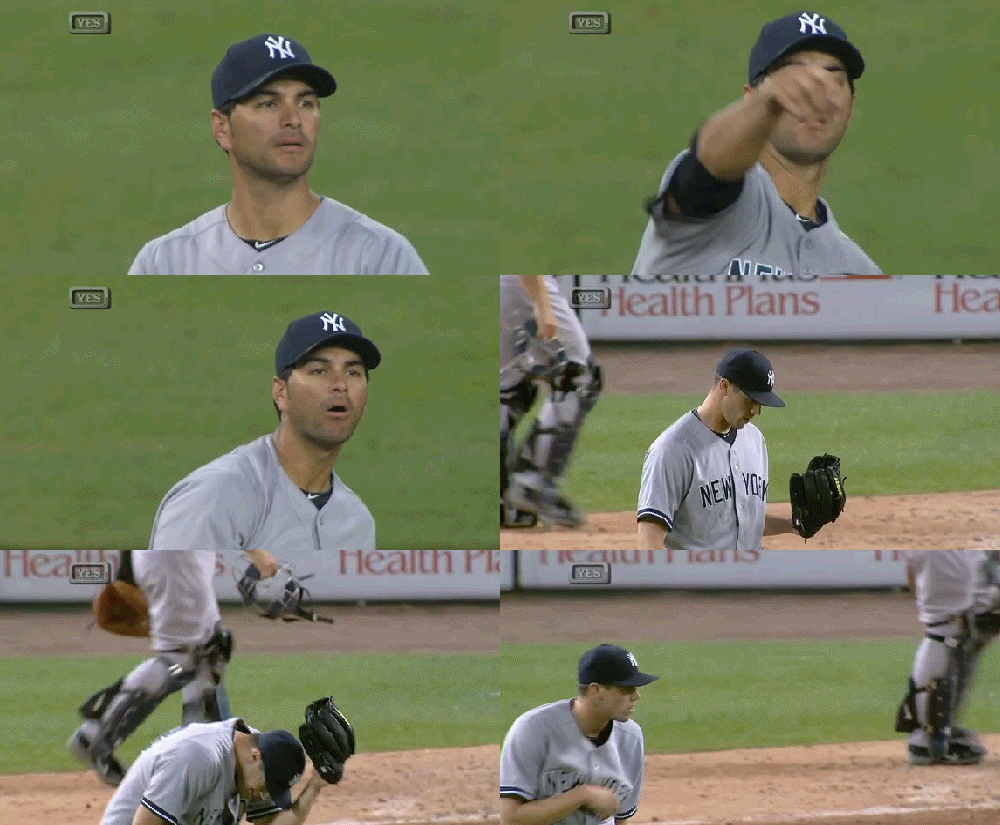
Though he spent most of his Gold Glove-caliber career in Oakland, Eric Chavez later became a Yankee, and it was there that he found himself involved in an all-time great blooper. I speak, of course, of the noggin incident, which gave us one of the best-ever baseball gifs. Just a simple groundout followed by an around-the-horn toss, after which Chavez accidentally hit pitcher Cody Eppley in the head with his toss back.

Category 2: Shiny

2016 Bowman's Best '96 Bowman's Best #96BB-NA Nolan Arenado

Speaking of Nolan Arenado, as I often do, here's a shiny card of him on the 1996 Bowman's Best design. Topps has quite the archive of past designs to use in reprints and reproductions, and that archive exploded in the mid-90s. Post #90 from Highly Subjective and Completely Arbitrary shows us what the contemporary 2016 set looked like, and this 1996 throwback was an insert set that year. It's faithful to the original, perhaps even a bit thicker, which is never a bad thing.

Even the stat categories on the back haven't changed. In an early attempt at advanced statistics, Topps included analytics like At Bats per Extra Base Hit, Games per RBI, and others. These aren't true Sabermetrics like we know them today, but certainly an attempt at trying to measure actual production beyond just counting. Interestingly, Games per Stolen Base is still on here as it was in 1996, and Nolan's rate is up in the mid-sixties. The game has certainly changed since that was a meaningful statistic for most players. Few players are still swiping bags these days. Nolan has more career triples than stolen bases, and triples are still somewhat rare even in the hitter's paradise that is Coors Field.

Below the Bowman Best Stat-Scan, as the analytics are officially called, the card back mentions Arenado's defensive wizardry, as cards usually do, stating that his Super Skills are his "astonishing reactions and short-area quickness at 3rd base".

2018 Topps Allen & Ginter Glossy Silver #36 Trevor Story

Compared to X-Fractors and Bowman's Best, Allen & Ginter really doesn't play in the shiny space. But this is a glossy parallel, so for A&G, this is about as shiny as it gets.

Specifically, this Trevor Story card is a Glossy Silver parallel, not to be confused with just the Glossy parallel, which Beckett has listed as a 1/1. I'm not sure how you'd tell the difference between those two, especially since I once saw an A&G mini (also from Nick, post #22) that was simply serial numbered with a blue ballpoint pen.

Cards like these were found in certain "hot boxes", Hobby boxes where all the base cards looked like this instead of the usual matte finish. A&G did something similar in 2017 with foil parallels, and Nick found those for me too.

As usual with Allen & Ginter, there isn't much on the back other than statistics verbosely spelled out. Batting average of Two Hundred Fifty Three, Drafted in June Two Thousand Eleven, and so on.

Category 3: My Friday Night

2019 Topps Utz #86 Charlie Blackmon

I'm breaking my own rules already by putting just a single card in this category. But follow my lead.

Last year, I searched high and low for Topps Utz cards, an oddball food issue set found in packages of Utz potato chips. I was never able to find any, though I did end up with numerous bags of delicious, crunchy potato chips as a consolation prize. I may have been looking in the wrong place, as even though the Utz bags I found last year had MLB team logos all over them, these cards were only offered in the mini snack-sized multi-packs, or so I've read.

I still don't know what I did wrong. The 10-ounce bags are basically a snack size for me.

It's true. I'm not making that up. I'm not proud to admit it, but once a bag of chips enters my kitchen, its lifespan is usually measured in minutes. Hours if I can tap into a supply of willpower.

I did a grocery run on Friday and got a bag, but they weren't Utz. I managed to make it last all the way until 10pm, about nine hours.

Anyway, I finally have an Utz card in my collection.

And as far as Friday goes, Charlie Blackmon was the hero for the Rockies that night. The Rockies were losing by a run in the bottom of the 9th. Ryan McMahon tied it up with a solo shot, saddling the Angels bullpen with yet another blown save. After a double and a pair of walks, Charlie Blackmon hit a 3-1 pitch over the wall for the second-ever walkoff grand slam in Rockies history. Ryan Spilborghs had the first, a 14th inning sprint around the basepaths back in 2009. The broadcast crew has been talking about little else the past couple of days, seeing as how Spilly has been on the TV team for years.

And all this happened around the time I finished that bag of chips.

Category 4: Infielder Parallels with Outfield Wall Banners

2017 Topps Gypsy Queen Green #245 DJ LeMahieu

This might seem like an oddly specific category, but I promise it will work out. First up is DJ LeMahieu, who has taken over a top-3 spot in 2020's batting average category now that Charlie Blackmon's .400 run is long gone. A well-rounded player, DJ is equally comfortable at the plate and in the field. He's just about to catch an incoming ball in this photo as a Pepsi banner looms behind him. 

This is the Green parallel from 2017 Gypsy Queen, which have arrived from all over the Cardsphere ever since. It's grown to be one of my favorite GQ designs so far. Curiously, more than a few of these parallels seem to have some centering issues. I haven't really noticed that on the base cards. Perhaps that's widely known among GQ aficionados, but this isn't a brand I follow too closely. I don't think I've ever bought it at retail.

2011 Topps Diamond Anniversary #286 Melvin Mora

Back in 2011, Melvin Mora got a curiously similar shot during his brief time as a Rockie. The incoming ball perfectly obscures his uniform number 6, which is currently worn by catcher Drew Butera. And just like DJ's card, Mora is in front of an outfield banner, which I believe is a Sony ad.

This is only Mora's second appearance on the blog, and by far the shiniest. This is one of the sparkly Diamond Anniversary parallels from the 60th year of Topps. They're not terribly uncommon, but they're certainly eye-catching. And the equivalent Mike Trout rookie card in 2011 Topps Update is worth many thousands of dollars, depending on the grade.

I haven't looked too closely at the 2021 Topps sell sheets, but by this count, they're up to their Platinum anniversary, the 70th. 2001 gave us untold levels of gold foil, 2011 has all this diamond shininess, but it remains to be seen just how much platinum will work its way into the Topps offerings next year.

Category 5: Jon Gray Parallels

2018 Topps Big League Rainbow Foil #239 Jon Gray /100

As a low-end set, I see Topps Big League arrive here frequently. The base cards I see a lot, and same with the gold parallels, which are really just a border color. There's no special foil involved there. But this is the first truly rare Big League card I've seen, the Rainbow Foil parallel. It's numbered to 100 right on the front, directly in Jon Gray's line of sight. He's probably used to that sort of thing, as I imagine having hair that long gets in your eyes at least once in a while. Between him and Blackmon, the Rockies don't mess around when it comes to long hair. That Utz card, by the way, tells us that Blackmon calls his mullet a "mu-LAY".

The card back has a fun "Did You Know?" fact about Gray, mentioning that one of his hobbies is ghost hunting.

It's really a shame that the league doesn't let these guys be themselves as much as some other sports do. Gray has his ghost hunting, Mike Trout has his meteorology, Charlie Blackmon is into fly fishing, CJ Wilson has quite a few varied interests. Sadly, fans don't really get to know about much of this unless they happen to see the occasional tweet or Cut4 post. Baseball card collecting is already a pretty niche hobby, and I'm sure that I'm one of the very few who actually still reads card backs. Major League Baseball might be able to have a player show up on the list of most famous athletes if they let them express themselves more. 

Although I have to hand it to Trevor Bauer. He's certainly trying his hardest.

2017 Topps Allen & Ginter Mini A&G Back #227 Jon Gray

All I'm saying is that card backs are a gold mine. In fact, you'd never even know this was a parallel if you didn't flip it over. Obviously, this is the mini-sized parallel already, but beyond that, this happens to be one of the back variations. It's the A&G back, just like Nick sent once before from the 2017 A&G mini set. He's filling out that 15-card page nicely, pretty much singlehandedly. My collection would be so much poorer without everything Nick has added to it over the years.

I've seen these twice now, so I'll flip this one over for you. It's only fair for me to scan the card backs once in a while if I keep stressing how important they are.

2017 Topps Allen & Ginter Mini A&G Back #227 Jon Gray (Reverse)

Category 6: Game Cards

2007 MLB Trade-Up #NNO Brian Fuentes

This is our final category, and I am pretty much in the dark about what this card is. This category will need a lot of research. That will be particularly difficult because Beckett has precisely nothing about this Brian Fuentes card. There's a giant comic-book exploding 1, a giant team logo, and not much else besides a quick note that Fuentes was the first Rockies reliever to make it to an All-Star game. That was in 2006, during a game held in Pittsburgh.

That and the 2007 copyright date help me narrow this down a little, and the card back on this playing-card-esque product has an MLB Trade Up logo. Still nothing on Beckett, but this does show up on a board game site. I've never heard of it, let alone played it. And I don't see a checklist other than a 52-card deck. If this is truly a deck that small, Fuentes might very well be the only Rockie in it.

I do know that Nick has always been into baseball card games, and has written a lot about MLB Showdown over the years. He's quite the collector of oddballs, and it's appropriate that he sent me something Beckett doesn't know about.

2011 Topps Sega Card Gen #257 Seth Smith

Unlike MLB Trade Up, I do see Sega Card Gen at least mentioned from time to time, primarily from the small handful of card bloggers residing in Japan. This doesn't quite feel like a playing card, but it does have rounded corners, despite what my scanner decided. It's a set that ties in to an actual arcade game, blending two of Japan's big entertainment industries. There's a spot on the arcade cabinet for your cards, along with a touchscreen where the game is actually played. I don't know if the cabinet can actually read which cards are inserted, or if that's more for display purposes and you have to enter your deck into the screen manually. I'd expect to see a QR code or something on the card back if it's the former, but the card number is pretty detailed, specifying "J11-257/410". So maybe that's what the system looks for.

2011 Topps Sega Card Gen #257 Seth Smith (Reverse)

In any case, the card back is nearly all in Japanese, so I have little idea what's going on here. Seth Smith is listed as a Power-hitting corner outfielder, his birthdate is there in YYYY/MM/DD format, and his height and weight are included in metric measurements. Beyond that, there are some numerals and bars which I assume relate to his skill in power and contact and fielding and so forth, but a lot of it is a mystery.

And apparently it's a Topps product, just like the Utz card. So I guess this isn't entirely an oddball after all.

Is it?

I guess each collector can decide for themselves.


Tuesday, September 8, 2020

The Trading Post #148: Padrographs: Abner to Zimmer

Rod at Padrographs is no stranger to on-card autographs. Just a couple days ago, he announced to the Cardsphere that he had completed his 585-card Padres Autographs frankenset, an impressive feat to say the least.

2014 Bowman Chrome Draft Top Prospects #CTP-15 David Dahl (AU)
Surely in his travels he has run across many non-Padres autographs, and that's presumably where he found this autographed David Dahl card from a 2014 Bowman offshoot. He offered it up for free on a post back in April, and I took the opportunity to make my Rockies autograph collection just a slightly bigger fraction of his amazing Padres collection.

It lacks any type of certification, so this is definitely from an in-person signing that happened long after printing. It's impossible to tell whether it was a TTM signing or presented by a fan who managed to encounter Dahl at a Spring Training game, but he definitely held this one in-hand at some point.

I often have a hard time keeping Bowman sets straight, but I've seen this one before. Trevor Story's card from the base 2014 Draft Top Prospects set arrived last year from the now-defunct Cards My Mom Didn't Throw Out blog. This one is shinier and Chromier, and slightly modifies the card number from "TP" to "CTP".

Unlike many Bowman prospects, David Dahl has spent lots of time in the Majors. But while he debuted the same year as set-mate Trevor Story, he's been beset by injuries year after year. He has yet to play a full season, and even the shortened 2020 season hasn't given him a break. He remains on the 10-day Injured List, but the Rockies are hopeful that he'll return soon.

Sadly, a serious 2015 injury in Double-A led to the removal of his spleen. Not only has he suffered one freak injury after another, but also lacking a spleen is certainly not helpful in the age of coronavirus. Despite the risk, he chose not to opt out of the 2020 season, and we may still see him in action in these final few weeks. He might even make an impact in the Postseason if the Rockies can snag yet another Wild Card spot, which is their only hope. First place in the NL West is hopelessly out of reach, as usual.

Thanks to Rob for the free card, and congratulations on your completed frankenset!

Sunday, September 6, 2020

The Trading Post #147: Highly Subjective and Completely Arbitrary

I learned a new term yesterday, the "last at-bat win". It's the away team's equivalent of a walk-off win. It refers to a team taking the lead in their final inning at the plate, then holding the lead for three more outs. The Rockies had just such a win yesterday against the Dodgers, thanks to key 9th inning hits by cousins Nolan Arenado and Josh Fuentes, followed by a Save courtesy of Daniel Bard.

The Angels had a win of each type yesterday against the Astros, both in Angel Stadium. Anaheim was the home team in Game 1 of a doubleheader, winning on a Jo Adell walkoff. They played as the away team in Game 2, a make-up game from a couple weeks ago that was postponed due to Hurricane Laura. The Angels won that one too in "last at-bat" fashion, as Anthony Rendon hit a three-run shot in the top of the 7th that ended up being the difference.

"I hate this doubleheader visiting stuff!", exclaimed Victor Rojas, the Angels announcer, after he mistakenly thought it was the second walk-off of the day.

All this happened in the span of just fourteen innings. Doubleheaders are seven innings this year. It was also 109°F at first pitch of Game 1.

Before 2020 shaped up to be such a wild ride, I claimed a couple free Opening Day cards from Highly Subjective and Completely Arbitrary. There's been an Angel atop this stack ever since it arrived, so their heroics yesterday made for a great occasion to write a blog post.

2018 Topps Opening Day Blue Foil #33 Zack Cozart
Despite what you see here, Zack Cozart is no longer an Angel. He was traded to the Giants over the offseason, who released him in January. He isn't on anyone's roster currently, and is getting to witness the 2020 season from the outside. He wasn't even an Angel yet when this card was printed shortly before the 2018 season. The card back has five years of his stats with the Reds, including his 2017 All-Star season. There's also mention of Joey Votto gifting Cozart a donkey thanks to that All-Star selection.

Yes, really.

I have no idea how to make a clean transition into this paragraph, so I'll just state the obvious and say that is one of the un-serialed Blue Foil parallels that appear year after year in Topps Opening Day. This isn't the parallel set's first appearance around here, as I found Byron Buxton's card a couple years ago. Incidentally, he beat out an infield single yesterday for his own walkoff.

Speed never has a bad day, they say.

2016 Topps Opening Day Striking Distance #SD-2 Robinson CanĂł
I also claimed this insert from 2016 Opening Day's Striking Distance set. I showed Mark Teixeira's card from this set back then, and Teixeira did indeed exceed the 400 homer milestone before calling it quits after 2016. Robinson CanĂł (named after Jackie) remains an active player, and has blown far beyond the 1,000 runs milestone, currently standing at 1,249.

On the topic of milestones and Angels, Mike Trout hit his 300th home run in Game 1 yesterday, passing Tim Salmon's 299 to take the all-time Angels lead. MLB marked the occasion with a 60-second montage of all 300, which is astonishing, mesmerizing, and slightly dizzying. And across town, Clayton Kershaw recently became the third-youngest pitcher to reach the 2,500 strikeout mark.

2019 Stadium Club Warp Speed #WS-7 Trevor Story
Those were the only two cards I actually claimed, but Brian kindly added in numerous extra Rockies cards he had been saving up for me. He must know I love Stadium Club, and this insert card of Trevor Story made its way into the envelope, complete with retro TSC logo.

As I recall, that phrase "Speed never has a bad day" was last uttered by Drew Goodman, the Rockies play-by-play TV announcer regarding none other than Trevor Story. He runs extremely well and has led the Rockies in stolen bases since 2018. While not truly capable of Faster-Than-Light travel as implied by the set's name of Warp Speed, he's in very good company in this 15-card insert set. He's joined by players like Trea Turner, who had an inside-the-park home run a few days ago, Whit Merrifield, who led the AL in stolen bases in both 2017 and 2018, the aforementioned Byron Buxton, and Mike Trout, who is, well, Mike Trout.

It's fun to see how card companies come up with designs to illustrate speed. Frequently it involves shapes like you see here, spirals and vortices and so forth. There's also a little Photoshop motion blur being added around his legs and wrist. That's easy enough to do in-camera with a slow shutter speed, but with the latest fast lenses and ultra-high ISO cameras, sports photographers are able to freeze action and keep it sharp and focused basically every time.

We're quite familiar with Topps Heritage and how they try to reproduce the look and feel of an old set. Reenacting portraits and poses, matching up teams to the old card number, and so on. In the coming years, we'll finally be arriving at the point when Topps started including action photos on their cards. Are they going to look like they do now, with a cleanly-blurred background and tack-sharp subjects? Or are they going to have an older look and feel, where more of the background is in focus, less motion is perfectly frozen, subjects aren't framed quite so tightly? Typeface and color shade nitpicks aside, the Heritage versions of early-'70s sets aren't going to look quite right to my eye if the action photos lack a certain retro look.

2013 Bowman Prospects Purple #BP102 Jayson Aquino
Brian was also on the lookout for purple-colored borders for me. 2013 Bowman and its Prospects offshoots were color-coded sets, but usually the colored borders are applied to every card equally. It's just an excellent conjunction when the checklist of a purple parallel set happens to land on a Rockies card.

This is another variant of Jayson Aquino's card that Julie sent my way. This one doesn't have a serial number and is much less shiny, but it still earns a place in my 2013 binder along with at least five other varieties. When I last wrote about him, he wasn't more than several months removed from his most recent MLB appearance. By now, that door seems to have closed for good for this Bowman Prospect.

2018 Topps Archives Purple #124 Nolan Arenado /175
Nolan Arenado appears on this parallel from 2018 Archives, which has an ever-so-slightly darker shade of purple on the border. When I looked at this set a few months ago, I lamented that DJ LeMahieu's card lacked purple. This certainly makes up for it, but the white-on-yellow text in the pennant is still completely illegible.

Fortunately, every fan knows just where Nolan Arenado plays. He's one of the true masters at the hot corner, a "human highlight reel" as the broadcast team likes to call him. The card back calls him "a genius gloveman", along with plenty of batting accolades and clutch hits. Also on the card back is a serial number, noting a print run of just 175 copies.

2017 Topps Gypsy Queen Missing Blackplate #252a Nolan Arenado
In that same post (#143) as LeMahieu, I received a certain variant of 2018 Gypsy Queen that didn't use the black printing plate during production. Apparently, Topps also created that same variant in the 2017 set. Compare this slightly blue-tinted card with the normal example, just a few cards down from Aquino in that post on Julie's trade, #112.

I continue to remain in awe not only at how many parallels there are these days, but also that numerous bloggers all over the country continue to find them for me.

The only thing that's really changed since the last time I wrote about a variant of this card is that I've now been to Petco Park, where this photo was taken.

2018 Donruss Out of this World Crystals #OW10 Nolan Arenado
We'll conclude with a short trip over to the unlicensed side of things. Panini can make shiny cards, too, and there's so much going on here that I barely noticed there were no logos on this one. Both Panini and Topps have used this broken glass shard pattern, which I've likened to Topps Atomic Refractors from 2011. I'm again surprised at how well it scans.

The set itself is a space-themed insert set called Out of this World, featuring Nolan Arenado standing on the moon. It contains twelve cards of some major power hitters, guys like Aaron Judge, Giancarlo Stanton, Mike Trout, and Joey Gallo, who has more career home runs than singles. Mickey Mantle is even in it, right there at card #7.

Curiously, Mickey Mantle's career ended in 1968, one year before the actual moon landing. But he put 536 into orbit from both sides of the plate, and all these guys, even Trout, have a long way to go before they can catch him.

There is no serial number on this card, which, according to Beckett, means it's the Crystals parallel. That could be, but what's weird is that the so-called base card is serial numbered to 999, yet this parallel is presumably more common.

I already put a Bowman card in this post, which is confusing enough. I won't dare try to figure Panini's methods out here.

This card especially stood out because of this photo I took last night, a waning gibbous moon with Mars appearing quite nearby. It won't look quite that close tonight, but celestial objects are always worth a look, especially if you have the luxury of dark skies. If you're unable to stargaze tonight, I'll simply note that the card back keeps the space theme going by mentioning Arenado's stellar 2017 season.

Thanks to Brian for the freebies and the unexpected Rockies bonuses!


Sunday, August 30, 2020

The Trading Post #146: The Diamond King

In all these years of blogging, I believe I've yet to feature a basketball card on Infield Fly Rule. I'm a Rockies fan above all other teams, but I do enjoy the occasional Nuggets or Avalanche game. Depending, of course, on the state of negotiations between the cable company and the RSN, but that's a different story. Denver fans don't have it easy lately.

The Nuggets made the playoffs a couple times in the mid-'90s, coinciding with the arrival of their first-round draft pick Dikembe Mutombo. He was a big name in Denver sports when I was in middle school, and I remember a few life-size posters hung up around the school where you could compare your height to the 7'2" center.

Of course, there were cards, too.

1991-92 Upper Deck #3 Dikembe Mutombo (RC)
I'm not sure where I first saw this card, but I quickly recognized the Denver skyline and knew it would be a good addition to my collection. It wasn't on the Eight Men Out list for long before The Diamond King reached out and sent a copy my way.

The Denver skyline has changed a lot in the almost three decades since Mutombo got his rookie card. Honestly, it's changed a lot in the past five years. But I can still recognize a lot of it. Just beyond his right shoulder stands the Kittredge Building with its arched windows, built in 1891, which places this photo somewhere along Glenarm Place in Downtown Denver. Behind the Kittredge is the DC Building, formerly known as The Denver Club, built in 1954 as one of Denver's first high-rises. Charles Schwab has space in that building now. Hidden between those two is the historic Paramount Theatre, still home to a Wurlitzer theatre organ.

Beyond that is a much more modern-looking glass tower, one that has a consistent style with most of the more recently-built skyscrapers. That one is 555 17th St, once the tallest building in Denver until several others passed it in an early-'80s building boom. It's home to Holland & Hart, one of the premier law firms in Denver. Their name was added to the building's exterior since this photo was taken.

On the other side of the street, the white building is 1600 Glenarm, formerly the Security Life Building. That white bump you see on the exterior that interrupts the windows is actually a glass elevator shaft, once ferrying patrons to the now-defunct Top of the Rockies restaurant. The last visible building, the tan one on the right, is 410 17th Street, a rather unremarkable late-'70s office building.

Standing between all three of the tallest buildings here and obscured by Mutombo himself is the Midland Savings Building from 1925, located at 444 17th Street. It just so happens that my mom worked in that building at Midland Federal Savings & Loan, back from a mostly bygone era of banking when there were commonly such things as Savings & Loan associations. This would have been in the early 1980s after my parents moved to Colorado, and shortly before the Savings & Loan industry faced deep crisis later in the decade, through no fault of my mother's.

My mom has contributed plenty of cards to this blog, so it's fitting that I can find a card that somewhat shows her own personal history, even though it's a stretch.

So that's great for pinpointing which part of town Mutombo was in when he posed for his photo (complete with early-'90s lapel and tie), but where exactly? I guessed this was taken at a hotel where Mutombo might have been staying shortly after an early visit to Denver, but I couldn't really find a building that had outdoor patios like this. I rotated the Google Earth view around 180 degrees and the answer became completely obvious and made perfect sense: The Denver Athletic Club. It's at 1325 Glenarm, and is older than any building you see here.

Back in 1992, you had a straight-on view from the Denver Athletic Club to the Kittredge Building, across many surface parking lots that were once a common sight. That space is now occupied by the Denver Pavilions, a two-block shopping mall, which also houses the movie theater where I saw Inception and Jurassic World: Fallen Kingdom.

Anyway, back to the card, as this drifted into tangent territory long ago. Since this is Upper Deck, of course there is a hologram on the back. It's not in the shape of a circle or diamond or home plate as found in early UD baseball sets, but rather in the shape of a triangle, generally representing the shape of a hoop and net.

Also on the back is Mutombo's career record at Georgetown. He won the Big East Defensive Player of the Year award in 1991, an award he'd win in the NBA four times. Georgetown alum Patrick Ewing is noted as the all-time leader in blocked shots for the Hoyas, and Mutombo is listed as being right behind him. Alonzo Mourning, a teammate of Mutombo's at Georgetown, is second on that career list.

I have to admit, I follow college basketball even less than pro basketball, especially in 2020 where the March Madness tournament didn't happen at all. But it is good to get a reminder of stars in other sports, especially in light of The Last Dance, the Michael Jordan documentary that aired this spring in which Patrick Ewing found himself in a fierce rivalry with His Airness. The documentary also fueled a flurry of interest in basketball cards throughout the hobby, and I got a glimpse at how highly valued some of these cards can be. Michael Jordan is right up there with Griffey and even beyond.

Leave it to me to turn a one-card post into a thousand words and take an entire Padres-Rockies game to write it. But I'm missing the city itself these days. I drive past many of these buildings when I go see a game anyway, and I haven't done that this year. Thanks to Upper Deck for giving us a look at Downtown Denver, circa 1992, and thanks to The Diamond King for crossing another want off my list.


Sunday, August 16, 2020

Mom Finds an Insert

Any time I see my mom for a visit, there's a significant chance I'll leave with a new card for my collection. She has quite the knack for finding things that not only are new to my collection, but also that I've never even seen before.

Enter an insert card from 2012 Panini Cooperstown.

2012 Panini Cooperstown Famous Moments #5 Nolan Ryan
I've been finding base cards from this set for quite some time, but this is the first time I've seen an insert card from this product. Panini doesn't get much love in this community other than this set, and I'm glad to see more of it other than the thirty base cards in my 2012 binder. This is from the twenty-card Famous Moments insert set, featuring Nolan Ryan's seventh and final career no-hitter on May 1st, 1991.

The card features a photo of the game ball from that day. It's not exactly a relic, but it is in the same ballpark. Lucky for me, a signed Nolan Ryan ball happens to already be in my collection, so I can put those two together and sort of have my own relic.

That's how it works, right?

The card back offers a lengthy write-up of Nolan Ryan's career and a timeline of those seven no-hitters. It begins by mentioning Sandy Koufax, who retired in 1966 with four career no-hitters to his name. That was same year that Ryan had his first brief appearance with a very young Mets team. Most of Ryan's no-nos came in the mid-'70s, but he twirled a couple more late in his career past the age of 40. Ryan remains the all-time leader with those seven.

A quick aside, the Infield Fly Rule just went into effect in the bottom of the 5th during the Rockies game today! That might be the first time I've seen the rule called while I've been writing a post.

Anyway, I got excited. It's the little things right now.

Other players represented in this set include Bill Mazeroski and Don Larsen, whose cards leave no doubt about the Famous Moment in question. Numerous others, like Harmon Killebrew, Charlie Gehringer, Maury Wills, and more, had great careers but maybe not one particular moment that stood out. These are usually along the lines of a milestone. Seaver's 3,000th strikeout, Mel Ott's 500th home run, Tony Gwynn's 3,000th hit, and so on.

Also in this set are Jackie Robinson and Willie Mays, legendary stars both. Each had moments so famous that they stand out even among their many other great accomplishments, but the moments that first came to mind weren't even the moments Panini selected. I'm referring to The Catch and Robinson's steal of home in the 1955 World Series, but they chose instead to feature Mays's four home runs in a single 1961 game, and Robinson breaking the color barrier in 1947, both excellent choices.

Panini Cooperstown lives up to its name with this insert set. Many of us are sticking close to home this year, although as a Rockies fan, 2020 would have been a great year to visit the Hall of Fame to see Larry Walker's induction. For now, I'll have to live vicariously through these cards.

Thanks, Mom!


Friday, August 14, 2020

The Trading Post #145: A Penny Sleeve for your Thoughts

It's not often when the Rockies are in first place in mid-August.

Asterisk.

As the weekend series against Texas opens, one of my many pending stacks of incoming cards caught my eye. There are only two cards here, but the gold-foil-to-card ratio was about as high as it can possibly be for a single PWE. This one came from Jon at A Penny Sleeve for your Thoughts, who just introduced me to the world of buybacks.

2011 Topps #230 Aaron Cook (2017 Rediscover Topps Gold)
Yes, after all these years of Topps doing buybacks and stamping cards, this is the very first one to enter my collection. Beckett doesn't list these at all, and there's nothing on the card other than the "Rediscover Topps" lettering to signify that this is anything but a normal 2011 Topps card. I don't even know the best way to caption it. And because there's no Beckett info on it, I had to turn to Google to figure out that this is from the 2017 series of buybacks. Apparently, that's the year when we were all encouraged to rediscover Topps.

I'm not sure exactly why we need to rediscover the 2011 design, of all years. Thanks to the stratospherically-priced Mike Trout rookie card (not to mention the rookie card of red-hot Charlie Blackmon) it's probably one of the best-known designs Topps has done in twenty years. And I certainly hope Topps didn't spoil any real Trout rookie with one of these stamps.

According to my research, there were five foil varieties to be found among 2017 buybacks, starting with the usual low-grade and most common bronze, ascending up the Olympic medal colors to this mid-range gold, and topping off with the rarest blue and red varieties. I'm not sure how well the silver would look when placed on a design that already uses a healthy dose of silver foil, but the gold does stand out quite nicely.

No word on whether there will be a meta buyback-of-buybacks at some distant point in the future. Who knows, it could eventually look like the annually-deposited layers of stickers that end up on the license plate of an old car.

As far as the underlying card itself, I like the 2011 design. It's clean, certainly far less busy than the recently-unveiled 2021 design. By the way, Jo Adell was the featured player on the 2021 design preview, and the guy had a rough week. In addition to giving the world its first glimpse of 2021 Topps, which was not all that well-received, he also committed a Canseco-style error that converted a fly ball into a home run.

Even though he's the career Rockies leader in innings pitched and several other categories, Aaron Cook is a rare bird around here. I can't help but notice that he wore #28, the number now worn by Nolan Arenado. In fact, I pointed this exact fact out once before when I saw an Aaron Cook card.

2000 Pacific Prism Holographic Gold #48 Pedro Astacio /480
Another pitcher toward the top of the Rockies career leaderboards is Pedro Astacio. He was the team's strikeout leader for a long time, and while two pitchers have since passed him on that statistic, he remains the team leader in complete games. Based on how important the bullpen has grown in today's game, he might never lose that record.

One other interesting statistical note. No other Rockie has hit more batters than Astacio, but he's nowhere to be found on the wild pitch leaderboard. Maybe it's an indication that hitters just crowded the plate against him, but the combination of those two statistics tell me that his control was right where he wanted it. Same goes for Jamey Wright, who's among the top-20 all-time of batters hit, and half that list consists of guys who played in the 19th century.

On to the card, which has to be one of the shiniest, most gold cards in my whole collection. The pattern glitters like a rainbow in a dozen different directions, and it looks great. I love cards like this, I really do. They're mesmerizing. So mesmerizing that I didn't even notice the serial number in the lower right until months after I opened this PWE. This Holographic Gold has a print run of 480, sort of a strange number. Strange, I thought, until I saw the print runs of some of the other color varieties of this card. 448, 916, 565, and even a couple prime numbers in 61 and 691.

The baseball card world lost such richness when Pacific went under.

And unlike the Topps buyback, in which I had no idea what year the stamp was from, Pacific leaves no doubt about their sets. This is 2000 Pacific Prism, card #48. It's right there on the card back, and we can thank Pacific for being among the first to add that collector-friendly feature.

It's rare for me to finish writing a post before first pitch. Granted, I don't usually do two-card posts, but I usually end up writing until at least the sixth or seventh inning. Scanning will take a little longer, but with just two cards, I don't have to worry much about whether my scanner will auto-crop each card on the first try or on the seventh.

Thanks, Jon, for these great gold cards and for giving me a glimpse at the strange world of Topps buybacks!


Sunday, August 2, 2020

The Trading Post #144: Padrographs: Abner to Zimmer (Part 3: Not Topps)

For the first time in a very long time, I'm composing a post while watching the Rockies play a live baseball game. That's not a sentence I expected to write as late as August. Under normal circumstances, I'd be watching the middle weekend of the Summer Olympics. But it was not to be.

In any case, I finally have some time to wrap up a three-part post about a trade with Padrographs: Abner to Zimmer. A lot of you have sent me cards in 2020, and I'm woefully behind. I'm trying to keep up with thank-yous on Twitter, but it might be a while before I get a full post written for each of these trades. I'm even running out of places for each stack. On the bright side, I haven't needed to buy pages yet.

Let's see what non-Topps goodies Rod was able to find to round out this trade package.

1997 Donruss #200 Eric Young
It's Opening Weekend at Coors Field, and the Rockies took two out of three against Rod's Padres. A win Friday could have set up a sweep today, but Wade Davis didn't get the job done that night. Regardless, lots of Rockies have been rounding the bases this weekend, just like we see the speedy Eric Young (Sr.) doing here on 1997 Donruss. It's an under-represented set in my collection, and these cards Rod sent might finally force a second page in my '97 binder.

This design has a tiny silver foil element in the lower left, which contains both the team logo and the player's position. Donruss might have scaled this down to near-microscopic proportions in response to the "loincloth" that the '96 set was known for. The foil on this card isn't quite perfect, as the black border slightly covers up the silver foil elements. This copy in particular has a very slight remnant of a Red Sox logo right along the edge.

But making the design elements so small lets the photo do most of the talking, and Young got an especially good Coors Field card, perfect for the frankenset. I can't quite tell who the opposing team is, but based on the color, it's probably the Dodgers. Maybe it's even from that crazy 16-15 game on June 30th, 1996, one of the classic slugfests in the stadium's history that got extra airtime when they were broadcasting replays earlier this year.

Behind that probable Dodger, you can see an earlier iteration of Coors Field, before the right-center fence was raised. If this photo were taken today, the yellow line would be significantly higher, even with the top of the out-of-town scoreboard in right field. There's a banner too, and while advertisements have generally crept into more areas of the ballpark on the outfield wall (as well as onto all jerseys league-wide), in the early days it was generally limited to the area above the bullpens. I'm guessing this banner is from Carquest, an auto-parts chain that no longer markets under that brand in Denver.

1997 Donruss #185 Ellis Burks
The foil element looks much better on this Ellis Burks card, even though he's not in his home ballpark. Burks's career was longer than Young's by this point, so there's no room for a write-up on this card back. Young's had a few nice words to say, including a mention of the first-ever Major League home run in Denver, one of the all-time great Rockies highlights.

1993 Pinnacle Cooperstown #5 Dale Murphy
Few remember, but Dale Murphy was briefly a Rockie in the team's early days. He even had an RBI in that inaugural home opener. He decided to retire from baseball after a couple months with the Rockies. His time in Denver was mostly forgettable, but he had put together an excellent career in the years leading up to that, so excellent that Pinnacle thought he'd make it to Cooperstown one day, including him in a small 30-card boxed set with other prospective Hall of Famers.

I had expected to tie this card in with Larry Walker's uniform number retirement, which was supposed to happen in April. I even had tickets. Walker, of course, finally became the first Rockie to be elected to the Hall of Fame, in his last year of eligibility. It was a real nail-biter. Murphy, despite back-to-back MVP awards and 398 career home runs (none as a Rockie) has been snubbed by Hall of Fame voters. He wouldn't have worn a Rockies cap on his plaque anyway, but still.

Pinnacle did a pretty good job in building this 30-card set. Most players did end up getting the Call to the Hall, with some obvious choices like Ken Griffey, Jr. and Tony Gwynn. There are of course the steroid-associated players who aren't in, Bonds and Clemens and such, but Murphy is one of just a small handful of the 30 who have a pretty solid case but still don't have a plaque. A few weren't able to keep the early magic going, like Dwight Gooden and Will Clark. Others like Don Mattingly and Cecil Fielder just didn't have the longevity to put a truly legendary career together.

That just leaves two players. First is Joe Carter, who still has an interesting case based on his RBI count and also passes the Bill Mazeroski test for having a World Series walkoff homer. And second, Dale Murphy. Both players fell just shy of 400 home runs, but assuming you're not a "Small Hall" sort of fan, I agree with Pinnacle and think both warrant inclusion.

It is too bad that Murph wasn't able to squeak just two pitches out of Mile High Stadium in the thin Denver air and get to that 400 mark. But their stories aren't done yet.

2019 Donruss Optic Lime Green #126 Kyle Freeland
This particular variety of Donruss Optic gives 1991 Fleer a run for its money. I think this colored parallel is the Lime Green flavor (pun intended), but the colored border situation over at Panini is truly insane, so that's the one I am guessing. There is no serial number, which narrows it down considerably.

Freeland, 1-0 on this short season after getting the win Saturday, appears to be pitching in an early-spring Wrigley Field. You can see the basket and the brick, but the ivy is still dormant. Most likely, this is from April 30th, 2018, a loss against Jon Lester, which turned out to be an early preview of the 2018 NL Wild Card matchup. I suppose this could be from that game instead, but the ivy would look different in early October compared to late April. In fact, that very playoff game is precisely what Donruss mentioned on the card back, where he pitched 6.2 scoreless innings in a high-pressure situation, helping the Rockies advance to the NLDS.

2009 Upper Deck Starquest Uncommon Blue #SQ20 Matt Holliday
Matt Holliday was also a starter in that game, but this Upper Deck card was printed long before the Wild Card game had been introduced as part of the Postseason format. He went 1-for-3 with a double that evening before being replaced by Gerardo Parra.

I've seen varieties of this Starquest card before, or at least this image (I think). Matt Holliday looks radiant on this design with a big silver starburst behind him. Upper Deck calls this one a "Blue Uncommon", but it just looks silver to me. Maybe there's the faintest whiff of a shade like smoke blue, but not really. The only blue I see is in the Upper Deck logo itself, which remains a big hole in the baseball side of this hobby. Color confusion aside, we've gone a whole decade without a real Upper Deck baseball card and it is most definitely a loss.

I'm just not seeing the colors this time. I never would have come up with Lime Green on Freeland's card. And this simply isn't blue.

2009 Upper Deck #235 Liván Hernández
It's been quite a while since I've seen 2009 Upper Deck. It's a great-looking set, although I must admit that I have trouble telling the years apart with later UD base sets. Not nearly as bad as with Bowman, but it's tricky. That little baseball diamond hologram is still there on the card back, and I always appreciate getting a uniform number as part of the nameplate on the front.

I have to admit that I don't remember Liván Hernández as a Rockie. It was a brief eight-game stretch in late 2008, and by the time this set came out, he was on to the Mets. He was a real journeyman, playing for nine different teams in his career, almost all in the National League. That gave him time for ten career home runs.

With the sudden implementation of the universal DH, it's possible that we'll never see a pitcher hit a home run again, excluding the rare pinch hit situation. Position players take the mound sometimes, why can't a pitcher pinch hit? The universal DH also reduces the number of interesting baseball card photos available for pitchers, leaving us with shots like this of Hernández firing a comebacker off to first as one of the most unusual-looking pitcher action photos we're likely to see.

1992-93 Excel #36 Mark Thompson
We'll wrap up with a Minor League card, courtesy of 1992-93 Fleer Excel. First off, this has to be the only baseball card set I've ever seen that crosses years. Sets featuring the other major sports do this regularly, but it's very strange to see this on a baseball set. This is an oddball for plenty of reasons. It is officially a Fleer card, and I don't normally lump major brands in with "oddballs", but this is unusual.

Long ago, the Short-Season A Minor League affiliates of the Colorado Rockies, also known as the Rockies, played in Bend, Oregon. That just so happens to be the home of Deschutes, one of my favorite craft breweries. Anyway, as you can see from Mark Thompson's cap, it was easy to adapt the interlocking "CR" typeface into "BR", and later "PR" when the team moved to Portland, right into Rod's neck of the woods. The team logo can be found on the back, and it uses the old Rockies logo with the purple on gray arch rather than the black on gray colors we're familiar with. "BR" might look fine, but stretching "B E N D" into that space where "COLORADO" usually goes looks a bit odd.

We also have a single line of stats, as 1992 truly was Thompson's only professional season to that point. He appeared in several 1993 Rockies team sets, along with numerous other Amateur Draft selections, many of whom never made the majors. The Rockies and Marlins found in 1993 Topps Series 2 looks more like a Bowman checklist. Thompson, though, spent seven seasons in the Majors and was in the Rockies starting rotation in 1996. He had precisely 0.0 bWAR in those seven seasons, but he went 9-11 in 1996, really quite good for a pre-humidor Rockies pitcher.

He hit one home run in his career. It happened in Wrigley Field off of former Rockie Kent Bottenfield.

It's been a long journey we've been on with this three-part series. I certainly didn't mean for it to take over two months to finish. Blogging hasn't been at the top of my activity list lately, but I have been keeping up with reading most of yours. I can't make any promises about when I'll write my next one (though I still haven't missed a month, nor do I intend to), but thanks to all of you who give me so much to write about. Because of the continued generosity of Rod and many others in this community, I have plenty of content, just limited time to actually write it.

Thanks, as always, for reading!