Showing posts with label Dale Murphy. Show all posts

Sunday, February 27, 2022

The Trading Post #168: Roger

I can't even remember the last time I did an in-person trade. Most likely it was when I was in middle school. But I had the chance to rekindle that activity around the holidays this year. 

Roger is an old family friend that my girlfriend has known forever. He and his wife Beth joined me, my girlfriend, and her sister to watch a late-season Broncos game on TV, which was the last game or two of the 2021 regular season. I can't quite place the exact week even though this was merely two months ago, but I did take the opportunity to give Roger a few cards from my collection. Roger is an avid card collector and often shares his extensive collection (including lots of graded vintage) on his Facebook page. He's one of the very few people in my immediate circle that speaks the language of card collecting.

I knew I wanted to surprise him with some cards for the holidays, but as nice as it is to chat with someone who knows about baseball cards, that does mean it's a bit tricky to put together an appropriate trade. I can't just come bearing a stack of recent Topps commons; that would simply shift duplicates I have seven or eight copies of into his stack of what is also likely seven or eight copies.

What to do?

I settled on a half-dozen or so duplicates from the oversized 1994 Fleer Extra Bases set. I originally got them from Julie at A Cracked Bat, one of the most entertaining blogs in this whole community. I haven't seen a post from her since October, so I hope she's well.

In any case, I felt reasonably confident that my extras from Fleer Extra Bases would be new to Roger's collection, and he certainly seemed to enjoy them. Many of us longtime Colorado residents remember all those early Rockies. Burks, Girardi, etc..., although I may have stumped him with Mark Thompson.

A couple weeks later my girlfriend gave me a stack of cards that Roger found for me in return. He knows I'm a Rockies fan (we've all been to a game together), and these cards from did not disappoint. Current Rockies, past Rockies, and even some yet-to-be Rockies. And football, to match the occasion.
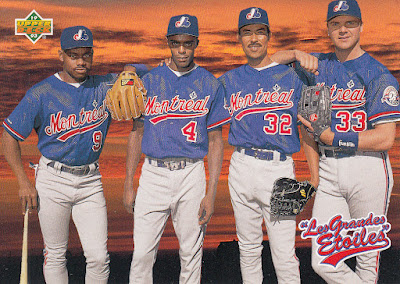
1993 Upper Deck #481 Marquis Grissom / Delino DeShields / Dennis Martínez / Larry Walker

1993 Upper Deck is one of the best sets to come out of the entire (first) overproduction era, and for good reason. This team card of the Montréal Expos shows four of the team's Big Stars ("Les Grandes Étoiles" in French on the card front), conveniently arranged according to height. From left to right, these players are Marquis Grissom, Delino DeShields, Dennis Martínez, and Larry Walker. Martínez is one of just a small handful of MLB players to hail from Nicaragua, and is also on the similarly short list of pitchers who have thrown a perfect game. None other than Marquis Grissom chased down the 27th out that afternoon in Los Angeles.

And of course Larry Walker is now a Hall-of-Famer. His #33 is retired in Coors Field, numerals that are prominently displayed on his attractive blue jersey. You can also see the 25th Anniversary patch the Expos wore in 1993. It's sad that they didn't make it to fifty, and that we didn't get to see how the 1994 Postseason would have played out. It's very possible that Larry Walker would have done better in Hall of Fame voting had he had the chance to display some heroics that year.

Here's hoping the 2022 season doesn't leave us with similar question marks.

1992 Stadium Club #256 Larry Walker

Here's another of a surprisingly acrobatic Larry Walker, this time a solo card from 1992 Stadium Club. This horizontal shot shows him in San Francisco's Candlestick Park, with Christy Mathewson's retired name banner in the background. Mathewson played in the days before uniform numbers, so just his name gets the special recognition. The Tigers gave Ty Cobb the same treatment on their wall of honor in left center at Comerica Park. 

Larry Walker would eventually have his number retired by a team that didn't exist when this photo was taken, during a ceremony that took place in a stadium that wasn't built yet.

1991 Topps #610 Andrés Galarraga

Few fans really think of this, but Andrés Galarraga and Larry Walker were teammates for three seasons on the Expos, long before they ever reached Blake Street Bomber status. Galarraga was even an All-Star in 1988, a fact I was surprised to learn when I thumbed through the All-Star subset in 1989 Topps at a young age. This posed shot makes for a great horizontal card, something we saw plenty of in 1991 Topps. 

I miss the Expos. I never had a chance to see them in person, at least not until they became the Washington Nationals. Maybe someday we'll have them back in some form, although it seems unrealistically hopeful to think about expansion when the current labor dispute appears to be quite serious.

1992 Topps Gold Winners #371 Dante Bichette

Moving on to a card that is new to my overall collection and not just a walk down memory lane, we come to former Brewer Dante Bichette. Like Galarraga, he was one of several players who had a rather unremarkable career going until he joined the Rockies. 

1992 marked the year Topps made the move away from traditional cardboard, as well as when they added their first photographs to the card back. Those photos showed a panorama of the team's home stadium, in this case County Stadium in Milwaukee. I ran across a photo on Reddit the other day showing Miller Park (now known as American Family Field) under construction right next to County Stadium, which you might enjoy seeing.

This is clearly a Topps Gold parallel, the first year of one of my all-time favorite parallel sets. Many of these were found as a one-per-pack parallel, but this particular card has a "Winner" stamp in the lower right. That's meant to differentiate it from a pack-pulled Gold card. Topps had a redemption program in place during 1992 where the reward was more Topps Gold cards, but unfortunately it was easily abused. Topps responded by including the Winner stamp on the redemption cards only, and they're generally more common than the normal Gold cards. This matches what I see in the ratio between the two types in my 1992 binder, but not dramatically so.

1991 Score #585 Joe Girardi

Early Score cards were known to have write-ups on the back that fell somewhere between pamphlets and novellas. Joe Girardi's 1991 Score card is no different, as it tells us all about how he became the starting catcher, his defensive and offensive accolades, how he beat up on the Giants in 1990, and that he blocks the plate well. The card front verifies that, as we can see an incoming Atlanta Brave baserunner (possibly Lonnie Smith) bearing down at motion-blurring speed.

We can also see a commemorative patch on Girardi's right sleeve, which is the All-Star game host patch the Cubbies wore during the 1990 season. 

1993 Upper Deck #706 Dale Murphy

Even casual fans likely know that all the above players once suited up for the Colorado Rockies. Maybe not Girardi; he's probably better known for his managerial career, but surely the rest. But not many know that Dale Murphy, one of the most well-loved Atlanta Braves players in history, was once a Rockie. It only lasted for 26 games in the early part of the 1993 season, but it really did happen. It was real enough for Murphy to make it into Series 2 of that magical 1993 Upper Deck set, and he even got a photo on the card back of him wearing that most desirable of '90s apparel, the Starter jacket.
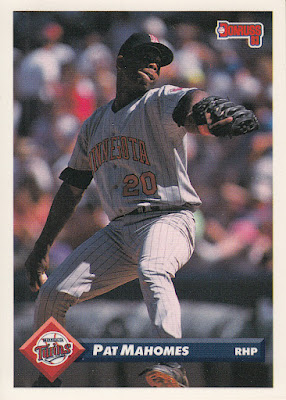
1993 Donruss #357 Pat Mahomes

Pat Mahomes never joined the Rockies, but he was a journeyman through 2003. Presumably, Roger included him in this stack because of the football connection. NFL fans all over recognize Patrick Mahomes of Kansas City as one of the game's superstars, but few know his dad spent about a decade as an MLB pitcher. 

After all these years, it's pretty surprising how little 1993 Donruss I have in my collection. It's not tiny; I'd say six or so full pages front and back, but for a major brand's base set from the first year I collected, it's positively scarce. I'm pleased to add this one to my collection. I would have preferred a better-exposed photograph, but Donruss was not great at that for a number of years.

2020 Donruss Retro '86 Signatures Red #84 Peter Lambert /99 (AU)

Roger gave me one card of a current Rockie, which is right-handed pitcher Peter Lambert. This one from 2020 Donruss is a parallel based on the 1986 Donruss set, and it includes a /99 serial number as well as a sticker autograph. The purple uniform, the dazzling red design, and the Coors Field forest almost made me forget the lack of MLB logos. It's a well-done card of a young player we all hope will turn into a solid member of the rotation.

Lambert did get a couple games in as a late-season call-up at the end of 2021, but he hasn't had much of a chance to make an impression on Rockies fans yet. He underwent Tommy John surgery in 2020, so hopefully 2022 will be a positive and injury-free season for him. Once the season starts, that is. We've blown well past the time when pitchers and catchers would have reported to Spring Training, with no real end in sight.

I'm not sure why there's a disconnect between the card number according to Beckett compared to the card back. This has "86S-PL" on the card back, so I don't know where #84 came from.

1977 Topps Football #100 O.J. Simpson AP

Finally, digging back into the archives that's more consistent with Roger's overall collection (at least with what he chooses to showcase on his Facebook page), here's O.J. Simpson's 1977 Topps football card, printed long before his second, much sadder, period of life.

I'm far from an expert on football cards, but I have learned that the annual Topps football releases used different designs than the familiar baseball sets. I can't be confident that's true for every year, but 1977 Topps baseball didn't look quite like this. Regardless, Topps didn't stray far from their signature ribbons and chevrons when choosing design elements. 

One of those banners on the top lists Simpson as a 1976 All-Pro, the NFL equivalent of an All-Star. There's also a little football graphic in the lower left noting that O.J. reached the 1,000-yard mark as a running back during the prior season. In fact, he made it well past that, with 1,503. Flipping the card over, we discover that he actually cracked the 2,000 yard mark once, which happened in 1973. 1,000 in a season is, you know, nice. Respectable. Maybe roughly equivalent to a 100-RBI baseball season. Not Hall-of-Fame material unless you string a ton of them together, but certainly enough to make you one of the most productive players on your team.

2,000 yards, on the other hand, is a different level. O.J. Simpson was the first to do it, and only seven others have done so since. Terrell Davis just got past that mark in the 1998 season, which is the same year the Broncos won their second Super Bowl. Some other names on that list are Eric Dickerson, Barry Sanders, and Adrian Peterson. Truly some of the greats.

I'll have to keep an eye out for more cards that Roger would like. This was a good trade, full of familiarity and also of surprises.


Sunday, August 2, 2020

The Trading Post #144: Padrographs: Abner to Zimmer (Part 3: Not Topps)

For the first time in a very long time, I'm composing a post while watching the Rockies play a live baseball game. That's not a sentence I expected to write as late as August. Under normal circumstances, I'd be watching the middle weekend of the Summer Olympics. But it was not to be.

In any case, I finally have some time to wrap up a three-part post about a trade with Padrographs: Abner to Zimmer. A lot of you have sent me cards in 2020, and I'm woefully behind. I'm trying to keep up with thank-yous on Twitter, but it might be a while before I get a full post written for each of these trades. I'm even running out of places for each stack. On the bright side, I haven't needed to buy pages yet.

Let's see what non-Topps goodies Rod was able to find to round out this trade package.

1997 Donruss #200 Eric Young
It's Opening Weekend at Coors Field, and the Rockies took two out of three against Rod's Padres. A win Friday could have set up a sweep today, but Wade Davis didn't get the job done that night. Regardless, lots of Rockies have been rounding the bases this weekend, just like we see the speedy Eric Young (Sr.) doing here on 1997 Donruss. It's an under-represented set in my collection, and these cards Rod sent might finally force a second page in my '97 binder.

This design has a tiny silver foil element in the lower left, which contains both the team logo and the player's position. Donruss might have scaled this down to near-microscopic proportions in response to the "loincloth" that the '96 set was known for. The foil on this card isn't quite perfect, as the black border slightly covers up the silver foil elements. This copy in particular has a very slight remnant of a Red Sox logo right along the edge.

But making the design elements so small lets the photo do most of the talking, and Young got an especially good Coors Field card, perfect for the frankenset. I can't quite tell who the opposing team is, but based on the color, it's probably the Dodgers. Maybe it's even from that crazy 16-15 game on June 30th, 1996, one of the classic slugfests in the stadium's history that got extra airtime when they were broadcasting replays earlier this year.

Behind that probable Dodger, you can see an earlier iteration of Coors Field, before the right-center fence was raised. If this photo were taken today, the yellow line would be significantly higher, even with the top of the out-of-town scoreboard in right field. There's a banner too, and while advertisements have generally crept into more areas of the ballpark on the outfield wall (as well as onto all jerseys league-wide), in the early days it was generally limited to the area above the bullpens. I'm guessing this banner is from Carquest, an auto-parts chain that no longer markets under that brand in Denver.

1997 Donruss #185 Ellis Burks
The foil element looks much better on this Ellis Burks card, even though he's not in his home ballpark. Burks's career was longer than Young's by this point, so there's no room for a write-up on this card back. Young's had a few nice words to say, including a mention of the first-ever Major League home run in Denver, one of the all-time great Rockies highlights.

1993 Pinnacle Cooperstown #5 Dale Murphy
Few remember, but Dale Murphy was briefly a Rockie in the team's early days. He even had an RBI in that inaugural home opener. He decided to retire from baseball after a couple months with the Rockies. His time in Denver was mostly forgettable, but he had put together an excellent career in the years leading up to that, so excellent that Pinnacle thought he'd make it to Cooperstown one day, including him in a small 30-card boxed set with other prospective Hall of Famers.

I had expected to tie this card in with Larry Walker's uniform number retirement, which was supposed to happen in April. I even had tickets. Walker, of course, finally became the first Rockie to be elected to the Hall of Fame, in his last year of eligibility. It was a real nail-biter. Murphy, despite back-to-back MVP awards and 398 career home runs (none as a Rockie) has been snubbed by Hall of Fame voters. He wouldn't have worn a Rockies cap on his plaque anyway, but still.

Pinnacle did a pretty good job in building this 30-card set. Most players did end up getting the Call to the Hall, with some obvious choices like Ken Griffey, Jr. and Tony Gwynn. There are of course the steroid-associated players who aren't in, Bonds and Clemens and such, but Murphy is one of just a small handful of the 30 who have a pretty solid case but still don't have a plaque. A few weren't able to keep the early magic going, like Dwight Gooden and Will Clark. Others like Don Mattingly and Cecil Fielder just didn't have the longevity to put a truly legendary career together.

That just leaves two players. First is Joe Carter, who still has an interesting case based on his RBI count and also passes the Bill Mazeroski test for having a World Series walkoff homer. And second, Dale Murphy. Both players fell just shy of 400 home runs, but assuming you're not a "Small Hall" sort of fan, I agree with Pinnacle and think both warrant inclusion.

It is too bad that Murph wasn't able to squeak just two pitches out of Mile High Stadium in the thin Denver air and get to that 400 mark. But their stories aren't done yet.

2019 Donruss Optic Lime Green #126 Kyle Freeland
This particular variety of Donruss Optic gives 1991 Fleer a run for its money. I think this colored parallel is the Lime Green flavor (pun intended), but the colored border situation over at Panini is truly insane, so that's the one I am guessing. There is no serial number, which narrows it down considerably.

Freeland, 1-0 on this short season after getting the win Saturday, appears to be pitching in an early-spring Wrigley Field. You can see the basket and the brick, but the ivy is still dormant. Most likely, this is from April 30th, 2018, a loss against Jon Lester, which turned out to be an early preview of the 2018 NL Wild Card matchup. I suppose this could be from that game instead, but the ivy would look different in early October compared to late April. In fact, that very playoff game is precisely what Donruss mentioned on the card back, where he pitched 6.2 scoreless innings in a high-pressure situation, helping the Rockies advance to the NLDS.

2009 Upper Deck Starquest Uncommon Blue #SQ20 Matt Holliday
Matt Holliday was also a starter in that game, but this Upper Deck card was printed long before the Wild Card game had been introduced as part of the Postseason format. He went 1-for-3 with a double that evening before being replaced by Gerardo Parra.

I've seen varieties of this Starquest card before, or at least this image (I think). Matt Holliday looks radiant on this design with a big silver starburst behind him. Upper Deck calls this one a "Blue Uncommon", but it just looks silver to me. Maybe there's the faintest whiff of a shade like smoke blue, but not really. The only blue I see is in the Upper Deck logo itself, which remains a big hole in the baseball side of this hobby. Color confusion aside, we've gone a whole decade without a real Upper Deck baseball card and it is most definitely a loss.

I'm just not seeing the colors this time. I never would have come up with Lime Green on Freeland's card. And this simply isn't blue.

2009 Upper Deck #235 Liván Hernández
It's been quite a while since I've seen 2009 Upper Deck. It's a great-looking set, although I must admit that I have trouble telling the years apart with later UD base sets. Not nearly as bad as with Bowman, but it's tricky. That little baseball diamond hologram is still there on the card back, and I always appreciate getting a uniform number as part of the nameplate on the front.

I have to admit that I don't remember Liván Hernández as a Rockie. It was a brief eight-game stretch in late 2008, and by the time this set came out, he was on to the Mets. He was a real journeyman, playing for nine different teams in his career, almost all in the National League. That gave him time for ten career home runs.

With the sudden implementation of the universal DH, it's possible that we'll never see a pitcher hit a home run again, excluding the rare pinch hit situation. Position players take the mound sometimes, why can't a pitcher pinch hit? The universal DH also reduces the number of interesting baseball card photos available for pitchers, leaving us with shots like this of Hernández firing a comebacker off to first as one of the most unusual-looking pitcher action photos we're likely to see.

1992-93 Excel #36 Mark Thompson
We'll wrap up with a Minor League card, courtesy of 1992-93 Fleer Excel. First off, this has to be the only baseball card set I've ever seen that crosses years. Sets featuring the other major sports do this regularly, but it's very strange to see this on a baseball set. This is an oddball for plenty of reasons. It is officially a Fleer card, and I don't normally lump major brands in with "oddballs", but this is unusual.

Long ago, the Short-Season A Minor League affiliates of the Colorado Rockies, also known as the Rockies, played in Bend, Oregon. That just so happens to be the home of Deschutes, one of my favorite craft breweries. Anyway, as you can see from Mark Thompson's cap, it was easy to adapt the interlocking "CR" typeface into "BR", and later "PR" when the team moved to Portland, right into Rod's neck of the woods. The team logo can be found on the back, and it uses the old Rockies logo with the purple on gray arch rather than the black on gray colors we're familiar with. "BR" might look fine, but stretching "B E N D" into that space where "COLORADO" usually goes looks a bit odd.

We also have a single line of stats, as 1992 truly was Thompson's only professional season to that point. He appeared in several 1993 Rockies team sets, along with numerous other Amateur Draft selections, many of whom never made the majors. The Rockies and Marlins found in 1993 Topps Series 2 looks more like a Bowman checklist. Thompson, though, spent seven seasons in the Majors and was in the Rockies starting rotation in 1996. He had precisely 0.0 bWAR in those seven seasons, but he went 9-11 in 1996, really quite good for a pre-humidor Rockies pitcher.

He hit one home run in his career. It happened in Wrigley Field off of former Rockie Kent Bottenfield.

It's been a long journey we've been on with this three-part series. I certainly didn't mean for it to take over two months to finish. Blogging hasn't been at the top of my activity list lately, but I have been keeping up with reading most of yours. I can't make any promises about when I'll write my next one (though I still haven't missed a month, nor do I intend to), but thanks to all of you who give me so much to write about. Because of the continued generosity of Rod and many others in this community, I have plenty of content, just limited time to actually write it.

Thanks, as always, for reading!