Showing posts with label Andres Galarraga. Show all posts

Saturday, March 8, 2025

Bees?

Remember that Diamondbacks game where a swarm of bees decided that the backstop would be a great place to set up shop? And they had to bring in a local beekeeper to vacuum them all up so the game could start? And then he victoriously threw out the first pitch?

2024 Topps NOW #145 Matt Hilton /16946

That was April 30th of last year.

Feels like ancient history.

But at the time, I was amused enough by this whole saga to be one of 16,946 Topps customers to order the related Topps Now card. Topps spared no expense in cranking out the bee puns front and back, warning us to "Bee very afraid" while "fans swarmed into Chase Field" to see the Dodgers and Diamondbacks "causing some buzz", etc....

The Diamondbacks ran with it, too. Beekeeper Matt Hilton even got a bobblehead later in the season.

At the end of the day, these cards are just toys. Might as well have some fun with it. 

2024 Topps NOW #774 Charlie Blackmon /1348

But it was a more serious atmosphere at Coors Field on September 29th, 2024, the date that career Rockie and four-time All-Star Charlie Blackmon finally decided to hang up the spikes. It was a beautiful Sunday afternoon in Denver, marking my seventh game of the season, and the first time I saw both the home opener and the final game in the same year. I sprung for a Club Level ticket to see Chuck Nazty off, and got there early to catch all the pre-game ceremonies.

Charlie got the honor of taking the field alone in the first inning, jogging out to his usual spot in center field, only this time with his uniform #19 mowed into the grass. He got a hit in his first at bat, left the game, and that was a wrap.

The card documenting the occasion was the third and final Topps Now card I bought in 2024. There's no paragraph on the back, just a photo of #19 high-fiving the fans as the team did their annual farewell lap of the warning track after the game ended. Incidentally, Charlie got a cameo on Ryan McMahon's Topps Now card from the 2024 home opener, bookending the season nicely.

2024 Topps NOW #39 Ryan McMahon /888 (Reverse)

In the little Spring Training action I've seen thus far in 2025, the team does have a different feel. The young guys that have peppered the Top 100 Prospects list are working their way up the farm system, and new fan favorites will emerge. Blackmon is still with the club in a front-office role as "Special Assistant to the General Manager," a title he shares with Vinny Castilla, Todd Helton, and Clint Hurdle.

You may recall that the Rockies gave Todd Helton a real live horse as his retirement gift in 2013. Charlie got his own steed, of sorts, as the team removed the promotional Toyota Tundra pickup truck from near the scoreboard in left field and gifted it to Charlie as a going-away present. There was a whole video on the scoreboard showing a huge crane taking it down the day before, and while I did vaguely note the truck's absence from its usual spot at the ballpark, I didn't quite put two and two together until they drove it onto the field.

I just hope Charlie doesn't run out of gas again, as DJ LeMahieu isn't in town to save him anymore.

2024 was a slow year on the baseball card front for me. I bought a couple blasters, received a few gifts, and picked up the Topps Factory Set, as is tradition. But I did feed a little nostalgia and branched far off the traditional path with one purchase.

Magic: The Gathering - Ice Age: Polar Kraken

To go along with the one Pokémon card in my entire collection, feast your eyes on what is now the one and only Magic: The Gathering card in my entire collection. 

I don't have the slightest idea what any of these numbers or symbols mean, but I do have a couple friends I could ask. And I only paid a few dollars for this on eBay, far below the value of the legendary Black Lotus card.

No, it's just the one particular card I remember seeing in my friend's collection in middle school, and that's about it. And now Seattle has a whole NHL team named after this mythical beast.


Back to baseball.

Chris over at Nachos Grande is running another Breaker's Club group, which got underway earlier this week. I didn't see a blog post about it, so those may be exclusively advertised on Discord now. I'm sure it's a lot of work to manage that in more than one place, and I might just be missing recent posts, but it's just another sign of the times that the blog community isn't what it once was. It's not lost on me that I only did four posts during the entire last year. Not that long ago I could crank four out in a long weekend or two. That's only half a Hanukkah!

Anyway, I bought in for the Rockies as I often do. Prior to that, I did have a couple boxes of cards to sort through from past Breaker's Clubs, and that was my main collecting accomplishment of 2024. It felt good to get those organized, as they had been sitting there a while. 

I don't remember anything major jumping out at me, but the one set I wrote down to mention in a future post was 1995 Bazooka. I don't trust Google Search as much as I once did, but I am not seeing any mention of this set on my blog before today. That surprises me, because in looking at the two-plus pages I have of this set in my 1995 binder, a few of these look extremely familiar. 

1995 Bazooka #102 Paul Molitor

Paul Molitor running the bases as a Blue Jay on Astroturf.

1995 Bazooka #113 Kirby Puckett

Kirby Puckett wearing a catcher's mitt.

1995 Bazooka #26 Robin Ventura

Robin Ventura on Tatooine, shielding his eyes from the twin suns with his fancy blue shades.

I could practically draw some of these from memory.

1995 Bazooka #83 Andrés Galarraga

But the Rockies look unfamiliar. Maybe the Bichette I already had, but this Galarraga, my favorite player from the Blake Street Bombers squad, doesn't ring a bell. It's probably the card that made me write a future reminder to myself.

It's a pretty basic photo and design for an entry-level set, complete with drop shadows under the lettering. The one unique design element is the position list on the right. It always seems to be on the right edge in this set regardless of whether it fits the photo or not, and the highlighted position comes in a variety of primary and secondary colors. Pitchers had four options depending on their handedness and role, and is likely the first time I ever saw the letters LHSP appear together in sequence.

Any color coding on the position markers appears to be purely coincidental. I saw it appear in purple on Expos, Dodgers, Blue Jays, and several other team cards, but Andrés Galarraga plays first base in green.

I don't make the rules now, and I certainly didn't in 1995.

As a 1995 release, of course these come in a parallel variety.

1995 Bazooka Red Hot #RH-6 Tony Gwynn

It's a partial parallel set called Red Hot, which has a red background and position marker, as well as that most '90s of premium design elements, gold foil. "Red Hot" isn't labeled anywhere on the card; it's just something I remembered from thirty years ago without having to look it up.

This hobby is nestled deep in my brain, truly.

Parallel or not, all varieties allow you to play the "Play Ball" game via a circular grid on the card back. It's meant to pair with a spinning pointer, conveniently included inside packs and awkwardly branded the "ToppSpinner".

This set is only 132 cards, a single Topps printing sheet. It wouldn't be terribly hard to complete or even to make a huge dent in the checklist for a minimal cost.

We'll see what 2025 has in store and whether I'll beat four posts this year.


Sunday, March 27, 2022

The Trading Post #169: More From Roger

Roger knows he has an outlet for cards now. I visited my girlfriend one evening recently and she gave me a small stack of four cards that he set aside for me, pretty much out of the blue. Unlike the first cards I got from him, these were from about ten years into the history of the Rockies. The turn of the millennium, as we don't often call it. 

In any case, I wasn't doing much collecting circa 2000-2002, and it's unusual to run across cards from this comparative lull in the hobby. Pinnacle was a thing of the past, and it wasn't looking too good for the remaining survivors. The Rockies didn't have an especially memorable team during that time either, and 2000 was one of just two non-pandemic seasons in the team's history that I didn't attend a game in person.

2001 Topps Chrome Traded #T15 Andrés Galarraga

Andrés Galarraga had long since moved on from the Rockies by the time 2001 rolled around. Topps was deep in their period of experimenting with colored borders, and this 2001 Chrome example from the Traded set actually looks pretty good when given the shiny treatment. I didn't love the mustard-yellow 2002 borders, but this emerald green from 2001 was really nice. It does suffer from that annoying curl that has plagued Topps Chrome for decades, but it looks so good otherwise.

This card from the Traded set actually documents The Big Cat moving from Atlanta to the San Francisco Giants. 1997 was his last season with the Rockies, at which point Todd Helton took over at first base. Galarraga missed the 1999 season while battling lymphoma, but made it back to the Bigs for a few more seasons. Following this stint with the Giants, he returned to his original team, the Expos. Then it was back to San Francisco, then another battle with that insidious foe cancer, then a final appearance in the Majors with the Angels at the end of 2004.

He finished with 399 career home runs, falling just a hair short of 400 (and maybe a chance at lots more if not for his health issues). He was my favorite player as I grew into being a Rockies fan, and he's the guy whose batting stance I liked to emulate while playing little league.

2003 Donruss Champions #93 Juan Uribe

Prior to this, I had a grand total of six cards in my collection from 2003 Donruss Champions, so I certainly can't call myself an expert. In looking at the checklist, each team was grouped together by card number. The Rockies were #90-96, a mere seven cards. Coincidentally, seven matches the number of triples Juan Uribe hit in 2002 as the Rockies shortstop, somehow a decline from the eleven he put up in less than half a season during his rookie year of 2001. Baseball-Reference and the card back are in agreement on that number, which happened to be a tie for the NL lead in 2001.

The design of this set is a little cramped, taken up mostly by the giant National League logo, the shiny Donruss Champions logo, and the banner-like superlative that occupies the remaining space on the left-hand side. When you visit Coors Field, you'll find lots of banners like that suspended from the rafters over the concourse, documenting Silver Sluggers, lots of batting titles, a Rookie of the Year award, and so on. They didn't get quite as specific as Donruss Champions did, but the team does have at least a little bit of hardware to show for a quarter-century or so as part of Major League Baseball.

2002 Fleer Tradition Update #U46 René Reyes SP (RC)

I guess I was watching the Rockies with some regularity in the early 2000s, because I do remember the name René Reyes. His Major League career spanned part of two seasons with the Rockies for a total -0.6 bWAR. Nothing great, and he only slugged one triple, or "trifecta" as that Donruss card called it. But his Minor League career was promising enough to be included in this retro-themed Fleer Tradition set with "PROSPECT" billing.

Further investigation of his Baseball-Reference page reveals the only negative value I can recall seeing for OPS+. That's a ballpark-adjusted metric, where the average is normalized to 100. Barry Bonds was +263 in 2004. Reyes was -2. 

So, short print or not, you can see why his career didn't last.

2000 Bowman's Best Year by Year #YY8 Juan González / Larry Walker

The final card today is definitely new to my mental collecting encylopedia, and thus to my 2000 binder. I don't run across many inserts from this era, but here's one anyway from 2000 Bowman's Best. It's a two-player card featuring both Larry Walker and Juan González, who each made their debut in 1989. They're the subject of that year in the Year By Year insert set, which looks at players who debuted in the same season and followed a similar career arc. 

González and Walker, for example, both hailed from outside the USA. Their careers peaked in the mid-1990s, each winning MVP honors around that time. González won the AL award in 1996 and 1998, and we're told that Walker captured his first in 1997. That ended up being a bit optimistic on the part of Topps, as Walker only had the one MVP to his name, which remains the only MVP award in Rockies history.

The card itself is a refractor, slightly textured, and I'm pretty sure it's acetate, although there are no transparent elements to confirm that.

Thanks again to Roger for the collectibles (he also gave me an old Rockies Magazine that was fun to flip through), and these will have a good home in my collection!


Sunday, February 27, 2022

The Trading Post #168: Roger

I can't even remember the last time I did an in-person trade. Most likely it was when I was in middle school. But I had the chance to rekindle that activity around the holidays this year. 

Roger is an old family friend that my girlfriend has known forever. He and his wife Beth joined me, my girlfriend, and her sister to watch a late-season Broncos game on TV, which was the last game or two of the 2021 regular season. I can't quite place the exact week even though this was merely two months ago, but I did take the opportunity to give Roger a few cards from my collection. Roger is an avid card collector and often shares his extensive collection (including lots of graded vintage) on his Facebook page. He's one of the very few people in my immediate circle that speaks the language of card collecting.

I knew I wanted to surprise him with some cards for the holidays, but as nice as it is to chat with someone who knows about baseball cards, that does mean it's a bit tricky to put together an appropriate trade. I can't just come bearing a stack of recent Topps commons; that would simply shift duplicates I have seven or eight copies of into his stack of what is also likely seven or eight copies.

What to do?

I settled on a half-dozen or so duplicates from the oversized 1994 Fleer Extra Bases set. I originally got them from Julie at A Cracked Bat, one of the most entertaining blogs in this whole community. I haven't seen a post from her since October, so I hope she's well.

In any case, I felt reasonably confident that my extras from Fleer Extra Bases would be new to Roger's collection, and he certainly seemed to enjoy them. Many of us longtime Colorado residents remember all those early Rockies. Burks, Girardi, etc..., although I may have stumped him with Mark Thompson.

A couple weeks later my girlfriend gave me a stack of cards that Roger found for me in return. He knows I'm a Rockies fan (we've all been to a game together), and these cards from did not disappoint. Current Rockies, past Rockies, and even some yet-to-be Rockies. And football, to match the occasion.

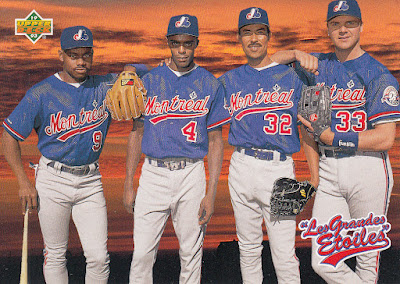
1993 Upper Deck #481 Marquis Grissom / Delino DeShields / Dennis Martínez / Larry Walker

1993 Upper Deck is one of the best sets to come out of the entire (first) overproduction era, and for good reason. This team card of the Montréal Expos shows four of the team's Big Stars ("Les Grandes Étoiles" in French on the card front), conveniently arranged according to height. From left to right, these players are Marquis Grissom, Delino DeShields, Dennis Martínez, and Larry Walker. Martínez is one of just a small handful of MLB players to hail from Nicaragua, and is also on the similarly short list of pitchers who have thrown a perfect game. None other than Marquis Grissom chased down the 27th out that afternoon in Los Angeles.

And of course Larry Walker is now a Hall-of-Famer. His #33 is retired in Coors Field, numerals that are prominently displayed on his attractive blue jersey. You can also see the 25th Anniversary patch the Expos wore in 1993. It's sad that they didn't make it to fifty, and that we didn't get to see how the 1994 Postseason would have played out. It's very possible that Larry Walker would have done better in Hall of Fame voting had he had the chance to display some heroics that year.

Here's hoping the 2022 season doesn't leave us with similar question marks.

1992 Stadium Club #256 Larry Walker

Here's another of a surprisingly acrobatic Larry Walker, this time a solo card from 1992 Stadium Club. This horizontal shot shows him in San Francisco's Candlestick Park, with Christy Mathewson's retired name banner in the background. Mathewson played in the days before uniform numbers, so just his name gets the special recognition. The Tigers gave Ty Cobb the same treatment on their wall of honor in left center at Comerica Park. 

Larry Walker would eventually have his number retired by a team that didn't exist when this photo was taken, during a ceremony that took place in a stadium that wasn't built yet.

1991 Topps #610 Andrés Galarraga

Few fans really think of this, but Andrés Galarraga and Larry Walker were teammates for three seasons on the Expos, long before they ever reached Blake Street Bomber status. Galarraga was even an All-Star in 1988, a fact I was surprised to learn when I thumbed through the All-Star subset in 1989 Topps at a young age. This posed shot makes for a great horizontal card, something we saw plenty of in 1991 Topps. 

I miss the Expos. I never had a chance to see them in person, at least not until they became the Washington Nationals. Maybe someday we'll have them back in some form, although it seems unrealistically hopeful to think about expansion when the current labor dispute appears to be quite serious.

1992 Topps Gold Winners #371 Dante Bichette

Moving on to a card that is new to my overall collection and not just a walk down memory lane, we come to former Brewer Dante Bichette. Like Galarraga, he was one of several players who had a rather unremarkable career going until he joined the Rockies. 

1992 marked the year Topps made the move away from traditional cardboard, as well as when they added their first photographs to the card back. Those photos showed a panorama of the team's home stadium, in this case County Stadium in Milwaukee. I ran across a photo on Reddit the other day showing Miller Park (now known as American Family Field) under construction right next to County Stadium, which you might enjoy seeing.

This is clearly a Topps Gold parallel, the first year of one of my all-time favorite parallel sets. Many of these were found as a one-per-pack parallel, but this particular card has a "Winner" stamp in the lower right. That's meant to differentiate it from a pack-pulled Gold card. Topps had a redemption program in place during 1992 where the reward was more Topps Gold cards, but unfortunately it was easily abused. Topps responded by including the Winner stamp on the redemption cards only, and they're generally more common than the normal Gold cards. This matches what I see in the ratio between the two types in my 1992 binder, but not dramatically so.

1991 Score #585 Joe Girardi

Early Score cards were known to have write-ups on the back that fell somewhere between pamphlets and novellas. Joe Girardi's 1991 Score card is no different, as it tells us all about how he became the starting catcher, his defensive and offensive accolades, how he beat up on the Giants in 1990, and that he blocks the plate well. The card front verifies that, as we can see an incoming Atlanta Brave baserunner (possibly Lonnie Smith) bearing down at motion-blurring speed.

We can also see a commemorative patch on Girardi's right sleeve, which is the All-Star game host patch the Cubbies wore during the 1990 season. 

1993 Upper Deck #706 Dale Murphy

Even casual fans likely know that all the above players once suited up for the Colorado Rockies. Maybe not Girardi; he's probably better known for his managerial career, but surely the rest. But not many know that Dale Murphy, one of the most well-loved Atlanta Braves players in history, was once a Rockie. It only lasted for 26 games in the early part of the 1993 season, but it really did happen. It was real enough for Murphy to make it into Series 2 of that magical 1993 Upper Deck set, and he even got a photo on the card back of him wearing that most desirable of '90s apparel, the Starter jacket.

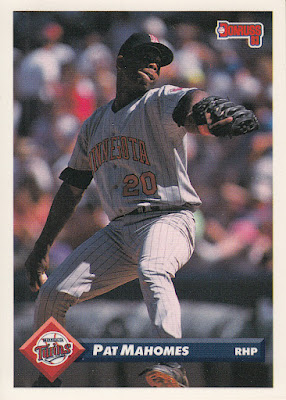
1993 Donruss #357 Pat Mahomes

Pat Mahomes never joined the Rockies, but he was a journeyman through 2003. Presumably, Roger included him in this stack because of the football connection. NFL fans all over recognize Patrick Mahomes of Kansas City as one of the game's superstars, but few know his dad spent about a decade as an MLB pitcher. 

After all these years, it's pretty surprising how little 1993 Donruss I have in my collection. It's not tiny; I'd say six or so full pages front and back, but for a major brand's base set from the first year I collected, it's positively scarce. I'm pleased to add this one to my collection. I would have preferred a better-exposed photograph, but Donruss was not great at that for a number of years.

2020 Donruss Retro '86 Signatures Red #84 Peter Lambert /99 (AU)

Roger gave me one card of a current Rockie, which is right-handed pitcher Peter Lambert. This one from 2020 Donruss is a parallel based on the 1986 Donruss set, and it includes a /99 serial number as well as a sticker autograph. The purple uniform, the dazzling red design, and the Coors Field forest almost made me forget the lack of MLB logos. It's a well-done card of a young player we all hope will turn into a solid member of the rotation.

Lambert did get a couple games in as a late-season call-up at the end of 2021, but he hasn't had much of a chance to make an impression on Rockies fans yet. He underwent Tommy John surgery in 2020, so hopefully 2022 will be a positive and injury-free season for him. Once the season starts, that is. We've blown well past the time when pitchers and catchers would have reported to Spring Training, with no real end in sight.

I'm not sure why there's a disconnect between the card number according to Beckett compared to the card back. This has "86S-PL" on the card back, so I don't know where #84 came from.

1977 Topps Football #100 O.J. Simpson AP

Finally, digging back into the archives that's more consistent with Roger's overall collection (at least with what he chooses to showcase on his Facebook page), here's O.J. Simpson's 1977 Topps football card, printed long before his second, much sadder, period of life.

I'm far from an expert on football cards, but I have learned that the annual Topps football releases used different designs than the familiar baseball sets. I can't be confident that's true for every year, but 1977 Topps baseball didn't look quite like this. Regardless, Topps didn't stray far from their signature ribbons and chevrons when choosing design elements. 

One of those banners on the top lists Simpson as a 1976 All-Pro, the NFL equivalent of an All-Star. There's also a little football graphic in the lower left noting that O.J. reached the 1,000-yard mark as a running back during the prior season. In fact, he made it well past that, with 1,503. Flipping the card over, we discover that he actually cracked the 2,000 yard mark once, which happened in 1973. 1,000 in a season is, you know, nice. Respectable. Maybe roughly equivalent to a 100-RBI baseball season. Not Hall-of-Fame material unless you string a ton of them together, but certainly enough to make you one of the most productive players on your team.

2,000 yards, on the other hand, is a different level. O.J. Simpson was the first to do it, and only seven others have done so since. Terrell Davis just got past that mark in the 1998 season, which is the same year the Broncos won their second Super Bowl. Some other names on that list are Eric Dickerson, Barry Sanders, and Adrian Peterson. Truly some of the greats.

I'll have to keep an eye out for more cards that Roger would like. This was a good trade, full of familiarity and also of surprises.


Tuesday, October 13, 2020

The Trading Post #154: Topps Cards That Never Were (Part 1: Older Rockies)

For nearly a year, I've had a stack of cards on my shelf from Topps Cards That Never Were. Jeremy offered a card from my Eight Men Out list along with some assorted Rockies, and upon receiving them, I immediately knew that what he ended up sending would take several posts to properly cover. There was so much here, and I hope you'll enjoy this journey as much as I did. My current plan is to divide this up into four posts, but who knows, it might require five.

To start things off, we'll look at some Rockies from earlier in the franchise's history, split roughly around the time of their only World Series appearance in 2007.

1996 Select Team Nucleus #4 Dante Bichette / Andres Galarraga / Larry Walker

A three-player acetate insert card from a Pinnacle insert set is as good a place to start as any. The important thing is to start. We all know the mid-'90s were weird, and mid-'90s inserts were even weirder. I have never even heard of this sciency-sounding Team Nucleus insert set, let alone seen one. It's 28 cards in total, one for each team. I imagine there's a Griffey from this set worth as much as a used car.

Each card depicts three of the team's top players, in this case Bichette, Walker, and Galarraga, as noted on the back. Well, actually, it's noted on the back in reverse order, since it's a mirror image on that side. 

Something about this bothers me though. The one in the middle, Walker, well, that doesn't really look like Larry Walker to me. I could be wrong, and the wraparound sunglasses make it hard to be sure, but that looks a little more like Vinny Castilla, if I had to guess. Walker didn't usually go clean-shaven, and his hair color is lighter than this. On the other hand, the crease above his chin might mean it's Walker after all, but it's the least Larry Walker-looking photo of Larry Walker I can remember.

Either way, they were the core of the Blake Street Bombers circa 1995, but this might be an error card that's been hiding in plain sight all these years.

1998 Topps Tek Pattern 54 #34 Larry Walker

Here's another acetate card, and this one unambiguously shows Walker. Maybe it's just how the last photo was lit, but his goatee, which he usually wears, is pretty light-colored. 

Topps Tek was the acetate king of the late-'90s, and this is its inaugural 1998 set. Good old Pattern #54, for you Topps Tek experts. There are all sorts of rainbow reflective bits, applied quite inconsistently on the card front. Flip it over and you'll find the expected mirror image, along with a close-up and the card number telling collectors what this fractured set was up to.

Also on the back, we get a few of Walker's upcoming milestones. Topps projected the 1999 season would see him pass 200 stolen bases, and that the 2001 season would get him to 300 homers and 1,000 RBIs. Topps hit the home run and RBI milestones right on the money, but it took him a couple more years to cross 200 SBs, making 2001 a milestone-heavy season for the Hall-of-Fame lefty, a year that also marked his final All-Star appearance.

1996 Emotion-XL #175 Andres Galarraga

We've seen 1996 Emotion-XL (simply renamed to E-X in later years) twice on this blog, once with the Confident Jason Bates, and again with Mile High Ellis Burks. This time it's the Big Cat Andres Galarraga.

I was about to say that Big Cat is not an emotion, but did you see that profanity-laced video yesterday of the trail runner in Utah who spent six minutes backing away from a mountain lion? I was out for a hike myself yesterday and didn't see anything on the trail bigger than a squirrel. It would be an amazing photographic opportunity to run across something more, uh, predatory, but I'd prefer not to have an encounter like that four miles deep on a US Forest Service trail. It's a very real possibility, though.

I'll just let 1996 Emotion-XL take care of the Big Cat emotion.

1997 Score Reserve Collection #332 Bruce Ruffin

Back to the realm of the baseball diamond, we're going to shift away from the Blake Street Bombers and into some of the less-famous pitchers that spent some time in Denver. Bruce Ruffin goes all the way back to the inaugural 1993 season. The ex-Phillie began his time in Denver as a starter, but was later shifted to the bullpen and took over as closer. 1997 was his final season, but he never got a true sunset card in 1998. This is as close as he got.

Clearly, this is a parallel, as the original 1997 Score cards didn't contain this gold seal. Beckett calls it the Reserve Collection, but the seal itself has a monogram representing "Hobby Reserve by Score". Longtime readers might recall the Series 1 version of this parallel, known as Premium Stock. The Reserve Collection is just the Series 2 iteration, which has thinner card stock, a white border, and a different gold seal. It's reminiscent of what Donruss did with the 1991 base set: Series 1 borders were blue, while Series 2 was green.

And we all love 1991 Donruss, don't we?

1995 SP #15 Juan Acevedo (RC) FOIL

One would think that you're more likely to find a base card before a parallel enters your collection. But with '90s cards, or really ever since the '90s, any one of the many varieties might come your way before you find the most common variety. In this case, just the opposite happened, as I got the Silver parallel of this die-cut Juan Acevedo card from Big Shep before this base version arrived.

Last time, I mentioned that the card back contains a photo of Acevedo bunting. Unexpectedly, we didn't get to see any of that for real in 2020, so I'll flip this one over on the scanner for you.

1995 SP #15 Juan Acevedo (RC) FOIL (Reverse)

I'm pretty sure he's wearing the Big Cat's helmet in this photo, #14. This elicits a lot of Emotions, pardon the obvious pun.

2003 Topps Total Award Winners #AW13 Mike Hampton

We'll keep things shiny with 2003 Topps Total. That's not hard to do, really. But we'll have another pitcher hitting, which is pretty hard to do. It just so happens that Mike Hampton won a Silver Slugger in 2002, earning him this (slightly miscut) light green insert card. It's a good follow up to his 2002 Topps Total base card, which showed him bunting.

And before you shout "COORS!" at me, please flip this card over and know that Mike Hampton won the Silver Slugger award as a pitcher four years running, with three different teams. He'd follow that up with a fifth in 2003 as an Atlanta Brave, keeping that streak going for as long as the Dodgers had their Rookie of the Year streak in the mid-'90s.

No Rockie has ever won a Cy Young award, which is represented by the white outline at the top of the column of icons on the right, but the Silver Slugger award has been won by a Rockie three times. As you see here, it was won twice by Hampton, and once by Germán Márquez in 2018.

If and when the National League adopts the designated hitter, cards like this will likely be a thing of the past.

2001 Bowman's Best #79 Mike Hampton

I'm seeing a lot of Bowman's Best these days, but those have been from recent years. This is from 2001, much closer to the brand's inception. We're staying with Mike Hampton for one more card, this time showing him pitching. As good as he was at the plate, pitchers are at home on the mound. This textured card isn't quite as shiny as you'd think, given all that gold on the left. But it has the usual rainbow background you'd expect of a premium brand like this.

What makes Hampton worthy of inclusion in the Best set, according to the card back? Well, this was only a few years removed from the 1998 home run chase between Mark McGwire and Sammy Sosa. Thus far in his career, Hampton had held both those players to a combined 10-for-63 (.159), surrendering just one home run each to the famed sluggers. Topps also threw in the 0-for-14 Mickey Morandini, one of the random players that shows up here surprisingly often.

2003 Fleer Double Header #112 Jason Jennings

The last of today's pitching rotation is Jason Jennings. As long as we're talking about awards, he's the only Rockie to win Rookie of the Year. He also has the only mini of this post, coming in at 2 1/4" x 3" on 2003 Fleer Double Header. Unlike the short-printed Flip Cards, this is just a flat piece of cardboard with nothing to unfold.

Despite his 2002 accolade, either this set was developed before his Rookie of the Year award was announced, or Fleer just didn't think it was worth mentioning. The paragraph on the back goes as late as August 2002, mentioning his one-hit quality start on August 1st. I know Fleer knows about it, because they gave him a subset card in 2003 Fleer Tradition. At least both cards show the 10th Anniversary team patch.

This is a weird set. It's slightly smaller than a 1975 Topps Mini, and whatever they're doing to the background of the photo looks very artificial. No lens will blur the background like that. I do like the cute little team cap in the lower right, though. It was definitely inspired by the key design element in 1981 Topps.

2002 Absolute Memorabilia Team Tandems #TT-11 Todd Helton / Larry Walker

Let's return to the standard size, shall we? Here's a shiny two-player insert set featuring Todd Helton and Larry Walker, printed by what was then the Donruss-Playoff company. It's the real Larry Walker, for sure, the only star player to bridge the team from the Blake Street Bombers era well into the Helton years.

This design element with a baseball surrounded by three circles would really be perfect for that Team Nucleus card, but this time it's Team Tandems. The card number begins with "TT", not to be confused with Tools of the Trade, another 2002 Playoff Absolute Memorabilia insert set which used the same prefix. 

I wasn't really collecting at this time, so I missed the drama that led to Donruss being purchased by Pinnacle in 1996, followed shortly thereafter by Pinnacle's bankruptcy in 1998. After that, Donruss became affiliated with the Playoff brand, leading to sets like this with "Playoff Corporation" in the fine print. Later on that of course led to Panini.

I've always thought of Panini simply as a continuation of Donruss, so it's weird to see them release what I think of as Pinnacle brands too, like Score. They've just snapped it all up, other than Upper Deck which ended up with Fleer, who is still doing its thing with the NHL. It's not unlike what happens with the phone companies, which you can get a feel for when I write about Pac Bell Park / SBC Park / AT&T Park.

You'd think Topps would acquire some of these brands once in a while. I mean, that's what Bowman is. It just happened so much longer ago.

2002 Donruss Originals #202 Larry Walker 84

Larry Walker appeared in a nearly-identical pose on this 2002 Donruss Originals card. That's how the greats do it, consistency. Just watch that 60-second Mike Trout montage of his 300 home runs.

The fine print on this card has "Donruss Trading Card Co.", despite being from the same year as that Playoff set. Were Donruss and Playoff two separate but simultaneous brands for a while? Was it sort of a sub-brand like Fleer did with Skybox? I'm not sure, but after reading up on all this, suddenly it makes a lot more sense as to why there's no Donruss section in my 1999 or 2000 binders.

Can we really blame the 1990s for being such a crazy time to collect? The ownership of most of these companies was in total upheaval. Don't forget Pacific either.

Anyway, once Donruss was back on shelves, they released this Originals set. It's sort of an equivalent to Topps Archives, where they dipped into their past designs to use with then-current players. They used four designs for the only year of the Originals brand, 1982, 1984, 1986, and 1988. Clearly, what you see here is the 1984 design. At first, I thought there was a weird printing error underneath the Donruss logo, but after looking past the curves, I realized it was actually Walker's left foot, and those are the Adidas stripes.

2004 SkyBox LE #70 Larry Walker

It's been a lot of Larry Walker in this post (depending on who's really on that Team Nucleus card), but one more did catch my eye. It's another die-cut, and it's the first card from 2004 Skybox LE to enter my collection. LE, which clearly stands for Limited Edition, adds a few thin border lines, uses selective color to make the primary subject pop out of the background, and even gives us the player's uniform number on the left.

On the card back, which leaves a lot of empty space as Fleer did on many of their sets at the time, we're given a single line of statistics with Walker's career totals, and a short paragraph. In it, we're told that "Larry Walker is the name you'll see most often in the Rockies record book." Todd Helton has since taken over many of the offensive categories, especially the ones that are simply counting stats, but Walker is still in first place in quite a few average-based and Sabermetric categories like OPS+. He remains the career leader in batting average, hit by pitches, on-base percentage, and others. This card gives us his 2003 OBP of .422, which was actually a few points lower than the .426 he racked up during his entire Rockies career.

2005 Upper Deck ESPN Web Gems #WG-22 Todd Helton

Upper Deck joined forces with ESPN in 2005 to make a small 90-card set, complete with ESPN-themed insert sets. There was an ESPY insert set, a SportsCentury insert set (sort of a precursor to 30 for 30), this Web Gems insert set, and a few others. It's also brand-new to my collection.

I don't watch ESPN regularly enough to know whether they ever utter "Web Gems" on-air anymore, but it used to be their name for the segment showing each day's best defensive plays. Hunter Renfroe of the Rays would be on it at least twice tonight in ALCS Game 3. If they don't use it anymore, they should. In a game where the three true outcomes are becoming increasingly common, I'd watch a Web Gems video every day, especially since I know Nolan Arenado will be on it every day.

Everyone knows that Nolan Arenado is the best defender to ever play for the Rockies (he's already the career leader in defensive WAR), but Todd Helton was pretty good too. Helton had his share of Web Gems, and you don't win three Gold Gloves without plenty of them. He had a career .996 fielding percentage, good for eighth all-time among first basemen.

2002 Upper Deck Ovation #129 Jay Payton

If you thought that Bowman's Best card contained a lot of texture, just wait until you see 2002 Upper Deck Ovation. The entire team logo is raised, and it takes up about half the card. Of course, since this is Upper Deck, there's lots of copper foil. 

I haven't shown this set on the blog since the early days of Infield Fly Rule, and that was before I changed my scanner settings to make the images look a little more realistic. I think the copper comes across a little better this way.

That was so long ago, I wouldn't have thought anything of it if I saw Jay Payton wearing #27 back then. That's Trevor Story's number now, and one of the easy ones to get in the stadium trivia games.

2001 Topps Gold #266 Terry Shumpert /2001

Concluding Part 1 but still early in this journey through Jeremy's trade is Terry Shumpert, who spent five seasons as a Rockie. He began his career with five seasons as a Royal, and I still think of him that way because of how many Terry Shumpert Royals cards I saw in my early days of collecting. Look it up though. He played more career games with the Rockies.

This is a parallel from 2001 Topps, back when Topps Gold really meant it. Granted, the Topps logo, the nameplate, and a thin part of the border would have been gold anyway, but making the whole border gold really adds a lot. Of course, it doesn't scan that well. On the back, the serial number is giant and gold, #1553 out of 2001. I've long lamented that Topps changed the Topps Gold serial numbers to black many years ago, and you'll see some examples of that in Part 2.

2001 Topps Gold #266 Terry Shumpert /2001 (Reverse)

That's how a serial number should look on a Topps Gold card.

The end.


Sunday, December 22, 2019

The Trading Post #139: Big Shep's Cards (Part 3: Other Brands)

I promised Pacific, so here's some Pacific.

1999 Pacific Omega #157 Robin Ventura
Compared to 1998, Pacific didn't change the design much for the Omega brand in 1999. The major difference is that there are no baseball seams separating the various design elements. A less major change is that the area on the right now uses the left photograph in shiny form, rather than the central action shot as in 1998. It's still pretty hard to see but the scanner picks it up reasonably well.

In short, this is definitely a Pacific card.

What it's not is a Rockies card. There were White Sox in my two previous posts covering a shipment from Big Shep's Cards, and I chalked it up to the similar uniforms worn by the Rockies and White Sox. I don't have an explanation for why Robin Ventura as a Met ended up in this package, other than that he began his career with the White Sox. Famously so, in fact, as he was with Chicago when that infamous brawl with Nolan Ryan took place.

2002 Upper Deck Victory #93 Jeff Cirillo
Not-quite-Rockies-cards have been a theme these past few posts. Just last time, when talking about Jeff Cirillo's Fleer Premium card, I pointed out how it was a true Rockies card, unlike his card in the follow up set the next year. For such a briefly-tenured Rockie, he actually ended up with some pretty great cards. But it didn't last long, as he was traded to the Seattle Mariners after just two seasons, part of the trade that sent Brian Fuentes to the Rockies.

Upper Deck noted this transaction in the 2002 release of their no-frills Victory set, a 660-card beast unencumbered by things like relics, autographs, and even insert sets. The photography isn't quite as good, but the set kept the spirit of Collector's Choice alive for a few more years beyond 1999.

The card back clearly lists Cirillo as a Mariner, and mentions his 11-game hitting streak as a Rockie toward the end of the 2001 season, a post-9/11 homestand during which I saw two games. We all had other things on our mind at that time, and I hadn't given much thought to Jeff Cirillo's hitting streak. In the September 29th game, the penultimate home game of the year and a classic 14-12 pre-humidor Coors Field slugfest, I recall Denny Neagle hitting a grand slam, and my sister dropping her Dippin' Dots spoon down to the level below us.

The card back mentions that Cirillo had a trio of three-hit games during that stretch. That was one of them. The game I saw a few days prior on September 26th was another, which was one of Tony Gwynn's final games.

1993 Donruss #790 Jerald Clark
Speaking of Gwynn, expansion draftee Jerald Clark got to play with him for several years before becoming an inaugural Rockie. 1993 Donruss included lots of Rockies and Marlins in their Series 2 release, just like Topps, but didn't have a chance to actually obtain photos of any expansion players in their new uniforms. They used the retro Rockies logo before it underwent slight revisions, which I've written about before. Basically, the colors on the upper arch were changed from purple-on-gray to gray-on-black, and the baseball's motion lines were lengthened.

1993 Topps didn't do much with official team logos, except for the back of the Rockies and Marlins dual-player prospect cards. There's a tiny team logo in the upper right, which is a weird mash-up of the longer motion lines but the old color scheme. Have a look:

1993 Topps #537 Jason Hutchins (RC) / Ryan Turner (Reverse)
Ryan Turner, by the way, is the first Rockie to appear on a baseball card, sneaking into both 1992 Upper Deck and 1992 Bowman.

Getting back to Jerald Clark, sharing the outfield with an all-time great like Gwynn must have been a fantastic experience. Clark never got to go to an All-Star game, although his team hosted the Midsummer Classic in 1992, documented by a large home plate-themed patch on his left sleeve. Flip the card over and you'll get an even better look at it.

That game was held at what was then known as Jack Murphy Stadium, the home of the Padres from their inception in 1969 until the beautiful Petco Park opened until 2004, just the fourth Major League stadium I've had a chance to visit. During the tech boom of the late 1990s, The Murph, as it's still locally known, was renamed Qualcomm Stadium, and remained the home of the San Diego Chargers until they moved northward to Los Angeles in 2017. Qualcomm Stadium was also the place where the Broncos finally won a Super Bowl, XXXII in early 1998. It remains standing, and is the home of the SDSU Aztecs, who once played a basketball game atop the deck of the USS Midway.

1994 Score #197 Danny Sheaffer
Everyone was in their proper uniforms and logos when the 1994 sets hit shelves, but we aren't quite done with San Diego yet. Just a year after they hosted the All-Star Game (and long before the mustard yellow and brown of 2016), the Padres celebrated their 25th Anniversary with another patch, which we can see on the sleeve of a sliding Guillermo Velasquez, who is making a cameo on Danny Sheaffer's card.

Velasquez played part of two seasons with the Padres, mainly off the bench. He appeared in relatively few games, allowing me to pinpoint this photo with complete confidence. It happened on August 8th, 1993 in the bottom of the 4th. Velasquez walked with two outs, advanced to second on a Mo Sanford balk, then was thrown out at home while testing the arm of Dante Bichette, who cleanly fielded a hit by Archi Cianfrocco and fired the ball back in to Sheaffer. That series of events allowed Score to snap a great action shot for the 1994 set, and gave Danny Sheaffer his Infield Fly Rule debut.

This is the first three-part post to appear in The Trading Post theme, and it's covered all the major brands that operated in the baseball card world during the Rockies' existence. Score isn't the most stellar representative of Pinnacle Brands, but it certainly counts and gave us better sets than a lot of people give them credit for.

1998 Score Rookie/Traded #RT78 Vinny Castilla
Years later, in 1998, Score was still snapping some fun photographs shortly before their bankruptcy. Mario wrote an excellent post about the fall of Pinnacle a few days ago, which chronicles a dark period in card collecting. That insolvency also meant the end of the Score brand as we knew it, a real shame.

This Vinny Castilla card looks a lot like a normal 1998 Score card, but the inverted blacks and grays (just like the old Rockies logo!) signify this is actually from the 1998 Rookie/Traded set, even though Castilla was neither a rookie nor traded. The card back has the lengthy write-up typical of Score, which mentions how well he hit lefties in 1997, and the statistics offered a very early hint at the Sabermetrics movement, including columns for Total Bases, On Base Percentage, and Slugging Percentage. They were still in the realm of traditional statistics, but were at least digging a little more deeply than just the usual stats found on baseball cards for decades.

This card would fit well into many mini-collections, thanks to Castilla being shown signing autographs. Even under magnification, I can't tell what set he is signing, but if I had to venture a guess, I think it's one of those perforated sheets of kid-oriented police safety cards. You know, the oddballs that have a color photo on one side and things like "Don't Do Drugs" and "Never Swim Alone" on the back, that sort of thing. I'm pretty sure I had a set like that when I was a kid, but it's likely one of the few parts of my collection that hasn't survived the years.

Not that I am spending a lot of time swimming with no lifeguard on duty anyway, no siree, not me.

1997 Collector's Choice Teams #CR Colorado Rockies Logo CL
You knew it was coming. We have arrived at the shiny section of the post.

Part of this stack included a large quantity of 1997 Collector's Choice. I see that set in trade packages often. However, flipping these over greeted me with some unusual card numbers. "CR 2", "CR 10", and so on. Clearly, they were from a team set, and this shiny card with a fully-fledged Rockies logo on the front is actually the team checklist. Not counting this one, there are thirteen cards, and it includes all the big Blake Street Bomber names of the day. Larry Walker, Vinny Castilla, Dante Bichette, and more. The card says that the 1996 Rockies were the first-ever team with both 200 home runs and 200 stolen bases, as well as a mention of the game in which they put up an 11-spot on July 12th against the Padres.

I have a vague recollection of that game. I wasn't there, but I remember watching a couple wild ones before going away to Boy Scout camp for a week that summer.

2004 Upper Deck Power Up #74 Preston Wilson
Caricature cards have never been my favorite. The subset from 1993 Score is as good as it needs to be. They look cartoony enough to be sort of fun, but they're not my cup of tea.

So when Upper Deck comes along and comically enlarges a player's head on a photograph, the results are downright terrifying. This card looks like a genetic lab experiment gone wrong. right down to the radioactive green sludge on the background. There's also a 9-character code on the right side, presumably for some type of online game. Confusingly, I happen to have another copy of this card in my collection already, and the code is exactly the same, so I have no idea what's going on here.

Preston Wilson did have quite a few RBI by the 2003 All-Star break, if you can read the strange font, that is. At least there's a shiny area.

1999 SP Top Prospects #103 Ben Petrick
On a much more serious note, MLB has its sights set on contracting Minor League Baseball. Night Owl wrote a great post about the minors last week, and if you're on Twitter, you're surely no stranger to the recent debate. I'll say what I'd say about any multi-billion dollar organization who isn't paying employees a living wage. Share the wealth. If Scott Boras can line up almost a billion dollars in the space of a week for a half-dozen or so of his top guys, then surely there's funding to ensure that playing professional baseball is a suitable career path, even if you don't make the Majors.

Remember that time Andrew McCutchen's paystub was leaked? Here's the Minor League equivalent.

Anyway, as far as this card goes, it's a sturdy, black-and-gold beauty from SP Top Prospects, showing Ben Petrick as a member of the New Haven Ravens, once a Rockies Double-A affiliate. They have since moved to become the New Hampshire Fisher Cats. Flip the card over and you'll see that Petrick began his Single-A career with Salem, then known as the Avalanche. They're still in Salem, now called the Salem Red Sox.

Maybe Petrick was just that good of a prospect before he ran into health issues, but it seems like I have more minor league cards of Petrick than anyone.

1995 SP Silver #15 Juan Acevedo
A few years prior, Juan Acevedo made it into the main release of Upper Deck's SP brand. This die-cut is actually the Silver parallel from the Premier Prospects subset. He had yet to reach the big leagues, but UD still has him pictured in a real Rockies road uniform, certainly from the same photo shoot as his base 1995 Upper Deck card.

As a bonus, the card back has a photo of him bunting! It's another mini-collection hit!

1994 Upper Deck #270 Andres Galarraga HFA
We just went through quite a few Upper Deck cards without seeing any copper, and now that we're seeing the 1994 base set, we finally get some, although it's ink instead of foil. I don't think I've ever shown it on the blog, but this might be my most commonly-seen card in all of 1994 Upper Deck. I've seen base versions of it numerous times, but Shep managed to find the Electric Diamond parallel for me, printed near the dimensions of Mile High Stadium, roughly where I sat for most of my trips to the defunct ballpark.

What we're seeing is the Home Field Advantage subset from 1994 Upper Deck, featuring Andres Galarraga. This subset wrapped up Series 1 with National League teams, and continued in Series 2 with the American League teams. On the back, there are plenty of fun facts about the stadium, including the obvious difference between the left- and right-field distances down the line, the fact that fly balls travel farther, and even a brief mention of Coors Field.

We're told that at the time, the Rockies were one of eight teams to share a home with an NFL team. Now, following the conclusion of the Oakland A's season, there are no more shared stadiums across baseball and football, as the Raiders are moving to Las Vegas.

In addition to all that, there are also home and road splits for both Galarraga and the Rockies as a whole. They crammed a lot in on the back, partially because the front is pretty sparse. Go find the base card and you won't even see that sparkly Electric Diamond text.

2001 Upper Deck MVP #323 Ron Gant
2002 Upper Deck MVP is one of my favorite black-bordered sets ever. 2001 had a bit more gray in there, actually quite similar to 1998 Score. There's a little bit of silver foil, too. Other than the MVP logo itself, it's done up in tasteful thin silver lines. Less is more with a design like this.

This is a double-debut post, as Ron Gant is joining Danny Sheaffer as members of the Infield Fly Rule club. I definitely remember Sheaffer, but Ron Gant as a Rockie is a lot fuzzier in my mind. He played here for less than sixty games in 2001. I remember him much more clearly as a Brave.

Upper Deck made a prediction on this card, expecting him to reach the 300-homer mark in 2001. When the Rockies traded him in July, he had precisely 300 home runs, adding two more on with Oakland to close the season. His career ended two years later, finishing up with 321, just two less than this card number.

I'm sure he wasn't chasing his card number.

If you celebrate it, enjoy your Hanukkah, which begins tonight. Otherwise, have a great Christmas or any other holiday you choose. Thanks for reading!