Showing posts with label Minor Leagues. Show all posts

Saturday, August 27, 2022

The Trading Post #172: Dime Boxes (Part 1: My Picks)

As August draws to a close, we're getting pretty close to Nick's 11th Anniversary. But it's finally time for me to put my entry in for "latest blog post documenting Nick's 10th Anniversary".

Starting in December of last year, Nick at Dime Boxes did a series of generous giveaway posts for the first full decade of his excellent blog. I managed to get claims put in on three or four of his ten giveaways, but more often than not they were pretty picked over by the time I saw the post. No matter, I'm sure they all went to great homes across the blog community.

I ended up selecting a baker's dozen worth of cards from those pages, which arrived in the mail accompanied by a healthy-sized stack of Rockies hand-selected by Nick. That'll be part 2.
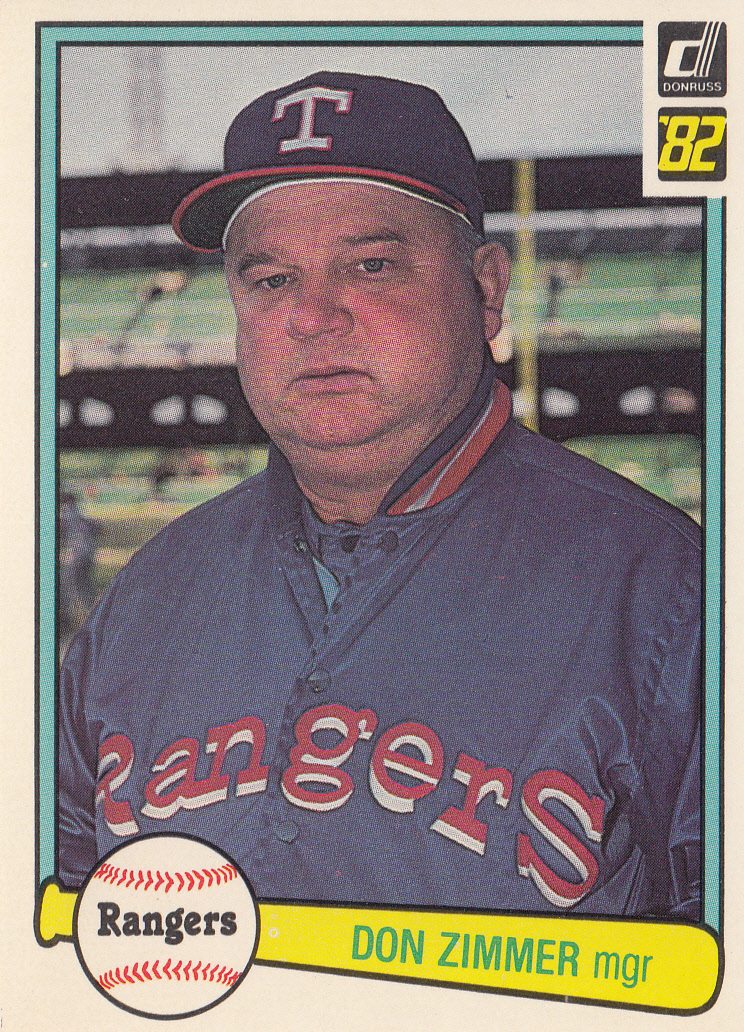
1982 Donruss #195 Don Zimmer MG

These cards won't be in chronological order, but we'll still be starting with the oldest card in the stack, one from 1982 Donruss. That was when Don Zimmer was managing the Texas Rangers. He actually wrapped up his playing career with that franchise, back when they were the second iteration of the Washington Senators. As their skipper, he had a 95-106 record. He had better results when he managed the Red Sox and Cubs, leading them both to winning records overall during his tenure.

As many times as I've seen the famous Bucky Dent home run from 1978, I never realized Don Zimmer was the manager of that unfortunate Red Sox team. But Donruss pointed it out on a lengthy write-up on the back, a wordy paragraph approaching what we once saw from Score.

Many of us remember Zimmer as Joe Torre's right-hand man during the late-'90s Yankees dynasty, and we got a little footage of him in ESPN's recent Derek Jeter miniseries The Captain. But not many remember him as a coach for the inaugural Colorado Rockies, where he appeared alongside manager Don Baylor in those early days at Mile High Stadium and Coors Field.

2015 Topps Archives #24 Cal Ripken Jr.

Rolling things back to very early in the Topps design library, here's a young-looking Cal Ripken, Jr. in 2015 Topps Archives, appearing on the 1957 design. I'll admit, I had to look that one up. Vintage, especially the more plain-looking designs, isn't always my strong suit. But 1992 vs. 1993 Fleer Ultra? I'm your guy.

We get partial career stats for Mr. Ripken on the card back, which has that not-quite-actual-cardboard smooth paper that Topps Archives is known for. The stats show his playing career between 1981 and 1996, but the final few seasons of his storied career are nowhere to be found, except of course in the overall totals. He played 3,001 career games, good for 10th all-time, although he was passed by Albert Pujols earlier this year, who is still going strong and trying to reach that 700 home run plateau before his inevitable retirement.

2016 Topps Bunt #24 Roberto Clemente

When Topps Bunt moved out of the digital app universe and took corporeal form in 2016, it included a mixture of current and retired players. I have about three pages of this set in my 2016 binder, and this Roberto Clemente will complement those other players nicely.

There's a little line on the card back suggesting that I "Collect and trade this card in the Topps Bunt app today!" Unfortunately, I only have this physical version of the Clemente card, and they've long since reached "Sold Out" status in the app. But by searching the app for the "Bunt Physical 16" set, I did discover that I still have a handful of digital cards of this set hiding in a dark virtual shoebox, including a Topaz parallel version of Brooks Robinson's digital card, with a global card count (effectively a serial number) of 440 and Rare classification.

The more traditional portion of the card back makes reference to Clemente's "electrifying defense in right field", and if you haven't seen that before, there are a few brief clips in this video.
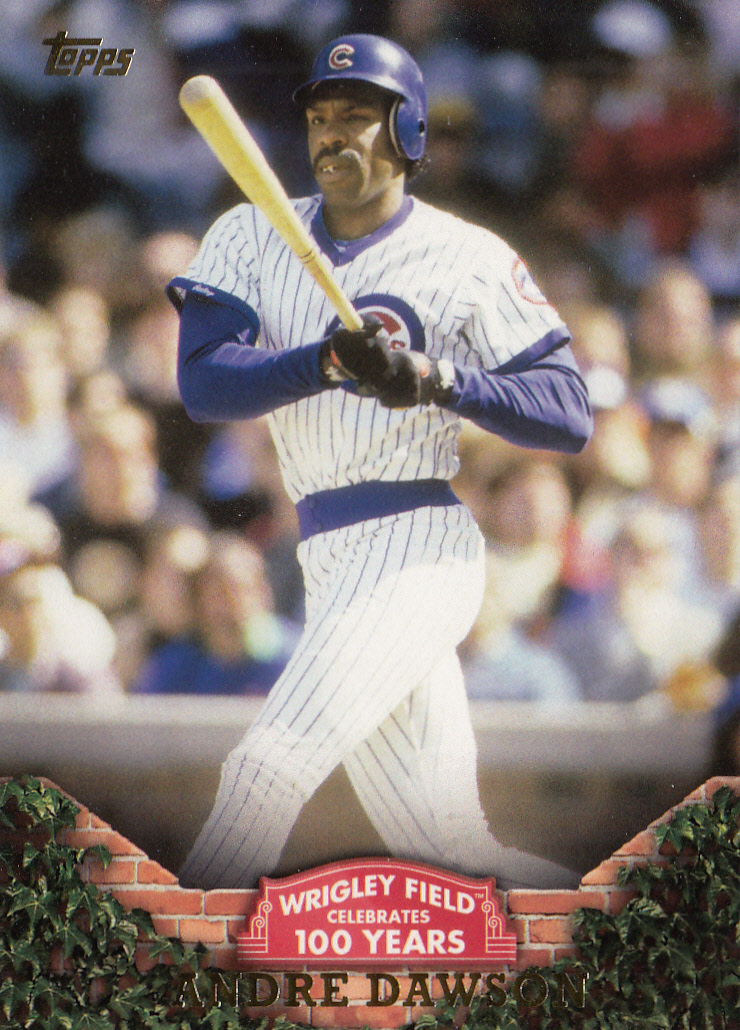
2016 Topps 100 Years at Wrigley Field #WRIG-11 Andre Dawson

This was totally unintentional, but somehow I ended up with a bunch of cards from NL Central teams. Well, of course there was no Central division during Clemente's days, nor Andre Dawson's Cubs tenure for that matter. But it was an odd coincidence.

This new-to-me insert set from 2016 Topps documents 100 years at Wrigley Field, which isn't entirely correct. The Cubs started playing there in 1916, yes, but the ballpark itself opened two years prior as the home park of the Chicago Whales of the ill-fated Federal League. 

Andre Dawson's time at Clark & Addison included an NL MVP award in 1987, which this card points out is the only MVP ever given to a player on a last-place team.

That particular fact reminds me of a story concerning Ralph Kiner, who led the NL in home runs in 1952 despite being on the dismal 42-112 Pirates. Apocryphally, he was told by Pirates management during contract negotiations, "We could have finished last without you."
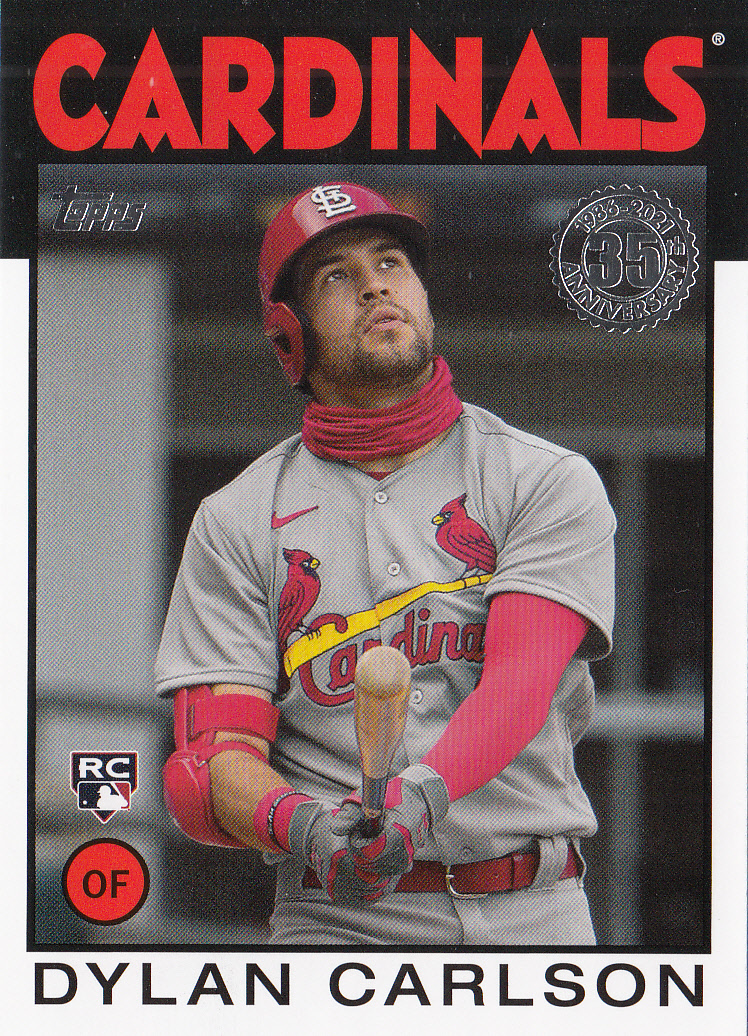
2021 Topps '86 Topps #86B-83 Dylan Carlson

In the spirit of anniversaries, Topps kept their 35th Anniversary series going in 2021, affixing the special silver seal to the 1986 design. Also gracing the design is the Rookie Card logo for Cardinals outfielder Dylan Carlson, who is seeing quite a show being put on by his teammates this season. 

The old veterans Pujols, Molina, and Wainwright are still making the highlight reels, Arenado is flashing the leather as usual, and there's talk of Paul Goldschmidt winning the Triple Crown, something that hasn't been done in the NL since his long ago Cardinal predecessor Joe Medwick won it in 1937.

1996 Stadium Club #299 Fernando Viña

1996 Stadium Club was one of the last sets I collected before I somewhat lost interest in baseball cards for a time, but I do recognize it well since little else went in front of it in the binders for several years. I'm still keeping the run of NL Central teams going, although 1996 puts us before Interleague Play began, and that catcher looks like a Texas Ranger to me, involved in an awkward play at the plate with Fernando Viña of the Brewers.

That would be explained by the fact that the Milwaukee Brewers were a member of the American League until switching leagues in 1998 to even things out with the Diamondbacks and Devil Rays expansion. 

Now that we finally have the Designated Hitter in the NL, the split between leagues is effectively meaningless. That new reality has led MLB to design a less divisional-heavy schedule for 2023, where all 30 teams will face each other for at least one series next season. I'll finally get to cross the Minnesota Twins off my list, the last team I haven't seen play.

Anyway, upon a closer look at this Stadium Club card, it actually looks more like a fight than a play at the plate. Viña appears to have his right hand formed into a fist, although I can't comment on the wisdom of getting into a fistfight with a player wearing a catcher's mask.

That catcher, by the way, is likely the Hall of Famer Iván "Pudge" Rodríguez, who is wearing a commemorative 1995 All-Star patch on his right sleeve. The Rangers showed off their year-old ballpark to the world then, although it was short-lived. It only opened in 1994, but the team has already replaced it with a Texas-sized enclosed stadium just across the street, which was the neutral "bubble" site of the World Series in 2020.

1994 Pinnacle Museum Collection #481 Tim Pugh /6500

Even when I'm picking images off a screen (and knowing how poorly most of our scanners do with shiny cards), I can recognize a shiny parallel when I see one, especially when it has this nifty Dufex technology that was exclusive to Pinnacle/Score at the time.

It's not serial numbered, but these Museum Collection parallels (not to be confused with the hyper-expensive Topps product of the same name) are known to have a print run of 6,500. There's also an Artist's Proof parallel that is even scarcer at just 1,000. Those print run ratios are approximately reflected in my collection. I have a single Artist's Proof, and this Tim Pugh card is my seventh Museum Collection. Unsurprisingly, five of those are Rockies, but somehow I've also ended up with two Cincinnati Reds and nothing else.

1999 Stadium Club Video Replay #VR2 Sammy Sosa

That covers all the NL Central teams, but we still have more to go in that division before we head further west.

When I selected this Stadium Club insert, I may or may not have realized that it was a lenticular motion card. But in any case, it's pretty cool. It's part of a tiny five-card insert set (40% Cubs by the way) called Video Replay, and it shows the motion of Sammy Sosa launching a baseball far into the distance. It's not quite as sharp as those Screenplays cards, which are nothing short of magic, but it's definitely an improvement over Sportflics. 

The video, such as it is, shows Sosa facing off a right-handed pitcher wearing #42, which should narrow down the number of possible plays considerably, but I came up empty. I investigated the rabbit hole for longer than I probably should have, but Sosa hit 609 career home runs, so it's like looking for a needle in a haystack. 

This card is from 1999, so I assume this is a video capture from 1998, and fewer and fewer players wore #42 after MLB retired it in 1997. José Lima is a candidate, and he served up numerous long balls to Slammin' Sammy throughout his career (more than any other pitcher besides Schilling, in fact), but that pitcher is clearly not José Lima. Nor is it Scott Karl, who is a lefty. My best guess was Jason Schmidt of the Pirates. Schmidt did give up a home run to Sosa during the 1998 home run race, but by then Schmidt had changed his uniform to #22. 

Maybe just a random fly ball from a prior season? It sure looks like a home run even in this low-res format, though. Possibly Spring Training? I don't know. Like I said, I investigated the rabbit hole. I don't like not knowing these things.

2021 Topps Fire #121 Nolan Arenado

Our last NL Central card is this Topps Fire card of Nolan Arenado, post-trade of course. You can tell because of that fire engine red jersey and helmet, which the Rockies don't wear.

I do have this card in the Bunt app, but the printed version has a proper card back. That card back tells us how Arenado rapidly made a splash with the Cardinals, hitting safely in his first nine games. That did one better than Roger Maris, who set the prior record in 1967.

Really, he's one of my all-time favorite players. It's just no fun seeing him on another team.

2019 Panini Titan #22 Nolan Arenado

But it's also not so fun anymore seeing cards of him on his original team, because we all know how that played out.

At least I have a space theme on this shiny Panini card to take the sting away a little. The set is called Titan, and it's a 25-card insert set found in 2019 Panini Chronicles. I can't tell you much else about this unlicensed set, but the card back does tell us that Arenado is "a titan straddling the hitting and fielding worlds".

I can tell you lots more about the space theme, though. That's supposed to be Saturn in the background, and Titan just so happens to be the largest moon of Saturn, as well as the second-largest moon in the solar system. It has a thick atmosphere of methane, and the Huygens space probe landed on it in 2005.
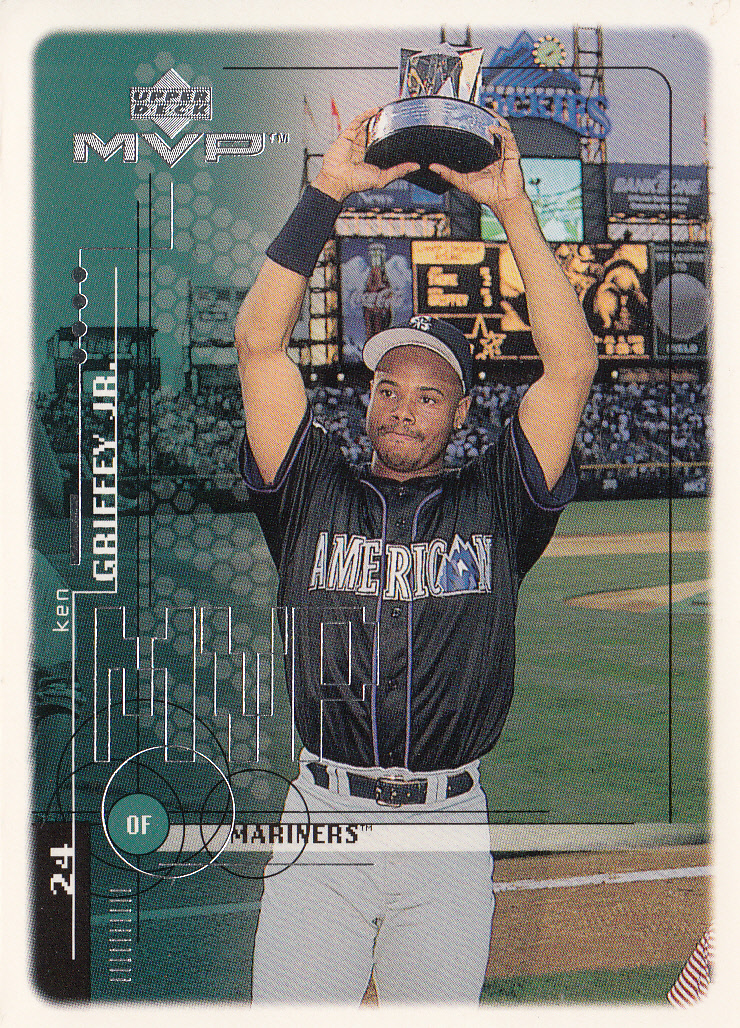
1999 Upper Deck MVP #190 Ken Griffey Jr.

It's rumored that some of the baseballs from the 1998 Home Run Derby even landed on Titan.

But seriously, Ken Griffey, Jr. did win the 1998 Derby at Coors Field, and he's pictured lifting the trophy on his 1999 Upper Deck MVP base card. This is a perfect candidate for my Coors Field frankenset, and one that I've had my eye on for some time.

I didn't get a chance to experience the All-Star festivities in 1998 (although I do remember a blimp hanging around town for the occasion), but I made the most of it when the All-Stars returned to Denver in 2021. The Home Run Derby trophy has changed a bit since '98, as has the Coors Field scoreboard and several of the corporations with ad space on it.

1992 Classic/Best #383 Bob Abreu

I don't usually go for Minor League or Bowman Prospect cards, but this 1992 Classic/Best set is one I've collected for a while. Surely they're not worth much, but I have early minor league cards of guys that went on to become huge stars or even Hall of Famers. Jim Edmonds, Shawn Green, Mike Piazza, Johnny Damon, and quite a few others. I can now add Bobby Abreu to the back pages of my 1992 binder, which is one I don't get a chance to see often enough.

This is more of a tenuous connection to the Rockies, but the Asheville Tourists were the Single-A affiliate of the Rockies until 2020. Prior to that, they were part of the Houston Astros' farm system, and following some shuffling among Rockies affiliates, they're back with the Astros again.

2008 Upper Deck Timeline #35 Roy Halladay

The final card I picked from Nick's giveaway is another color-coded Upper Deck beauty, Roy Halladay's card from the short-lived UD Timeline. To be fair, pretty much everything Upper Deck was printing at that time was short-lived, even the fantastic UD Masterpieces set.

Roy Halladay in particular caught my eye because he was from my home state of Colorado. He went to high school at Arvada West, quite near me and not far at all from a few good birdwatching sites. The Athletic ran a story a couple years ago about his high school championship game, where he faced off against Brad Lidge's Cherry Creek High School team. 

It's sad to talk about him in the past tense. But he was excellent all throughout his career, and as people all over Colorado know, long before he got to the Majors.

Congratulations to Nick on his first decade of blogging, and by now we know his second decade is already off to a solid start.


Sunday, January 3, 2021

The Trading Post #162: Card Hemorrhage (Part 1: Assorted Goodies)

I'm all the way up to #162 in The Trading Post theme. That's a lot of trades, and many of them I've split up into two or even three parts. This one will be a two-parter, but the unusual thing this time is that this was all from a single PWE.

Yes, Jay at Card Hemorrhage expertly crafted a bespoke PWE, stuffed two dozen cards inside, affixed three stamps to it, and sent it on its way. According to the postmark, it took a little over two weeks to complete its journey through the mail system, but it was worth the wait. Especially because I had no idea I was even waiting at all. 

2001 Topps Archives Reserve #63 Satchel Paige

Usually I lead off the two-part posts with the Rockies, but I'm flipping it around this time. Mainly because there was an excellent and timely Archives Reserve card in here, but also because I have to admit that I'm getting a little disillusioned with the Rockies. Yet another offseason is going by without much happening, although free agent Trevor Bauer was asking for Denver restaurant recommendations on Twitter the other day, so what do I know? 

Sushi Den, by the way.

In any case, I've gone on record before as saying that Topps Archives Reserve is my favorite reprint set ever. The iconic cards, the wide representation of sets, the shininess. It can't be beat. So Jay took note of that and sent Satchel Paige's card from this 100-card set. I'm not quite sure where Topps got the extra "L" in his name, but on the back, they did acknowledge the travesty of segregation, referring to his Major League career as "long deferred and much interrupted". That's language from 1953, one small step on a very long path. Another thing that was "long overdue" was recognizing the Negro Leagues as a bona fide Major League, something MLB finally decided to do on December 16th. Coincidentally, that's the same day this PWE was postmarked. 

Next comes the long process of including all those years of incomplete record keeping into the official statistics, and I'm waiting for the day when Paige's Baseball-Reference page shows more than the 28 wins he earned after he reached his forties.

Now's a great time to learn more about Paige, and Buck O'Neil, and Cool Papa Bell, and Oscar Charleston, and Martín Dihigo, and many more. Joe Posnanski has taught me quite a bit since last year, such as this tidbit gleaned from O'Neil, that so many Negro League teams were called the Giants as sort of a code word. It was often difficult to get proper press coverage when a Negro League team was in town, but if you heard tell that "the Giants" were playing, those who were clued in would know what was up, and potentially had the opportunity to witness these greats in their prime.

2014 Topps Chrome #14 Alex Guerrero (RC)

A decade or so later, things became much more difficult for Cuban players for an entirely different set of reasons, but that started to change in the early '90s. Today, Cuban-born players are well-represented in MLB, including some of the latest hot rookies like Luis Robert and Randy Arozarena. Álex Guerrero was once among them, and signed with the Dodgers in late 2013. He ended up with playing time in 2014 and 2015, all with the Dodgers. 

He got a card in 2014 Topps Series 2, as well as in this smaller Chrome set, and it's a great photo. It fits into the all-dirt "Tatooine" mini-collection, and I'm guessing this is a spring training shot. The photo is cropped too tightly to identify either his teammate or the opposing runner, but I'm guessing that's an Angel.

1995 Leaf Cornerstones #5 Will Clark / Dean Palmer

This mid-'90s insert isn't quite as shiny as the first two, but it does have that sparkly rainbow look around the border. New to my collection, the Cornerstones insert set features the primary corner infielders from a tiny selection of six teams. Most of us remember Will Clark as a Giant, but he spent most of the later part of his career with the Texas Rangers. Joining him across the diamond was Dean Palmer. 

On both the front and the back, this card shows a nice right-handed/left-handed symmetry, typical for their respective positions. There are defensive stats on the back as well, such as putouts and errors. Maybe I'm spoiled by Nolan Arenado, but Palmer's .912 fielding percentage at the hot corner is really, um, not that great.

It's a nice design, though. The colors and theme work well, and I'd love to see Topps do a current 30-team version of this set. The only odd thing here besides the tiniest crease on the front is the numbering. Leaf was inconsistent in their use of numerals and words, noting this card as "5 of six".

2014 Bowman Chrome Draft Top Prospects #CTP-83 Clayton Blackburn

The last shiny card before we get into more normal-looking cardboard comes from Bowman Chrome. It's from a year. 

Seriously, it's from 2014. I'll never be good at Bowman.

Of the zillions of Bowman Prospect cards out there, this one in particular makes me think that Jay might be an extremely diligent reader of Infield Fly Rule. As I documented in 2016, I've been to one single Minor League game in my life. I saw the Sacramento River Cats host the Salt Lake Bees, and guess who the home team's starter was that day? Yep, Clayton Blackburn.

Like the many prospects who fill Bowman checklists, Blackburn never saw Major League action, although he did spend some brief time on active MLB rosters. He just never had the chance to actually take the mound.

I did enjoy the Minor League experience, and it's nice to keep tabs on these guys as they progress through the farm system. Players you happen to see in person take on a whole new life and you really find yourself rooting for them to make it to The Show. It's just not something that's as easy to keep tabs on when you have a Major League team a short drive away. Maybe that's why I'm so terrible at Bowman.

2020 Topps Heritage Minors #25 Heliot Ramos

Another enjoyable aspect of Minor League Baseball is just how fun the team names are. One level down from the River Cats in the Giants farm system, you'll find the Richmond Flying Squirrels. Just have a look at this logo. Elsewhere in MiLB you'll find the Isotopes, the Yard Goats, the RubberDucks, the Jumbo Shrimp, and best of all, the Trash Pandas.

Heliot Ramos plays for the Flying Squirrels, or at least he did in 2019. Minor League Baseball was entirely shut down in 2020, and I have to wonder how much career development has simply been derailed. To lose a whole season at a young age certainly can't bode well for many Major League hopefuls. But maybe one day, Ramos will make his way through Sacramento and on to San Francisco. At that point, odds are good I'll see him play an NL West game at Coors Field someday. 

That is, assuming the MLB divisions aren't massively realigned. Expect the unexpected.

2015 Topps Gypsy Queen Glove Stories #GS-10 Pablo Sandoval

In case you haven't been caught up with meme culture or Guardians of the Galaxy, a Trash Panda is a humorous name for a raccoon (see also: danger noodle, aka snake). This is not to be confused with Kung Fu Panda, the nickname for third baseman Pablo Sandoval. He was featured in a long-running but defunct Gypsy Queen insert set called Glove Stories. It featured some of the best defensive plays on the diamond, and this one in particular is from the 2014 NL Wild Card game, in which Panda went over the railing (at 1:28 in video) to snag a foul pop. If you leave the field of play as part of a catch, you run the risk of allowing runners to advance one base, but as I understand the rules, there's no danger when there's no one on base. 

Other than falling into the concrete dugout, of course.

1976 Topps #101 Pete LaCock

We'll take a brief foray into vintage before continuing. I don't have much 1976 Topps in my collection, but I am just a little bit closer to filling a complete page in my vintage binder. Pete LaCock retired several years before I was born, and if not for his name that doesn't pass the playground test, he'd probably just be another unknown in the vast expanse of 1970s commons. But he's been embraced by the Cardsphere, so that's why I now have a -1.9 rWAR player in my collection. And it's actually in really nice shape for being 45 years old, even though the centering isn't perfect. It's very 1970s.

So what can we find out about Pete LaCock? Well, he played in Japan in 1981, but his final 1980 season was enough to earn a trifecta of sunset cards all three sets that year. Topps, of course, and the inaugural Donruss and Fleer sets. In more recent years, he coached various Minor League teams like the Blacksnakes and the Saltdogs. And he happens to be the son of the original Hollywood Squares host, Peter Marshall, whose real name is Ralph LaCock.

1994 Stadium Club #109 Gregg Jefferies

On to the wonderful world of Stadium Club, where we see Gregg Jefferies trying to steal second base in Wrigley Field. The cameo here is unclear, but I'm guessing that's a "6" on this Cubs uniform. I'm not entirely confident in this, but my best guess is that it's José Vizcaíno, who wore #16 in Chicago. Oddly enough, Vizcaíno was the cameo player on another Stadium Club card that Jay sent me last time

Cue Twilight Zone Music...

1994 Stadium Club doesn't get enough love. After three years, Topps changed the brand's logo and started using the "TSC" abbreviation. They also changed the card backs from what had been a pretty consistent design since the brand's inception in 1991. Gone was the tiny image of the player's first Topps card, replaced by a second photo and all sorts of different typefaces and colors. 

On the front, the color of the player's first name denotes which division the team is in. The same color coding is also used on the card number. 1994 was the first season where MLB used the six divisions we know now, so Topps decided it would be helpful to guide fans into understanding the new alignments. As we all know, 1995 Fleer took that idea to the extreme. 

Also on the back, Topps gave us a word or two to describe the player or his season, in this case "efficient". Fleer also borrowed that idea for their Emotion brand. Topps did it a year before, though with much less emphasis. And the red foil I never see enough of was something Pacific ran with for years before their demise. It turns out this was a pretty influential set.

Out of curiosity, I glanced through a few of my other '94 Stadium Club cards to see what Topps came up with for the player's phrase. Robin Ventura was "rockin' robin". Barry Larkin was "cin-tillating", pun and hyphen intended. These are all lower-case. Wade Boggs was "better than pie", referencing his lifetime batting average being higher than Pie Traynor's, which held true into retirement.

I was ten when this was all happening. It was fun.

2014 Stadium Club #79 Brandon Phillips

So you can imagine my excitement when Topps brought the brand back in 2014, the same year I started this blog. I'm not saying I caused it, but I'm also not saying I didn't. In those ensuing decades, the brand grew up a lot, developing yet another logo, toning down the card back tremendously and using words like "loquacious", and focusing even more on the photography.

Here, Brandon Phillips has a Brewer caught in a rundown, but I can't see the numbers clearly enough to know who it is. That might be Jonathan Lucroy watching from the safety of second base, which is a wild guess based on the first digit of the uniform number. Whoever the trail runner is, Phillips has good speed, and I definitely wouldn't expect him to win this footrace.

2015 Stadium Club #99 Chase Utley

2015 Stadium Club is just as good, if not better. I only have a page or so of it in my collection, which is odd. Usually I buy at least a blaster of it, but I only have enough to equal a value pack or two. So I'm glad to add this Chase Utley card to the pages. As posed shots go, this is one of the best, showing him in the dugout at Nationals Park, with his reflection in a glass door. 

Utley is wearing the "CB" memorial patch from the 2014 Phillies season, honoring Claire Betz, a part-owner of the team who died earlier that year. You can also see the banners on the structure beyond the left field wall, over Utley's left shoulder. There's a big banner with the Curly W, and under 5x magnification a Nats player is visible on it. It's very hard to say for sure, but I think it's #28, Jayson Werth.

In the reflection, the angles play a little differently, so Utley's bat mostly obscures that banner. But look closely, and you'll be able to see a mirror image of the Geico Gecko in the window, sitting right on Chase Utley's shoulder like a little cartoon angel.

1992 Stadium Club #800 Jose Rijo

José Rijo is trying to get a better look at all that through his goofy sunglasses. Despite all his fun cards, the only other time he's been on the blog was just a normal pitching card. For mini-collections, he's a frequent subject. He fits into the signing autographs mini-collection, the sunglasses mini-collection, and he's pretty much all by himself in the squirt gun mini-collection.

He was also a pretty good pitcher. He was both an All-Star and a World Series MVP, and probably would have put up even better numbers if his elbow didn't give him fits for years on end.

We'll see some Rockies in Part 2. In the meantime, have a Happy New Year and thanks for reading!


Sunday, December 22, 2019

The Trading Post #139: Big Shep's Cards (Part 3: Other Brands)

I promised Pacific, so here's some Pacific.

1999 Pacific Omega #157 Robin Ventura
Compared to 1998, Pacific didn't change the design much for the Omega brand in 1999. The major difference is that there are no baseball seams separating the various design elements. A less major change is that the area on the right now uses the left photograph in shiny form, rather than the central action shot as in 1998. It's still pretty hard to see but the scanner picks it up reasonably well.

In short, this is definitely a Pacific card.

What it's not is a Rockies card. There were White Sox in my two previous posts covering a shipment from Big Shep's Cards, and I chalked it up to the similar uniforms worn by the Rockies and White Sox. I don't have an explanation for why Robin Ventura as a Met ended up in this package, other than that he began his career with the White Sox. Famously so, in fact, as he was with Chicago when that infamous brawl with Nolan Ryan took place.

2002 Upper Deck Victory #93 Jeff Cirillo
Not-quite-Rockies-cards have been a theme these past few posts. Just last time, when talking about Jeff Cirillo's Fleer Premium card, I pointed out how it was a true Rockies card, unlike his card in the follow up set the next year. For such a briefly-tenured Rockie, he actually ended up with some pretty great cards. But it didn't last long, as he was traded to the Seattle Mariners after just two seasons, part of the trade that sent Brian Fuentes to the Rockies.

Upper Deck noted this transaction in the 2002 release of their no-frills Victory set, a 660-card beast unencumbered by things like relics, autographs, and even insert sets. The photography isn't quite as good, but the set kept the spirit of Collector's Choice alive for a few more years beyond 1999.

The card back clearly lists Cirillo as a Mariner, and mentions his 11-game hitting streak as a Rockie toward the end of the 2001 season, a post-9/11 homestand during which I saw two games. We all had other things on our mind at that time, and I hadn't given much thought to Jeff Cirillo's hitting streak. In the September 29th game, the penultimate home game of the year and a classic 14-12 pre-humidor Coors Field slugfest, I recall Denny Neagle hitting a grand slam, and my sister dropping her Dippin' Dots spoon down to the level below us.

The card back mentions that Cirillo had a trio of three-hit games during that stretch. That was one of them. The game I saw a few days prior on September 26th was another, which was one of Tony Gwynn's final games.

1993 Donruss #790 Jerald Clark
Speaking of Gwynn, expansion draftee Jerald Clark got to play with him for several years before becoming an inaugural Rockie. 1993 Donruss included lots of Rockies and Marlins in their Series 2 release, just like Topps, but didn't have a chance to actually obtain photos of any expansion players in their new uniforms. They used the retro Rockies logo before it underwent slight revisions, which I've written about before. Basically, the colors on the upper arch were changed from purple-on-gray to gray-on-black, and the baseball's motion lines were lengthened.

1993 Topps didn't do much with official team logos, except for the back of the Rockies and Marlins dual-player prospect cards. There's a tiny team logo in the upper right, which is a weird mash-up of the longer motion lines but the old color scheme. Have a look:

1993 Topps #537 Jason Hutchins (RC) / Ryan Turner (Reverse)
Ryan Turner, by the way, is the first Rockie to appear on a baseball card, sneaking into both 1992 Upper Deck and 1992 Bowman.

Getting back to Jerald Clark, sharing the outfield with an all-time great like Gwynn must have been a fantastic experience. Clark never got to go to an All-Star game, although his team hosted the Midsummer Classic in 1992, documented by a large home plate-themed patch on his left sleeve. Flip the card over and you'll get an even better look at it.

That game was held at what was then known as Jack Murphy Stadium, the home of the Padres from their inception in 1969 until the beautiful Petco Park opened until 2004, just the fourth Major League stadium I've had a chance to visit. During the tech boom of the late 1990s, The Murph, as it's still locally known, was renamed Qualcomm Stadium, and remained the home of the San Diego Chargers until they moved northward to Los Angeles in 2017. Qualcomm Stadium was also the place where the Broncos finally won a Super Bowl, XXXII in early 1998. It remains standing, and is the home of the SDSU Aztecs, who once played a basketball game atop the deck of the USS Midway.

1994 Score #197 Danny Sheaffer
Everyone was in their proper uniforms and logos when the 1994 sets hit shelves, but we aren't quite done with San Diego yet. Just a year after they hosted the All-Star Game (and long before the mustard yellow and brown of 2016), the Padres celebrated their 25th Anniversary with another patch, which we can see on the sleeve of a sliding Guillermo Velasquez, who is making a cameo on Danny Sheaffer's card.

Velasquez played part of two seasons with the Padres, mainly off the bench. He appeared in relatively few games, allowing me to pinpoint this photo with complete confidence. It happened on August 8th, 1993 in the bottom of the 4th. Velasquez walked with two outs, advanced to second on a Mo Sanford balk, then was thrown out at home while testing the arm of Dante Bichette, who cleanly fielded a hit by Archi Cianfrocco and fired the ball back in to Sheaffer. That series of events allowed Score to snap a great action shot for the 1994 set, and gave Danny Sheaffer his Infield Fly Rule debut.

This is the first three-part post to appear in The Trading Post theme, and it's covered all the major brands that operated in the baseball card world during the Rockies' existence. Score isn't the most stellar representative of Pinnacle Brands, but it certainly counts and gave us better sets than a lot of people give them credit for.

1998 Score Rookie/Traded #RT78 Vinny Castilla
Years later, in 1998, Score was still snapping some fun photographs shortly before their bankruptcy. Mario wrote an excellent post about the fall of Pinnacle a few days ago, which chronicles a dark period in card collecting. That insolvency also meant the end of the Score brand as we knew it, a real shame.

This Vinny Castilla card looks a lot like a normal 1998 Score card, but the inverted blacks and grays (just like the old Rockies logo!) signify this is actually from the 1998 Rookie/Traded set, even though Castilla was neither a rookie nor traded. The card back has the lengthy write-up typical of Score, which mentions how well he hit lefties in 1997, and the statistics offered a very early hint at the Sabermetrics movement, including columns for Total Bases, On Base Percentage, and Slugging Percentage. They were still in the realm of traditional statistics, but were at least digging a little more deeply than just the usual stats found on baseball cards for decades.

This card would fit well into many mini-collections, thanks to Castilla being shown signing autographs. Even under magnification, I can't tell what set he is signing, but if I had to venture a guess, I think it's one of those perforated sheets of kid-oriented police safety cards. You know, the oddballs that have a color photo on one side and things like "Don't Do Drugs" and "Never Swim Alone" on the back, that sort of thing. I'm pretty sure I had a set like that when I was a kid, but it's likely one of the few parts of my collection that hasn't survived the years.

Not that I am spending a lot of time swimming with no lifeguard on duty anyway, no siree, not me.

1997 Collector's Choice Teams #CR Colorado Rockies Logo CL
You knew it was coming. We have arrived at the shiny section of the post.

Part of this stack included a large quantity of 1997 Collector's Choice. I see that set in trade packages often. However, flipping these over greeted me with some unusual card numbers. "CR 2", "CR 10", and so on. Clearly, they were from a team set, and this shiny card with a fully-fledged Rockies logo on the front is actually the team checklist. Not counting this one, there are thirteen cards, and it includes all the big Blake Street Bomber names of the day. Larry Walker, Vinny Castilla, Dante Bichette, and more. The card says that the 1996 Rockies were the first-ever team with both 200 home runs and 200 stolen bases, as well as a mention of the game in which they put up an 11-spot on July 12th against the Padres.

I have a vague recollection of that game. I wasn't there, but I remember watching a couple wild ones before going away to Boy Scout camp for a week that summer.

2004 Upper Deck Power Up #74 Preston Wilson
Caricature cards have never been my favorite. The subset from 1993 Score is as good as it needs to be. They look cartoony enough to be sort of fun, but they're not my cup of tea.

So when Upper Deck comes along and comically enlarges a player's head on a photograph, the results are downright terrifying. This card looks like a genetic lab experiment gone wrong. right down to the radioactive green sludge on the background. There's also a 9-character code on the right side, presumably for some type of online game. Confusingly, I happen to have another copy of this card in my collection already, and the code is exactly the same, so I have no idea what's going on here.

Preston Wilson did have quite a few RBI by the 2003 All-Star break, if you can read the strange font, that is. At least there's a shiny area.

1999 SP Top Prospects #103 Ben Petrick
On a much more serious note, MLB has its sights set on contracting Minor League Baseball. Night Owl wrote a great post about the minors last week, and if you're on Twitter, you're surely no stranger to the recent debate. I'll say what I'd say about any multi-billion dollar organization who isn't paying employees a living wage. Share the wealth. If Scott Boras can line up almost a billion dollars in the space of a week for a half-dozen or so of his top guys, then surely there's funding to ensure that playing professional baseball is a suitable career path, even if you don't make the Majors.

Remember that time Andrew McCutchen's paystub was leaked? Here's the Minor League equivalent.

Anyway, as far as this card goes, it's a sturdy, black-and-gold beauty from SP Top Prospects, showing Ben Petrick as a member of the New Haven Ravens, once a Rockies Double-A affiliate. They have since moved to become the New Hampshire Fisher Cats. Flip the card over and you'll see that Petrick began his Single-A career with Salem, then known as the Avalanche. They're still in Salem, now called the Salem Red Sox.

Maybe Petrick was just that good of a prospect before he ran into health issues, but it seems like I have more minor league cards of Petrick than anyone.

1995 SP Silver #15 Juan Acevedo
A few years prior, Juan Acevedo made it into the main release of Upper Deck's SP brand. This die-cut is actually the Silver parallel from the Premier Prospects subset. He had yet to reach the big leagues, but UD still has him pictured in a real Rockies road uniform, certainly from the same photo shoot as his base 1995 Upper Deck card.

As a bonus, the card back has a photo of him bunting! It's another mini-collection hit!

1994 Upper Deck #270 Andres Galarraga HFA
We just went through quite a few Upper Deck cards without seeing any copper, and now that we're seeing the 1994 base set, we finally get some, although it's ink instead of foil. I don't think I've ever shown it on the blog, but this might be my most commonly-seen card in all of 1994 Upper Deck. I've seen base versions of it numerous times, but Shep managed to find the Electric Diamond parallel for me, printed near the dimensions of Mile High Stadium, roughly where I sat for most of my trips to the defunct ballpark.

What we're seeing is the Home Field Advantage subset from 1994 Upper Deck, featuring Andres Galarraga. This subset wrapped up Series 1 with National League teams, and continued in Series 2 with the American League teams. On the back, there are plenty of fun facts about the stadium, including the obvious difference between the left- and right-field distances down the line, the fact that fly balls travel farther, and even a brief mention of Coors Field.

We're told that at the time, the Rockies were one of eight teams to share a home with an NFL team. Now, following the conclusion of the Oakland A's season, there are no more shared stadiums across baseball and football, as the Raiders are moving to Las Vegas.

In addition to all that, there are also home and road splits for both Galarraga and the Rockies as a whole. They crammed a lot in on the back, partially because the front is pretty sparse. Go find the base card and you won't even see that sparkly Electric Diamond text.

2001 Upper Deck MVP #323 Ron Gant
2002 Upper Deck MVP is one of my favorite black-bordered sets ever. 2001 had a bit more gray in there, actually quite similar to 1998 Score. There's a little bit of silver foil, too. Other than the MVP logo itself, it's done up in tasteful thin silver lines. Less is more with a design like this.

This is a double-debut post, as Ron Gant is joining Danny Sheaffer as members of the Infield Fly Rule club. I definitely remember Sheaffer, but Ron Gant as a Rockie is a lot fuzzier in my mind. He played here for less than sixty games in 2001. I remember him much more clearly as a Brave.

Upper Deck made a prediction on this card, expecting him to reach the 300-homer mark in 2001. When the Rockies traded him in July, he had precisely 300 home runs, adding two more on with Oakland to close the season. His career ended two years later, finishing up with 321, just two less than this card number.

I'm sure he wasn't chasing his card number.

If you celebrate it, enjoy your Hanukkah, which begins tonight. Otherwise, have a great Christmas or any other holiday you choose. Thanks for reading!


Sunday, October 13, 2019

An LCS Survivor: Bill's Sports Collectibles (Part 2)

After digging through the dollar box, my attention turned to the packed shelves and tables inside Bill's Sports Collectibles in Denver. Go back and have a look at Part 1 if you want a refresher. I was surprised by a few things in there, but what I found elsewhere in the store was even more unexpected.

1988 Denver Zephyrs CMC #24 Darryl Hamilton
Denver had long had its eyes on a Major League Baseball franchise, but from the mid-'50s until 1993, the highest level was only a Triple-A team. First known as the Bears, then later the Zephyrs, they shared Mile High Stadium with the Broncos.

Bill's was in business way back when the team was still known as the Bears, so that they still have Denver Zephyrs team sets lying around shouldn't surprise anyone. This 25-card 1988 set from a company called CMC is actually quite scarce. According to Beckett, there were only 10,000 sets produced.

At the time, the Zephyrs were an affiliate of the Milwaukee Brewers. Darryl Hamilton made his debut with the Brewers the very same year as this card. Without digging too deeply, I believe he is one of just two players in this set to later return to Denver as a Colorado Rockie, which he did in the late-90s. Sadly, he passed away in 2015.

The card back doesn't specify Hamilton's birthdate or birthplace. Rather, it says: "Born: Age 23".

Just one of those goofy errors you probably won't see outside of an oddball set like this.

1988 Denver Zephyrs CMC #1 Mark Knudson
Mark Knudson got card #1 and it has taken a beating over the years. He had some Major League experience by 1988 but spent much of his career getting called up and being sent down. Most of his time in the big leagues was spent with the Brewers, but he did wrap his career up with the inaugural 1993 Rockies.

Knudson. a Denver native, only appeared in a few games with the early Rockies, but he does have the distinction of being the first Coloradan to play for Denver's big league club, paving the way for Kyle Freeland. He's still active in Denver-area sports, and he did some sports radio work as well. In fact, I recall him as the analyst who interviewed Joe Girardi on the radio after an autograph signing at the Rockies Dugout Store in Boulder.

1988 Denver Zephyrs CMC #15 Charlie O'Brien
Charlie O'Brien and Mark Knudson were certainly a battery for the Denver Zephyrs, and O'Brien had some big league experience under his belt by 1988, too. I remember him more as a Met, but he spent about as much time with the Brewers. He came back to Denver, in a sense, as a member of the 1995 Atlanta Braves. The Braves, of course, beat the Rockies in the 1995 NLDS, which partially took place just a few exits away from Mile High Stadium on the other side of Downtown Denver.

1988 Denver Zephyrs CMC #5 Paul Mirabella
I'm not familiar with Paul Mirabella, but I picked this card because it was the only card in the set that showed a slightly different angle of Mile High Stadium. He has his back to right-center field, and we can see the edge of the stands with more of the second level in view. The seats in that level were blue in the lower rows and orange in the upper rows, which of course are Broncos colors. The camera isn't panned far enough right to see the Ring of Fame, a feature that has been carried over to the new Broncos stadium, which most people in Denver still just call Mile High anyway. Partially that's because of tradition, and partially it's because fans can't keep track of which company is the latest one to buy the naming rights.

As of September, the new Broncos stadium is now officially known as Empower Field at Mile High, which precisely no one is going to use.

Those are the highlights of the Denver Zephyrs team set. I made one other purchase that day, and I think I may have unearthed an overproduction-era surprise.

1993 Toys 'R' Us #42 Mike Timlin
I became a baseball fan in 1993. Other than two packs when I was younger, I became a baseball card collector in 1993, as well. I thought I had a pretty good handle on things that year. Fleer, Topps, Upper Deck, I know them all. 1993 takes up two binders in my collection, not to mention all the factory sets. Even the lesser-known sets like Triple Play, Studio, and more have a place. It's not like the late-'90s when there was far too much to keep track of. I can even tell 1993 Ultra from 1992 Ultra. I knew it all, or so I thought.

So what the heck is this thing? Do you recognize this set? Have you ever seen it? Because I had absolutely no idea it existed.

What we're seeing is a card from 1993 Toys 'R' Us, a one hundred card set that was co-branded with Topps Stadium Club and packaged in a little 3D plastic case that was meant to look like a Toys 'R' Us store. It also came with a few 5" x 7"-sized "Master Photos".

Ringing any bells?

I've been on the blogs a long time and this is completely new for me. Granted, this set is pre-Rockies and pre-Marlins, so it makes some sense that it's not in my collection, but I've never even seen anything from it. Not the Toys 'R' Us logo on the blogs of the oddball collectors. Not this backwards-hat autograph-signing shot of Mike Timlin, which is just begging to be in a mini-collection. Not the Piazza, the hot rookie that year. Not even the Griffey.

1993 Toys 'R' Us #23 Larry Walker
This Expos-era Larry Walker card is about the closest thing to a Rockies card as you'll find in this set. Pedro Astacio is in it as well. Gary Sheffield is too, if you're looking for a Marlins proxy.

So now that there's yet another Stadium Club set out there that's eluded my knowledge for over a quarter century, what are we looking at here? Well, this is broken up into three subsets: Young Stars, Future Stars, and Rookie Stars. You can tell which is which in gold foil above the nameplate and the signature backwards "R" of the Toys 'R' Us logo. Most of the players you've heard of fall into the "Young Stars" category.

1993 Toys 'R' Us #33 Iván Rodríguez
Players like, oh, I don't know, Iván Rodríguez? Whose son Dereck is now pitching for the Giants, teammates with Carl Yastrzemski's grandson. It's a great action shot, watching a young Pudge waiting for a foul ball to return to Earth. We also learn that the colorful Toys 'R' Us logo can appear in either upper corner.

On the card back, each card has a date for a key milestone in the player's career. His first home run was on August 30th, 1991. His first four hit game was on July 2nd, 1991. Larry Walker's first double was on April 10th, 1990.

1993 Toys 'R' Us #17 Ryan Thompson
Here's one of the Future Star cards, which is really not different design-wise. It's just a subset with fewer players who actually did turn into stars. This card does look pretty familiar, but that's probably because it's similar to both his 1993 Topps and 1993 Stadium Club cards, showing him leading off of first base with a Pittsburgh Pirate in the background. This is probably from his same trip to first base in Shea Stadium.

1993 Toys 'R' Us #11 Pat Mahomes
Rookie Stars is the third and final subset, and this card caught my eye. Any current NFL fan will recognize the name Pat Mahomes, because his son, Patrick, is the starting quarterback for the Kansas City Chiefs and last year's NFL MVP. Pat, the dad, didn't have nearly as much success in Major League Baseball as is son is having in pro football, although his career did span eleven years.

So there are a hundred cards like that in a little black box, but I also mentioned something called a Master Photo. What's that?

1993 Toys 'R' Us Master Photos #3 Carlos Baerga
Inside the packaging, you'll find about a dozen of these 5" x 7" prints, effectively a partial parallel set. All of the Master Photos are from the "Young Stars" subset. They're unnumbered with a plain back, but the photos match the actual cards in the set. Beckett did assign a card number for each, but there's no sign of one anywhere. The photo itself is slightly larger than a standard 2.5" x 3.5" card, and the inner gold border approximately matches the dimensions of a standard card, giving you the impression that that's where you cut it. Both rectangular borders, the stripes at the top, and all the gold foil take on a rainbow foil appearance in the Master Photo series.

Carlos Baerga had one of the better photos to pick from, a great double-play shot over a sliding Sam Horn of the Orioles.

1993 Toys 'R' Us Master Photos #12 Frank Thomas
Frank Thomas, one of the darlings of 1993 baseball card collecting, got a Master Photo too. The Hall of Famer is wrapping up the ALCS postgame show with a few other retired stars as I write this, but back then, he and Griffey were the key players in any baseball card set.

And I don't remember seeing this in Beckett back then, either. But according to their website, there were 7,500 cases of this product produced. It's just a little unsettling, knowing I have three cards from the 1993 Milk Bone set, for example, yet in all my travels have never glimpsed this thing. Like it's a snow leopard or something.

Don't get me wrong, I like discovering new things. I just worry I'll be drummed out of the ranks for not knowing about a set this big from my first year of collecting, especially given how much 1991 Score I bought with my allowance at Toys 'R' Us that was probably sold right alongside this set.

Anyway, they're like eight bucks plus shipping on eBay right now if you want one. And if you find yourself in Denver, Bill's probably has a few in the back.