
As August draws to a close, we're getting pretty close to Nick's 11th Anniversary. But it's finally time for me to put my entry in for "latest blog post documenting Nick's 10th Anniversary".
Starting in December of last year, Nick at Dime Boxes did a series of generous giveaway posts for the first full decade of his excellent blog. I managed to get claims put in on three or four of his ten giveaways, but more often than not they were pretty picked over by the time I saw the post. No matter, I'm sure they all went to great homes across the blog community.
I ended up selecting a baker's dozen worth of cards from those pages, which arrived in the mail accompanied by a healthy-sized stack of Rockies hand-selected by Nick. That'll be part 2.
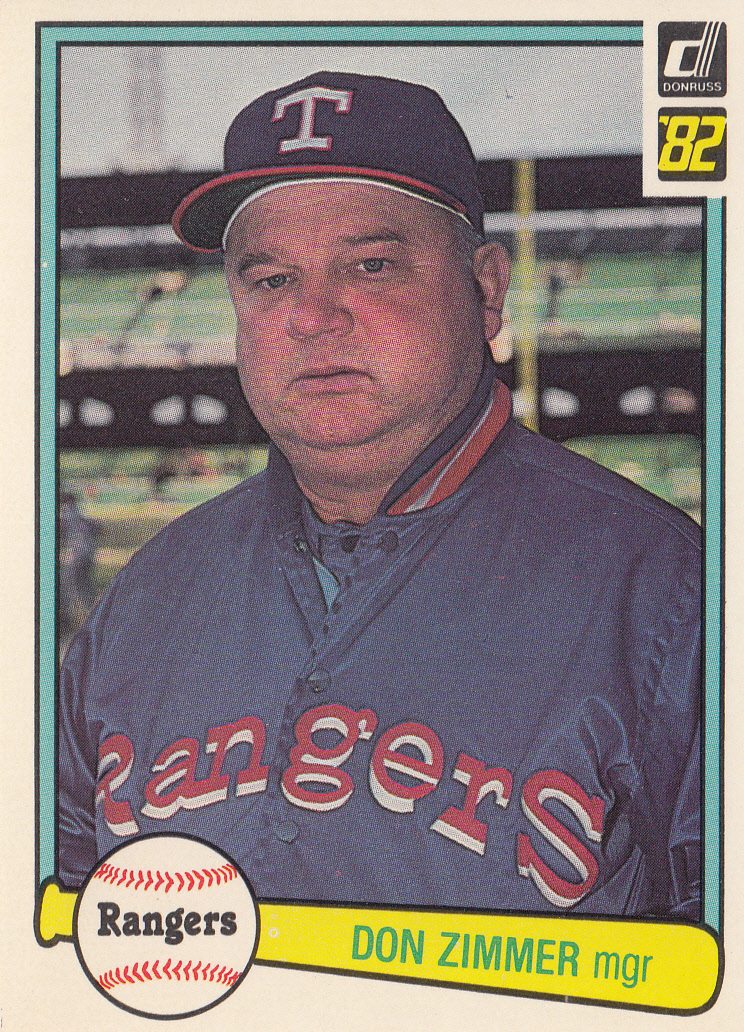 |
| 1982 Donruss #195 Don Zimmer MG |
These cards won't be in chronological order, but we'll still be starting with the oldest card in the stack, one from 1982 Donruss. That was when Don Zimmer was managing the Texas Rangers. He actually wrapped up his playing career with that franchise, back when they were the second iteration of the Washington Senators. As their skipper, he had a 95-106 record. He had better results when he managed the Red Sox and Cubs, leading them both to winning records overall during his tenure.
As many times as I've seen the famous Bucky Dent home run from 1978, I never realized Don Zimmer was the manager of that unfortunate Red Sox team. But Donruss pointed it out on a lengthy write-up on the back, a wordy paragraph approaching what we once saw from Score.
Many of us remember Zimmer as Joe Torre's right-hand man during the late-'90s Yankees dynasty, and we got a little footage of him in ESPN's recent Derek Jeter miniseries The Captain. But not many remember him as a coach for the inaugural Colorado Rockies, where he appeared alongside manager Don Baylor in those early days at Mile High Stadium and Coors Field.
 |
| 2015 Topps Archives #24 Cal Ripken Jr. |
Rolling things back to very early in the Topps design library, here's a young-looking Cal Ripken, Jr. in 2015 Topps Archives, appearing on the 1957 design. I'll admit, I had to look that one up. Vintage, especially the more plain-looking designs, isn't always my strong suit. But 1992 vs. 1993 Fleer Ultra? I'm your guy.
We get partial career stats for Mr. Ripken on the card back, which has that not-quite-actual-cardboard smooth paper that Topps Archives is known for. The stats show his playing career between 1981 and 1996, but the final few seasons of his storied career are nowhere to be found, except of course in the overall totals. He played 3,001 career games, good for 10th all-time, although he was passed by Albert Pujols earlier this year, who is still going strong and trying to reach that 700 home run plateau before his inevitable retirement.
 |
| 2016 Topps Bunt #24 Roberto Clemente |
When Topps Bunt moved out of the digital app universe and took corporeal form in 2016, it included a mixture of current and retired players. I have about three pages of this set in my 2016 binder, and this Roberto Clemente will complement those other players nicely.
There's a little line on the card back suggesting that I "Collect and trade this card in the Topps Bunt app today!" Unfortunately, I only have this physical version of the Clemente card, and they've long since reached "Sold Out" status in the app. But by searching the app for the "Bunt Physical 16" set, I did discover that I still have a handful of digital cards of this set hiding in a dark virtual shoebox, including a Topaz parallel version of Brooks Robinson's digital card, with a global card count (effectively a serial number) of 440 and Rare classification.
The more traditional portion of the card back makes reference to Clemente's "electrifying defense in right field", and if you haven't seen that before, there are a few brief clips in this video.
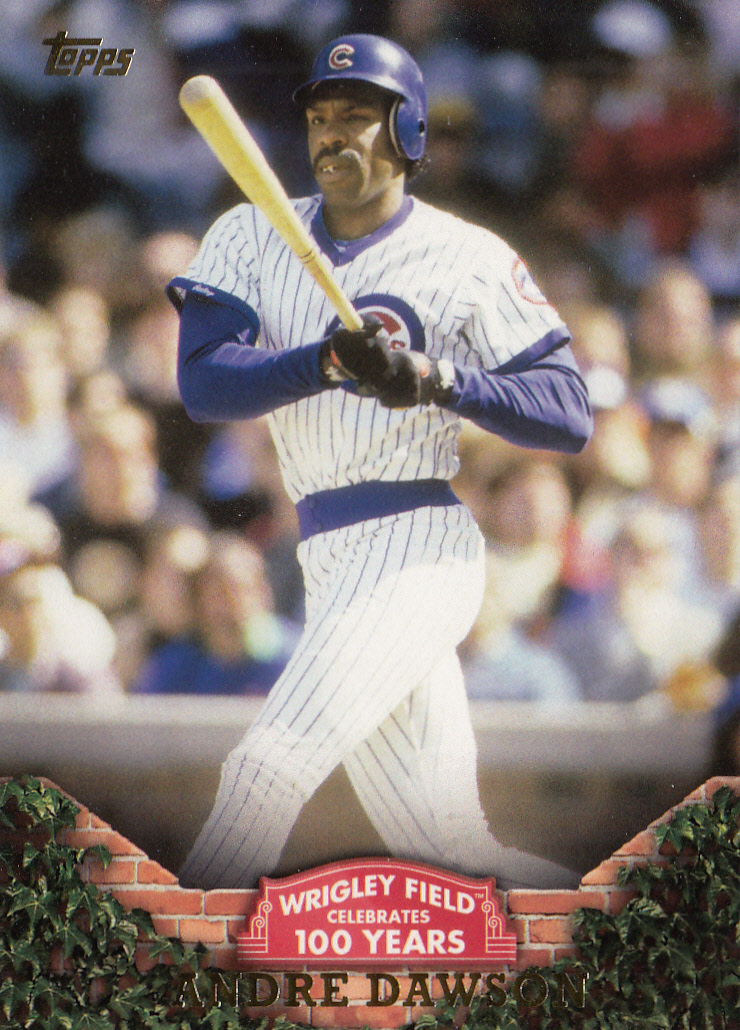 |
| 2016 Topps 100 Years at Wrigley Field #WRIG-11 Andre Dawson |
This was totally unintentional, but somehow I ended up with a bunch of cards from NL Central teams. Well, of course there was no Central division during Clemente's days, nor Andre Dawson's Cubs tenure for that matter. But it was an odd coincidence.
This new-to-me insert set from 2016 Topps documents 100 years at Wrigley Field, which isn't entirely correct. The Cubs started playing there in 1916, yes, but the ballpark itself opened two years prior as the home park of the Chicago Whales of the ill-fated Federal League.
Andre Dawson's time at Clark & Addison included an NL MVP award in 1987, which this card points out is the only MVP ever given to a player on a last-place team.
That particular fact reminds me of a story concerning Ralph Kiner, who led the NL in home runs in 1952 despite being on the dismal 42-112 Pirates. Apocryphally, he was told by Pirates management during contract negotiations, "We could have finished last without you."
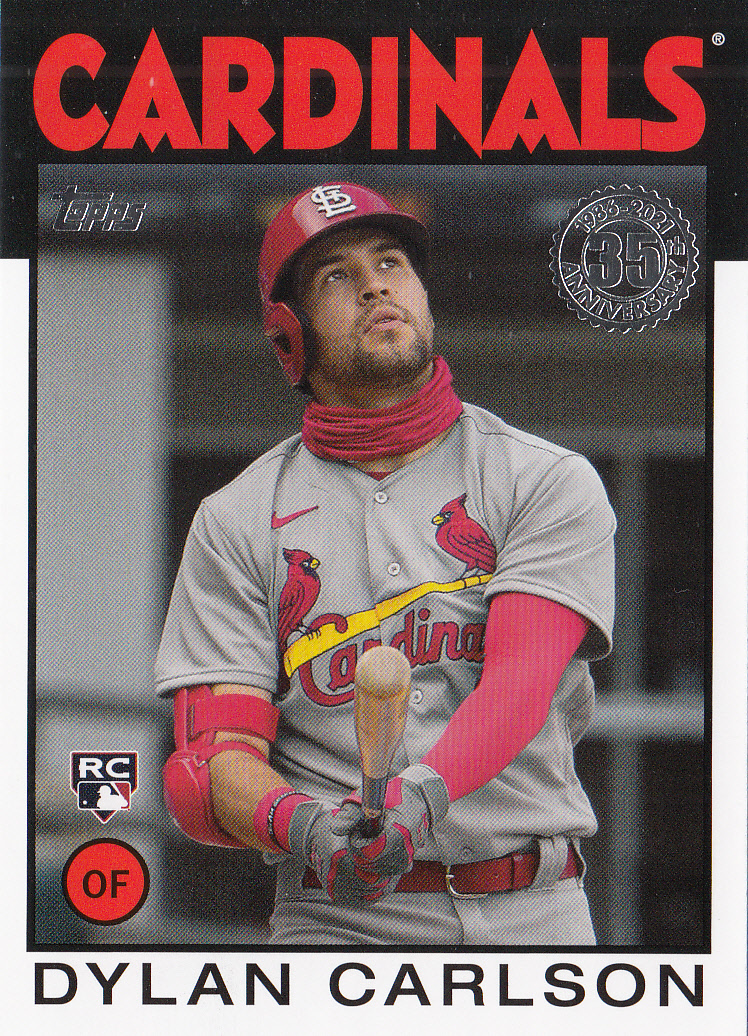 |
| 2021 Topps '86 Topps #86B-83 Dylan Carlson |
In the spirit of anniversaries, Topps kept their 35th Anniversary series going in 2021, affixing the special silver seal to the 1986 design. Also gracing the design is the Rookie Card logo for Cardinals outfielder Dylan Carlson, who is seeing quite a show being put on by his teammates this season.
The old veterans Pujols, Molina, and Wainwright are still making the highlight reels, Arenado is flashing the leather as usual, and there's talk of Paul Goldschmidt winning the Triple Crown, something that hasn't been done in the NL since his long ago Cardinal predecessor Joe Medwick won it in 1937.
 |
| 1996 Stadium Club #299 Fernando Viña |
1996 Stadium Club was one of the last sets I collected before I somewhat lost interest in baseball cards for a time, but I do recognize it well since little else went in front of it in the binders for several years. I'm still keeping the run of NL Central teams going, although 1996 puts us before Interleague Play began, and that catcher looks like a Texas Ranger to me, involved in an awkward play at the plate with Fernando Viña of the Brewers.
That would be explained by the fact that the Milwaukee Brewers were a member of the American League until switching leagues in 1998 to even things out with the Diamondbacks and Devil Rays expansion.
Now that we finally have the Designated Hitter in the NL, the split between leagues is effectively meaningless. That new reality has led MLB to design a less divisional-heavy schedule for 2023, where all 30 teams will face each other for at least one series next season. I'll finally get to cross the Minnesota Twins off my list, the last team I haven't seen play.
Anyway, upon a closer look at this Stadium Club card, it actually looks more like a fight than a play at the plate. Viña appears to have his right hand formed into a fist, although I can't comment on the wisdom of getting into a fistfight with a player wearing a catcher's mask.
That catcher, by the way, is likely the Hall of Famer Iván "Pudge" Rodríguez, who is wearing a commemorative 1995 All-Star patch on his right sleeve. The Rangers showed off their year-old ballpark to the world then, although it was short-lived. It only opened in 1994, but the team has already replaced it with a Texas-sized enclosed stadium just across the street, which was the neutral "bubble" site of the World Series in 2020.
 |
| 1994 Pinnacle Museum Collection #481 Tim Pugh /6500 |
Even when I'm picking images off a screen (and knowing how poorly most of our scanners do with shiny cards), I can recognize a shiny parallel when I see one, especially when it has this nifty Dufex technology that was exclusive to Pinnacle/Score at the time.
It's not serial numbered, but these Museum Collection parallels (not to be confused with the hyper-expensive Topps product of the same name) are known to have a print run of 6,500. There's also an Artist's Proof parallel that is even scarcer at just 1,000. Those print run ratios are approximately reflected in my collection. I have a single Artist's Proof, and this Tim Pugh card is my seventh Museum Collection. Unsurprisingly, five of those are Rockies, but somehow I've also ended up with two Cincinnati Reds and nothing else.
 |
| 1999 Stadium Club Video Replay #VR2 Sammy Sosa |
That covers all the NL Central teams, but we still have more to go in that division before we head further west.
When I selected this Stadium Club insert, I may or may not have realized that it was a lenticular motion card. But in any case, it's pretty cool. It's part of a tiny five-card insert set (40% Cubs by the way) called Video Replay, and it shows the motion of Sammy Sosa launching a baseball far into the distance. It's not quite as sharp as those Screenplays cards, which are nothing short of magic, but it's definitely an improvement over Sportflics.
The video, such as it is, shows Sosa facing off a right-handed pitcher wearing #42, which should narrow down the number of possible plays considerably, but I came up empty. I investigated the rabbit hole for longer than I probably should have, but Sosa hit 609 career home runs, so it's like looking for a needle in a haystack.
This card is from 1999, so I assume this is a video capture from 1998, and fewer and fewer players wore #42 after MLB retired it in 1997. José Lima is a candidate, and he served up numerous long balls to Slammin' Sammy throughout his career (more than any other pitcher besides Schilling, in fact), but that pitcher is clearly not José Lima. Nor is it Scott Karl, who is a lefty. My best guess was Jason Schmidt of the Pirates. Schmidt did give up a home run to Sosa during the 1998 home run race, but by then Schmidt had changed his uniform to #22.
Maybe just a random fly ball from a prior season? It sure looks like a home run even in this low-res format, though. Possibly Spring Training? I don't know. Like I said, I investigated the rabbit hole. I don't like not knowing these things.
 |
| 2021 Topps Fire #121 Nolan Arenado |
Our last NL Central card is this Topps Fire card of Nolan Arenado, post-trade of course. You can tell because of that fire engine red jersey and helmet, which the Rockies don't wear.
I do have this card in the Bunt app, but the printed version has a proper card back. That card back tells us how Arenado rapidly made a splash with the Cardinals, hitting safely in his first nine games. That did one better than Roger Maris, who set the prior record in 1967.
Really, he's one of my all-time favorite players. It's just no fun seeing him on another team.
 |
| 2019 Panini Titan #22 Nolan Arenado |
But it's also not so fun anymore seeing cards of him on his original team, because we all know how that played out.
At least I have a space theme on this shiny Panini card to take the sting away a little. The set is called Titan, and it's a 25-card insert set found in 2019 Panini Chronicles. I can't tell you much else about this unlicensed set, but the card back does tell us that Arenado is "a titan straddling the hitting and fielding worlds".
I can tell you lots more about the space theme, though. That's supposed to be Saturn in the background, and Titan just so happens to be the largest moon of Saturn, as well as the second-largest moon in the solar system. It has a thick atmosphere of methane, and the Huygens space probe landed on it in 2005.
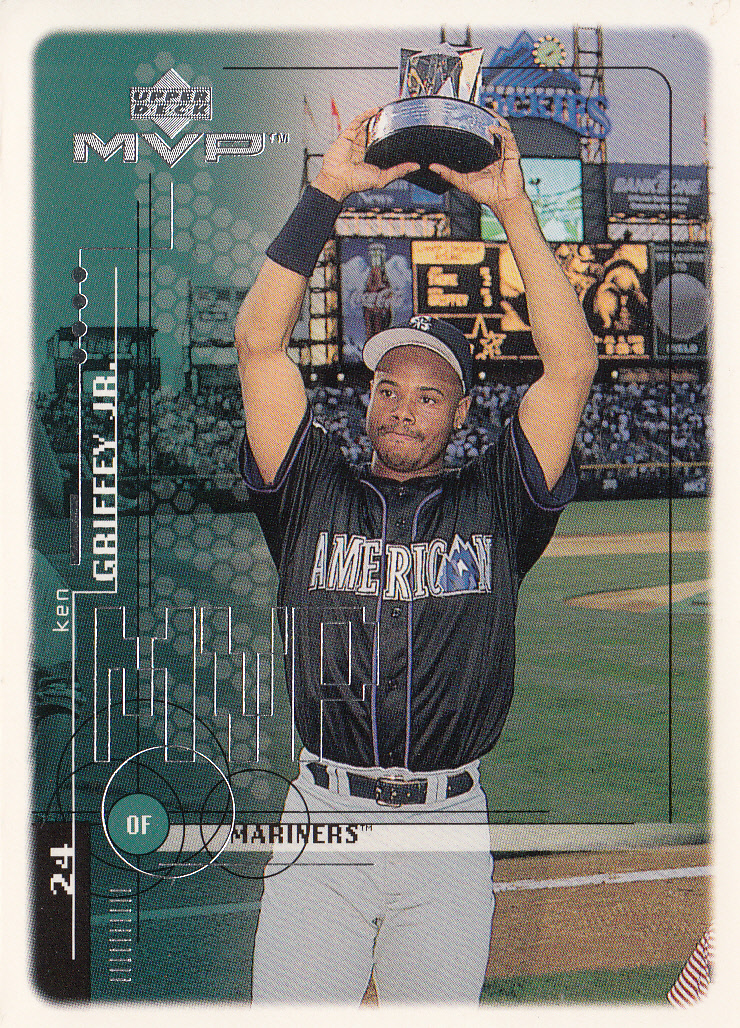 |
| 1999 Upper Deck MVP #190 Ken Griffey Jr. |
It's rumored that some of the baseballs from the 1998 Home Run Derby even landed on Titan.
But seriously, Ken Griffey, Jr. did win the 1998 Derby at Coors Field, and he's pictured lifting the trophy on his 1999 Upper Deck MVP base card. This is a perfect candidate for my Coors Field frankenset, and one that I've had my eye on for some time.
I didn't get a chance to experience the All-Star festivities in 1998 (although I do remember a blimp hanging around town for the occasion), but I made the most of it when the All-Stars returned to Denver in 2021. The Home Run Derby trophy has changed a bit since '98, as has the Coors Field scoreboard and several of the corporations with ad space on it.
 |
| 1992 Classic/Best #383 Bob Abreu |
I don't usually go for Minor League or Bowman Prospect cards, but this 1992 Classic/Best set is one I've collected for a while. Surely they're not worth much, but I have early minor league cards of guys that went on to become huge stars or even Hall of Famers. Jim Edmonds, Shawn Green, Mike Piazza, Johnny Damon, and quite a few others. I can now add Bobby Abreu to the back pages of my 1992 binder, which is one I don't get a chance to see often enough.
This is more of a tenuous connection to the Rockies, but the Asheville Tourists were the Single-A affiliate of the Rockies until 2020. Prior to that, they were part of the Houston Astros' farm system, and following some shuffling among Rockies affiliates, they're back with the Astros again.
 |
| 2008 Upper Deck Timeline #35 Roy Halladay |
The final card I picked from Nick's giveaway is another color-coded Upper Deck beauty, Roy Halladay's card from the short-lived UD Timeline. To be fair, pretty much everything Upper Deck was printing at that time was short-lived, even the fantastic UD Masterpieces set.
Roy Halladay in particular caught my eye because he was from my home state of Colorado. He went to high school at Arvada West, quite near me and not far at all from a few good birdwatching sites. The Athletic ran a story a couple years ago about his high school championship game, where he faced off against Brad Lidge's Cherry Creek High School team.
It's sad to talk about him in the past tense. But he was excellent all throughout his career, and as people all over Colorado know, long before he got to the Majors.
Congratulations to Nick on his first decade of blogging, and by now we know his second decade is already off to a solid start.


