Showing posts with label Cal Ripken. Show all posts

Saturday, August 27, 2022

The Trading Post #172: Dime Boxes (Part 1: My Picks)

As August draws to a close, we're getting pretty close to Nick's 11th Anniversary. But it's finally time for me to put my entry in for "latest blog post documenting Nick's 10th Anniversary".

Starting in December of last year, Nick at Dime Boxes did a series of generous giveaway posts for the first full decade of his excellent blog. I managed to get claims put in on three or four of his ten giveaways, but more often than not they were pretty picked over by the time I saw the post. No matter, I'm sure they all went to great homes across the blog community.

I ended up selecting a baker's dozen worth of cards from those pages, which arrived in the mail accompanied by a healthy-sized stack of Rockies hand-selected by Nick. That'll be part 2.
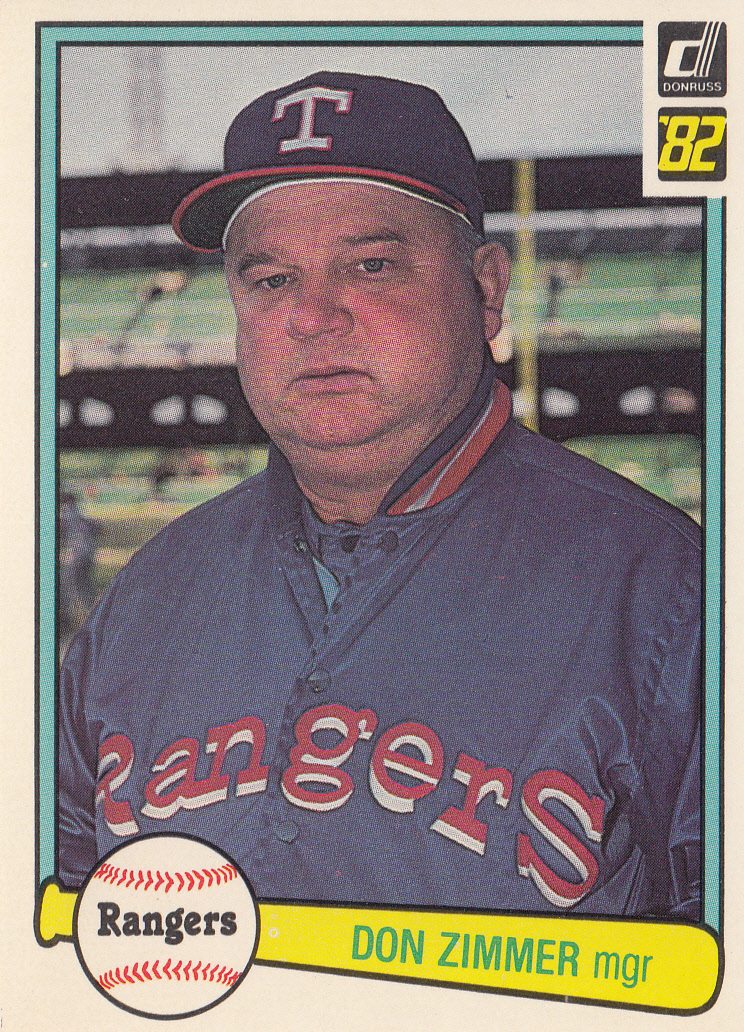
1982 Donruss #195 Don Zimmer MG

These cards won't be in chronological order, but we'll still be starting with the oldest card in the stack, one from 1982 Donruss. That was when Don Zimmer was managing the Texas Rangers. He actually wrapped up his playing career with that franchise, back when they were the second iteration of the Washington Senators. As their skipper, he had a 95-106 record. He had better results when he managed the Red Sox and Cubs, leading them both to winning records overall during his tenure.

As many times as I've seen the famous Bucky Dent home run from 1978, I never realized Don Zimmer was the manager of that unfortunate Red Sox team. But Donruss pointed it out on a lengthy write-up on the back, a wordy paragraph approaching what we once saw from Score.

Many of us remember Zimmer as Joe Torre's right-hand man during the late-'90s Yankees dynasty, and we got a little footage of him in ESPN's recent Derek Jeter miniseries The Captain. But not many remember him as a coach for the inaugural Colorado Rockies, where he appeared alongside manager Don Baylor in those early days at Mile High Stadium and Coors Field.

2015 Topps Archives #24 Cal Ripken Jr.

Rolling things back to very early in the Topps design library, here's a young-looking Cal Ripken, Jr. in 2015 Topps Archives, appearing on the 1957 design. I'll admit, I had to look that one up. Vintage, especially the more plain-looking designs, isn't always my strong suit. But 1992 vs. 1993 Fleer Ultra? I'm your guy.

We get partial career stats for Mr. Ripken on the card back, which has that not-quite-actual-cardboard smooth paper that Topps Archives is known for. The stats show his playing career between 1981 and 1996, but the final few seasons of his storied career are nowhere to be found, except of course in the overall totals. He played 3,001 career games, good for 10th all-time, although he was passed by Albert Pujols earlier this year, who is still going strong and trying to reach that 700 home run plateau before his inevitable retirement.

2016 Topps Bunt #24 Roberto Clemente

When Topps Bunt moved out of the digital app universe and took corporeal form in 2016, it included a mixture of current and retired players. I have about three pages of this set in my 2016 binder, and this Roberto Clemente will complement those other players nicely.

There's a little line on the card back suggesting that I "Collect and trade this card in the Topps Bunt app today!" Unfortunately, I only have this physical version of the Clemente card, and they've long since reached "Sold Out" status in the app. But by searching the app for the "Bunt Physical 16" set, I did discover that I still have a handful of digital cards of this set hiding in a dark virtual shoebox, including a Topaz parallel version of Brooks Robinson's digital card, with a global card count (effectively a serial number) of 440 and Rare classification.

The more traditional portion of the card back makes reference to Clemente's "electrifying defense in right field", and if you haven't seen that before, there are a few brief clips in this video.
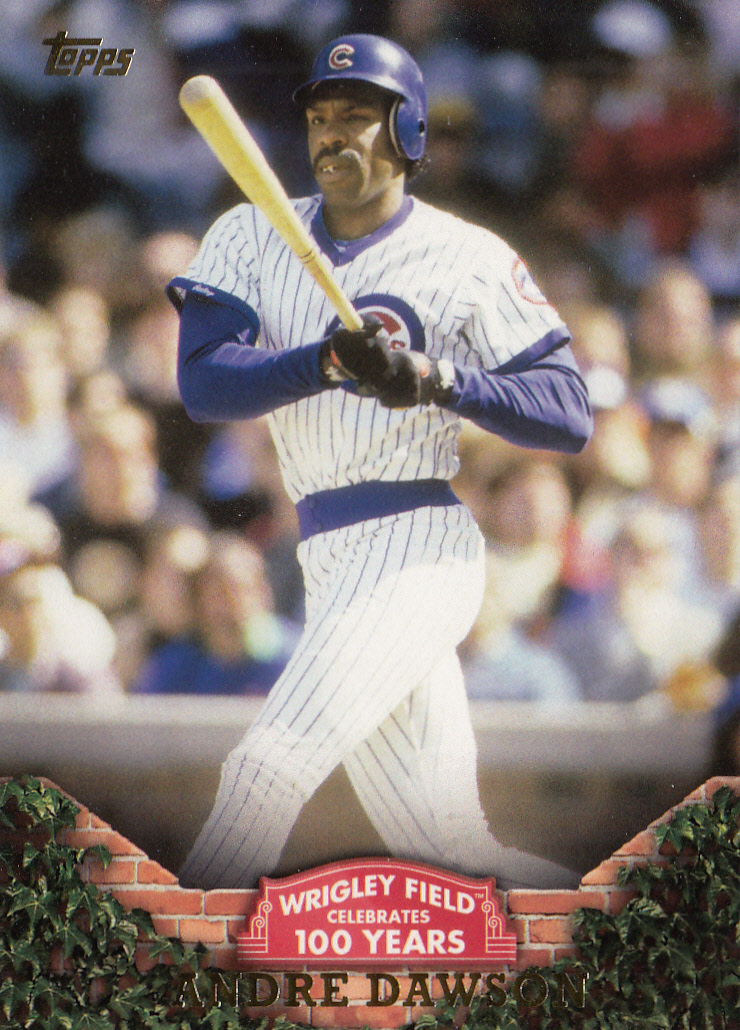
2016 Topps 100 Years at Wrigley Field #WRIG-11 Andre Dawson

This was totally unintentional, but somehow I ended up with a bunch of cards from NL Central teams. Well, of course there was no Central division during Clemente's days, nor Andre Dawson's Cubs tenure for that matter. But it was an odd coincidence.

This new-to-me insert set from 2016 Topps documents 100 years at Wrigley Field, which isn't entirely correct. The Cubs started playing there in 1916, yes, but the ballpark itself opened two years prior as the home park of the Chicago Whales of the ill-fated Federal League. 

Andre Dawson's time at Clark & Addison included an NL MVP award in 1987, which this card points out is the only MVP ever given to a player on a last-place team.

That particular fact reminds me of a story concerning Ralph Kiner, who led the NL in home runs in 1952 despite being on the dismal 42-112 Pirates. Apocryphally, he was told by Pirates management during contract negotiations, "We could have finished last without you."
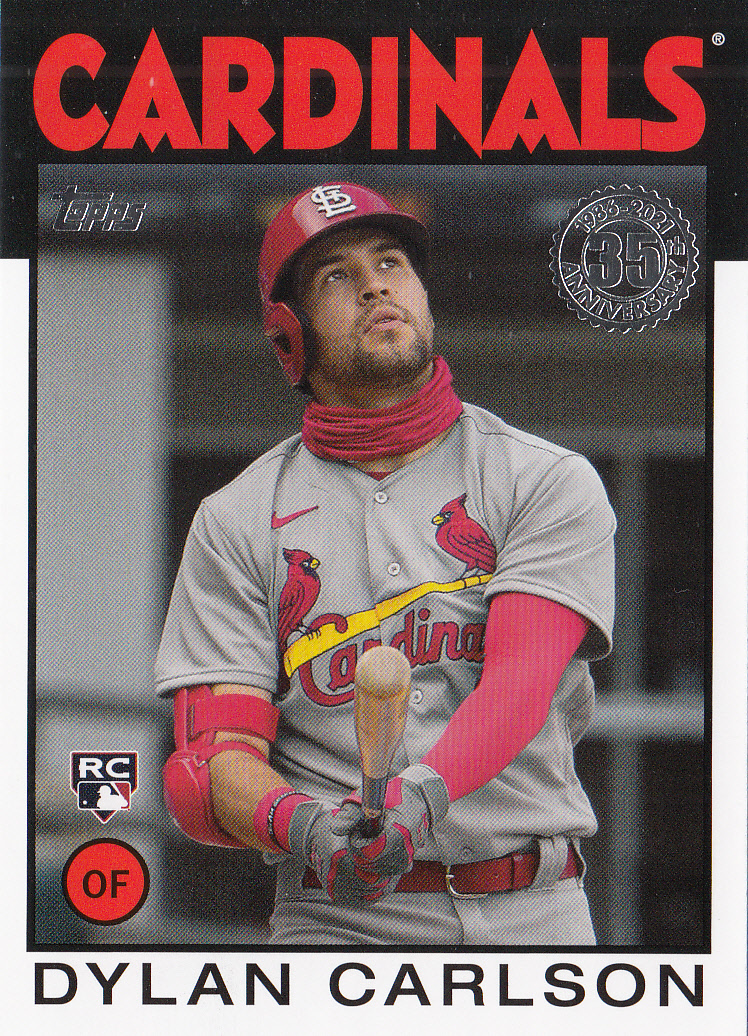
2021 Topps '86 Topps #86B-83 Dylan Carlson

In the spirit of anniversaries, Topps kept their 35th Anniversary series going in 2021, affixing the special silver seal to the 1986 design. Also gracing the design is the Rookie Card logo for Cardinals outfielder Dylan Carlson, who is seeing quite a show being put on by his teammates this season. 

The old veterans Pujols, Molina, and Wainwright are still making the highlight reels, Arenado is flashing the leather as usual, and there's talk of Paul Goldschmidt winning the Triple Crown, something that hasn't been done in the NL since his long ago Cardinal predecessor Joe Medwick won it in 1937.

1996 Stadium Club #299 Fernando Viña

1996 Stadium Club was one of the last sets I collected before I somewhat lost interest in baseball cards for a time, but I do recognize it well since little else went in front of it in the binders for several years. I'm still keeping the run of NL Central teams going, although 1996 puts us before Interleague Play began, and that catcher looks like a Texas Ranger to me, involved in an awkward play at the plate with Fernando Viña of the Brewers.

That would be explained by the fact that the Milwaukee Brewers were a member of the American League until switching leagues in 1998 to even things out with the Diamondbacks and Devil Rays expansion. 

Now that we finally have the Designated Hitter in the NL, the split between leagues is effectively meaningless. That new reality has led MLB to design a less divisional-heavy schedule for 2023, where all 30 teams will face each other for at least one series next season. I'll finally get to cross the Minnesota Twins off my list, the last team I haven't seen play.

Anyway, upon a closer look at this Stadium Club card, it actually looks more like a fight than a play at the plate. Viña appears to have his right hand formed into a fist, although I can't comment on the wisdom of getting into a fistfight with a player wearing a catcher's mask.

That catcher, by the way, is likely the Hall of Famer Iván "Pudge" Rodríguez, who is wearing a commemorative 1995 All-Star patch on his right sleeve. The Rangers showed off their year-old ballpark to the world then, although it was short-lived. It only opened in 1994, but the team has already replaced it with a Texas-sized enclosed stadium just across the street, which was the neutral "bubble" site of the World Series in 2020.

1994 Pinnacle Museum Collection #481 Tim Pugh /6500

Even when I'm picking images off a screen (and knowing how poorly most of our scanners do with shiny cards), I can recognize a shiny parallel when I see one, especially when it has this nifty Dufex technology that was exclusive to Pinnacle/Score at the time.

It's not serial numbered, but these Museum Collection parallels (not to be confused with the hyper-expensive Topps product of the same name) are known to have a print run of 6,500. There's also an Artist's Proof parallel that is even scarcer at just 1,000. Those print run ratios are approximately reflected in my collection. I have a single Artist's Proof, and this Tim Pugh card is my seventh Museum Collection. Unsurprisingly, five of those are Rockies, but somehow I've also ended up with two Cincinnati Reds and nothing else.

1999 Stadium Club Video Replay #VR2 Sammy Sosa

That covers all the NL Central teams, but we still have more to go in that division before we head further west.

When I selected this Stadium Club insert, I may or may not have realized that it was a lenticular motion card. But in any case, it's pretty cool. It's part of a tiny five-card insert set (40% Cubs by the way) called Video Replay, and it shows the motion of Sammy Sosa launching a baseball far into the distance. It's not quite as sharp as those Screenplays cards, which are nothing short of magic, but it's definitely an improvement over Sportflics. 

The video, such as it is, shows Sosa facing off a right-handed pitcher wearing #42, which should narrow down the number of possible plays considerably, but I came up empty. I investigated the rabbit hole for longer than I probably should have, but Sosa hit 609 career home runs, so it's like looking for a needle in a haystack. 

This card is from 1999, so I assume this is a video capture from 1998, and fewer and fewer players wore #42 after MLB retired it in 1997. José Lima is a candidate, and he served up numerous long balls to Slammin' Sammy throughout his career (more than any other pitcher besides Schilling, in fact), but that pitcher is clearly not José Lima. Nor is it Scott Karl, who is a lefty. My best guess was Jason Schmidt of the Pirates. Schmidt did give up a home run to Sosa during the 1998 home run race, but by then Schmidt had changed his uniform to #22. 

Maybe just a random fly ball from a prior season? It sure looks like a home run even in this low-res format, though. Possibly Spring Training? I don't know. Like I said, I investigated the rabbit hole. I don't like not knowing these things.

2021 Topps Fire #121 Nolan Arenado

Our last NL Central card is this Topps Fire card of Nolan Arenado, post-trade of course. You can tell because of that fire engine red jersey and helmet, which the Rockies don't wear.

I do have this card in the Bunt app, but the printed version has a proper card back. That card back tells us how Arenado rapidly made a splash with the Cardinals, hitting safely in his first nine games. That did one better than Roger Maris, who set the prior record in 1967.

Really, he's one of my all-time favorite players. It's just no fun seeing him on another team.

2019 Panini Titan #22 Nolan Arenado

But it's also not so fun anymore seeing cards of him on his original team, because we all know how that played out.

At least I have a space theme on this shiny Panini card to take the sting away a little. The set is called Titan, and it's a 25-card insert set found in 2019 Panini Chronicles. I can't tell you much else about this unlicensed set, but the card back does tell us that Arenado is "a titan straddling the hitting and fielding worlds".

I can tell you lots more about the space theme, though. That's supposed to be Saturn in the background, and Titan just so happens to be the largest moon of Saturn, as well as the second-largest moon in the solar system. It has a thick atmosphere of methane, and the Huygens space probe landed on it in 2005.
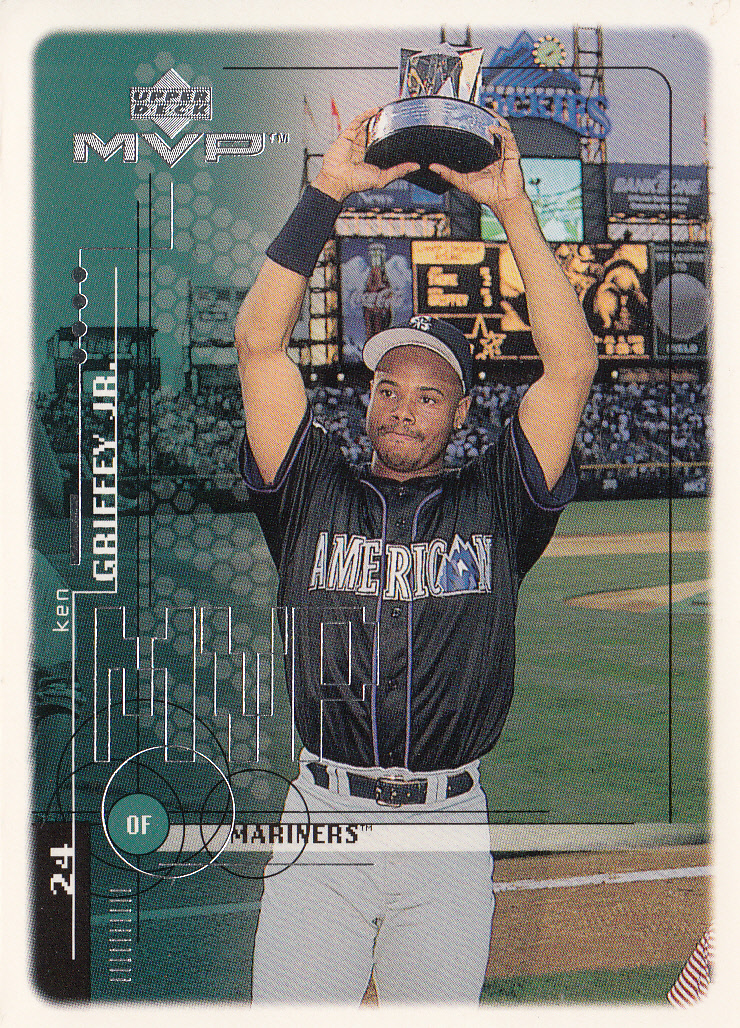
1999 Upper Deck MVP #190 Ken Griffey Jr.

It's rumored that some of the baseballs from the 1998 Home Run Derby even landed on Titan.

But seriously, Ken Griffey, Jr. did win the 1998 Derby at Coors Field, and he's pictured lifting the trophy on his 1999 Upper Deck MVP base card. This is a perfect candidate for my Coors Field frankenset, and one that I've had my eye on for some time.

I didn't get a chance to experience the All-Star festivities in 1998 (although I do remember a blimp hanging around town for the occasion), but I made the most of it when the All-Stars returned to Denver in 2021. The Home Run Derby trophy has changed a bit since '98, as has the Coors Field scoreboard and several of the corporations with ad space on it.

1992 Classic/Best #383 Bob Abreu

I don't usually go for Minor League or Bowman Prospect cards, but this 1992 Classic/Best set is one I've collected for a while. Surely they're not worth much, but I have early minor league cards of guys that went on to become huge stars or even Hall of Famers. Jim Edmonds, Shawn Green, Mike Piazza, Johnny Damon, and quite a few others. I can now add Bobby Abreu to the back pages of my 1992 binder, which is one I don't get a chance to see often enough.

This is more of a tenuous connection to the Rockies, but the Asheville Tourists were the Single-A affiliate of the Rockies until 2020. Prior to that, they were part of the Houston Astros' farm system, and following some shuffling among Rockies affiliates, they're back with the Astros again.

2008 Upper Deck Timeline #35 Roy Halladay

The final card I picked from Nick's giveaway is another color-coded Upper Deck beauty, Roy Halladay's card from the short-lived UD Timeline. To be fair, pretty much everything Upper Deck was printing at that time was short-lived, even the fantastic UD Masterpieces set.

Roy Halladay in particular caught my eye because he was from my home state of Colorado. He went to high school at Arvada West, quite near me and not far at all from a few good birdwatching sites. The Athletic ran a story a couple years ago about his high school championship game, where he faced off against Brad Lidge's Cherry Creek High School team. 

It's sad to talk about him in the past tense. But he was excellent all throughout his career, and as people all over Colorado know, long before he got to the Majors.

Congratulations to Nick on his first decade of blogging, and by now we know his second decade is already off to a solid start.


Sunday, August 15, 2021

Gold Medal Club (Part 2: Inserts)

I wouldn't have to split my posts up into multiple parts if Topps didn't pack their blasters so full of blog-worthy cards.

Or if I didn't find myself writing at least 1,500 words every time I put a stack of cards together.

Either way, Stadium Club kept me interested for another year with fun inserts, new and old.

2021 Stadium Club Greats #SCG-23 Roger Clemens

If you dig out your old 1991 Stadium Club box, you'll find a card of Roger Clemens that looks nearly identical to this. The photo on this Stadium Club Greats insert is the same as on the 1991 original. The only difference you'll find is gold foil instead of silver, although it's less likely to be centered quite as well. That was a common issue with early TSC, the foil not lining up all that well with the rest of the design elements. This is a sample size of one, but it appears that they've made great strides in that department over the past thirty years.

Thirty years, yes, that's how long it's been since Stadium Club first hit the shelves. It's been on-again off-again since then, but I continue to enjoy its renaissance.

This isn't a straight reprint, as the card back has an entirely new theme. Instead of the green back with the so-called BARS System and a little image of the player's first Topps card, we get a lengthy write-up of the Red Sox portion of Clemens's career. It mentions three Cy Young awards, four times he led the league in ERA, and his massive career strikeout total that has him in third place behind only Nolan Ryan and Randy Johnson. It skips over additional awards earned during rest of his career with the Blue Jays, Yankees, and Astros, and makes no mention of his lengthy campaign to get into the Hall of Fame.

2021 Stadium Club Virtual Reality #VR-7 Ronald Acuña Jr.

For the 1995 set, Topps debuted a partial parallel set called Virtual Reality. It attempted to project the final full-season stats for 1994, which was cut short by the infamous strike. Sadly, the current state of the world gave Topps an opportunity to trot this theme out one more time, although that's one aspect of Stadium Club I would have preferred to never see again.

According to the Topps prognosticator, if the 2020 season hadn't been pandemic-shortened, Acuña would have finished with 124 runs scored, 38 homers, and a .250 average. His actual numbers during the 60-game season were 46 runs, 14 homers, and still a .250 average.

By running a bit of math, it appears that Topps really didn't forecast anything beyond multiplying his actual stats by 2.7, which is simply the rate of how much longer a full season would have been than the shortened season. There was no factoring in a hot spring, a late-season surge, a midsummer slump, or the actual difficulty of schedule the Braves would have faced if they played the rest of the divisions. It's an interesting exercise, but take these numbers with a grain of salt.

1995 Stadium Club Virtual Reality #94 Joe Girardi

The 1995 Virtual Reality set didn't take things quite so linearly. In looking at the back of Joe Girardi's '95 VR card, Topps had some faith that Girardi would bump up his average with a "late-season rush", and would put together a nice four-game hitting streak in an alternate-universe Labor Day weekend of September 1994. Which, as we know, is quite typical of how Rockies seasons go.

They also thought Barry Bonds would tie Roger Maris's single-season home run record of 61. Clearly they put some thought into this project back in the mid-'90s rather than just put =[cell]*2.7 into a spreadsheet and filled down.

2021 Stadium Club Sepia #43 Evan White (RC)

My haul of colored parallels was right in line with stated pack odds. I felt like I got a nice mixture of what was on offer, starting with Evan White's rookie card in Sepia form. The young first baseman already has a Gold Glove to his name, but his promising career is on hold for right now while he recovers from hip surgery.

2021 Stadium Club Black Foil #183 Joc Pederson

Back to the world of full color, here's Joc Pederson pictured (very briefly) as a Chicago Cub. Pederson only spent the first half of the 2021 season in the Windy City before becoming an early casualty of the Cubs rebuilding program. He was traded to the Braves in mid-July, shortly before most of his more well-known teammates were sent elsewhere.

The first game Pederson played as a Brave was against the Tampa Bay Rays, but that was a home game. He never played the Rays as a Cub, so I'd guess that this shot of him with a Mike Zunino cameo was actually taken during the 2020 World Series when he was still a Dodger, then given the Photoshop treatment.

This card is one of the Black Foil parallels, which is somehow even less shiny than you'd expect.

2021 Stadium Club Red Foil #38 Cal Ripken. Jr.

The Red Foil is much more striking, and is reminiscent of early Stadium Club sets like 1994. Of course, both Cal Ripken, Jr. and cameo player Wade Boggs were in that set, and between the two, we're looking at two Hall of Fame plaques, thirty-one All-Star appearances, sixteen Silver Sluggers, and more. Add to that a Rookie of the Year award for Boggs, and two MVP awards for Ripken, which is mentioned on the card back.

2021 Stadium Club Red Foil #77 Jesús Sánchez (RC)

Jesús Sánchez is clearly amazed by those accolades.

2021 Stadium Club Autographs #SCBA-JM Julian Merryweather (AU) (RC)

I was lucky enough to pull an autograph in this blaster, an on-card signature of Toronto Blue Jays rookie Julian Merryweather. He's appeared in twelve Big League games thus far, but has been recovering from an oblique strain for most of this year. When he does return, he'll pitch in Toronto for the first time. His home games thus far have only been played at his team's temporary homes in Buffalo and Dunedin, FL.

He's on the older side for a rookie, as he'll be turning 30 in just a couple months.

2021 Stadium Club Oversized Master Photos #OBPDG Deivi García

Concluding this 2021 Stadium Club blaster is the first card I found in it, the Master Photo box topper. It has unusual dimensions of 3 3/8" x 3 3/4", and is significantly smaller than past Master Photos I've seen from older Stadium Club sets. Compared to that, I'm unsure what makes this "Oversized".

I don't know much about Deivi García, who is probably the least well-known name in the entire collection of Master Photos, but it is nice to see an unfamiliar player on the 1993 Stadium Club design. There isn't much to be found on the back. It's mostly white like an old photo print. One of the corners is a little dinged, and there's also a little damage on the back of Sánchez's card. I escaped the worst of it, but I definitely heard some tales of woe regarding quality control of this beautiful set. I'm sure this not-quite-square thing would have gotten damaged eventually wherever I found a place to store it, but it's concerning.

I'm continuing to keep an eye on Target's website for Topps product, and it's actually somewhat consistently available. You have to be quick, but not as quick as when flippers were running rampant in the card aisle. They have A&G, Gypsy Queen, and Series 2 blasters available as I write this, so act fast if you want some!

And keep your fingers crossed for good quality control.


Saturday, September 21, 2019

The Trading Post #133: Chavez Ravining

Relatively speaking, Alex Markle at Chavez Ravining and I have been trading a lot this year. There have only been a small handful of swaps, but compared to my general level of activity in the hobby and in the Cardsphere this year, it's been a furious pace.

Luck smiled upon me earlier this year, and I won a contest on his blog. We'll get to that later on, but Alex also happens to know that I like green cards. I like green in general, and my next iPhone purchase is likely to be in that color. And what better team to lead off with than that most green of teams, the Oakland Athletics?

2019 Topps '84 Topps Silver Pack Chrome #T84-22 Rickey Henderson
Rickey Henderson played for a ton of teams during his long career, but mostly with Oakland. The inset photo of Rickey on this shiny 1984 design looks like about the right vintage to match the design, but the main photo is that famous 1991 shot of Henderson, when he broke the all-time stolen base record by swiping third and triumphantly lifting it towards the sky.

That photo graced numerous cards throughout the hobby in 1992. I hadn't seen it for a while, so thanks to Topps for digging it out of the archives for another one of their Silver Pack releases. Anyone who has run across a Silver Pack card before will recognize the background refractor pattern.

It doesn't stand out, but sharp-eyed readers will notice a small "35th Anniversary" seal in the upper right. Yes, 2019 marks the 35th anniversary of the 1984 set, which also happens to be my birth year. Along with nearly everyone else my age, it took until 1987 for me to discover card collecting, but Topps missed no opportunity to commemorate an anniversary, and they also mentioned Don Mattingly's rookie card from that set.

2012 Topps Triple Threads Unity Relics Emerald #TTUR-58 Matt Kemp /18 (MEM)
It's fine to call something "green" when it's a normal thing like a Silver Pack card or an iPhone. But when you get into the rarefied air of Triple Threads, throw in a relic, and stamp an /18 serial number, suddenly you find yourself using the term "Emerald".

Speaking of anniversaries, Dodger Stadium opened in 1962, and in 2012, the Dodgers wore a commemorative patch to mark the 50th anniversary. It's rather blurry, but we can see that on Matt Kemp's right sleeve. Of course, the main event is that Dodger Blue relic, outlined in a nearly-accurate home plate shape. Above that, we see that Kemp earned an NL Player of the Week award in mid-April 2012, his third straight time winning that award, dating back to September 2011.

Now, the Rockies often play the Dodgers around the ends and beginnings of seasons. Of course, they're divisional, so they're kind of always playing the Dodgers, including this very weekend. But I checked the game logs, and the Rockies didn't suffer this particular flurry of offense by Matt Kemp. The Padres were not so lucky, though.

2019 Bowman Prospects Camo #BP-143 Brendan Rodgers
While we're still on the topic of green, I will point out that the green-backed 1991 Bowman set is one of very, very few Bowman sets I can correctly pick out out at a glance, and 1989 is only on that list because of its universally-hated non-standard size. Despite the frequent complaint of unmemorable designs, the brand is still going strong in 2019, colored parallels and all. This one of young Rockie Brendan Rodgers is the Camo parallel, the only colored border in the 2019 Bowman Prospects set that doesn't involve a serial number.

The middle infielder got his first look at the big leagues this year, but only appeared in 25 games before needing season-ending shoulder surgery. He has yet to hit his first big-league home run, but did smash a couple extra-base hits before adding his lot to the disappointing season the Rockies had.

On the card back, the "Up Close" section keeps the spirit of Studio alive, telling us that Rodgers is a video game streamer and has a bulldog named Pudge.

2019 Bowman Prospects #BP-145 Roberto Ramos
Roberto Ramos, appearing on the standard-issue Bowman border, has yet to debut in the MLB. Under the old roster rules, we'd probably have seen him in a September call-up by now, but that will have to wait. He hit 30 home runs and hit .309 in Triple-A this year, so it's surely only a matter of time.

I had a pretty good handle on the Rockies' farm system for a while, but they called most of them up this year, leaving behind players I haven't heard of such as Roberto Ramos. He will have to change that uniform number when he makes it, as it's currently worn by starting pitcher Chi Chi Gonzalez, who recently earned his first win since 2015.

2019 Bowman #22 Nolan Arenado
Nolan Arenado cards keep showing up around here, and that's fine with me. He remains my favorite active player, and even if the Rockies are getting blown out, you can count on him for a great defensive play or two anytime he's in the field. He's no slouch at the plate, either. The layer of dirt on his uniform is just a small piece of evidence about what a great player he is. If he keeps it up, he'll be in the company of some truly legendary players.

Which brings us to the main attraction, our contest winnings.

2016 Topps MLB Debut Medallion #MDM-CR Cal Ripken Jr.
And what a beautiful card it is. I've seen manufactured patches from time to time, and even sold one to my favorite dealer at a card show, but these medallions are pretty cool. It's about as thick as cards come, and it features one of my favorite retired stars, Cal Ripken, Jr.

Every Hall-of-Famer, even the Ironman with 2,632 consecutive games played, had to debut sometime. For Ripken, that day was August 10th, 1981. Incidentally, that's not when The Streak began. He wouldn't become an everyday starter until May of 1982, finally deciding to end the streak on his own terms in September, 1998.

When I started sixth grade, one of our regular weekly projects was to cut a current event out of the newspaper and bring it in to class. I was just getting my bearings in middle school, but I clearly remember three or four of my classmates presenting stories of Cal Ripken, Jr. breaking Lou Gehrig's record of consecutive games played. It was in early September, 1995, and I was glad to see that at least a few new kids I shared a classroom with were interested in baseball. I also remember my teacher correcting everyone's pronunciation of Mike Deveraux's surname, which is not "Dever-ox".

Thank you, Alex, for running this contest and giving me a trip down memory lane with one of my favorite all-time players!

Sunday, December 25, 2016

The Trading Post #84: Jaybarkerfan's Junk

Anytime you see a package on its way to you from Hazel Green, Ala., you know that some goodies are on their way from Jaybarkerfan's Junk. The creator of the #Supertraders group made sure that all his readers were able to get in on some holiday trading action. He ran what he called a Trade-a-Thon in November, offering each reader the chance to claim up to five cards throughout the two-week process. I claimed four, and even with the bonus pack he threw in, this will be a rare post without any Rockies.

2008 UD Masterpieces #5 Max Scherzer (RC)
Upper Deck Masterpieces is an absolutely beautiful set. 2008 was the second of only two years that UD printed this product. Even with short prints, it's only a 120-card checklist, but they did an absolutely terrific job selecting players for the set. Max Scherzer, who had no Major League experience when this card was printed, has gone on to win two Cy Young Awards, and he threw two no-hitters in 2015. The first of those was only a pitch away from being a perfect game, but one pitch got a little bit away from him, Jose Tabata leaned into it, and Scherzer had to settle for a no-hitter.

It's a heck of a card to get your Rookie Card logo on. Upper Deck couldn't know how dominant he would become, and we've all seen our share of busted prospects, but things worked out really well for this card, and more importantly, for Max Scherzer.

2010 Bowman Prospects Black #BP1 Stephen Strasburg
Scherzer spent the majority of his career so far in Detroit, but now shares the rotation with Stephen Strasburg on the Washington Nationals. Strasburg was the most hyped pitching prospect in recent memory, drawing comparisons to Mark Fidrych. Watching his debut back in 2010 was quite impressive, as he struck out fourteen Pirates in his first-ever start. Unfortunately, he needed Tommy John surgery shortly after that, but he's settled into a groove in the Nats' pitching staff. The Nationals have had a pretty terrifying rotation ever since his debut, fielding guys like Gio Gonzalez, Doug Fister, Jordan Zimmerman, etc....

Of course, this card itself has quite the story behind it. Strasburg mania was in full force in late spring 2010, and there was finally a Bowman gold mine out there. They print cards of virtually every young prospect out there, many of whom never make it to the Majors. But Strasburg's First Bowman Card was the rare item that briefly brought baseball cards back into the national spotlight. His /1 Superfractor parallel of this Bowman card was found in 2010, and promptly spiraled to a five-figure sale price on eBay. Just months later, it changed hands again for $25k. The national media didn't miss that story, and I'm sure that millions of Americans that hadn't paid attention to the hobby for years or even decades got a crash course in the existence of parallels, printing plates, and /1 products.

The above is a parallel itself, the black-bordered variety. Bowman's base Prospect set that year actually used a white border, saving the black borders for a parallel set.

So while I don't have the Superfractor that's worth as much as a new car, I am able to add a parallel to my collection that reminds me of the Strasburg Fever that gripped the nation in 2010.

2004 Fleer InScribed #80 Tom Seaver RET /1000
Fleer made a lot of sets in their final few years of existence. I thought I had seen most of them, but this Inscribed set is new to my eyes. 2004 was the only year of this set, but it's pretty striking. The thick black border has a matte finish with some silver foil (including that serial number). The background of the photo is also matte, but the player's image itself is glossy. It's a minimalist design, and all the right elements catch the light, while others fade into the background. The "Inscribed" logo at the top isn't my favorite, but I'd be interested in finding more of these.

Only the ten retired players in this set got the /1000 serial number, and all ten of those are Hall of Famers. There were also fifteen rookies rounding out the main set at a print run of /750, containing a few recognizable names like Matt Holliday, Yadier Molina, and Kevin Youkilis.

Seaver had a long, Hall-of-Fame worthy career, but this card only had room for five seasons. Fleer featured his early time on the Mets for this card, giving us stats from 1969 through 1973. During that time, he led the league in strikeouts and ERA three times, somehow managing to miss out on the Cy Young Award for two of those seasons. During that same span, he appeared in two World Series, winning one, was an All-Star in each of those five seasons, and might have gotten into the Hall on those five seasons alone, not even counting the other fifteen seasons he pitched.

Not sure if Strasburg will join Seaver in the Hall of Fame, but I like Scherzer's chances.

1992 Triple Play Gallery #GS-11 Cal Ripken, Jr.
It wasn't all pitchers in this package. I have a soft spot for these early-1990s Donruss insert cards after they finally decided to evolve their design a bit. Cal Ripken, Jr. was definitely one of my favorite players when he was still active. I didn't get to see much of him at all, since it was pretty tough to see American League games back then, especially before Interleague Play. The All Star Game was usually the only time he'd make a TV appearance in my household. Cable, not to mention MLB.TV, has really changed things.

Of course, this card mentions his streak of consecutive games played, a record he'd break about three seasons later, toward the end of 1995. I remember being in sixth grade when that happened, and that many of my classmates chose the occasion to feature in their "Current Events" presentations to the class.

Ripken wasn't just known for his longevity, like Omar Vizquel or Jamie Moyer. He was darn talented out there, winning two MVP awards in his career, and making the All-Star team every year from 1983 until his retirement in 2001. He even hit a first-pitch homer in that 2001 All-Star Game in Seattle.

Not a bad way for one of my favorite all-time players to wrap up a legendary career.

1986 Sportflics #8 Cal Ripken, Jr.
My fellow Supertrader didn't stop there though. He even threw in an unopened pack of cards for his Trade-a-Thon participants, and I ended up with a pack of 1986 Sportflics. I bought some of the 1994 product, but I didn't really know this brand went back further than that. I might have a card or two from the 1990 set, but definitely none this old.

Of course, these never scan well, but the lenticular printing process on this card allows for one of three images to be visible, depending on how the card is tilted. A much younger Ripken, only several hundred games into his streak, gets one headshot and two action shots at the plate. I'm sure he sat a few late innings later in the streak, but at the time of printing, he hadn't sat a single inning in 603 games. That's nearly 5,500 straight innings!

There were a couple of miniature trivia cards in here, a little smaller than those World Series History lenticular insert cards from 1991 Score. On these, we learn that Ernie Banks holds the NL Record for most Grand Slams in a single season, with 5. Albert Pujols has since tied that NL mark, and a couple AL'ers even surpassed it with 6. Travis Hafner did it about a decade ago, as did Don Mattingly just a year after this was printed. The other Trivia card is about Mike Schmidt, then the active player with the most Gold Glove awards.

1986 Sportflics #179 1985 Gold Glove
I found this final card to be quite interesting, and I assumed that these Sportflics cards just displayed two images like they did in 1994, until I looked more closely. This is something like a League Leader card, but riffing off of the second trivia card, they picked six 1985 Gold Glovers to feature. The three photos on the top (Don Mattingly, George Brett, and Keith Hernandez) are posed shots, while the three on the bottom (Willie McGee, Ron Guidry, and Dale Murphy) are action photos. My scanner preferred to show Brett and Guidry, plus a ghostly inclusion of McGee's bat.

By the way, the presence of Dale Murphy makes this ever-so-slightly a Rockies post, as the two-time MVP signed as a free agent with the Rockies in 1993 and played 26 games for them before retiring.

Anyway, these six players all led a statistic in 1985, as well as an award for defensive excellence. Every position has a Gold Glove winner (sometimes co-winners), so there's no mention of thirteen other players, unlike what we might see on a more traditional League Leaders card.

Keith Hernandez led the NL in Game-Winning RBIs in 1985, a statistic that isn't tracked anymore. There was quite a bit of debate about whom to actually credit with a GW-RBI (the back of 1987 Topps went wild over this stat). A walkoff hit is easy enough to figure out, but when your team takes the lead by three in the 7th, for example, but ends up only winning by one, the GW-RBI went to the player that took the lead, not the player that padded the cushion enough.

To my mind, that sounds pretty much the same as how a winning pitcher is determined. All a team has to do is keep a lead to ensure a pitcher gets the win. It can be a cat-and-mouse game all night, but as long as the lower-scoring team doesn't at least tie it, the pitcher of record remains the same. I'm sure better statisticians than I can explain the nuances of why tracking Wins that way is fine, but GW-RBIs isn't. But I digress.

When the statistic existed, no one had more than Keith Hernandez, thanks in large part to his 1985 performance. And we definitely just went down a statistical rabbit hole there, but they're an integral part of baseball, now more than ever.

Just like trading is an integral part of card collecting.


Saturday, July 11, 2015

Road Trip!

Last week, my girlfriend and I took a road trip to visit some of her friends and family in Oklahoma, Texas, and Arkansas. What better week to do it than the week of July 4th (assuming you have air conditioning in your vehicle, of course)? Though my home state of Colorado is a hotbed for craft beers, we found that the microbrewery craze has infiltrated that region as well, as we came back with several six packs from the Dallas area.

While it was nice to get away and relax for a while, the hobby was still in the back of my mind. I was frequently glancing at the many roadside stores, curious if I might find a card shop nestled in one of those towns. As we were preparing to head out of Arkansas and back toward Oklahoma City, my vigilance was rewarded just outside Fayetteville.

1992 Bowman #611 Bill Swift (FOIL)
I spotted a small white sign as we were about to leave town. A few quick turns later, I walked through a windowless and unassuming white door. Inside, I found Cleve's Baseball Cards and Collectibles to be a well-stocked shop, and after wandering around for a few minutes, I asked for a box of baseball singles to dig through, affording me a #walletcard photo op.

A photo posted by AdamK (@adamk0310) on

Bill Swift's card above was the first one I picked out of that box, which more or less ended up being a quarter box, once we settled up. Gold foil from the early '90s draws me in no matter which state I'm in.

1994 Score Gold Rush #118 Willie Blair
I was surprised to find so many Rockies cards in a corner of Arkansas. Almost a quarter of the Score Gold Rush parallels I found were Rockies. The owner even had a flag on display from the 1998 All Star Game, the only year it's been in the Mile High City. Turns out, he is a Rockies fan, and he even owned a chain of record stores in the Denver area back in the '70s. Small world.

1999 Upper Deck 10th Anniversary Team #X5 Cal Ripken
I immediately recognized the 1989 Upper Deck design on this card, but figured it to be a more recent throwback parallel. Sure enough, this is from 1999's 10th Anniversary Team insert set, UD's self-congratulatory set documenting its first decade. The gold foil on the base line is rather tasteful, but there are only so many gold seals you can put on a card before it starts looking cluttered.

There's a tiny photo of Ripken's actual 1989 card on the back, and they picked a pretty similar shot for this anniversary card. I didn't know the specifics of this card when I set it aside, but an iconic design is always worth a second look.

2001 Topps Through The Years Reprints #50 Derek Jeter '93
I knew this was a reprint right off the bat, thanks to the Topps 50th Anniversary logo in the lower right, but I'd know this card anywhere. Other than Griffey's rookie from the aforementioned 1989 Upper Deck set, Jeter's rookie from 1993 Topps is one of very few cards from that era that still holds some value. Last year, I bought the Topps Gold parallel of this card from Christian, my primary card show dealer, for around $15. 

Topps released many reprints in their golden anniversary year, spanning insert sets, a large subset of the Traded set, and even some gold-bordered Factory Set exclusives.

2001 Topps Through The Years Reprints #42 Ken Griffey, Jr. '92
This Griffey is the one of three others I have from this 50-card insert set, and I'm pretty sure it came from one of my first-ever visits to Christian's table, circa 2003.

1994 Leaf Slideshow #6 Barry Bonds
I collected a lot of Leaf cards, even in my childhood days. It was a nice product, and affordable, even on a kid's budget. I thought I knew the 1993 and 1994 sets pretty well, which is why I was surprised when my girlfriend showed me this one out of the dollar box. It's made to look like a slide (remember those?), and might be the first transparent card to hit the market, a few years before 1997 Skybox E-X 2000.

It's full color and everything. And if you could hack a slide projector to fit a baseball card, I'm sure it would project nicely before melting.

And now, how about a few cards with absolutely no gold foil at all?

2005 Finest #162 Reggie Jackson RET
Due to the high price of Topps Finest, I've never actually purchased a box or even a pack of it. I've always relied on scavenging the discount boxes. I find them rather frequently, but there are definitely gaps in my collection. This is my first card from 2005 Finest, and it strongly resembles the ripple/fingerprint element in this year's Topps base set.

I've compared the hexagon-heavy 2003 Finest to 2014 Stadium Club Triumvirates, so if one wants a preview for what Topps has up its sleeve in coming years, Finest seems to be a good place to look.

Speaking of 2014 Stadium Club, this was the first time I found the set in a discount box.

2014 Stadium Club #53 Willie Mays
In addition to Mays and this vintagey-looking photograph (to go along with his Field Access insert), I also found Yasiel Puig's card. Two players that couldn't be more different. 

2014 Stadium Club is only a 200-card set, and I'd love to build the whole thing. I've yet to purchase any 2015, but from what I've seen so far in the blog community, I don't like it as much as this epic 2014 set.

2000 Topps Tek Pattern 5 #9 Andruw Jones
Topps also resurrected the Topps Tek brand last year, and I found a few examples from 2000 in this box. Like all Topps Tek sets, there are numerous background variations, but unlike the nearly 10,000-card master sets of a few years prior, this one is a much more manageable 900.

1996 Leaf Preferred Steel #2 Paul Molitor
I found about a half dozen Leaf Steel cards, which you've seen before on Infield Fly Rule. As you can see, these were all pretty beat up and chipped around the edges, but that doesn't affect their heft or magnetism. It's surprising, though, that pretty much the only metal baseball cards out there are quite fragile.

1992 Kellogg's All-Stars #1 Willie Stargell
I'm not the biggest fan of oddballs, but these Kellogg's cards are starting to grow on me. Unlike the miniature ones we're a bit more familiar with, this is close to normal-sized. It's a standard width card, though it's about a centimeter shorter. It's from 1992, and I had no idea Kellogg's was making these 3-D cards that recently. Whatever they did, they found a way to prevent the cracks that are frequently seen on earlier cards.

2000 Pacific Crown Royale #89 Rickey Henderson
My girlfriend found a few of these "Princess" cards in the same dollar box that yielded Bonds' transparent slide, so I couldn't resist. She also noticed that they had a sealed box of Crown Royale football cards on the shelf, and I had no idea that Panini resurrected this brand in recent years. 

Henderson in a Mets uniform is pretty unfamiliar, but he did play for quite a few teams in his long career, especially toward the end. Unlike, say, John Elway, he didn't quite know when to hang them up, and he kept signing with whatever team would take him.

Just when you thought Pacific cards couldn't get any crazier, they go and do something like this:

1998 Pacific Paramount Special Delivery #20 Jose Cruz, Jr.
From the Special Delivery insert set, they sort of went postal here.

Pun intended.

The back looks like a postcard, with a second photo in the upper right made to look like a postage stamp, echoing the overall outline of this card. The font on the back is script, clearly mimicking handwriting. It's sort of like the Studio credit card idea on steroids. Which is entirely appropriate for 1998.

I guess when you stumble on a card shop a thousand miles from home that's run by a Rockies fan, anything goes.