Showing posts with label Topps Bunt. Show all posts

Saturday, August 27, 2022

The Trading Post #172: Dime Boxes (Part 1: My Picks)

As August draws to a close, we're getting pretty close to Nick's 11th Anniversary. But it's finally time for me to put my entry in for "latest blog post documenting Nick's 10th Anniversary".

Starting in December of last year, Nick at Dime Boxes did a series of generous giveaway posts for the first full decade of his excellent blog. I managed to get claims put in on three or four of his ten giveaways, but more often than not they were pretty picked over by the time I saw the post. No matter, I'm sure they all went to great homes across the blog community.

I ended up selecting a baker's dozen worth of cards from those pages, which arrived in the mail accompanied by a healthy-sized stack of Rockies hand-selected by Nick. That'll be part 2.
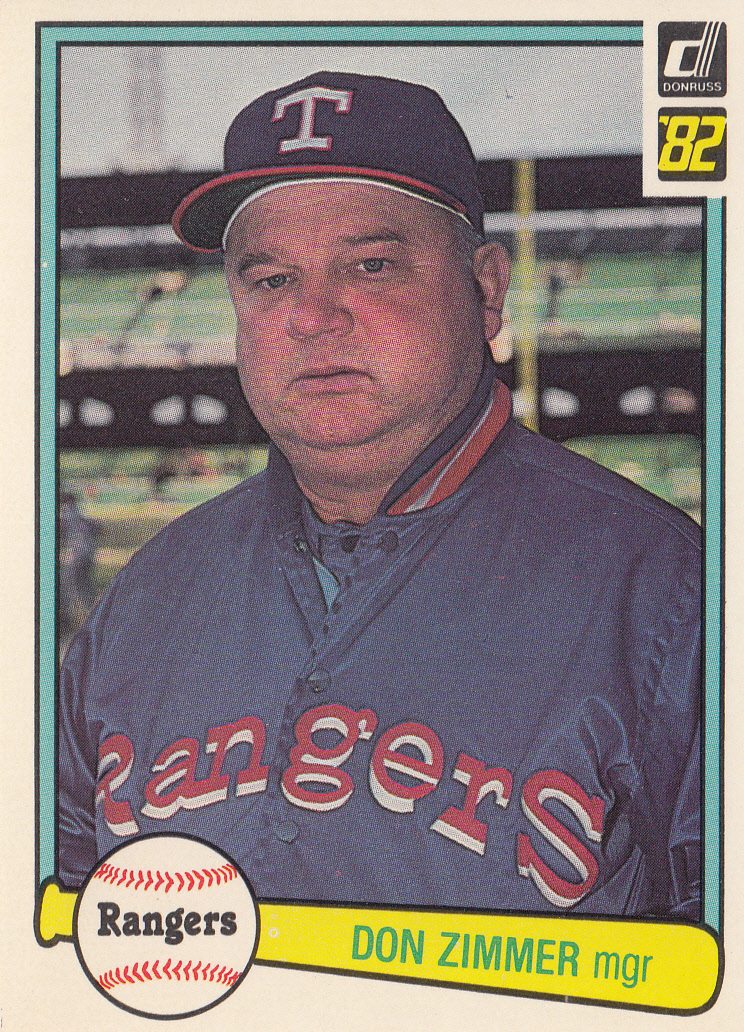
1982 Donruss #195 Don Zimmer MG

These cards won't be in chronological order, but we'll still be starting with the oldest card in the stack, one from 1982 Donruss. That was when Don Zimmer was managing the Texas Rangers. He actually wrapped up his playing career with that franchise, back when they were the second iteration of the Washington Senators. As their skipper, he had a 95-106 record. He had better results when he managed the Red Sox and Cubs, leading them both to winning records overall during his tenure.

As many times as I've seen the famous Bucky Dent home run from 1978, I never realized Don Zimmer was the manager of that unfortunate Red Sox team. But Donruss pointed it out on a lengthy write-up on the back, a wordy paragraph approaching what we once saw from Score.

Many of us remember Zimmer as Joe Torre's right-hand man during the late-'90s Yankees dynasty, and we got a little footage of him in ESPN's recent Derek Jeter miniseries The Captain. But not many remember him as a coach for the inaugural Colorado Rockies, where he appeared alongside manager Don Baylor in those early days at Mile High Stadium and Coors Field.

2015 Topps Archives #24 Cal Ripken Jr.

Rolling things back to very early in the Topps design library, here's a young-looking Cal Ripken, Jr. in 2015 Topps Archives, appearing on the 1957 design. I'll admit, I had to look that one up. Vintage, especially the more plain-looking designs, isn't always my strong suit. But 1992 vs. 1993 Fleer Ultra? I'm your guy.

We get partial career stats for Mr. Ripken on the card back, which has that not-quite-actual-cardboard smooth paper that Topps Archives is known for. The stats show his playing career between 1981 and 1996, but the final few seasons of his storied career are nowhere to be found, except of course in the overall totals. He played 3,001 career games, good for 10th all-time, although he was passed by Albert Pujols earlier this year, who is still going strong and trying to reach that 700 home run plateau before his inevitable retirement.

2016 Topps Bunt #24 Roberto Clemente

When Topps Bunt moved out of the digital app universe and took corporeal form in 2016, it included a mixture of current and retired players. I have about three pages of this set in my 2016 binder, and this Roberto Clemente will complement those other players nicely.

There's a little line on the card back suggesting that I "Collect and trade this card in the Topps Bunt app today!" Unfortunately, I only have this physical version of the Clemente card, and they've long since reached "Sold Out" status in the app. But by searching the app for the "Bunt Physical 16" set, I did discover that I still have a handful of digital cards of this set hiding in a dark virtual shoebox, including a Topaz parallel version of Brooks Robinson's digital card, with a global card count (effectively a serial number) of 440 and Rare classification.

The more traditional portion of the card back makes reference to Clemente's "electrifying defense in right field", and if you haven't seen that before, there are a few brief clips in this video.
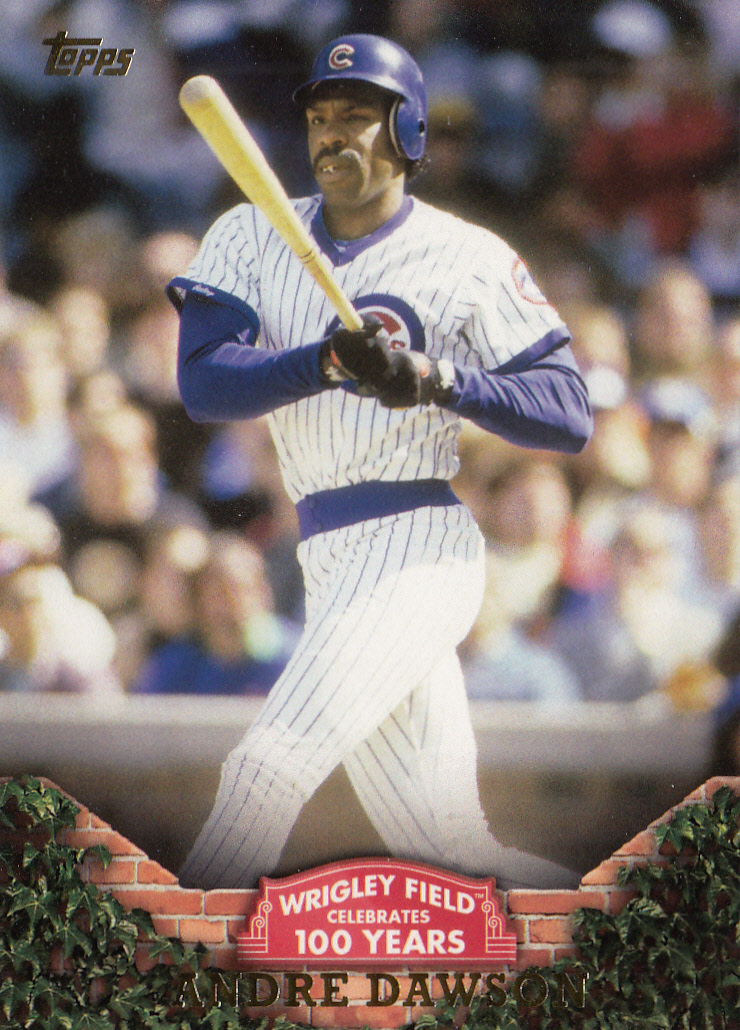
2016 Topps 100 Years at Wrigley Field #WRIG-11 Andre Dawson

This was totally unintentional, but somehow I ended up with a bunch of cards from NL Central teams. Well, of course there was no Central division during Clemente's days, nor Andre Dawson's Cubs tenure for that matter. But it was an odd coincidence.

This new-to-me insert set from 2016 Topps documents 100 years at Wrigley Field, which isn't entirely correct. The Cubs started playing there in 1916, yes, but the ballpark itself opened two years prior as the home park of the Chicago Whales of the ill-fated Federal League. 

Andre Dawson's time at Clark & Addison included an NL MVP award in 1987, which this card points out is the only MVP ever given to a player on a last-place team.

That particular fact reminds me of a story concerning Ralph Kiner, who led the NL in home runs in 1952 despite being on the dismal 42-112 Pirates. Apocryphally, he was told by Pirates management during contract negotiations, "We could have finished last without you."
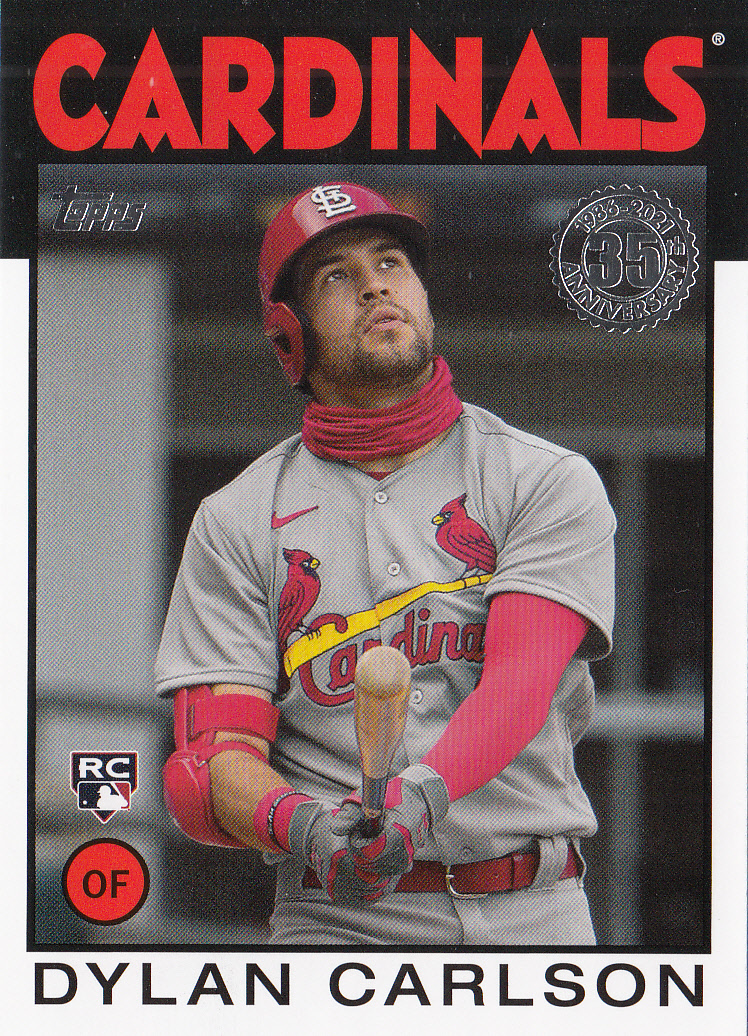
2021 Topps '86 Topps #86B-83 Dylan Carlson

In the spirit of anniversaries, Topps kept their 35th Anniversary series going in 2021, affixing the special silver seal to the 1986 design. Also gracing the design is the Rookie Card logo for Cardinals outfielder Dylan Carlson, who is seeing quite a show being put on by his teammates this season. 

The old veterans Pujols, Molina, and Wainwright are still making the highlight reels, Arenado is flashing the leather as usual, and there's talk of Paul Goldschmidt winning the Triple Crown, something that hasn't been done in the NL since his long ago Cardinal predecessor Joe Medwick won it in 1937.

1996 Stadium Club #299 Fernando Viña

1996 Stadium Club was one of the last sets I collected before I somewhat lost interest in baseball cards for a time, but I do recognize it well since little else went in front of it in the binders for several years. I'm still keeping the run of NL Central teams going, although 1996 puts us before Interleague Play began, and that catcher looks like a Texas Ranger to me, involved in an awkward play at the plate with Fernando Viña of the Brewers.

That would be explained by the fact that the Milwaukee Brewers were a member of the American League until switching leagues in 1998 to even things out with the Diamondbacks and Devil Rays expansion. 

Now that we finally have the Designated Hitter in the NL, the split between leagues is effectively meaningless. That new reality has led MLB to design a less divisional-heavy schedule for 2023, where all 30 teams will face each other for at least one series next season. I'll finally get to cross the Minnesota Twins off my list, the last team I haven't seen play.

Anyway, upon a closer look at this Stadium Club card, it actually looks more like a fight than a play at the plate. Viña appears to have his right hand formed into a fist, although I can't comment on the wisdom of getting into a fistfight with a player wearing a catcher's mask.

That catcher, by the way, is likely the Hall of Famer Iván "Pudge" Rodríguez, who is wearing a commemorative 1995 All-Star patch on his right sleeve. The Rangers showed off their year-old ballpark to the world then, although it was short-lived. It only opened in 1994, but the team has already replaced it with a Texas-sized enclosed stadium just across the street, which was the neutral "bubble" site of the World Series in 2020.

1994 Pinnacle Museum Collection #481 Tim Pugh /6500

Even when I'm picking images off a screen (and knowing how poorly most of our scanners do with shiny cards), I can recognize a shiny parallel when I see one, especially when it has this nifty Dufex technology that was exclusive to Pinnacle/Score at the time.

It's not serial numbered, but these Museum Collection parallels (not to be confused with the hyper-expensive Topps product of the same name) are known to have a print run of 6,500. There's also an Artist's Proof parallel that is even scarcer at just 1,000. Those print run ratios are approximately reflected in my collection. I have a single Artist's Proof, and this Tim Pugh card is my seventh Museum Collection. Unsurprisingly, five of those are Rockies, but somehow I've also ended up with two Cincinnati Reds and nothing else.

1999 Stadium Club Video Replay #VR2 Sammy Sosa

That covers all the NL Central teams, but we still have more to go in that division before we head further west.

When I selected this Stadium Club insert, I may or may not have realized that it was a lenticular motion card. But in any case, it's pretty cool. It's part of a tiny five-card insert set (40% Cubs by the way) called Video Replay, and it shows the motion of Sammy Sosa launching a baseball far into the distance. It's not quite as sharp as those Screenplays cards, which are nothing short of magic, but it's definitely an improvement over Sportflics. 

The video, such as it is, shows Sosa facing off a right-handed pitcher wearing #42, which should narrow down the number of possible plays considerably, but I came up empty. I investigated the rabbit hole for longer than I probably should have, but Sosa hit 609 career home runs, so it's like looking for a needle in a haystack. 

This card is from 1999, so I assume this is a video capture from 1998, and fewer and fewer players wore #42 after MLB retired it in 1997. José Lima is a candidate, and he served up numerous long balls to Slammin' Sammy throughout his career (more than any other pitcher besides Schilling, in fact), but that pitcher is clearly not José Lima. Nor is it Scott Karl, who is a lefty. My best guess was Jason Schmidt of the Pirates. Schmidt did give up a home run to Sosa during the 1998 home run race, but by then Schmidt had changed his uniform to #22. 

Maybe just a random fly ball from a prior season? It sure looks like a home run even in this low-res format, though. Possibly Spring Training? I don't know. Like I said, I investigated the rabbit hole. I don't like not knowing these things.

2021 Topps Fire #121 Nolan Arenado

Our last NL Central card is this Topps Fire card of Nolan Arenado, post-trade of course. You can tell because of that fire engine red jersey and helmet, which the Rockies don't wear.

I do have this card in the Bunt app, but the printed version has a proper card back. That card back tells us how Arenado rapidly made a splash with the Cardinals, hitting safely in his first nine games. That did one better than Roger Maris, who set the prior record in 1967.

Really, he's one of my all-time favorite players. It's just no fun seeing him on another team.

2019 Panini Titan #22 Nolan Arenado

But it's also not so fun anymore seeing cards of him on his original team, because we all know how that played out.

At least I have a space theme on this shiny Panini card to take the sting away a little. The set is called Titan, and it's a 25-card insert set found in 2019 Panini Chronicles. I can't tell you much else about this unlicensed set, but the card back does tell us that Arenado is "a titan straddling the hitting and fielding worlds".

I can tell you lots more about the space theme, though. That's supposed to be Saturn in the background, and Titan just so happens to be the largest moon of Saturn, as well as the second-largest moon in the solar system. It has a thick atmosphere of methane, and the Huygens space probe landed on it in 2005.
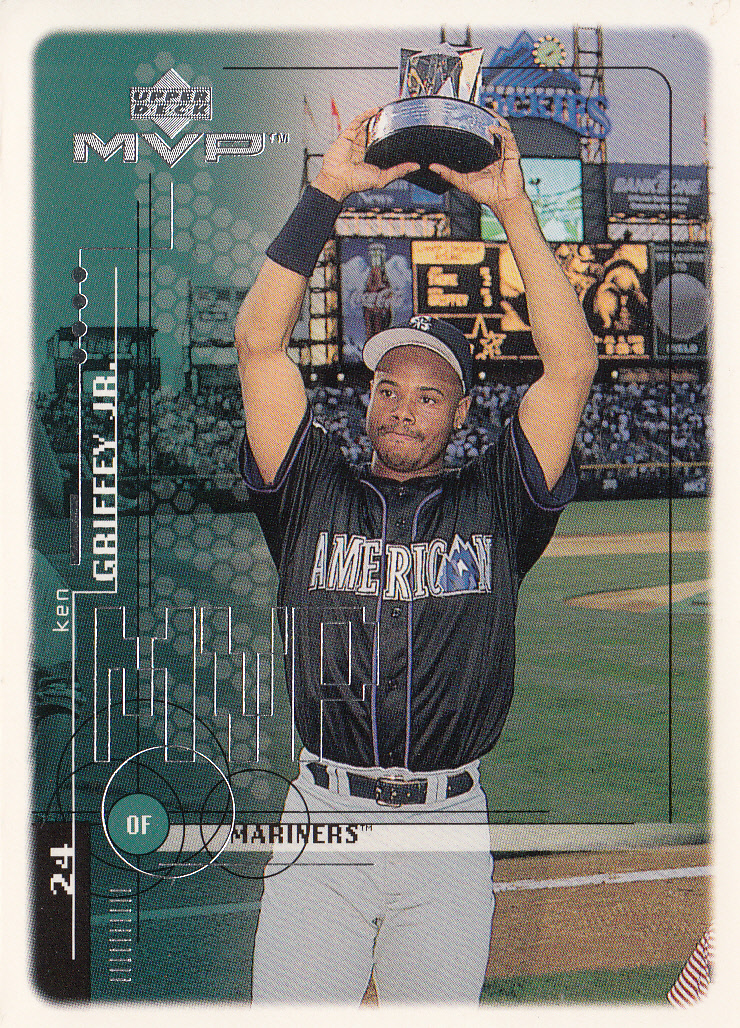
1999 Upper Deck MVP #190 Ken Griffey Jr.

It's rumored that some of the baseballs from the 1998 Home Run Derby even landed on Titan.

But seriously, Ken Griffey, Jr. did win the 1998 Derby at Coors Field, and he's pictured lifting the trophy on his 1999 Upper Deck MVP base card. This is a perfect candidate for my Coors Field frankenset, and one that I've had my eye on for some time.

I didn't get a chance to experience the All-Star festivities in 1998 (although I do remember a blimp hanging around town for the occasion), but I made the most of it when the All-Stars returned to Denver in 2021. The Home Run Derby trophy has changed a bit since '98, as has the Coors Field scoreboard and several of the corporations with ad space on it.

1992 Classic/Best #383 Bob Abreu

I don't usually go for Minor League or Bowman Prospect cards, but this 1992 Classic/Best set is one I've collected for a while. Surely they're not worth much, but I have early minor league cards of guys that went on to become huge stars or even Hall of Famers. Jim Edmonds, Shawn Green, Mike Piazza, Johnny Damon, and quite a few others. I can now add Bobby Abreu to the back pages of my 1992 binder, which is one I don't get a chance to see often enough.

This is more of a tenuous connection to the Rockies, but the Asheville Tourists were the Single-A affiliate of the Rockies until 2020. Prior to that, they were part of the Houston Astros' farm system, and following some shuffling among Rockies affiliates, they're back with the Astros again.

2008 Upper Deck Timeline #35 Roy Halladay

The final card I picked from Nick's giveaway is another color-coded Upper Deck beauty, Roy Halladay's card from the short-lived UD Timeline. To be fair, pretty much everything Upper Deck was printing at that time was short-lived, even the fantastic UD Masterpieces set.

Roy Halladay in particular caught my eye because he was from my home state of Colorado. He went to high school at Arvada West, quite near me and not far at all from a few good birdwatching sites. The Athletic ran a story a couple years ago about his high school championship game, where he faced off against Brad Lidge's Cherry Creek High School team. 

It's sad to talk about him in the past tense. But he was excellent all throughout his career, and as people all over Colorado know, long before he got to the Majors.

Congratulations to Nick on his first decade of blogging, and by now we know his second decade is already off to a solid start.


Monday, February 18, 2019

The Trading Post #126: A Cracked Bat (Part 2: Not as Shiny)

As we saw in Part 1, I have a strong affinity for shiny cards, but regular cards, including those dripping with gold foil, have a place in my collection too. That brings us to Part 2 of a recent shipment from Julie at A Cracked Bat, featuring cards printed on regular card stock but no less awesome or less new to my collection.

2017 Topps Bunt Vapor #V-CG Carlos Gonzalez
I purchased some 2017 Topps BUNT when it was for sale at Target, but I didn't manage to pull any cards as rare as this purple Vapor insert of Carlos Gonzalez. It's numbered to /99 right on the front, and shares equal scarcity with inserts featuring two other background designs, Splatter and Galaxy.

I still have the BUNT app on my iPhone, but I haven't opened it in months. Like most of the BUNT set, this card ties in to the digital app, as the back includes a scratch-off area with a code to redeem a digital version within the app itself. Unfortunately, Topps didn't give collectors much time to do that, as the unscratched code expired in December 2017.

Luckily, in case you missed that short deadline, Topps included a paragraph to keep detail-oriented collectors like me happy. We're told about how CarGo closed out May 2012, which included a game with three home runs, followed the day after with a shot in the first inning. That feat has totally slipped under the radar, and all because he had a night of rest. He'd be immortalized in baseball history with Scooter Gennett and Mark Whiten if he had hit all four of those in a single game.

2017 Topps Fire #175 Nolan Arenado
Those BUNT inserts could easily be confused with Topps Fire, but Fire went a little bit more over the top. This trade package as a whole represented my first-ever look at the set, and here's an example of a base card after the couple parallels and inserts from Part 1. The little light spots all over the card are supposed to be sparks rising in a column of smoke, but they look a little more like a starfield to me, giving this card a very sci-fi look. Maybe something out of one of the Thor movies.

Topps also went with a selective color look here, desaturating Nolan Arenado's skin tones while leaving his purple uniform intact. They also left the 2017 Spring Training patch on his right sleeve alone, the burnt orange of the Arizona desert distracting a little bit from every possible Rockies color.

2018 Topps Fire #164 Charlie Blackmon
We'll see plenty more of Nolan later, but here's how Topps Fire evolved with the 2018 set. I still have a pretty small sample size with Topps Fire, so I'm not sure how much the card backgrounds vary from card to card. The few I've seen each look pretty unique, though. If you ask me, they look a lot like recent Diamond Kings, especially the Aurora inserts. Charlie's beard is as wild as the background, and Topps gave us a little more right-sleeve patch action, this time with the Rockies' 25th Anniversary patch.

Along with teammate David Dahl, Blackmon got hitched after the 2018 season concluded (no, not to each other), and Dahl and Blackmon will be the starting corner infielders this year, as the Rockies appear not to be pursuing Carlos Gonzalez in free agency. That will give Ian Desmond responsibility in center field. He does have experience in position #8, but not in an outfield as large as Coors Field's. He's been a disappointment at the plate, so hopefully he can turn things around. Seeing Ian Desmond and Daniel Murphy coming in to basically replace CarGo and DJ LeMahieu will take some getting used to.

1996 Donruss Press Proofs #224 Dante Bichette /2000
Dante Bichette was always more of a corner outfield guy himself, but he did play center on occasion. The "loincloth" design element of 1996 Donruss lists him as a Left Fielder. It's an excellent bat rack shot, and you might notice the overall design has a little more gold tint than usual. That's because it's a Press Proof parallel, as noted vertically on the right. That little rectangular medallion in the center gives us the print run of "1st 2,000 Printed", although there is not an actual serial number. It's a rarely-seen variety, and my first example from the 1996 set. I have a couple from 1995, which have appeared on the blog before.

This is a great addition to my collection, and as it turns out, I don't seem to even have the base variety. It will be one of the easier rainbows to complete, as this and the base card are the only two types out there. To find a card that's as rare as a Stadium Club First Day Issue before the regular one seems pretty unusual, especially from a set printed shortly after the overproduction bubble collapsed.

1996 Pacific Gold Crown Die Cuts #DC-29 Dante Bichette
Pacific gave us a similar take on Dante Bichette in 1996, choosing to highlight some of the same stats on the card back as Donruss did, primarily his league-leading stats in home runs and RBIs, and his solid batting average of .340, way above his usual .310. It wasn't quite enough for the Triple Crown, as Mike Piazza was a few points ahead (Piazza was always ruining things for Bichette), and of course Tony Gwynn was heads and shoulders above everyone, way up at .368.

Pacific had it right; it truly was Bichette's "finest season as a pro", and he never eclipsed those numbers. He even came pretty close to the MVP that year, just being edged out by Barry Larkin.

Of course, with Pacific we can always count on some unusual designs, such as this massive die-cut gold crown, which distracts us from the nearly identical photograph they used two years later in 1998 Paramount. It's not the same image, as Bichette is a little later in his follow-through on this one, and 1997's Jackie Robinson patch is nowhere to be found, but that same WGN logo at Wrigley field is peeking in on the lower right.

Sadly, 2019 will be the final year the Cubbies will be broadcast on WGN. They're starting up a new regional sports network in 2020, to be known as Marquee. In their perpetual short-sightedness, the league and the teams are alienating their local fans, especially those wanting nothing to do with cable TV. Cubs day games being broadcast on WGN, which was once in an affordable basic-cable tier, allowed many of us young fans to watch games after school, and is probably why there are Cubs fans everywhere.

I've written about this before, and I think in this day and age when attention is more and more valuable, locking your content behind a paywall with ever-increasing fees is going to force plenty of people to simply look elsewhere. I've even heard marketing pundits compare it to boxing. It's not that boxing is gone, but it's not a thing that everyone listens to on the radio like they did in the 1930s. And if there is another strike in 2021, MLB is going to have an awful time trying to get those fans back.

Anyway, that's enough pontificating about media distribution for now. The whole point of this blog is to pontificate about baseball cards.

1996 Pacific Estrellas Latinas #EL-11 Andres Galarraga
Julie found another one from Pacific's Estrellas Latinas insert set to go along with Vinny Castilla's card that arrived just a few posts ago. That's a complete team set from this 36-card insert set. Granted, it's just two cards, but that's not bad for a set I had no idea even existed a few months ago.

Now that I have two to compare, it's clear that the gold pattern in the background is identical across the whole set. The card back has the Spanish paragraph with an English translation as usual with Pacific, which means we get to see Andres Galarraga's nickname in two languages, "el Gato Grande" and "The Big Cat". We're also told he stole 12 bases in 1995, not something one would expect for someone with a nickname like that.

2015 Topps Mini Black #442 Tyler Matzek /10
Tyler Matzek was found throughout Topps sets for a while, but he's completely fallen off the radar, as he hasn't pitched in the Majors since 2015. The back paragraph refers to him as a "one-time Minor League 'wild man'", so maybe those tendencies crept back in. Still, he also got a card in 2015 Topps, which means he got a card in 2015 Topps Mini, along with all its extra-rare parallels. This Black parallel is numbered to a mere 10 copies.

If you can believe it, this isn't even the rarest card Julie has ever sent me. I once received a 2014 Stadium Club Members Only parallel from her. It's a bit of a guessing game on those but there are probably just seven out there. Short of just sending me a printing plate, that's about as rare as it gets.

The 2015 flagship design will be remembered for being a bridge between the solid-color borders Topps used throughout their history and the quasi-full-bleed designs we have today. Night Owl ranked it at the very top of this decade's designs, and it's definitely memorable.

2018 Topps Gypsy Queen #65 Trevor Story
Topps has finally decided that "Gypsy Queen" takes up too much space on a design, so they just shortened it to GQ. They did this on autograph cards last year, and the change has now arrived on the main set. I don't think I've ever bought a pack of the stuff, yet I am pretty sure I have something from every year it's been out. 2018's design is a bit more modern-looking than some past years, and I actually like this quite a bit. I particularly like the photo of Trevor Story flinging a ball toward first base while nonchalantly blowing a bubble. That's how routine it is for him.

Not even a retro design like Gypsy Queen is immune to Sabermetrics, as the card back mentions that Story had 11 Defensive Runs Saved last season, tops for NL shortstops. That paragraph resides above a little gold-colored plaque with the Gypsy Queen name in it.

2018 Topps '83 Topps Blue #83-76 Ryan McMahon
Story has a locked-in starting gig, but Ryan McMahon's future with the Rockies is uncertain. He'll probably be a utility player for some time to come, and he's got some big shoes to fill if he wants to play on the right side of the diamond with some big names ahead of him. In fact, the Rockies recently signed Mark Reynolds to a Minor League deal, and he has plenty of experience playing first base at Coors. The young prospect, though he looks good on this 1983 design, has his work cut out for him.

2018 marked the 35th anniversary of the '83 design, and Topps honored it with a 100-card insert set featuring current and retired players, along with the usual slew of colored parallels. This is obviously the blue one. It's the continuation of the 30th Anniversary 1987 cards printed in 2017. Julie has sent me those, too. I still haven't purchased any, but Topps is using the 1984 design on their Anniversary cards this year.

Speaking of, I'm just a few weeks away from my own 35th Anniversary, so to speak. I was born the same year Don Mattingly's rookie card was leaving the Topps factories.

2018 Topps MLB Awards #MLBA-23 Nolan Arenado
Half the size of the '83 Anniversary set, Topps put out a 50-card MLB Awards insert set to honor 2017's top performers. To no one's surprise, including Topps', Nolan Arenado added another Gold Glove to his trophy case. At the time, it was his fifth, and he won a sixth for his 2018 campaign. As Topps says, "there's little drama associated with the announcement". His Defensive Runs Saved count reached 20, and he was credited with 57 completely subjective "Good Fielding Plays".

The design is a bit unnecessarily busy, but the photo selection is appropriate for a defense-focused card of maybe the best defender in the game right now.

2018 Score #13 Nolan Arenado
He's great at the plate, too. Panini recognized that, and added Nolan to the 2018 Score set, yet another of the many legacy Pinnacle brands they have resurrected. They took a page from 1989 Fleer and many others in editing the bat to extend outside the frame, and we can also see soon-to-be center fielder Ian Desmond in the on-deck circle.

I'm a little disappointed, because if there's one thing I associate with Score, it's the novel-length write-ups found on the card backs. This one has a bit about his rate of home runs per at bat, massively higher than the average big-leaguer, especially with runners in scoring position.

Someday I will read all my old Score cards. I can only imagine the gems hiding in there. For example, I just learned that Jim Clancy, #424 in the 1990 Score set and then an Astro, was the first Blue Jay to reach 100 wins with the club. He remains third on the all-time Jays win list, behind Dave Steib and Roy Halladay. Interestingly, and perhaps unsurprisingly, no Rockie pitcher has reached that milestone yet. The current leader is Jorge De La Rosa, with 86.

1990 Score #424 Jim Clancy (Reverse)
That's what a Score card should look like. Yes, I realize that Clancy's write-up is shorter than most, but that's because Score included his complete career stats, something Topps did for the 2019 set to everyone's appreciation.

2018 Panini Chronicles #35 Nolan Arenado
By the way, that Score card isn't actually a main set. It's a 30-card insert set for this one, 2018 Panini Chronicles. Like the Score insert, it uses the same photo front and back, although we do get a different write up on the base card. Nolan doesn't just rack up Gold Gloves, but also Silver Sluggers, and he's becoming so feared a hitter that the number of walks he's drawn has been increasing steadily, as this card tell us.

If I collected other sports, I'd probably know Panini's lineup better. After all, they have the exclusive license for both the NBA and NFL. Baseball seems like it's getting more niche all the time, and Panini has the licenses for both the most popular sports league in the USA, and also the one with the best-known players. Not a single MLB player is on ESPN's 100 most famous athletes, not even the generational superstars like Mike Trout, or the flashy crowd-pleasers like Yasiel Puig.

2018 Topps Heritage New Age Performers #NAP-14 Nolan Arenado
Topps has kept the New Age Performer insert set going with Heritage for a while, usually offering some funky hippie fonts to take us back to the late 1960s. When I saw this card, I thought of another particular card of his that I thought was a New Age Performer, but it was actually something from Topps Archives.

2018 Topps Archives #66 Wade Davis
There are a couple pages of 2008 Heritage in my collection, and a real 1959 Topps Robin Roberts card, my first-ever vintage card, so I am a little familiar with this design. At first glance, I thought it was Heritage, but Wade Davis hadn't quite hit the big leagues in '08. So that leaves Topps Archives again, and they changed the card stock just enough where I can't pick it out by feel anymore.

This marks Wade Davis' first appearance on the blog. He was a bit shaky in his closer role, something I witnessed firsthand in 2018, but he still led the NL with 43 saves. He was a "door-slamming fireman" more often than not, but six blown saves is not great. We'll see if he can stay atop the NL leaderboard in 2019.

1994 Fleer Extra Bases #246 Greg Harris
The final cards of this post are from yet another new-to-me set, the oversized Fleer Extra Bases. It's a monster 400-card set that I never knew existed, and I have no idea how you'd store that many cards like this. The width is exactly what we're used to, but they're about an inch taller. I guess it would fit in 9-pocket pages if you just leave the top row empty and use 50% more pages.

The aspect ratio allows for some unique cropping, but I am pretty sure there are no horizontal cards to be found. The usual Rockies of the inaugural era turned up, as well as Greg Harris, who is also making his debut on Infield Fly Rule. This gentleman is Greg W. Harris, not to be confused with his ambidextrous contemporary, Greg A. Harris, who played for Boston at the time.

Fleer tells us that Harris "has the ability to be one of the Rockies' top pitchers." That may have been true, but Harris did not fare well in two seasons with the Rockies. He went 1-8 in 1993, and technically improved his win percentage in 1994 by going 3-12. His career ended a year later, his career cut short by a botched surgery, but he ended up winning a lawsuit against his doctor. Quite the crazy story.

He became a Rockie via a trade with the Padres, who also sent Bruce Hurst to the Rockies. Hopes were high, but Hurst's best years were behind him. He only appeared in three games as a Rockie, and he was one of many players whose careers ended with the 1994 strike.

This has gone down as the worst trade in Rockies history, as they shipped Brad Ausmus, Doug Bochtler, and Andy Ashby off to San Diego. Believe it or not, Ashby was the PTBNL in this one.

At least they got it out of the way early.

1994 Fleer Extra Bases Second Year Stars #15 David Nied
We'll close with another chapter in Rockies pitching busts, the first overall pick in the Rockies/Marlins expansion draft, David Nied. Rumor has it that the Atlanta Braves chose to protect Deion Sanders over Nied in the draft, but they were none too happy with Neon Deion after he split time between the Braves and NFL's Atlanta Falcons during the 1992 Postseason. The latest episode of 30 for 30 tells that story brilliantly.

Anyway, the Rockies have had problems with pitching literally since day one. That reality has changed, and the perception is starting to change, as well. But despite what Fleer says, Nied didn't turn out to be a Second Year Star. Elsewhere in this 20-card insert set, you'll find a few Marlins from the expansion draft, including Jeff Conine and Trevor Hoffman. Also in that set are Mike Piazza, Pedro Martinez, and Tim Salmon. Nied is the lone Rockie.

It's a good design, though, and you can find this filmstrip theme in various Stadium Club inserts. The four images on the left aren't actually any different. Rather, they're just progressively zoomed-in. It looks similar on the back, but with a slant.

Julie included lots of the Blake Street Bomber guys with this stack of Extra Bases cards, but based on who I got in the insert set, I chose to take a darker path and get a feel for how bumpy the pitching really was in those early days.

Some of these sets are so new I just haven't had a chance to buy them yet. But Julie has some sort of magic way of unearthing surprises even for this seasoned collector.


Wednesday, October 17, 2018

The Case Hit Group Break (Part 1: Rockies)

I keep signing up for group breaks, including Nachos Grande's upcoming break, so it's only right that this blog gets its money's worth for all the PayPal transactions I've been doing. Over the summer, Trevor at Bump and Run Football Card Blog ran a break for 2018 Stadium Club, 2018 Topps Series 2, and 2018 Diamond Kings, as well as the usual handful of extras that make it in to many shipments. I had these sitting on my side table for months, and it turns out that I did quite well!

Stadium Club is always a favorite, and I have a blaster sitting on my coffee table that I've yet to open. That's definitely more due to busyness than patience, but I'll get to it someday. If I wait another couple months I might just give myself a nightly Hanukkah gift out of that blaster. You know, because the celebration is for the holy oil lasting seven nights plus one extra night.

I've never run one myself, but it seems to be quite difficult to sell all 30 teams, so most breaks these days seem to be good for two team slots, a selected team and a random team. It should be no surprise which team I selected, and the all-powerful randomizer chose the Pittsburgh Pirates as my second team. I'll be splitting those up into two posts, starting with the team that was most recently swept in the playoffs.

2018 Stadium Club #6 Carlos Gonzalez
This year's Stadium Club design isn't necessarily my favorite. Lots of bloggers haven't liked the lettering of the position being so large, and it is a bit more imposing than the faint outline of the team name. This year's set reminds me a bit of 2006 Upper Deck, but let's be honest, there are only so many things you can do with a minimalist full-bleed design.

Carlos Gonzalez, the Rockies right fielder, can frequently be seen laying out like this to make a catch. I've seen it in person more than once and it's exhilarating to watch. Here, he's doing it on the road, but I can't quite tell which stadium this is. There's an extremely faint outline around the ball, making me wonder if this is an effect of HDR photography. I took a couple photos of my cousin juggling last month, and the HDR software in the iPhone left an outline some distance above the ball itself. It was much more pronounced, so maybe a fancy DSLR and a $4,000 telephoto lens will minimize that effect.

2018 Stadium Club #204 Charlie Blackmon
These come in horizontal alignment, too. We never seem to call it "portrait" or "landscape" in this hobby like we do on our computer screens, just plain old "vertical" and "horizontal".

The photos are pin-sharp, as usual, letting us see pretty much every strand of hair in Charlie Blackmon's beard. And mullet. And even on his forearm. Once you look past that, you can see the well-liked Rockies spring training logo, as well as a prominent bat doughnut as Charlie warms up.

It's pretty difficult to color-code a design like this, but Topps managed to subtly do so on the back. It's a vertical back, and the background is meant to look like you're looking down on the field from the seats in the upper deck. Those seats are color-coded, and they're purple on Rockies cards, yellow on Pirates cards. Those don't actually match the real seats at the ballparks (Coors Field seats are dark green), but it's a clever way to group each team. The upper portion of the back even reminds me of 1993 Fleer Ultra.

2018 Stadium Club Red Foil #290 Nolan Arenado
Colored parallels are still found in Stadium Club, and I ended up with a couple of these. I'm not sure on the relative scarcity of these Red Foils, but they stand out pretty well, maybe a bit more so than in past years. Nolan's uniform number looks ever so slightly odd near the large position letters, but this is a great card which shows the five-time Gold Glover doing what he does best. He might be the best third baseman in the game. "An apparent consensus has been reached" on that. The card says so.

2018 Stadium Club Photographer's Proof #98 Jon Gray
We'll rotate 90 degrees and enhance on this card of Jon Gray. He's had some trouble handling the pressure of the high-leverage games he's appeared in, but I think he'll be a fixture of the Rockies rotation for some time to come. He's certainly good enough to appear in a small-ish set like Stadium Club, which apparently has a new type of parallel, Photographer's Proof.

I honestly had no idea what I had on my hands this whole summer, but this is an amazing pull! It's a 1:2 case hit, or 1:512 packs. It's not serial numbered, but if it's anything like those Members Only parallels, there are probably less than ten copies. A glance at eBay seems to put the print run at just seven.

Design-wise, it seems to be a replacement for the Contact Sheet insert set, using the filmstrip theme on one edge of the card. Trevor kindly put this in a penny sleeve, and I'm amazed at how lucky this pull is! That's why we do group breaks, I guess.

2018 Topps #668 Tyler Anderson
I got shut out of Rockies in the Diamond Kings box, but that's fine. That Gray card will make up for a lot. There were a few Pirates in the box, so at least I got a look at the design. It wasn't advertised up front, but Trevor also added in a blaster of 2018 Topps Series 2, and a few base cards went into my pile. I just finished sorting the factory set, but it's nice to have a few extras here and there.

Tyler Anderson was a regular member of the Rockies' rotation, earning a record of 7-9 this season. I saw him pitch a time or two at Coors this year, and he started NLDS Game 2. He did his best to keep the Rockies in the series, as did most of the pitching, but the offense just didn't get the job done.

I haven't kept up too closely with the 2018 releases. at least not beyond what I see on the blogs. The waterslide set is one I might have a little trouble remembering in a few years.

2017 Topps Bunt Blue #22 Jeff Hoffman
On his 2017 Bunt card, and by extension the Blue parallel, Topps predicted that Jeff Hoffman would "almost certainly" be a member of the Rockies' rotation, but that seems not to be panning out. The key return from the Troy Tulowitzki trade had a rocky six games in the majors during 2018, is currently playing in a High-A league, and didn't make the 40-man roster during September callups. Luckily for the Rockies, they have a few other young stars like Kyle Freeland and German Marquez to hold things down.

Right next to that blaster of Stadium Club, I have an unopened blaster of Topps Big League, the low-end replacement for Bunt. The mobile app is still active, but I haven't kept up with it regularly for a few years. These Blue parallels were nice, though. Sort of a poor man's printing plate. Beyond the headliners of the break itself, it and the rest of these cards were a nice bonus.

2018 Topps Opening Day At The Ballpark #ODB-COR Colorado Rockies
I'm not terribly broken-hearted about the demise of Bunt. But if Opening Day inserts are gone, Topps and I are going to have a problem. They're continually the best in my book, and they certainly have me eagerly awaiting the next home opener.

This 2018 card shows the home opener from 2017, which was Bud Black's first home game with the Rockies. He's facing the field for his first national anthem ceremony at Coors Field, and little did he know that he'd lead the team to a Wild Card spot two years in a row. In fact, that Wild Card game against the Cubs a couple weeks ago was the first Postseason win that Black ever led a team to, despite over a decade of managerial experience, mostly with the Padres. Before that, the last win he was a part of in the Postseason was Game 7 of the 1985 World Series as a member of the Royals. It's amazing that you can spend over thirty years in the sport between Postseason wins.

I'm sure when Matt Holliday rejoined the Rockies this summer, he and Bud Black had a chat about the 2007 Tiebreaker game. Black, you see, was in his first year managing the Padres when Holliday may or may not have touched home plate.

The Rockies rarely begin the season at home, and that will be the case in 2019, too. They'll face the Dodgers on Friday, April 5th, after a road trip against both Florida teams. They'll be the first to see the new Marlins logo, rumored to debut next month. It's probably best they start on the road, as early spring snowstorms are quite common around here. And the city has embraced the Friday afternoon party we can always count on.

1994 Topps Gold #186 Marcus Moore
Following Mike Munoz in the Obscure Rockies Relief Pitchers category (which you used to actually find in a base set) is Marcus Moore, who appeared in 56 games as a Rockie during their Mile High Stadium years. He was traded to the Reds in 1995, but didn't suit up for them until '96. He earned two saves in 23 games for Cincinnati, then that was it for his career.

I remember the name, and I remember this card, as I remember most from 1994 Topps. I assume we have decided to call it "The Home Plate Set", but it will always be my first factory set to me. This is probably a photo from spring training, as the Rockies never wore black jerseys during the regular season for many years. Ballplayers still wore stirrups back then, and you can spot a little "CR" logo on his left ankle.

And of course, it's a Topps Gold parallel, perhaps my favorite parallel set of all time.

1994 Pacific #191 Pedro Castellano
How about another Rockie I've never shown on the blog before? We'll turn to Pacific for this one, that quirky brand which existed in that weird space between being an oddball and a major producer. Appropriately for this Venezuelan utility player, part of this card is in Spanish, as Pacific frequently used on their cards. Sort of a Latin American equivalent of O-Pee-Chee.

Pacific used gold foil for this 1994 set, which pretty much everyone was doing at the time. Pacific also took a shot at making their own version of the Topps Rookie Cup, a rather flat-looking trophy in the lower right. He's listed as a "1994 Rookie", but didn't actually play during the 1994 season. His career spanned 51 games from 1993-1996, mostly during that inaugural year.

1994 Pacific #205 Armando Reynoso
Armando Reynoso, a member of the Mexican Baseball Hall of Fame, had a card in the same 1994 Pacific set. Mr. Pickoff is in the legendary Wrigley Field on this card, and you can just make out the basket below the foul pole. Reynoso pitched in the Windy City twice in 1993, but judging by the ivy, it looks more like early spring than mid summer, so I will date this one to May 5th, 1993, Cinco de Mayo. Reynoso took the loss in a quick afternoon game, just two hours and eighteen minutes.

I've seen this set numerous times, but I only now noticed the marble-like color-coded design at the bottom, very similar to what Score Select looked like in 1995. 1993 Fleer Ultra had that look too, but Pacific was way more of an innovator than anyone gives them credit for.

1994 Pacific Silver Prisms #20 Andres Galarraga
Our final card was printed before the advent of serial numbers or a set label on the back, but from what I've read, there was a print run of 8,000 cards. Quite scarce for 1994. The Big Cat appears before a triangular Silver Prism background; there is also a circular background variety.

If you flip it over, you'll find a big purple diamond, as well as a few highlights of Galarraga's 1993 campaign, such as his league-leading .370 batting average, totals for Hits, Doubles, and Home Runs, and a mention that he was the 1993 NL Comeback Player of the Year. It's not an award that has nearly as much prestige as the Rookie of the Year, but apparently it's been awarded in each league since 1965. Galarraga was the only Rockie to earn it until Greg Holland did so last year.

Trevor did an awesome job for me on this break! I feel quite bad that it's taken so long for me to finally put up a post, and I haven't even gotten to the Pirates yet. No case hits in there, but we will get a look at some old-time Hall of Famers and that 2018 Diamond Kings set.


Saturday, October 7, 2017

The Last Minute Group Break (Part 2: Diamondbacks)

That did not turn out the way I'd hoped.

Here it is, Saturday night, and I'm watching the Diamondbacks in Game 2 of the NLDS at Dodger Stadium, a game the Rockies could be playing in if Wednesday's wild Wild Card game went just a bit differently.

2017 Topps Bunt #109 Zack Greinke
Of the four Wild Card starters across both leagues, only Zack Greinke held it together in the first inning, and that ended up being the difference. Greinke joined Arizona for the 2016 season, and had a much better year in 2017, helping the Diamondbacks sink the Rockies and get their revenge for the 2007 NLCS. He's a bit removed from his near-Cy Young 2015 season with the Dodgers, but he stayed in the NL West and remained a thorn in the Rockies' side.

His card from 2017 Bunt came my way as part of Chris's late-spring Ultimate Group Break. You saw the Rockies in Part 1, way back when they were still part of the 2017 Postseason picture. The random luck of the draw netted me the Rockies' chief rivals, the Arizona Diamondbacks, as my second team. They're, let's just say, not my favorite team. They weren't going into Wednesday, so you can imagine how I feel now.

2017 Topps Archives #287 Paul Goldschmidt
That's partly thanks to this mischievous-looking fellow at the bat rack, Paul Goldschmidt. Goldy launched a three-run shot off of Jon Gray in the first inning of the Wild Card game before an out had even been recorded, and the D-Backs kept the Rockies in the rear-view mirror the rest of the way. There were four home runs, four triples, including a demoralizing one by reliever Archie Bradley in the 8th that really put it away, and a slew of hits, making for the offensive battle we all expected.

And ex-Rockie Daniel Descalso had one of those homers. I thought something like that might happen.

Anyway, here we are, and I'm watching the rest of the Postseason on the sidelines, as is usually the case.

Goldschmidt's card from 2017 Topps Archives obviously uses the 1992 design, one that I think is better color-coded than the Rockies cards in that set. The blue borders here aren't quite right, but the Rockies got yellow, light blue, and red. Chase Field also makes a rare appearance on the back, but doesn't quite capture the park as well as Ian Desmond's card did. This one has little more than the infield and dugout areas, but it does show the unusual dirt path between the mound and the plate, something found only there and in Detroit's Comerica Park.

2002 Flair #12 Mark Grace
When Mark Grace played there, it was still called the Bank One Ballpark, colloquially known as "The Bob", which is why the Diamondbacks' mascot is a bobcat rather than a snake. Bank mergers have made D. Baxter the Bobcat (get it?) a bit of anachronism, though Grace's teammate Jay Bell's son Brantley was the brains behind all this. Jay Bell, of course, scored the winning run in Game 7 of the 2001 World Series, in which Mark Grace singled to lead off that fateful 9th inning.

The background photo of Mark Grace on this upscale Flair card has the look of a man who just won a World Series, and he's even sporting an alternate Diamondbacks logo to go along with his previous-year action shot. I haven't seen many 2002 Flair cards, and I particularly like the color of the foil. It's not copper, like we've see on so many Upper Deck cards, but more of a rose gold.

2008 Upper Deck #406 Eric Byrnes
Here's one for Nick's Short Term Stops theme. Not as a Diamondback. Everyone in Denver knows him as a Diamondback, as he didn't make many friends during the 2007 NLCS around here. But when I flipped this 2008 UD card over, apparently Byrnes spent part of 2005 in Denver, his second of three teams that year, forcing Upper Deck to abbreviate that to "ATH/RCK/ORI" on the vertical-backed card. He played just 15 games here, which was apparently something that we all just decided to forget.

2008 Upper Deck X #2 Conor Jackson
Yes, I'm a bit salty, but again, it's not something that just began on Wednesday. This goes way back. And I'm completely fine with the hitting clinic the Dodgers put on in the bottom of the 5th in Game 2 on their way to a 2-0 series lead.

But I guess it's good to have a rival. Who would the Yankees be without the Red Sox? Or vice versa? Who would Tom Brady be without air?

I kid, I kid.

Other than Greinke and Goldschmidt, these are all bonus cards that Chris included in my shipment, and I found quite a few cards to like, even of a division rival. Conor Jackson was swinging a decent bat for a few years, and the back of this Upper Deck X card documents his four home runs in September 2007. One of those homers helped beat the Rockies as the season was winding down, marking the Rockies' only loss between September 16th, 2007 and the end of the NLCS.

If the Rockies somehow won that game, they would have had a 22-game win streak heading into the World Series. That makes the Indians' accomplishment this year all the more impressive, but underscores just how amazing Rocktober was back in 2007.

2012 Triple Play #300 Real Feel Jersey (MEM)
In addition to this stack of hand-selected cards, Chris also threw in an unopened pack of 2012 Triple Play. I don't see a lot of love for Triple Play sets, especially recently, but I was lucky enough to pull this relic card out of that pack. The card doesn't depict any particular player or team, and thus has no need to disclaim that the relic "is not from any particular game" etc... like most relic cards do.

The coloring on this card happens to make it fit quite well with a bunch of Diamondbacks cards, and it might actually be a real D-Backs road jersey. The back gives us a lengthy history of the baseball jersey that would not be out of place on an early Score card, and it's one of six relic types you could pull, a few of the others being the base, batting glove, and bat. This is card #300, the final one in the Triple Play set that year. It's not officially listed as a short print, but the "short set" runs only to card #90. Even jerseys of no particular player must be relatively scarce.

Munnatawket Custom #1 Paul Goldschmidt
If the Real Feel jersey capped off the 2012 Triple Play set, then Paul Goldschmidt opened up the magnificent Munnatawket Mini custom set with card #1. I recently lamented that this set hadn't made an appearance around the blogs in quite a while. It's amazing that these have been kicking around for almost ten years, and I'm happy to add another to the small quantity I've managed to collect.

2008 Topps Update #UH293 Adam Dunn
Obviously, the Rockies are heavily represented in my Coors Field frankenset, but the ones that aren't are typically NL West teams. Dee Gordon's card from 2011 Topps Update is a prime example, as he's shown acrobatically turning two over Ty Wigginton with the left field bleachers in view. The Diamondbacks seem to have all sorts of Coors Field cards, including this one of strikeout king Adam Dunn.

And when you're a strikeout king without being a pitcher, that's a bad thing. At this point in his career, he was good for about 40 home runs a season, but he'd put up darn near 200 strikeouts doing it. This Update card points out that no player before Dunn was ever traded during the season when he was leading the league in home runs.

He's either striking out or hitting a home run here, and because you can spot the Coors Field signage on the dugout roof behind him, it's a fair bet that he might be hitting one of those 40-ish home runs instead of striking out. Dunn did hit one home run at Coors Field as a Diamondback, even though that was just a 44-game stretch before he became a free agent and signed with the Nationals.

2008 Upper Deck Spectrum #1 Chris B. Young
This Upper Deck Spectrum card (another card #1) caught my eye with this striking turquoise color, not really a Diamondbacks color anymore, but a pretty card nonetheless. It's not a color-coded set to begin with, but it came in a few colored parallel variations.

This gentleman is Chris B. Young, currently playing in the Postseason for the Red Sox, not to be confused with Chris R. Young, a pitcher for the Royals. They both have quite a bit of Postseason experience. Chris B. played in the 2007 NLCS against the Rockies with a few of these other guys, but Chris R. earned his ring with Kansas City in 2015. Both are still in the league, and it's still a touch confusing.

But that's nothing compared to Khris Davis of the Athletics and Chris Davis of the Orioles. Both are noted power hitters. They've never played together, but somehow they both managed to strike out exactly 195 times this season, tying for third in the American League.

I can't mention 200-strikeout hitters like the Davises and Adam Dunn without mentioning Tony Gwynn at the other end of the spectrum (pun not intended), who only had slightly more strikeouts in the final twelve years of his career.

Of course, that was a Strike-shortened period. I'm sure his total of 203 would be two or three higher if 1994 and 1995 were full seasons.

2003 Ultra #129 Junior Spivey
I don't especially remember much about Junior Spivey. I know he was on the Diamondbacks, and I probably saw him play once or twice, but I don't recall any specific plays. I just like this acrobatic card of him playing the infield, which is cropped perfectly to fit the card and even the little dip in the bottom banner.

The old Diamondbacks uniforms and colors are on display quite vividly on this Fleer Ultra card, as is their large snake patch on the left sleeve. In the days before HDTV, I never really got a good look at that patch, and it always looked like a hot air balloon or a parachutist to me. In reality, has the state, team name, and a large snake head.

I like seeing their occasional retro jersey, but I think there's only room for one purple team in the NL West, and we were there first.

2012 Topps Update #US22 Chris Nelson
I just couldn't do a whole post of Diamondbacks. I had to get this Update card of third baseman Chris Nelson in here to wrap it up. Even if the Rockies lost the Wild Card game, they're still my team. And they're even more fun to watch when they have a four-time Gold Glover covering the hot corner, who makes plays like this look effortless.

I talk a big game about not liking the Diamondbacks, but really, I'd like nothing more than to see our rivalry expand over the next few seasons.

Perhaps a rematch next year? This time at Coors Field.

Unless, of course, the Rockies finally win the division for once.