Showing posts with label Local Card Shop. Show all posts

Saturday, November 6, 2021

Two Years of Change

Two years and two days ago, I spent $28 at a Local Card Shop in Aurora, Colo. It was my first visit to All C's Collectibles, one of the few LCS survivors that had somehow flown under my radar all these years. They also specialize in comics, but as a lifelong baseball fan, I stayed on the periphery of the store where most of the MLB-related goodies were to be found.

I spent most of my time and money going through a discount box, picking out anything shiny or Stadium Club that I could find, including a pair of cards of a player who has stolen the spotlight the past couple days.
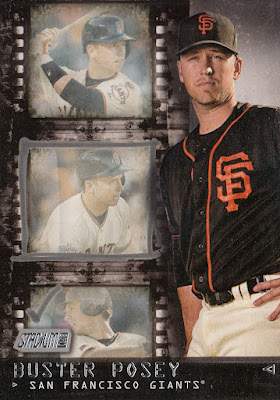
2016 Stadium Club Contact Sheet #CS-8 Buster Posey

As you have likely heard by now, Buster Posey announced his retirement. Spending his entire career as a catcher for San Francisco, he won three World Series with the Giants, as well as a Rookie of the Year award, an MVP award, and seven All-Star selections. Twelve seasons might seem like a relatively short career, but catcher is a grueling position, and the broken leg he suffered in 2011 led to the current rules we have around blocking the plate and the sliding lane.

Still, at just 34, he's not the only one to step away from his sport when he probably had some good years left. Andrew Luck of the Indianapolis Colts comes to mind, and there's speculation that Posey just made a tremendous amount of money as an early investor in BodyArmor, a sports drink brand that Coca-Cola just acquired for $5.6 billion.

Back in 2016, Posey found himself in numerous Stadium Club insert sets. I picked up this one from the 10-card photography-themed Contact Sheet set, which I've seen before (I'm at 50% completion!). One of the filmstrip photos of Posey shows the "LON" memorial patch the Giants wore in 2015 for Lon Simmons, the team's longtime broadcaster. The card back mentions his two grand slams in late June 2015, and if you're curious whether he hit either of those against the Rockies, he did not. They were divisional, though, as they came against the Dodgers and then the Padres.

Now is probably a good time to share the highlight of his final MLB hit, a two-out double in Game 5 of the NLDS against the Dodgers.
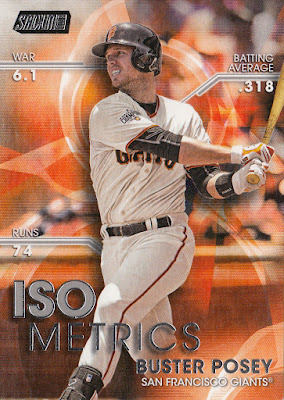
2016 Stadium Club ISOmetrics #I-24 Buster Posey

Elsewhere in the 2016 Stadium Club master set, Posey was included in the 25-card ISOmetrics insert set, heavily color coded for a Giants player. I've seen this set a couple times too, although I'm far from completing it. 

The season-specific stats Topps highlighted on the card front here are pretty representative of his overall career. His batting average dipped a bit since 2015, as is true for the entire league. 74 runs scored isn't even a career high for him, but is quite excellent for a catcher. And 6.1 WAR in a season is also excellent, although neither Fangraphs nor Baseball-Reference list 6.1 for his 2015 WAR. That complex calculation has evolved over time, and varies depending on whom you ask, so I won't say it's an error. For all I know, Topps has their own WAR calculation.

Posey's fWAR for 2021 was 4.9, ranking among the highest WARs any player has ever put up in the final season of their career, and many players near the top of that list were involved in the 1919 Black Sox scandal.
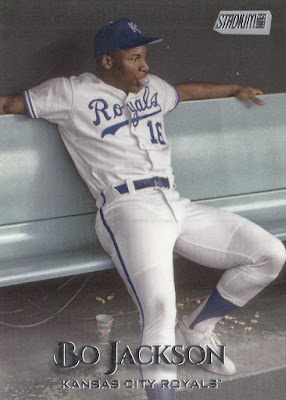
2019 Stadium Club #178 Bo Jackson

Moving forward a few years in the history of Stadium Club, I found a couple base cards from 2019. First was a relaxed Bo Jackson at the height of his baseball career with the Royals, casually blowing a bubble in the dugout.

Bo Jackson's career will always be one of the great what-ifs in baseball lore. Without getting into the gory details, a freak injury he suffered in an NFL game led to the need for a hip replacement, ending his football career and impacting his MLB career. He attempted a comeback, but it was not to be. It's a real shame, because he could have been one of the all-time greats.

Buck O'Neil used to tell a story about a particular sound he heard once in a great while, a crack of the bat unlike any other. "Like a stick of dynamite going off," he said. In a lifetime around the game of baseball, he said he heard it three times. First from Babe Ruth. Second from Josh Gibson. And finally from Bo Jackson.

Joe Posnanski tells it better than I could ever dream to.
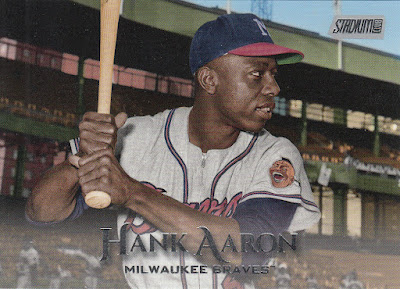
2019 Stadium Club #54 Hank Aaron

The last Stadium Club card I picked was of Braves legend Hank Aaron, who sadly passed away earlier this year. The Atlanta Braves were able to win the 2021 World Series in six games over the Astros, a fitting tribute to one of the greatest players of all time. The Braves won 88 regular season games this year, 44 before the All-Star Break, and 44 after. We also find ourselves in the 44th week of the year, which Vin Scully pointed out on Twitter.

And of course, Hammerin' Hank's uniform number was 44, which we saw mowed into the outfield grass at Truist Park.

This particular photo was from when the Braves were playing in Milwaukee, as you can tell by the letter M on Aaron's cap. That narrows this down to some point between 1954 and 1965, before the Braves departed for Atlanta in 1966. It would be another 20 years past that before they finally got rid of that logo on Aaron's left sleeve.
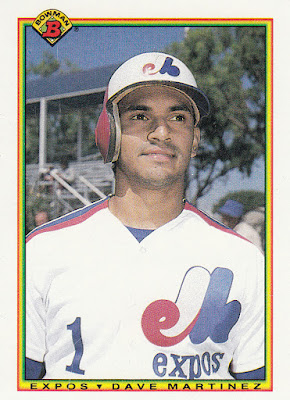
1990 Bowman #121 Dave Martinez

We'll come back to the discount box in a bit, but first I wanted to cover a few other affordable collectibles I found scattered throughout the store. First was a factory set of 1990 Bowman, priced at around $5 or $6. I'll never turn down a complete set for those prices. 

1990 was the year Bowman mercifully decided to get with the times and go with standard card dimensions, abandoning the 1950s-era size that won't fit in 9-pocket pages. It's a simple design, not deviating much from the 1989 design other than adding the player's name and team at the bottom in lieu of a facsimile signature.

It wasn't a particularly remarkable purchase otherwise except for one thing. This shopping trip was less than a week after the Nationals won Game 7 of the 2019 World Series. Then, as now, the team was managed by Dave Martinez, who once played for the Montreal Expos. The Nationals franchise, of course, was once known as the Expos, but that wasn't the weird part. The weird part was that there was one particular card facing the other direction inside the box. As best I could tell the set was still factory sealed, but somehow, after all those years, I found one card in the middle facing the wrong way, against the slight curl of the rest of the cards.

Dave Martinez.
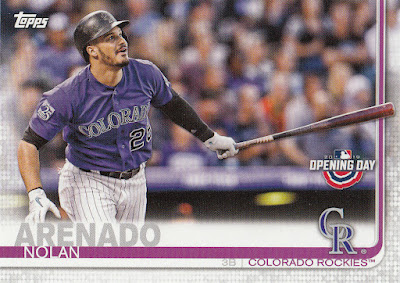
2019 Topps Opening Day #31 Nolan Arenado

I found some current packs toward the front of the store, and I selected one from 2019 Opening Day. I always enjoy the set no matter how far we are from the actual occasion. And I've enjoyed several variations of this well-cropped horizontal photo of Nolan Arenado the past couple years, even though it is significantly less festive than last time I saw it.

Little did I know at the time Nolan wasn't going to be playing for the Rockies by the time I got this post up. It's basically a foregone conclusion that Trevor Story won't be coming back, and the latest news is that Jon Gray isn't likely to reach a deal either, even though he's the only one of the three who actually wants to remain with the team.

At least Charlie Blackmon will be around for another year.

1998 Pinnacle Inside #109 Tony Clark

Although none of that may end up mattering much anyway, because MLB is hurtling headlong towards another labor dispute. I only mention it here because former Tiger Tony Clark is now the executive director of the MLB Player's Association, so his name will likely be in the news plenty this offseason.

Shortly before their bankruptcy, Pinnacle released the Inside brand for a second year. This slightly blurry photo of Tony Clark is flanked by a few of his 1997 stats, much in the same style as Buster Posey's ISOmetrics card. I got a whole pack of these, and I still have the can they came in.

Yes, the can. Like a can of tomatoes.

Pinnacle was out there. So was Pacific. The hobby is poorer without them around.

Now, back to the discount box.
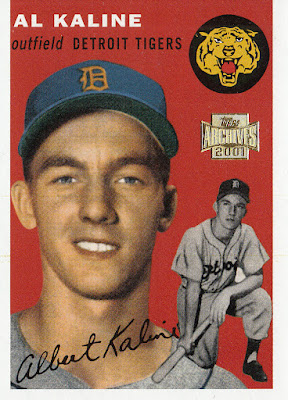
2001 Topps Archives #245 Al Kaline 54

By now, we've probably had our fill of Topps reprints, but in 2001, Topps Archives was pretty exciting. This isn't quite as alluring as the refractor-finish Archives Reserve set that year, but it's printed on actual cardboard and is surprisingly thick. In other words, it's a reprint that has the general look and feel of the original card, gold foil seal notwithstanding. Also the '54s were slightly larger than the standard size we know today. Just like '89 Bowman and Topps Big, which were my first exposure to the 3 3/4" x 2 5/8" size.

Sadly, like Henry Aaron, Al Kaline is no longer with us. He passed away on April 6th, 2020, and I wrote a tribute post at the time. But back in 1954, he was a young rookie, destined for great things. He didn't make it into the 1953 set, so this '54 is his Rookie Card. It would definitely cost a few hundred bucks to get a relatively nice original, so I'm happy with a $1 reprint.

For now.
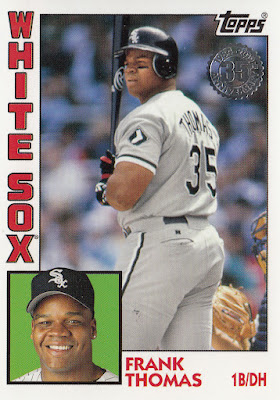
2019 Topps '84 Topps #T84-30 Frank Thomas

Frank Thomas didn't get a ton of Postseason playing time during his Hall of Fame career, but he's a regular fixture on the broadcast team now, right next to David Ortiz and Álex Rodríguez. Topps gave him a card in their 1984-themed 35th Anniversary set in 2019, and this time The Big Hurt is holding an actual baseball bat, not that famed piece of rebar.
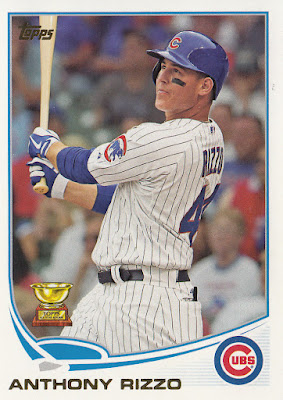
2017 Topps Update All Rookie Cup #ARC-21 Anthony Rizzo

But as an example of reprints getting a bit out of hand, here's a 2017 card of Anthony Rizzo, a mere four years after the original came out. The gold foil clearly differentiates it from the actual 2013 base card it replicates, but Topps still saw fit to include the word "REPRINT" on the card back to avoid any confusion.

The card itself is from a 50-card insert set found in 2017 Topps Update, which focused on the history of the Topps Rookie Cup. Rizzo did get one on his card in 2013, and he shares the checklist with players new and old. Buster Posey, Stephen Strasburg, Lou Brock, and many more. The card back has large images of the two Topps Rookie Cup versions found on cards throughout the years, and an explanation of Rizzo's 2012 season that earned him one.

I'm sure this is the 1990s kid in me talking, but I have to say I like the gold foil on the 2013 design more than the silver foil Topps originally used. Not that you could tell either way from the scan.
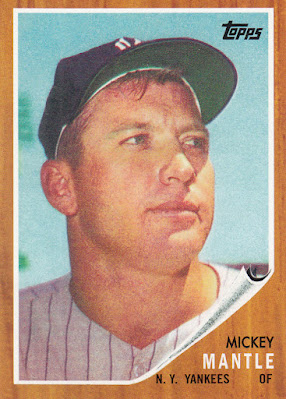
2010 Topps Cards Your Mom Threw Out #CMT-11 Mickey Mantle

Reprints do have their place, and for the longest time I relied on them to learn the vintage designs and keep some of my dad's idols in my collection. I eventually remedied that, but I still enjoy the 1962 Mickey Mantle in whatever form it takes. 

This one is from the famous 2010 "Cards Your Mom Threw Out" insert set, something Topps put out with absolute confidence during the first year of their monopoly. It spanned 174 cards across three series, and features some of the most iconic Topps cards of all time, starting with the '52 Mantle at card #CMT-1.
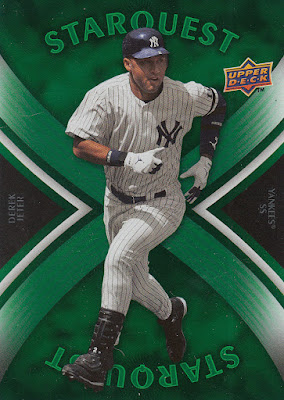
2008 Upper Deck First Edition StarQuest #SQ-9 Derek Jeter

Even as we get further away from a time where Upper Deck had a presence on the baseball side of the Hobby, I still can't get enough of these green Starquest cards. It's such a pleasing shade of emerald and they will practically jump out of any discount box right into my hand.

Derek Jeter was officially inducted into the Baseball Hall of Fame just a couple months ago, but the actual vote that put him there was about to get underway a mere two weeks after I visited All C's. No one was surprised that he was a first-ballot member, but the identity of the lone voter who left him off their ballot remains a mystery, and ensured that his longtime teammate Mariano Rivera would be the only unanimous inductee for the foreseeable future.

By the way, Derek Jeter has another connection to this post. He is the star player depicted on my can of 1998 Pinnacle Inside. I opened it on the bottom for display purposes, and a smiling Jeter in a warm-up jacket is pictured on the front.

I mean, it's a cylinder, so there technically isn't a "front" of the can, so to speak, but nearer the seam on the "back", there's a nutrition facts-looking label called "Product Facts". The serving size is 10 cards, and there is 1 serving per container. The pack odds are given, and we are promised that we're getting 100% of our % Daily Value of Collectability (sic), Top Players, Inside Info, and Cool Inserts.

Pinnacle very accurately and loudly proclaims that the Inside '98 set is "THE ONLY BASEBALL CARD IN A CAN!" It really was unique but it takes up so much space to package, ship, and store cards that way. It isn't particularly kid-friendly, either. Pinnacle was sure to stamp on the top of the can to "Open with adult supervision". I managed to do it without leaving a sharp edge, but this product was a lawsuit waiting to happen.
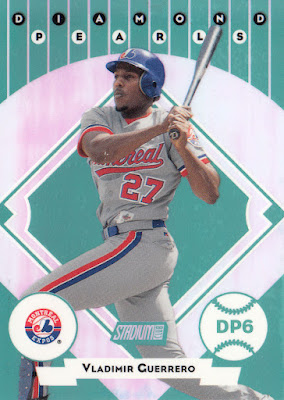
2001 Stadium Club Diamond Pearls #DP6 Vladimir Guerrero

After his son wrapped up his rookie season in 2019, I found a card of Vladimir Guerrero, Sr. He was part of the 20-card Diamond Pearls insert set from 2001 Stadium Club, the set that tends to have stickier cards than perhaps any other. This one doesn't seem too bad, but the surface does look a little bumpy to me. Maybe even slightly blistered.

In any case, this card became accidentally relevant during the 2021 Postseason, thanks to Joc Pederson's unique fashion choice of a string of pearls. He's quite the character, and he now finds himself on a short list of players who won the World Series in two consecutive years with different teams.
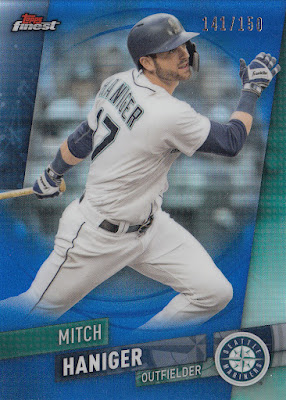
2019 Finest Blue Refractors #57 Mitch Haniger /150

I've never opened a box of Topps Finest, but I seem to have no trouble finding the occasional gem from the expensive set, like this beautiful Blue Refractor numbered to /150.

Alas, despite all this talk of the Postseason and the World Series, the Mariners haven't quite been able to sneak in for twenty years, though they got tantalizingly close this year. Outfielder Mitch Haniger has been one of their stars, and even has an All-Star appearance to his name. 

The card back tells us about his highlights on June 12th, 2018 against the Angels. Topps got the details...sort of accurate? Haniger did have a home run and an outfield assist that day, but they got the innings all wrong and they incorrectly imply that Haniger's homer was of the walkoff variety.

Incidentally, if you've ever been curious about how to pronounce my last name, it's pretty similar to Haniger. I have a couple extra consonants in there, but that's the general sound. It rhymes with Gallagher.
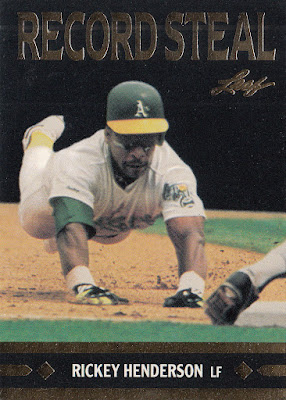
1991 Leaf Gold Rookies #BC26 Rickey Henderson DP

Finally, I couldn't pass up any early '90s insert with this much gold foil. Leaf really pulled out all the stops for this bonus card. Believe it or not, it's actually the final card of a 26-card insert set called Gold Rookies. Lots of prospects fill out that checklist, like Ryan Klesko, Mike Mussina, and Mo Vaughn.

Sharp-eyed readers will notice that Rickey Henderson, was not, in fact, a rookie in 1991. Nor was Nolan Ryan, who is also in this checklist. But Leaf decided that honoring Rickey Henderson's record-breaking 939th stolen base and Nolan Ryan's 7th no-hitter were worth disrupting the overall theme of a Rookies set. I can't say I disagree.

A well-stocked LCS, especially one that's been in town for so long, always has surprises. Including some fresh, sealed 1998 air.


Monday, November 11, 2019

A more local LCS (Part 3)

We come to the end of our three-part series on my trip to Colorado Sports Cards, the newest and closest-to-me LCS in the Denver area. Part 1 saw all the affordable goodies you'd expect to find at a card shop, and Part 2 a bunch of Topps Archives from a consignment box in the center of the store. Part 3 will wrap things up, containing everything other than Topps Archives I pulled from the consignment box.

2017 Topps Gallery #90 Eric Thames
Topps Gallery was one of the high-end brands Topps released in the late-'90s, and I regained a bit of familiarity with it in a recent organization project. Cards with artist-painted artwork as the primary image might seem recent, or perhaps a holdover from the overproduction era (read: Diamond Kings), but card artwork goes back to the very earliest days of not only Topps, but also to the very concept of a baseball card. Topps Gallery carries on that tradition, with this particular card of Eric Thames featuring artwork by Mayumi Seto.

Eric Thames is wearing a throwback Brewers jersey on this card, but once the 2020 season arrives, we'll see the classic "MB" return to the field as the primary logo. Whether slugger Thames will return to the Brewers is an open question, but as the club declined their option on him, he'll likely suit up elsewhere in the league next season.

Thames is perhaps best known for his amazing flurry of eleven home runs in April 2017, which is mentioned on the card back and remains a Brewers record. He honed his swing in the Korea Baseball Organization (KBO) and upon his return to the Major Leagues, was swatting balls out of Miller Park left and right, taking the April home run title away from Trevor Story.

2008 UD Masterpieces #64 Joba Chamberlain
Upper Deck joined in on the artwork card trend, giving us two of their best-ever sets, 2007 and 2008 Upper Deck Masterpieces. If there was ever a reason to advocate for UD getting an MLB license again, Masterpieces is it. They were only 90 cards, making them easier to complete than some recent Topps insert sets, and they were also some of the most beautiful sets to ever come out of the Upper Deck factory.

This was the only Masterpieces card I found that day, depicting Yankees reliever Joba Chamberlain. He played in the shadow of Mariano Rivera, but was a member of the Yankees when they won the World Series in 2009, and is perhaps best-known for being attacked by a swarm of midges in Cleveland during the 2007 ALDS. This card doesn't say anything about that, but does tell us that he delivered a 0.38 ERA in his rookie year of 2007.

2018 Topps Chrome Prism Refractors #28 Gregory Polanco
Artwork cards require a certain deliberate appreciation, but reflective cards like Topps Chrome quite literally have that "shiny object" attraction. I'm happy to have both in my collection. This Gregory Polanco card is more than just shiny. Rather, it's what I think is a Prism Refractor. It's shiny, sure, and the background pattern looks like what you'd get if a hummingbird's feathers got stuck in a baseball card. It's more subtle than in past years, with more obvious patterns like 2011 "liquorfractors" coming to mind, but it works pretty well with the recent borderless Topps designs.

2018 Topps Chrome #51 Ian Happ
Ian Happ's card is just of the normal Chrome variety, which makes the bottom banner shiny and the Wrigley Field ivy alarmingly dark. It's hard to tell exactly which position Happ is playing in this action photo, because he plays all over the field. His home run count has declined since his rookie total of 24, however he's a valuable utility player who appears to be filling Ben Zobrist's shoes on the Cubs roster. Managers might be willing to accept a bit less power at the plate if they know they can slot you in anywhere. And with Kyle Schwarber in left field, who singlehandedly makes a case for the NL adopting the Designated Hitter rule, Happ may one day have even more opportunities to cover left field in Wrigley.

And as we all know, strange things happen in Wrigley's left field.

2018 Donruss Variations #225 Anthony Rizzo RETRO
Happ's teammate, Anthony Rizzo, appeared in the same retro 2018 Donruss subset as Nolan Arenado from about a month ago. Like Topps, the Donruss brand has been around long enough to repurpose many of their classic designs for reprints. The 1984 set is a great choice, but I doubt they'll get the same appreciation if they reuse the 1991 design.

As the card back tells us, Anthony Rizzo, who just won his third Gold Glove, is heavily involved in philanthropic activities. He's a cancer survivor, and his foundation has raised millions of dollars for cancer research and healthcare. Panini may not be able to use MLB team names and logos, but a close look at Rizzo's right batting glove lets us see the ribbon logo of his foundation.

2019 Donruss Variations #181 Blake Snell
Sometimes Panini looks back at classic Donruss sets, and sometimes they give us easy-to-spot variations. Like Topps, some of the variations just use a different photo, so you either have to be an expert or have good reference material on hand. Apparently that is the case with Rizzo's card, which is a variation I had no idea about until I looked it up on Beckett. But other variations use the player's nickname in addition to an alternate photograph to differentiate, like this Blake "Zilla" Snell card.

I prefer the latter. Who has time to be checking their cards for little sparkles or wondering whether the photo on the front is anything out of the ordinary?

Panini has been doing the nickname variation for a few years with the Donruss brand, and I once received a variation of Daniel Murphy's card from the 2017 set, courtesy of Nick. I had no idea at the time that "Murph" would one day become a Rockie.

Blake Snell, one of the few players in this day and age with a nickname that isn't simply a slight alteration of his actual name (i.e. "Murph"), won the AL Cy Young Award in 2018. He regressed significantly this year, so he isn't a finalist for the 2019 award, but his teammate Charlie Morton is.

2018 Finest #39 Wil Myers
Back to shiny, this time in the form of 2018 Topps Finest. The mirror finish is nice, and reminds me of something like Fleer Brilliants or Pinnacle Certified, but that's an awfully busy background design. The card back is a little more interesting in this case, as we get a complete history of cycles hit by the San Diego Padres.

After close to a half-century of games, Matt Kemp finally hit for the cycle for the first time in Padres history. That happened on August 14th, 2015. Not long after that, on April 10th, 2017, Wil Myers hit for the second Padres cycle. Careful observers will note that both those feats were accomplished at Coors Field.

That leaves the Miami Marlins as the only remaining team without a cycle.

They will be visiting Denver from July 20th-23rd, 2020.

Interestingly, the Padres are still on the hunt for their first franchise no-hitter. Their chances of finally crossing that off the list will likely depend on whether they sign one of the free agent ace pitchers this offseason.

2008 SPx #57 Johan Santana
For the longest time, the Mets were the team who had gone the longest without a no-hitter following their inception. They had played just over eight thousand games before Johan Santana managed to finally throw one in June 2012. There is debate about whether that feat put an end to Santana's career, but the Mets finally got that elusive performance. The Padres didn't start until 1969, so it took them until this past spring to surpass the Mets' no-hitter drought.

I can't resist the die-cut pattern of 2008 SPx. I'll buy this every time I come across it. In fact, it's the third time I've had it on the blog.

This card is yet another example of how these posts practically write themselves. I did not know that Wil Myers hit for the cycle in Coors Field, let alone that his 2018 Topps Finest card mentioned it. Nor did I have a deliberate plan to follow it up with the pitcher who threw the only no-hitter in Mets history. But that's how it worked out. And while this SPx card pictures Santana with the Twins, the logo and team name clearly indicate this is a Mets card. It was printed right around the time the Twins traded the two-time Cy Young winner to the Mets for a bunch of prospects, including Philip Humber, who would somehow toss a perfect game before Santana would break that minor curse for the Mets.

In case you were curious, the only player still active as part of that 2008 trade is Carlos Gómez.

2008 Topps Allen & Ginter Mini #262 Mark Spitz
As much as I don't want to admit it, we are in the offseason. I suppose that makes it appropriate to have a non-baseball sports card. Minis, and especially these cigarette-card-sized minis, can be hard to find in a five-row card box. They have a tendency to slip out of stacks, especially when the curly 2010 Chrome is anywhere to be found in said stack. Even so, this mini of swimming legend Mark Spitz survived the journey.

2008 Allen & Ginter was released just weeks before the 2008 Beijing Olympics, the Games at which Michael Phelps broke Mark Spitz's record of seven gold medals in one Olympics, winning a whopping eight. Phelps may have come away from Beijing with a little more hardware than Spitz had when he left Munich in 1972, although technically they tied each other by setting seven world records. One of Phelps's eight races wasn't quite done in world record time.

Olympic Games are four years apart, so depending on the sport, you do see repeat participants and winners over the years. Certain sports like gymnastics and figure skating don't lend themselves quite as well to dynastic domination as swimming or snowboarding. Spitz is known for his 1972 Olympics, but this card back informed me that he also won four medals in Mexico City in 1968, including two golds.

Tokyo 2020 will mark the first Olympics in two decades that won't feature Michael Phelps in the pool. He didn't medal, but his Olympic career began way back in 2000 in Sydney, just a few months after Johan Santana began his Major League career.

No-hitters and cycles are impressive, of course. But one of the most amazing sports moments I can remember was when Michael Phelps edged out his opponent by a hundredth of a second to win one of those eight golds.

I guess the offseason isn't so bad, especially when there are Winter Olympics every four years. The next Winter Games will next take place in 2022, also in Beijing.

Maybe the Padres will finally have their no-hitter by then. Or at least the Marlins might have a cycle.

Sunday, October 13, 2019

An LCS Survivor: Bill's Sports Collectibles (Part 2)

After digging through the dollar box, my attention turned to the packed shelves and tables inside Bill's Sports Collectibles in Denver. Go back and have a look at Part 1 if you want a refresher. I was surprised by a few things in there, but what I found elsewhere in the store was even more unexpected.

1988 Denver Zephyrs CMC #24 Darryl Hamilton
Denver had long had its eyes on a Major League Baseball franchise, but from the mid-'50s until 1993, the highest level was only a Triple-A team. First known as the Bears, then later the Zephyrs, they shared Mile High Stadium with the Broncos.

Bill's was in business way back when the team was still known as the Bears, so that they still have Denver Zephyrs team sets lying around shouldn't surprise anyone. This 25-card 1988 set from a company called CMC is actually quite scarce. According to Beckett, there were only 10,000 sets produced.

At the time, the Zephyrs were an affiliate of the Milwaukee Brewers. Darryl Hamilton made his debut with the Brewers the very same year as this card. Without digging too deeply, I believe he is one of just two players in this set to later return to Denver as a Colorado Rockie, which he did in the late-90s. Sadly, he passed away in 2015.

The card back doesn't specify Hamilton's birthdate or birthplace. Rather, it says: "Born: Age 23".

Just one of those goofy errors you probably won't see outside of an oddball set like this.

1988 Denver Zephyrs CMC #1 Mark Knudson
Mark Knudson got card #1 and it has taken a beating over the years. He had some Major League experience by 1988 but spent much of his career getting called up and being sent down. Most of his time in the big leagues was spent with the Brewers, but he did wrap his career up with the inaugural 1993 Rockies.

Knudson. a Denver native, only appeared in a few games with the early Rockies, but he does have the distinction of being the first Coloradan to play for Denver's big league club, paving the way for Kyle Freeland. He's still active in Denver-area sports, and he did some sports radio work as well. In fact, I recall him as the analyst who interviewed Joe Girardi on the radio after an autograph signing at the Rockies Dugout Store in Boulder.

1988 Denver Zephyrs CMC #15 Charlie O'Brien
Charlie O'Brien and Mark Knudson were certainly a battery for the Denver Zephyrs, and O'Brien had some big league experience under his belt by 1988, too. I remember him more as a Met, but he spent about as much time with the Brewers. He came back to Denver, in a sense, as a member of the 1995 Atlanta Braves. The Braves, of course, beat the Rockies in the 1995 NLDS, which partially took place just a few exits away from Mile High Stadium on the other side of Downtown Denver.

1988 Denver Zephyrs CMC #5 Paul Mirabella
I'm not familiar with Paul Mirabella, but I picked this card because it was the only card in the set that showed a slightly different angle of Mile High Stadium. He has his back to right-center field, and we can see the edge of the stands with more of the second level in view. The seats in that level were blue in the lower rows and orange in the upper rows, which of course are Broncos colors. The camera isn't panned far enough right to see the Ring of Fame, a feature that has been carried over to the new Broncos stadium, which most people in Denver still just call Mile High anyway. Partially that's because of tradition, and partially it's because fans can't keep track of which company is the latest one to buy the naming rights.

As of September, the new Broncos stadium is now officially known as Empower Field at Mile High, which precisely no one is going to use.

Those are the highlights of the Denver Zephyrs team set. I made one other purchase that day, and I think I may have unearthed an overproduction-era surprise.

1993 Toys 'R' Us #42 Mike Timlin
I became a baseball fan in 1993. Other than two packs when I was younger, I became a baseball card collector in 1993, as well. I thought I had a pretty good handle on things that year. Fleer, Topps, Upper Deck, I know them all. 1993 takes up two binders in my collection, not to mention all the factory sets. Even the lesser-known sets like Triple Play, Studio, and more have a place. It's not like the late-'90s when there was far too much to keep track of. I can even tell 1993 Ultra from 1992 Ultra. I knew it all, or so I thought.

So what the heck is this thing? Do you recognize this set? Have you ever seen it? Because I had absolutely no idea it existed.

What we're seeing is a card from 1993 Toys 'R' Us, a one hundred card set that was co-branded with Topps Stadium Club and packaged in a little 3D plastic case that was meant to look like a Toys 'R' Us store. It also came with a few 5" x 7"-sized "Master Photos".

Ringing any bells?

I've been on the blogs a long time and this is completely new for me. Granted, this set is pre-Rockies and pre-Marlins, so it makes some sense that it's not in my collection, but I've never even seen anything from it. Not the Toys 'R' Us logo on the blogs of the oddball collectors. Not this backwards-hat autograph-signing shot of Mike Timlin, which is just begging to be in a mini-collection. Not the Piazza, the hot rookie that year. Not even the Griffey.

1993 Toys 'R' Us #23 Larry Walker
This Expos-era Larry Walker card is about the closest thing to a Rockies card as you'll find in this set. Pedro Astacio is in it as well. Gary Sheffield is too, if you're looking for a Marlins proxy.

So now that there's yet another Stadium Club set out there that's eluded my knowledge for over a quarter century, what are we looking at here? Well, this is broken up into three subsets: Young Stars, Future Stars, and Rookie Stars. You can tell which is which in gold foil above the nameplate and the signature backwards "R" of the Toys 'R' Us logo. Most of the players you've heard of fall into the "Young Stars" category.

1993 Toys 'R' Us #33 Iván Rodríguez
Players like, oh, I don't know, Iván Rodríguez? Whose son Dereck is now pitching for the Giants, teammates with Carl Yastrzemski's grandson. It's a great action shot, watching a young Pudge waiting for a foul ball to return to Earth. We also learn that the colorful Toys 'R' Us logo can appear in either upper corner.

On the card back, each card has a date for a key milestone in the player's career. His first home run was on August 30th, 1991. His first four hit game was on July 2nd, 1991. Larry Walker's first double was on April 10th, 1990.

1993 Toys 'R' Us #17 Ryan Thompson
Here's one of the Future Star cards, which is really not different design-wise. It's just a subset with fewer players who actually did turn into stars. This card does look pretty familiar, but that's probably because it's similar to both his 1993 Topps and 1993 Stadium Club cards, showing him leading off of first base with a Pittsburgh Pirate in the background. This is probably from his same trip to first base in Shea Stadium.

1993 Toys 'R' Us #11 Pat Mahomes
Rookie Stars is the third and final subset, and this card caught my eye. Any current NFL fan will recognize the name Pat Mahomes, because his son, Patrick, is the starting quarterback for the Kansas City Chiefs and last year's NFL MVP. Pat, the dad, didn't have nearly as much success in Major League Baseball as is son is having in pro football, although his career did span eleven years.

So there are a hundred cards like that in a little black box, but I also mentioned something called a Master Photo. What's that?

1993 Toys 'R' Us Master Photos #3 Carlos Baerga
Inside the packaging, you'll find about a dozen of these 5" x 7" prints, effectively a partial parallel set. All of the Master Photos are from the "Young Stars" subset. They're unnumbered with a plain back, but the photos match the actual cards in the set. Beckett did assign a card number for each, but there's no sign of one anywhere. The photo itself is slightly larger than a standard 2.5" x 3.5" card, and the inner gold border approximately matches the dimensions of a standard card, giving you the impression that that's where you cut it. Both rectangular borders, the stripes at the top, and all the gold foil take on a rainbow foil appearance in the Master Photo series.

Carlos Baerga had one of the better photos to pick from, a great double-play shot over a sliding Sam Horn of the Orioles.

1993 Toys 'R' Us Master Photos #12 Frank Thomas
Frank Thomas, one of the darlings of 1993 baseball card collecting, got a Master Photo too. The Hall of Famer is wrapping up the ALCS postgame show with a few other retired stars as I write this, but back then, he and Griffey were the key players in any baseball card set.

And I don't remember seeing this in Beckett back then, either. But according to their website, there were 7,500 cases of this product produced. It's just a little unsettling, knowing I have three cards from the 1993 Milk Bone set, for example, yet in all my travels have never glimpsed this thing. Like it's a snow leopard or something.

Don't get me wrong, I like discovering new things. I just worry I'll be drummed out of the ranks for not knowing about a set this big from my first year of collecting, especially given how much 1991 Score I bought with my allowance at Toys 'R' Us that was probably sold right alongside this set.

Anyway, they're like eight bucks plus shipping on eBay right now if you want one. And if you find yourself in Denver, Bill's probably has a few in the back.


Saturday, October 12, 2019

An LCS Survivor: Bill's Sports Collectibles (Part 1)

Playoff baseball affords such a great opportunity to get a bunch of posts hammered out. In past years I've gotten some big organization projects done, but this year is a writing year. On tap for today, this two-game LCS day (that's League Championship Series, not Local Card Shop as in the title), I'm diving into my dollar box finds from what might be the oldest card shop in the Denver area, Bill's Sports Collectibles on South Broadway.

This trip was actually quite some time ago, and I found a great variety in both the dollar box and on their shelves, so be sure to come back for Part 2!

1992 Triple Play Gallery #GS-3 Jack Morris
Last time I saw a card from 1992 Triple Play Gallery was when Wes was still regularly blogging. He sent me the Cal Ripken, Jr. card from the lone insert set found in packs of '92 Triple Play. Jack Morris, who had just joined the Blue Jays following his MVP performance with the Twins in the 1991 World Series, also appeared in the 12-card set. Gallery obviously featured the artwork of Dick Perez and a healthy amount of silver foil.

Morris reached three World Series with three different teams, and won them all. At the time this card was printed, he had a 4-0 record in his World Series starts. He'd drop a couple games in the 1992 Series with the Jays, spoiling that perfect record, but still came out on top. Some years later, he found himself in Cooperstown, but not everyone in the set was so lucky. Sharing this small checklist with Ripken and Morris were some lesser stars, guys like Ryan Klesko, Frank Viola, and Bobby Bonilla. They're still in the conversation after their retirements, but are more likely to be found in the proverbial Hall of the Very Good.

2011 Topps Update Diamond Anniversary #US80 José Bautista
2011 really doesn't seem that long ago, but most of the participants in the 2011 Home Run Derby have since retired. That seems to include José Bautista, who did not play during the 2019 season. He is unlikely to make it to Cooperstown, but he made quite a name for himself as a power hitter in the early 2010s, punctuated with the Greatest Bat Flip of All Time. Any time the subject of either bat flips or Division Series Game 5s come up, he's sure to be mentioned.

He didn't advance past the first round in the 2011 Derby held in Phoenix, but his participation earned him a Topps Update card and all the sparkly, shiny variants that go with it. Not quite a Liquorfractor, but still cool. Regardless, the hunt for Mike Trout's Rookie Card makes this a tough set to unearth, at least cheaply. Although, Charlie Blackmon's Rookie Card finds its way to me surprisingly often.

2017 Topps '87 Topps #87-52 Jose Canseco
One thing that's decidedly easier to unearth is 1987 Topps and its various reprint offshoots. I have a giant stack of it sitting near my duplicates box that was basically collateral damage in a recent thrift store find. I was more interested in the 1984 and older Topps, plus (gasp) 1988 Donruss.

Anyway, back in 2017, Topps took advantage of the 30th anniversary of the iconic set, and this reprint set grew to a cavernous 200 cards across the two flagship series that year. I've seen it at least three times, and I clearly can't stop myself.

The A's logo was a bit different on the originals, and Jose Canseco actually had a Topps Rookie Cup on his real 1987 card. The Jackie Robinson patch on his right sleeve dates this photograph to 1997 during his second brief stint with the A's. The Red Sox traded him back to Oakland that year for a real pitcher, John Wasdin.

John Wasdin, of all people, joined the Rockies as part of a trade-deadline deal in 2000 for Mike Lansing, the headliner from a couple posts ago. There are a few guys in that trade who I never knew were Rockies.

1991 Upper Deck #HH1 Hank Aaron Hologram
Upper Deck was still sort of feeling things out in 1991, which led to things like a single-card insert set. It seems a little bit like cheating to put this Heroes of Baseball card on my "Completed Sets" list, but it really is the only one with this type of card number. Beckett lists it as part of the 1991 UD main set, but I am choosing to ignore that.

I'm glad it scanned reasonably well, because it's a full hologram of a later-career Hank Aaron, complete with a Heroes of Baseball logo in the lower right. It's quite stunning, as full hologram cards tend to be. The card was created as a promo for the Heroes of Baseball series, basically an Old-Timer's game that Upper Deck sponsored. They made quite a big deal about it on the card back, which feels almost like a sticker. Supposedly, these Upper Deck Heroes of Baseball games were played in Major League stadiums prior to actual games, but I can find very little information about them. If they did happen, they may have been lost to history.

There are a small handful of similar non-hologram cards out there, but it seems that the Heroes of Baseball series was much less of a big deal than Upper Deck wanted it to be. Does anyone know more about these games, or better yet, did you see one in person?

1993 Bowman #27 Shawn Green
While you're very unlikely to find a Mike Trout rookie card in a dollar box (or 12-for-$10, whatever this was), finding early cards of players who went on to become big stars isn't too difficult. Most of us remember Shawn Green as a Dodger or maybe a Met, but he began his career with the Blue Jays. He wore the number 15 for most of his career, but he appeared in three games with Toronto in 1993 wearing #56, which we can see on the card back. It looks like he has that number written on the knob of his bat, but a closer look reveals that it's actually his initials, the similar-looking "SG".

When Bowman told us "he owns plenty of power potential", I doubt even they knew he would one day put himself on the very short list of players who hit four home runs in a game. That feat is roughly the hitter's equivalent of pitching a perfect game, and the list of perfect games is actually slightly longer. On the 4-HR list, you'll find a wide variety of players who had lightning strike four times. Hall of Famers like Lou Gehrig and Willie Mays, bigger stars of their day like Bob Horner and Carlos Delgado, and complete surprises like Scooter Gennett and Mark Whiten. Whiten, for example, hit around 4% of his career home runs just in that one game.

The Perfect Game list reads pretty much the same way. There aren't too many lists you'll find that contain both Randy Johnson and Philip Humber.

2003 Topps Traded #T181 Hanley Ramírez FY (RC)
I noticed Topps' 1st Year Card logo the other day on a Clint Barmes card, and here it is again on Hanley Ramírez's Rookie Card. Most of us remember the splash he made with the Florida Marlins (pun not intended), winning the 2006 NL Rookie of the Year. He made headlines more recently after signing a massive and ill-fated contract with the Boston Red Sox. But few realize that was technically his second stint with the Red Sox, as he debuted as a substitute in a pair of blowout wins for Boston late in the 2005 season. He struck out twice.

His performance fell off a cliff, and while he did get some playing time with Cleveland this year, his future as a big-leaguer remains uncertain.

1990 Fleer #644 Tom Drees (RC) (AU) / Dann Howitt (RC)
With all these players so far being at least in the Hall of the Very Good, you might wonder why I picked a random prospects card from 1990 Fleer. I usually do go for on-card autographs when I find them in a discount box, but this one is special.

I've talked a lot over the years about my first pack being from 1987 Topps (there it is again), and that I can recall the couple dozen cards in it from memory. Well, my second-ever pack was 1990 Fleer, and this prospect card was in it. I don't have quite the same recollection of that 1990 pack, but I just thumbed through that factory set and recognized around a dozen with 100% certainty, including former Rockies Joe Girardi and Gary Wayne.

On the left, and whose signature graces this card, is Tom Drees. Drees appeared in a grand total of four games with the White Sox at the age of 28. He retired with a career ERA of 12.27, and that was that. His cardmate, Dann Howitt, spent a few years as a utility player in the American League, but didn't play past 1994. Both players had a career WAR of -0.3, but unfortunately Drees got there much more quickly.

I knew nothing about either player all this time until looking them up, but I love the sense of nostalgia I get from seeing this card enter my collection a second time.

2017 Topps Allen & Ginter Sport Fish and Fishing Lures #SFL-4 Bass
Departing the world of baseball entirely, we find ourselves in the land of Allen & Ginter insert sets. They've done some real oddballs over the years, and you might think that a set about fishing lures would take the cake. But this has a real connection to the early A&G tobacco cards from the 19th Century. They released a set in 1889 entitled "Fish from American Waters", so this pays homage to what an A&G set really looked like long ago.

I don't know much about fishing, but I do have a few good friends who tie their own flies and fish the high waters of the Rocky Mountains. I haven't done much beyond casting off a dock with live bait and a red and white bobber when I was about ten. I totally get the appeal of being outside and potentially catching your dinner, though. I've never been bass fishing, but this card is quite educational.

All fishermen have tales, and here's the closest one I can relate. At my previous job, I took a call from a prospective customer in New York. Interestingly, he was calling from Altenkirch, a sport fishing rod company that once counted none other than Babe Ruth and Lou Gehrig as customers. I'm unsure if they're still in business, but that was certainly one of the most memorable calls I took in over seven years at that job.

2008 Topps Allen & Ginter #92 Dan Jansen
2008 was fairly early in the life of the resurrected Allen & Ginter brand, and many of the non-sport cards were still fairly well-known figures. Think more Harriet Tubman and Albert Einstein than Guy Fieri. 2008 was the year of the Beijing Olympics, and Topps included a few former Olympians in the set that year. I found the card of Dan Jansen, the speed skater who finally won his gold medal in Norway in 1994.

Jansen was always a favorite, but despite competing in Olympic Games since 1984, he didn't have a single Olympic medal to his name. As the card back states, he competed in the 1988 Calgary games shortly after learning that his sister had died of leukemia. His string of bad luck in competition carried through 1992 and right into 1994, where he finally won a medal in his last race, and it was gold.

It would make an excellent 30 for 30 episode.

1971 Topps #210 Rod Carew
The final few cards are going to slot in nicely with my rather limited vintage collection. First up is Rod Carew's 1971 Topps card. Condition-wise, it's seen better days, and the black borders of 1971 are such that most cards don't hold up so well over the years. But still, a Rod Carew card for a buck? Yes, please.

Carew was an All-Star in every year of his career except the last. He won the AL MVP award in 1977, and held the Stolen Base record before Rickey Henderson demolished it in 1991. I haven't found great stats yet for how many times these players stole a base other than second, but this card says that Carew stole home a whopping seven times in 1969. You'd surely have to count back quite a few seasons to find seven recent steals of home.

The patch Carew is wearing isn't a memorial patch, rather it's the standard patch worn by the Twins for much of their early existence. It depicts the two twins, Minnie and Paul, shaking hands across the river with a large baseball in the background.

I had always assumed that Topps didn't include any player photos on the card back until 1993, but buying a little vintage corrected my thinking on that, as that design element was first used way back in 1971.

1961 Topps #63 Jim Kaat
Backing things up a full decade, here's the oldest one I found that day, from 1961. This is the first 1961 card in my whole collection, but actually my second Jim Kaat card. I don't know why the sudden influx of vintage Twins cards, but that's what came out of the discount box.

Kaat pitched well into his forties, and finally got his ring with the 1982 Cardinals, but his career began in 1959 with the original Washington Senators. 1961 was actually the first year of the Twins, so this card is a lot like like a 1993 Rockies or Marlins card. There's no team logo to be found, but this card may have been the first-ever look a 1961 collector got at the Twins. They weren't an expansion team, so maybe it would be better to compare it to a 2005 Nationals card.

Other than a little paper loss on the back (thankfully not over the cartoons), this is in surprisingly good condition for being almost sixty years old.

1967 Topps #355 Carl Yastrzemski
In conclusion, here is Carl Yastrzemski's 1967 Topps card.

The end.

No seriously, I can say a few words. Mainly that this is a Carl Yastrzemski card! And it's from his Triple Crown year, no less! Who cares that it's creased and looks like someone took a bite out of it? It's a Carl Yastrzemski card!

Before Miguel Cabrera in 2012, no one had won the Triple Crown since Yaz in 1967. It's not officially recognized, but some say he won the Quadruple Crown that year, because he also led the league in hits, on top of the usual Home Runs, RBI, and batting average statistics. He's the only Triple Crown winner in MLB history to do so.

We're even getting extra practice in how to spell his last name, because his grandson, Mike, currently plays for the San Francisco Giants.

The card back is a wealth of vertically-oriented mid-century goodness. There are a couple cartoons, a mention of his two batting titles, and even a bit about what Yastrzemski was up to in the offseason—a job with a Boston printing firm. Which blows my mind. We're in the $400 million contract era now, and one of not that many players who are still ahead of Mike Trout in career WAR worked for a printing firm in the offseason. In the Sixties!

You never know what you'll find in the dollar box.

And you also never know what you'll find on the shelves of a card store that's been in business since 1981. That'll be Part 2.

Tuesday, August 18, 2015

Not Mickey Mantle (Part 1: Not Topps)

Even when I make a special trip to my local card shop to pick up the new centerpiece of my collection, I'm always up for some low-priced goodies. The beauty of a well-stocked LCS or card show is that there's something for everyone, so in addition to a half-century old Mickey Mantle card, I was sure to pick out some $1 foil packs from the mid 1990s.

1994 Leaf #395 Paul Molitor
I know most people probably think of Paul Molitor as a Brewer, but he was a member of the 1993 champion Toronto Blue Jays, which was the first World Series I watched (or at least remember watching). I saw so many cards of him that year in a Toronto uniform, so it doesn't seem that unusual to me. The same goes for Bob Welch as an Oakland A.

If I've learned anything about this hobby from all my fellow bloggers, it's that the first cards you were exposed to seem to set a pretty strong benchmark by which other eras are judged. Night Owl is a huge fan of the mid-1970s, but some strike-era glossy, full bleed cards with more than a little gold foil is right up my alley.

Especially for a buck a pack.

1994 Leaf #269 Kent Hrbek
I only knew Kent Hrbek and many of the not-quite-superstar AL players only from their baseball cards. 1994 was long before the days of MLB.TV, and even a few years before my family ponied up for cable television. I saw Matt F. mention Hrbek's Twitter account not long ago, when the slugging first baseman followed him, so why not throw him in here?

By the way, if you're a fan of podcasts, Matt from Heartbreaking Cards of Staggering Genius and Dave from Card Junk get together once a month or so and discuss the latest in the card collecting hobby. I'd say it's worth a listen if you want to branch out from the blogs or Twitter for some card discussion. And Dave's movie reviews always leave me chuckling.

1996 Rockies Fleer #3 Ellis Burks
Of course, podcasts lack the benefit of the visuals we can include on our blogs and in our tweets, so I'll stick to writing for now. How else would you get a look at one of the Rockies' three 30/30 club members, and his 1995 commemorative Coors Field patch?

This card of Ellis Burks came from a 1996 Fleer Rockies team pack, an item I see quite frequently in the Denver area. It's a 20-card team set, and the cards come 10 to a pack. What's unusual about them is that they have a glossy finish, unlike Fleer's 1996 and 1997 base sets, which had a delicate but distinctive matte finish. These have a plain silver foil, unlike the parallel Tiffany cards, which had a rainbow foil. I had these misfiled for quite some time until I took a closer look.

1994 Score Rookie/Traded #RT32 Brian Harper
The giant rack of dollar packs was pretty full of football, so I had to dig pretty deep to find a dozen packs to my liking. Three were from Score's 1994 Rookie/Traded set, one that I think reminds us all of 1990 Donruss. And few of us want to be reminded of 1990 Donruss. To be honest, I thought these were of the 1994 base set until I opened them. I chose one of the traded veterans to scan, because the names on the rookies are almost completely unreadable. That's quite a trick without using any foil.

1994 Score Rookie/Traded #RT131 Norberto Martin
See what I mean?

1997 Score #7 Ryan Klesko
By contrast, 1997 Score doesn't really struggle with readability problems. Other than a widely spaced, all lower-case, sans-serif font that really stretches itself out on horizontal cards, it's fine. What isn't so fine is that in just ten cards, I got two duplicates and two checklists. So if you want a card of Ryan Klesko at the bat rack, let me know. I can spare it.

Overall, these non-Topps packs were about 50/50. I'll open mid-1990s Leaf all day long, but the Score products were scraping the bottom of the barrel a bit.

Let's move on to a more interesting section of Mike's Stadium Sportscards, the unnamed center table bargain area with 4/$30 pricing. Which happens to decrease to 4/$25 when you're in the store for 1962 vintage.

This LCS is absolutely packed to the gills with cards and memorabilia. Mike, myself, and three other customers were practically climbing over each other for 45 minutes trying to move to different sections of the store. The bargain area has quite an assortment, ranging from stacks of junk wax to plaques to hardcover books. I found a copy of Harry Caray's Holy Cow! for a Cubs fan coworker. But what I really went for in this area were the complete sets.

1994 Sportflics #146 Will Clark
It's no secret that lenticular cards don't scan well, but Sportflics did an interesting take on a traded player here, depicting Will Clark with a Giants cap, then a Rangers cap following an off-season trade. They don't line up perfectly, but it's a clever idea, and Clark has the same half-grin in each photo.

Mr. Clark came along with 192 other Sportflics cards, a complete 1994 set that I found in the large plastic bins underneath the bargain table.

2004 Upper Deck #549 Paul Lo Duca
I also found a few sub-100 card small sets, and I had to consult my Completed Sets page in-store to check whether I already had various Fleer Update and Topps Traded sets.

This Paul Lo Duca, in another unfamiliar uniform, is from the 2004 Upper Deck Update set. Unlike most other brands, UD numbered these 50 cards consecutively with the 270-card series 1 and 2, something I wish Topps would do. But then that would mess with their card #661 gimmick.

1992 Pinnacle Rookies #14 Monty Fariss
Even smaller, coming in at just 30 cards, was 1992 Pinnacle Rookies. Though they don't have the same cult-classic design as the 1992 base set, I believe they mark Pinnacle's first foray into gold foil. It's unusual that they left the logo alone in the upper right. Usually that was the first thing to get the gold treatment. There's also a bit of gold foil on the back, which may have been an industry first.

I really couldn't tell you much about Monty Fariss, but I do appreciate a good broken bat card on a set that's new to me. It was even packaged in its original box with that same card-sized styrofoam padding Pinnacle liked to include.

1992 Donruss #153 Kevin Maas
For a mere $6.25, part of my haul was a complete 1992 Donruss set. Especially on the card backs, Donruss had been giving us pretty much the same card ever since their inception in the early 1980s. By 1992 at least they saw fit to shift the elements around a bit to make room for a headshot.

1994 Donruss #436 Reggie Sanders
Gold foil made its inevitable appearance by 1994, and they finally did away with the practice of including the player's full name on the back. After a dozen years of "Ronald Maurice Darling, Jr.", it was long overdue. I found the complete series 2 in the bargain area, a perfect complement to the series 1 already in my collection. We're going to need a bigger box.

1992 Upper Deck Gold Hologram #183 Chris Hoiles
Last of all for the non-Topps portion of this two-post series is another factory set, 1992 Upper Deck. Kevin Maas makes another appearance just a couple cards down (I swear that was an accident), but this time he's sporting Yankee pinstripes in a cameo on Chris Hoiles' card in a great play at the plate shot.

Preceding Upper Deck SP by one year, the 1992 UD factory set cards are slightly differentiated from their pack-based cousins. Flip these over, and you'll find a gold hologram on each one of the 800 cards. I've run across these a few times before, but they do take a bit of an eagle eye to spot on their own.

It's definitely not counterfeit.