Showing posts with label Mickey Mantle. Show all posts

Monday, June 26, 2023

Joel Kaningher (1947-2023)

My dad passed away earlier this year.

It happened just a few weeks after I penned this post about four new cards I found for my collection amongst the belongings he left behind here in Colorado. It has been a difficult several months to say the least, and is certainly part of why you haven't seen me write anything since then. 

In mid-March, I flew down to Florida to settle his estate. My sister had already planned a trip down there to visit him, so I just tagged along on what we all expected would be a different kind of vacation. An old friend of mine who lives nearby helped me clean out his office and bedroom, and I flew back to Colorado a few days later with a few of his prized possessions. Watches, books, photo albums, things like that. A few fountain pens, which has turned into quite the little addiction, let me tell you.

And yes, baseball cards.

It wasn't much. His card collection from when he was a boy was long gone before I was even born. And most of the few hundred cards he kept from my duplicates box stayed behind in Colorado. But I did find three or four pages of his favorites from recent years.

2010 Yankees Topps 27 World Championships #YC2 Lou Gehrig

Over half of the cards I found came from this complete 27-card set that Topps released in 2010, documenting each of the 27 World Series the Yankees have won in their illustrious history. I remember giving this set to him as a gift, probably for Father's Day. I'm glad he liked it so much that he kept it nearby all this time.

Lou Gehrig was before Dad's time, as was much of the team's success that began with Babe Ruth. The Iron Horse also predated Topps itself, so for all the 1920s, '30s, and '40s guys, Topps simply added their photos to the 1952 design. Later on in the set they did true reprints of actual Topps cards, which you'll see later.

DiMaggio is actually not in this set, surely a rights issue that Topps couldn't resolve.

2010 Yankees Topps 27 World Championships #YC15 Mickey Mantle

But Mickey Mantle is. Three times, actually. 

A reprint of Mantle's mythical 1952 Topps rookie card is #15 in this checklist, already over halfway through the set before The Commerce Comet even makes an appearance. 

Even a casual collector knows this card front very well. But this particular reprint set is a bit different. The back is a dark blue with pinstripes, and it contains a decently long paragraph describing the Series (more or less like the lenticular mini cards found in 1991 Score), along with the overall World Series outcome, and the special championship logo unique to that year.

The 1952 World Series went the distance, with the Bronx Bombers taking the full seven games to defeat their crosstown rivals, the Brooklyn Dodgers. My dad was actually born in Brooklyn, but moved to Queens as a child, a decade or so before the Mets came into existence.

It should be obvious by now that my dad was a Yankees fan, through and through. And none other than The Mick was his favorite player.

2010 Yankees Topps 27 World Championships #YC19 Roger Maris

He spoke fondly of Roger Maris, too. Dad would have been fourteen years old during the home run chase of 1961, exactly as old as I was when McGwire and Sosa had their own chase in 1998. I think he felt bad for Maris when remembering how much the media pressure got to him when he hit 61 in '61.

The Yankees did win the World Series that year, a year after their heartbreaking loss to Pittsburgh at the hands of Bill Mazeroski. Topps reprinted Maris's 1961 card, and noted on the card back that the new home run champion hit a World Series home run in Game 3 against the Reds.

2010 Yankees Topps 27 World Championships #YC24 Derek Jeter

I don't think Dad really followed the Yankees that much in the 1970s or '80s, although I did find a picture of him wearing the classic "NY" hat circa 1983. But when the dynasty re-established itself in the late 1990s, he and I were both excited to watch it. Derek Jeter was of course a huge part of that, reprinted here on his 1998 card. It's not quite a perfect reprint, but the only major difference is that the foil is silver instead of gold.

2002 New York Yankees Pocket Schedule

He took my sister and I to Maine and New York City for a vacation in 2002, and he picked up this Yankees pocket schedule somewhere during that trip. One of these games in mid-June says the Yankees played in Colorado. June 19th, to be exact. He splurged on two Club Level tickets for that game, and we got to see the Yankees rout the Rockies in a 20-10 victory. Until last Saturday, that was the most runs I had ever seen an opposing team score against the Rockies.

You'll notice the schedule documents 26 World Championships. The 27th was in 2009, and coincidentally my dad and I went to see them play in Anaheim that year. He lived all over the country, and telling his story through a few baseball games barely scratches the surface of who he was. But, as Terence Mann says in Field of Dreams, baseball marks the time.

2016 Topps #93 Charlie Blackmon

The rest of the cards I found were more stowaways from my duplicates box, like this 2016 base card of Charlie Blackmon. Dad retired to Florida in early 2016, so I'm not quite sure how he got this card. I don't remember mailing it to him, but maybe it was a duplicate I gave him from my very first pack or two of 2016 Topps Series 1. If that's what it was, he moved to Florida very soon after.

In any case, he enjoyed the local teams here, and we watched plenty of Rockies games both on TV and in person together. He knew how much of a baseball fan he raised. He taught me how to keep score, he (and my mom) drove me to little league games and practices, they bought me cards for holidays and birthdays, they took me and my sister to the ballpark.

I remember he got home from work early one summer afternoon, and he said, "I drove by Mile High Stadium on the way home and the seats were starting to fill up. There's probably a game on." And I immediately turned on the stereo to find that he was right. And surely, surely he knew that I stayed up past my bedtime listening to the Rockies on my little clock radio.

2014 Stadium Club #17 Michael Cuddyer

After all he gave me, I'm glad I at least got to share my love of Stadium Club with him. He picked this one out, and while he was never a Rockies die-hard like me, he knew a good card when he saw it.

I noticed the 20th Anniversary patch on Michael Cuddyer's sleeve on this 2014 Stadium Club card, the year the brand returned from a long hiatus. And this year the Rockies are wearing a 30th Anniversary patch. 

Which means that memory I have of turning on the radio is either 29 or 30 years old. Not sure how I feel about that.

2015 Topps First Pitch #FP-01 Jeff Bridges

Dad picked out a fun card or two, such as this well-liked First Pitch insert card of Jeff Bridges. Along with baseball, my dad liked movies. And chess, and physics, and cooking, and a thousand other topics. But during those years when our interest in baseball waned a little bit, he introduced me to plenty of movies. Blade Runner, Midnight Cowboy, Little Big Man, other movies with and without Dustin Hoffman. Later in his life, he just enjoyed watching his favorites over and over again. Charlie Wilson's War was a particular favorite of his, and I think I remember him mentioning Crazy Heart, which would explain why he liked this Jeff Bridges card.

1993 Yankees Team Stadium Club #5 Wade Boggs

But it always came back to the Yankees. That was his team no matter what. I asked him once who he would root for if it ever came down to Rockies vs. Yankees in the World Series. Without much hesitation, he told me the Yankees. I like them too, thanks to him, but I'd have to say the opposite. Mainly I grew to like New York because I wanted a horse in the race when the Postseason came around, and the Rockies, as we all know, are usually wrapped up by the end of September.

Losing 25-1 like they did on Saturday doesn't bode well for this year, either.

But those pinstripes are timeless, and they look good on this Wade Boggs Team Stadium Club card.

2011 Topps Lost Cards #60YOTLC-6 Whitey Ford

It's sad that 2009 was the last Yankees championship Dad got to see. But being alive for seventeen of them is pretty cool. He was still keeping an eye on them in these Aaron Judge years, and I think he would have liked Joe Posnanski's recent feature in Esquire about the new Captain of the Yankees.

I'm wrapping up with this insert card of Whitey Ford, from "The Lost Cards" Topps insert set. Due to rights issues, Ford was never actually in the 1955 set, but this is what it would have looked like.

Whitey Ford, it so happens, is one of the later Yankees connections I had to my dad. During that awful year of 2020, Whitey Ford was one of the many Hall of Famers we lost. I talked to my dad not long after that, asking about more of his old baseball memories. The main thing I remember was him repeatedly using Ford's nickname, "The Chairman of the Board", and I'm sure he saw him pitch at the old Yankee Stadium. 

Dad went to many Yankees games when he was young (somehow nearly always against the White Sox, he told me), and he idolized Mickey Mantle. I can't imagine how special it must have been for him to watch such a legendary superstar play just up the street. It's sad though, because we all know how much knee pain Mantle endured during his career, how "it about killed him", my dad said, when Mantle finished with a .298 lifetime batting average, how even though he's undoubtedly one of the greatest of all time, the knee injury The Mick suffered as a rookie made his career a what-if.

And my dad watched his childhood hero go through that, and the aftermath. I hardly ever saw him upset or bothered by anything he saw in the news, especially over something as inevitable as a celebrity death. But one of the few times I saw him shaken up was in 1995, when the newspaper came one morning and he learned of Mickey Mantle's death. It got to him.

I'll never know what it was really like to watch Mickey Mantle play, but I think at least maybe a little of how much time and effort my dad put into cultivating a love of baseball in his only son was to try to share some of that magic that he (and my grandfather) got to witness all those decades ago in the Bronx.

Thanks, Dad.


Saturday, November 6, 2021

Two Years of Change

Two years and two days ago, I spent $28 at a Local Card Shop in Aurora, Colo. It was my first visit to All C's Collectibles, one of the few LCS survivors that had somehow flown under my radar all these years. They also specialize in comics, but as a lifelong baseball fan, I stayed on the periphery of the store where most of the MLB-related goodies were to be found.

I spent most of my time and money going through a discount box, picking out anything shiny or Stadium Club that I could find, including a pair of cards of a player who has stolen the spotlight the past couple days.

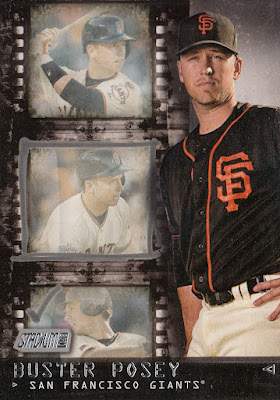
2016 Stadium Club Contact Sheet #CS-8 Buster Posey

As you have likely heard by now, Buster Posey announced his retirement. Spending his entire career as a catcher for San Francisco, he won three World Series with the Giants, as well as a Rookie of the Year award, an MVP award, and seven All-Star selections. Twelve seasons might seem like a relatively short career, but catcher is a grueling position, and the broken leg he suffered in 2011 led to the current rules we have around blocking the plate and the sliding lane.

Still, at just 34, he's not the only one to step away from his sport when he probably had some good years left. Andrew Luck of the Indianapolis Colts comes to mind, and there's speculation that Posey just made a tremendous amount of money as an early investor in BodyArmor, a sports drink brand that Coca-Cola just acquired for $5.6 billion.

Back in 2016, Posey found himself in numerous Stadium Club insert sets. I picked up this one from the 10-card photography-themed Contact Sheet set, which I've seen before (I'm at 50% completion!). One of the filmstrip photos of Posey shows the "LON" memorial patch the Giants wore in 2015 for Lon Simmons, the team's longtime broadcaster. The card back mentions his two grand slams in late June 2015, and if you're curious whether he hit either of those against the Rockies, he did not. They were divisional, though, as they came against the Dodgers and then the Padres.

Now is probably a good time to share the highlight of his final MLB hit, a two-out double in Game 5 of the NLDS against the Dodgers.

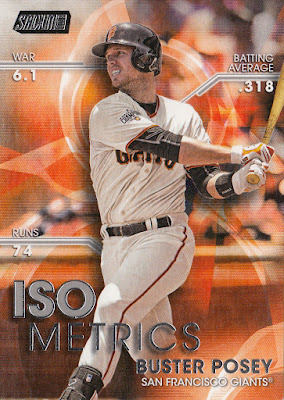
2016 Stadium Club ISOmetrics #I-24 Buster Posey

Elsewhere in the 2016 Stadium Club master set, Posey was included in the 25-card ISOmetrics insert set, heavily color coded for a Giants player. I've seen this set a couple times too, although I'm far from completing it. 

The season-specific stats Topps highlighted on the card front here are pretty representative of his overall career. His batting average dipped a bit since 2015, as is true for the entire league. 74 runs scored isn't even a career high for him, but is quite excellent for a catcher. And 6.1 WAR in a season is also excellent, although neither Fangraphs nor Baseball-Reference list 6.1 for his 2015 WAR. That complex calculation has evolved over time, and varies depending on whom you ask, so I won't say it's an error. For all I know, Topps has their own WAR calculation.

Posey's fWAR for 2021 was 4.9, ranking among the highest WARs any player has ever put up in the final season of their career, and many players near the top of that list were involved in the 1919 Black Sox scandal.

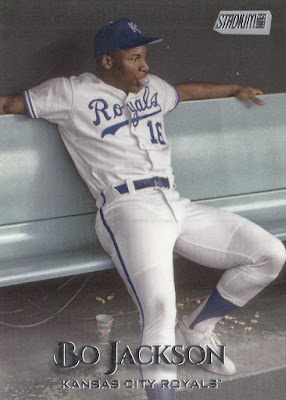
2019 Stadium Club #178 Bo Jackson

Moving forward a few years in the history of Stadium Club, I found a couple base cards from 2019. First was a relaxed Bo Jackson at the height of his baseball career with the Royals, casually blowing a bubble in the dugout.

Bo Jackson's career will always be one of the great what-ifs in baseball lore. Without getting into the gory details, a freak injury he suffered in an NFL game led to the need for a hip replacement, ending his football career and impacting his MLB career. He attempted a comeback, but it was not to be. It's a real shame, because he could have been one of the all-time greats.

Buck O'Neil used to tell a story about a particular sound he heard once in a great while, a crack of the bat unlike any other. "Like a stick of dynamite going off," he said. In a lifetime around the game of baseball, he said he heard it three times. First from Babe Ruth. Second from Josh Gibson. And finally from Bo Jackson.

Joe Posnanski tells it better than I could ever dream to.

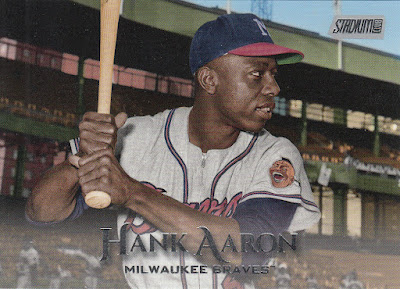
2019 Stadium Club #54 Hank Aaron

The last Stadium Club card I picked was of Braves legend Hank Aaron, who sadly passed away earlier this year. The Atlanta Braves were able to win the 2021 World Series in six games over the Astros, a fitting tribute to one of the greatest players of all time. The Braves won 88 regular season games this year, 44 before the All-Star Break, and 44 after. We also find ourselves in the 44th week of the year, which Vin Scully pointed out on Twitter.

And of course, Hammerin' Hank's uniform number was 44, which we saw mowed into the outfield grass at Truist Park.

This particular photo was from when the Braves were playing in Milwaukee, as you can tell by the letter M on Aaron's cap. That narrows this down to some point between 1954 and 1965, before the Braves departed for Atlanta in 1966. It would be another 20 years past that before they finally got rid of that logo on Aaron's left sleeve.

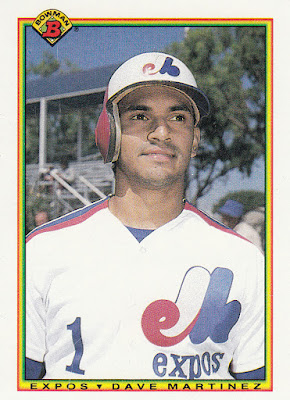
1990 Bowman #121 Dave Martinez

We'll come back to the discount box in a bit, but first I wanted to cover a few other affordable collectibles I found scattered throughout the store. First was a factory set of 1990 Bowman, priced at around $5 or $6. I'll never turn down a complete set for those prices. 

1990 was the year Bowman mercifully decided to get with the times and go with standard card dimensions, abandoning the 1950s-era size that won't fit in 9-pocket pages. It's a simple design, not deviating much from the 1989 design other than adding the player's name and team at the bottom in lieu of a facsimile signature.

It wasn't a particularly remarkable purchase otherwise except for one thing. This shopping trip was less than a week after the Nationals won Game 7 of the 2019 World Series. Then, as now, the team was managed by Dave Martinez, who once played for the Montreal Expos. The Nationals franchise, of course, was once known as the Expos, but that wasn't the weird part. The weird part was that there was one particular card facing the other direction inside the box. As best I could tell the set was still factory sealed, but somehow, after all those years, I found one card in the middle facing the wrong way, against the slight curl of the rest of the cards.

Dave Martinez.

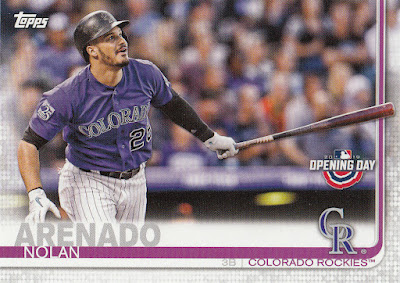
2019 Topps Opening Day #31 Nolan Arenado

I found some current packs toward the front of the store, and I selected one from 2019 Opening Day. I always enjoy the set no matter how far we are from the actual occasion. And I've enjoyed several variations of this well-cropped horizontal photo of Nolan Arenado the past couple years, even though it is significantly less festive than last time I saw it.

Little did I know at the time Nolan wasn't going to be playing for the Rockies by the time I got this post up. It's basically a foregone conclusion that Trevor Story won't be coming back, and the latest news is that Jon Gray isn't likely to reach a deal either, even though he's the only one of the three who actually wants to remain with the team.

At least Charlie Blackmon will be around for another year.

1998 Pinnacle Inside #109 Tony Clark

Although none of that may end up mattering much anyway, because MLB is hurtling headlong towards another labor dispute. I only mention it here because former Tiger Tony Clark is now the executive director of the MLB Player's Association, so his name will likely be in the news plenty this offseason.

Shortly before their bankruptcy, Pinnacle released the Inside brand for a second year. This slightly blurry photo of Tony Clark is flanked by a few of his 1997 stats, much in the same style as Buster Posey's ISOmetrics card. I got a whole pack of these, and I still have the can they came in.

Yes, the can. Like a can of tomatoes.

Pinnacle was out there. So was Pacific. The hobby is poorer without them around.

Now, back to the discount box.

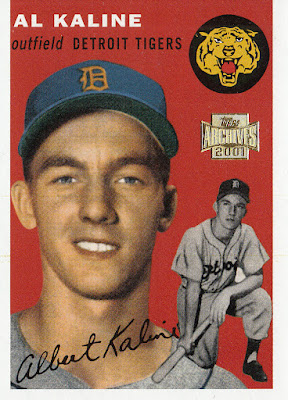
2001 Topps Archives #245 Al Kaline 54

By now, we've probably had our fill of Topps reprints, but in 2001, Topps Archives was pretty exciting. This isn't quite as alluring as the refractor-finish Archives Reserve set that year, but it's printed on actual cardboard and is surprisingly thick. In other words, it's a reprint that has the general look and feel of the original card, gold foil seal notwithstanding. Also the '54s were slightly larger than the standard size we know today. Just like '89 Bowman and Topps Big, which were my first exposure to the 3 3/4" x 2 5/8" size.

Sadly, like Henry Aaron, Al Kaline is no longer with us. He passed away on April 6th, 2020, and I wrote a tribute post at the time. But back in 1954, he was a young rookie, destined for great things. He didn't make it into the 1953 set, so this '54 is his Rookie Card. It would definitely cost a few hundred bucks to get a relatively nice original, so I'm happy with a $1 reprint.

For now.

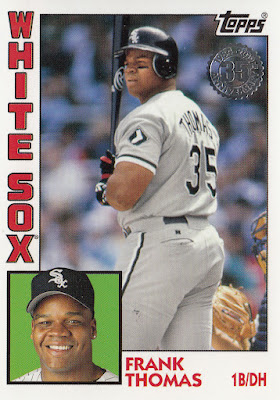
2019 Topps '84 Topps #T84-30 Frank Thomas

Frank Thomas didn't get a ton of Postseason playing time during his Hall of Fame career, but he's a regular fixture on the broadcast team now, right next to David Ortiz and Álex Rodríguez. Topps gave him a card in their 1984-themed 35th Anniversary set in 2019, and this time The Big Hurt is holding an actual baseball bat, not that famed piece of rebar.

2017 Topps Update All Rookie Cup #ARC-21 Anthony Rizzo

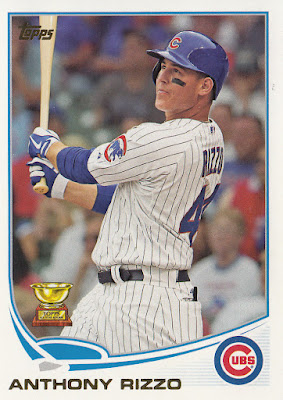
But as an example of reprints getting a bit out of hand, here's a 2017 card of Anthony Rizzo, a mere four years after the original came out. The gold foil clearly differentiates it from the actual 2013 base card it replicates, but Topps still saw fit to include the word "REPRINT" on the card back to avoid any confusion.

The card itself is from a 50-card insert set found in 2017 Topps Update, which focused on the history of the Topps Rookie Cup. Rizzo did get one on his card in 2013, and he shares the checklist with players new and old. Buster Posey, Stephen Strasburg, Lou Brock, and many more. The card back has large images of the two Topps Rookie Cup versions found on cards throughout the years, and an explanation of Rizzo's 2012 season that earned him one.

I'm sure this is the 1990s kid in me talking, but I have to say I like the gold foil on the 2013 design more than the silver foil Topps originally used. Not that you could tell either way from the scan.

2010 Topps Cards Your Mom Threw Out #CMT-11 Mickey Mantle

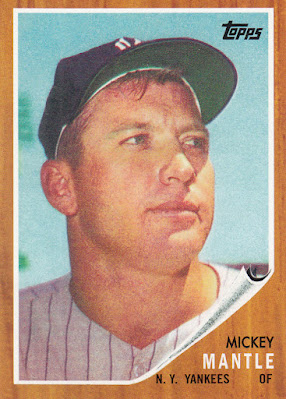
Reprints do have their place, and for the longest time I relied on them to learn the vintage designs and keep some of my dad's idols in my collection. I eventually remedied that, but I still enjoy the 1962 Mickey Mantle in whatever form it takes. 

This one is from the famous 2010 "Cards Your Mom Threw Out" insert set, something Topps put out with absolute confidence during the first year of their monopoly. It spanned 174 cards across three series, and features some of the most iconic Topps cards of all time, starting with the '52 Mantle at card #CMT-1.

2008 Upper Deck First Edition StarQuest #SQ-9 Derek Jeter

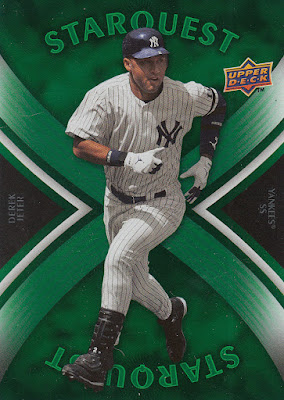
Even as we get further away from a time where Upper Deck had a presence on the baseball side of the Hobby, I still can't get enough of these green Starquest cards. It's such a pleasing shade of emerald and they will practically jump out of any discount box right into my hand.

Derek Jeter was officially inducted into the Baseball Hall of Fame just a couple months ago, but the actual vote that put him there was about to get underway a mere two weeks after I visited All C's. No one was surprised that he was a first-ballot member, but the identity of the lone voter who left him off their ballot remains a mystery, and ensured that his longtime teammate Mariano Rivera would be the only unanimous inductee for the foreseeable future.

By the way, Derek Jeter has another connection to this post. He is the star player depicted on my can of 1998 Pinnacle Inside. I opened it on the bottom for display purposes, and a smiling Jeter in a warm-up jacket is pictured on the front.

I mean, it's a cylinder, so there technically isn't a "front" of the can, so to speak, but nearer the seam on the "back", there's a nutrition facts-looking label called "Product Facts". The serving size is 10 cards, and there is 1 serving per container. The pack odds are given, and we are promised that we're getting 100% of our % Daily Value of Collectability (sic), Top Players, Inside Info, and Cool Inserts.

Pinnacle very accurately and loudly proclaims that the Inside '98 set is "THE ONLY BASEBALL CARD IN A CAN!" It really was unique but it takes up so much space to package, ship, and store cards that way. It isn't particularly kid-friendly, either. Pinnacle was sure to stamp on the top of the can to "Open with adult supervision". I managed to do it without leaving a sharp edge, but this product was a lawsuit waiting to happen.

2001 Stadium Club Diamond Pearls #DP6 Vladimir Guerrero

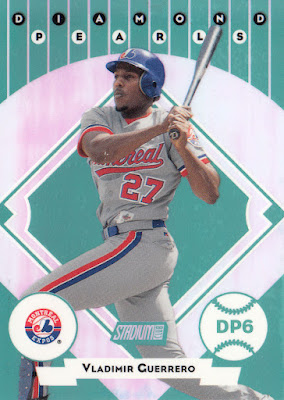
After his son wrapped up his rookie season in 2019, I found a card of Vladimir Guerrero, Sr. He was part of the 20-card Diamond Pearls insert set from 2001 Stadium Club, the set that tends to have stickier cards than perhaps any other. This one doesn't seem too bad, but the surface does look a little bumpy to me. Maybe even slightly blistered.

In any case, this card became accidentally relevant during the 2021 Postseason, thanks to Joc Pederson's unique fashion choice of a string of pearls. He's quite the character, and he now finds himself on a short list of players who won the World Series in two consecutive years with different teams.

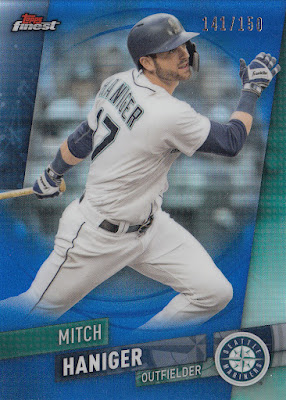
2019 Finest Blue Refractors #57 Mitch Haniger /150

I've never opened a box of Topps Finest, but I seem to have no trouble finding the occasional gem from the expensive set, like this beautiful Blue Refractor numbered to /150.

Alas, despite all this talk of the Postseason and the World Series, the Mariners haven't quite been able to sneak in for twenty years, though they got tantalizingly close this year. Outfielder Mitch Haniger has been one of their stars, and even has an All-Star appearance to his name. 

The card back tells us about his highlights on June 12th, 2018 against the Angels. Topps got the details...sort of accurate? Haniger did have a home run and an outfield assist that day, but they got the innings all wrong and they incorrectly imply that Haniger's homer was of the walkoff variety.

Incidentally, if you've ever been curious about how to pronounce my last name, it's pretty similar to Haniger. I have a couple extra consonants in there, but that's the general sound. It rhymes with Gallagher.

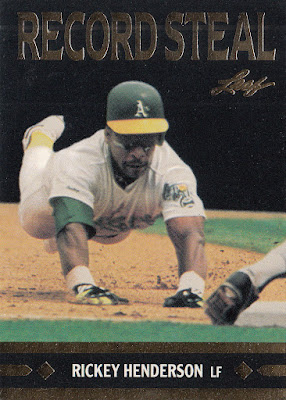
1991 Leaf Gold Rookies #BC26 Rickey Henderson DP

Finally, I couldn't pass up any early '90s insert with this much gold foil. Leaf really pulled out all the stops for this bonus card. Believe it or not, it's actually the final card of a 26-card insert set called Gold Rookies. Lots of prospects fill out that checklist, like Ryan Klesko, Mike Mussina, and Mo Vaughn.

Sharp-eyed readers will notice that Rickey Henderson, was not, in fact, a rookie in 1991. Nor was Nolan Ryan, who is also in this checklist. But Leaf decided that honoring Rickey Henderson's record-breaking 939th stolen base and Nolan Ryan's 7th no-hitter were worth disrupting the overall theme of a Rookies set. I can't say I disagree.

A well-stocked LCS, especially one that's been in town for so long, always has surprises. Including some fresh, sealed 1998 air.


Saturday, July 17, 2021

All-Star Week

Now that the All-Star break is complete, the second half of the MLB season is underway. Even though we call it the halfway point, the true midpoint of the season falls around the end of June or beginning of July, but I'm sure the players don't split hairs like that. I'd bet a lot of them, especially those on contending teams, would perceive the midpoint to be around the trade deadline at the end of July, or even later.

It's a long season.

Traditionally, I use the All-Star Break as an excuse to do some entertaining at my home, but this year I had the rare opportunity to attend the festivities in person. As I'm sure I've mentioned before, I hadn't been to the ballpark since the final Rockies home game of 2019. It was a bit weird to be back among a crowd of that size (or really to see Coors Field that full in general), but it was a fun experience.

2021 Topps Heritage #31 Pete Alonso

Pete Alonso was the big winner Monday night at the Home Run Derby, and he took home the trophy for the second consecutive time. For that occasion I sat in the Rockpile at Coors, the distant bleacher section in straightaway center. A former coworker of mine had an extra ticket and invited me along, which is exactly the same way I got a World Series ticket back in 2007. It really helps to be the first baseball guy everyone thinks of.

Normally, the Rockpile is far, far away from the action, but it was actually a pretty solid seating area for the Home Run Derby. Anything that was hit over the center field wall was out of sight for me, but for the tape-measure shots landing in The Rooftop or on the left field concourse, I had a surprisingly good view. Sort of like being in a control tower.

To make sure fans got a good show, none of the balls used in the Home Run Derby were kept in the humidor, where game balls are usually conditioned for a month. This ensured that souvenirs reached the deepest parts of the park, both in batting practice and in the tournament itself. One BP ball landed directly on the concrete fifteen feet or so behind me when I was standing on the concourse eating a burger. I lost an inch of beer as a sea of humanity suddenly closed in around me.

Nowhere was safe.

My friend stayed in that area for the entire tournament hoping to catch a ball, and a couple of Pete Alonso's shots were right in his vicinity. 

This 2021 Topps Heritage card is pretty much how Polar Bear looked all night. No batting helmet, admiring a long home run in his post-swing pose. Repeat 74 times throughout the evening, walk away with $1 million. 

Incidentally, Alonso has made more money winning two Home Run Derby tournaments than he's made from his regular playing career so far.

2020 Topps Heritage #346 Trey Mancini

Trey Mancini was Alonso's foe in the final round, and while he put up a respectable 22, it wasn't enough to take the title. But he beat Matt Olson and hometown favorite Trevor Story to get all the way to the final.

If you've watched this tournament since they changed it to a timed format, you'll know that distance equals time. That is, if you hit especially long home runs, you'll earn a little extra time to keep hitting dingers. In past years, players had to hit two homers beyond 440 feet to qualify for bonus time. This year, the distance to qualify was increased to just one beyond 475 feet. Almost everyone got it. 

It was a quite a show. And it was inspiring to see Trey Mancini do so well, because he was being treated for stage 3 colon cancer little more than a year ago. The back of this 2020 Topps Heritage card tells us that he almost went into medicine, like a few of his close family members. Last year, he got a closer look at the healthcare system than he intended, for several reasons.

2020 Topps Big League Roll Call #RC-25 Shohei Ohtani

I raided a few piles on my card shelf to find most of these, and this insert is from a blaster of 2020 Topps Big League that I have yet to blog about. Big League is growing on me more and more, and this is the second consecutive post containing that crossed-bats "BL" logo. The Roll Call insert set tells us a lot about how the players interact with their fans and how popular their merchandise is. Apparently, the Angels simply can't keep Ohtani gear in stock.

And judging by the buzz around Shohei Ohtani, I believe it. Coming into the Derby, he was the league leader in home runs, and showed everyone in the ballpark why. Fans that would usually be much too far away to catch a ball were in striking distance. If you're visiting The Rooftop or sitting just below it, normally you can enjoy your snacks, take in the Denver skyline, and perhaps enjoy a sunset if the weather is just right. But on Monday, the fans up there needed to keep their eyes peeled. Juan Soto, who ended up beating Ohtani in the first round after an exhilarating series of tiebreakers, hit the longest homer of the night up there at 520 feet.

A surprising number of Derby participants, including Trevor Story and both finalists, weren't even on the actual All-Star Game roster the following day. But Ohtani most definitely was, and he made history by being both the starting pitcher and leadoff hitter. Seeing him play will definitely be a story to tell someday.

2018 Stadium Club #241 Aaron Judge

I've been going to games since I was a kid, and I've still never seen the Twins or Royals play. So to have a chance to see all the superstars in one place on one day is pretty amazing. For Tuesday's All-Star Game, I sat in right field near the foul pole. I was in the first row of the third deck, several rows below The Rooftop. And I had a great view of Aaron Judge throughout most of batting practice and for the first few innings

As each session of batting practice winds down, players often toss balls to fans in the first few rows of the lower sections. But Judge took aim at the second level of the Rooftop, basically the very top of the stadium and approximately where the purple row would be. I saw him fling four or five balls all the way up there, at least as high as the foul pole. All the while he had a huge smile on his face.

I am now an Aaron Judge fan.

Batting practice was effectively a continuation of the Home Run Derby itself. I'm not sure who was up at the time, possibly Joey Wendle, but during BP a few balls came screaming into the third deck. One landed nearby about three or four seats to my left, and at a terrifying velocity. I didn't end up with that ball either, but I didn't really bother trying. I was ten feet away and I knew it was a hopeless endeavor, as it was snatched up in a split second.

Sure got my heart racing, though.

Of course, there was a special pre-game tribute to the late Hank Aaron, with a video on the scoreboard and specially-commissioned artwork presented to his widow. His uniform #44 was mowed into the right field grass, and all players wore that number during the Home Run Derby.

2019 Topps #602 Germán Márquez

As the game itself got started, Nolan Arenado got a great standing ovation, a continued show of appreciation from Denver-area fans. I missed the series a couple weeks ago when the Cardinals came to town, so I had to wait until the player introduction ceremony and his at-bats to voice my support.

Germán Márquez, the lone current Rockie on the All-Star roster, pitched the 4th inning and got quite the ovation of his own as he struck out the final batter.

2019 Topps Base Set Photo Variations #700D Vladimir Guerrero, Jr. /Fielding 

Vladimir Guerrero, Jr. was the ultimate star of the show, hitting a Derby-worthy solo home run in the third inning, eventually being named the game's MVP as the American League won the Midsummer Classic yet again.

Also, apparently Chevrolet doesn't give away a car to the MVP anymore? Did I miss that announcement? I told the kids sitting next to me that Vlad was about to get a free Corvette C8 or something. Disappointed them for no reason.

2021 Topps Opening Day Mascots #M-2 Wally the Green Monster

In any case, there was a lot to do all weekend. I already did a post about the Play Ball Park, but I missed the Futures and Celebrity games, and didn't make it to see the Red Carpet show. I didn't watch much of the Draft either. It's a jam-packed schedule. But there's a little more to tell.

On the first-level concourse, near the alarmingly long line to get into the merchandise store, many of the team mascots were keeping the fans company. Among the sightings were Mr. Met, Rosie Red, Stomper, Fredbird, Orbit, the Phillie Phanatic, and Wally the Green Monster. The All-Star Game is truly a place where all the greats are brought together.

Prior to the Derby, my friends and I stopped into the Hall of Legends, a temporary memorabilia display in the new McGregor Square complex across 20th Street from Coors. The showcase consisted of jerseys, bats, and other memorabilia from Marshall Fogel, a local Denver-area collector. You might remember something similar from the Play Ball! exhibit several years ago.

And there was one other thing.

1952 Topps #311 Mickey Mantle (PSA GEM-MT 10)

One of three known Gem Mint 10 examples of a 1952 Topps Mickey Mantle.

This has gone on display on rare occasions in the past, but what better way to celebrate All-Star week than to let the public have a glimpse of this ultra-valuable baseball card. A PSA 9 recently sold for over $5 million, so this one is likely worth around $10 million.

Sometimes I wonder if the entire production run of something like 1988 Donruss is worth that much. That's a question for another day, I suppose.

The last time Denver hosted the All-Star Game was in 1998. At that time I was in no position to attend, and I'm glad I was able to this time around. It's a once-in-a-generation experience to take part in the festivities, and I'm excited to look back on this decades down the line to see how many of these guys ended up in the Hall of Fame.


Tuesday, August 30, 2016

Book Review: Independence, Mantle, and Miss Able

Earlier this summer, I swung by Denver's most famous independent bookstore, Tattered Cover, for a book signing. This particular location is just a few streets down from Coors Field, where the author, Jan Sumner, spent several seasons as a batting practice pitcher for the Rockies.

He had plenty of stories to tell about that, and who his favorite players were to throw to. John Vander Wal was mentioned, as well as lots of the inaugural Rockies. But most of the discussion centered around Sumner's new book, Independence, Mantle, and Miss Able, a baseball-focused history of Sumner's birthplace, Independence, Kansas. It's a town of about 10,000 in the southeast corner of the state, and has been responsible for more than its share of baseball history and well-known citizens.

One of two photos on the cover is a shot of a baseball game being played under the lights. The minor league stadium in Independence is where, in 1930, the first night game in organized baseball was played. There are many claims to this innovation, but all of the preceding games, some as early as the 1890s, were either under temporary lights, in an exhibition game, or not considered part of "Organized Baseball."

The Major Leagues followed suit about midway through the decade, but the idea was pioneered in Independence, KS. Of course, nightly attendance shot way up, as you could now catch a ballgame after a long workday.

Sumner was kind enough to pose for a #WalletCard shot along with my signed copy of his book.


The other photo on there is of the 1949 Independence Yankees, a Class-D team in the Yankees farm system, part of the Kansas-Oklahoma-Missouri (KOM) League. You might spot a familiar face on that photo. In the front row on the far right is a young Mickey Mantle, playing in his first season of professional ball.

Yes, The Mick kicked off his legendary career in the sleepy town of Independence, hitting .313 in his first season before a promotion to Class-C Joplin in 1950.

A Class-D team in a regional league isn't exactly the lap of luxury, so players had to live in local residences with a roommate. Bob Mallon (2nd from left in back row), a pitcher who played two seasons for Independence before running into arm trouble and leaving professional baseball, was present at the book signing, and had a few stories of his own. Mallon and Mantle were roommates during that 1949 season, even sharing a bed in another player's home, believe it or not.

These low-level minor league teams still need to be managed, and Independence had some great ones. Burleigh Grimes, the last pitcher that was grandfathered into being allowed to throw a spitball, managed in 1948. Harry Craft took over in 1949 to oversee Mantle's development. Craft had an average playing career, but managed Mantle, Roger Maris about a decade later, and the inaugural Houston Colt .45s in the early 1960s.

As Sumner writes, numerous big leaguers came through Independence, not just Mickey Mantle. Ralph Terry, originally a catcher, pitched for the Independence Indians in 1953. He'd later find success with the Major League-level Yankees playing alongside Mickey Mantle, even winning the World Series MVP award in 1962.

As it is today, minor league baseball was not exactly a lucrative profession. Terry got a job with Sinclair Oil, one of the major local employers. More on that later.

Other players to come through included Harry Bright, who reached his only World Series as a Yankee in 1963. Sandy Koufax struck out Bright for his 15th strikeout in Game 1, which was at that time a single-game World Series record until Bob Gibson broke it with 17 just five years later. As he puts it, "I wait 17 years to get into a World Series, then when I finally get there, 69,000 people are yelling — yelling for me to strike out!"

Forest Glenn Wright isn't a well-known name, but he played for the Class-D Independence Producers way back in 1921. He'd have his best year in 1925 for the Pittsburgh Pirates, becoming one of the very few players to turn an unassisted triple play, and one of only three who did it in the 9th inning. He'd help the Pirates win the World Series that year, the last one they'd win until 1960.

Bill Virdon, an Independence Yankee in 1950, spent several years in their farm system. He was an outfielder, but with Mantle, Gene Woodling, and Hank Bauer in the Yankees outfield, he'd need to find another way to get called up. He was traded to the Cardinals with a few other players for Enos Slaughter (even then, the Yankees were giving up promising minor leaguers for established stars). Virdon was named the 1955 NL Rookie of the Year for St. Louis, only to be traded once again in 1956, this time to the Pirates.

Virdon got his revenge on the Yankees, though. The Pirates were down 7-4 going into the 8th inning of 1960's World Series Game 7. Virdon got on base for his second hit of the day, and scored one of the five runs the Pirates put up that inning to take the lead.

The Yankees always seem to have some postseason magic in the 9th inning, and Mantle and Yogi Berra both plated runners to tie it up facing Harvey Haddix. Yes, that same Harvey Haddix who pitched 12 innings of perfect ball in 1959 but still lost the game in the 13th.

Of course, the Pirates weren't done. Bill Mazeroski, the leadoff hitter in the bottom of the 9th, drilled one off of Ralph Terry over the head of Yogi Berra. Just off-camera in center field was Mickey Mantle, so that game was a real who's who of ex-Independence players. Mazeroski's homer remains the only walkoff home run in any World Series Game 7.

Judging by the play-by-play, that must have been a heck of a game to watch.

That one didn't go his way, but Mickey Mantle was no stranger to home runs. His first professional homer came in Independence. The ball was never found, and legend has it that it landed on Monkey Island, an enclosure at the zoo beyond the center field wall.

That spot has its own claim to fame, as it is the origin of an early group of NASA's rhesus monkey astronauts. Neither NASA nor Russia were quite to the point of human spaceflight in 1958, but there was lots of preparation underway for that eventuality. If, of course, spaceflight was survivable. Some monkeys had seemed to survive the flight above 100 kilometers of altitude, but perished due to mechanical problems. It was still unknown whether a mammal could survive in weightlessness for that long, and whether a rocket could reliably be up to such a task.

In May 1959, Miss Abel, the nickname of the Independence monkey that had "The Right Stuff" was sent up in a rocket with a squirrel monkey from Peru, Miss Baker. The two primates survived the flight, and shot to stardom. Literally, I suppose.

Miss Abel died a few days later due to complications from surgery, but Miss Baker survived to see the space program reach orbital flight, a handful of trips to the moon, and even the space shuttle. Of course, she probably didn't realize any of that was going on, but still. I guess that's why we pick monkeys to do these things first.

Independence, Kansas had its share of famous residents that never left earth or played pro ball, and lots of them are profiled in the book. Laura Ingalls Wilder lived near there in 1870 as a young child. That's alluded to in a pilot episode of Little House on the Prairie, when grizzled old Mr. Edwards drops by the Ingalls' cabin after crossing the Verdigris River on a snowy Christmas after running into Santa Claus in Independence.

Vivian Vance, who played Ethel Mertz on I Love Lucy, grew up in Independence, as did Harry Sinclair, the man who gave his name to the Sinclair Oil Corporation, the same company that employed Ralph Terry on non-game days.

If you remember your history class, Harry Sinclair was caught on the wrong side of the Teapot Dome Scandal, where his and other oil companies were given leasing rights to an oil field without a proper bidding process. President Warren G. Harding is named as one of the worst presidents in history for this and other scandals that occurred during his term. Sinclair actually spent six months in jail, though it was for jury tampering, not due to the scandal itself.

Prior to that, Sinclair was one of the founding members of the short-lived Federal League. Though it only existed from 1913-1915, it planted the seed of free agency that took decades to germinate. Its lawsuit against the National League led to an exemption from antitrust law, something that largely exists throughout professional sports today. It also gave us Wrigley Field, then known as Weeghman Park, which was built for the Chicago Whales, the Windy City's entry in the Federal League. It is recognized as a Major League, but wasn't canonized until 1968.

Overall, this was a fun and quick read. It could use a bit more editing and polishing, but still shed lots of light on a surprising amount of history in such a small town. It's only a couple bucks in Kindle format at the moment, if you don't wish to go for a physical copy. But if you happen to meet the author, a signed Kindle just isn't the same.

Tuesday, June 7, 2016

#TheStreak

If you have the MLB At Bat app on your smartphone, you've probably been getting daily notifications about Joe DiMaggio's performance at the plate.

No, we're not stuck in a time warp, where the Yankee Clipper is again patrolling the enormous outfield at Yankee Stadium, but this does happen to be the 75th anniversary of DiMaggio's league-record 56-game hitting streak that he put together in the summer of 1941. As of June 7th, he's up to 22, with plenty more left to go.

1993 Pinnacle DiMaggio #1 An American Hero
The first day or two, it was rather odd to see DiMaggio's name pop up in my notification feed alongside my hometown Rockies and today's latest stars. What's even weirder than seeing DiMaggio's name and the old-time pitchers he faced is seeing defunct team abbreviations, like SLB and PHA. Those franchises are still around, but have long since departed those cities and even changed names.

75 years is quite a long time, and despite all the changes that baseball has gone through since the summer before Pearl Harbor, Joe DiMaggio's record has stood the test of time. Plenty have fallen since then, including the career home run record (twice), career strikeouts, career stolen bases, consecutive games played, number of Red Sox championships, and lots more. A few still remain, like the season RBI record, career doubles, and lowest career ERA.

Because of how the game has changed (or just out of sheer luck), some are likely to outlast the pyramids, like career wins, career losses (same guy), career shutouts, season wins, and I'd wager consecutive no hitters. Even if lightning strikes twice and someone hurls two no-hitters in a row again, no one will ever throw three straight. I expect Johnny Vander Meer's name to come up following every no-hitter remaining in baseball's future.

1993 Pinnacle DiMaggio #9 Classic Swing
But every time a guy gets on base by putting the ball in play, he's challenging DiMaggio's 56-game mark. That classic swing pictured on this special Pinnacle card generated a tremendous amount of power, good enough for 361 career home runs, a stat in which he led the league twice. He also had nine World Series rings to show for his illustrious career, and everyone chasing his 1941 record has their work cut out for them.

To honor his legendary accomplishments, Pinnacle took their black borders that were such a hit the year before, added a bit of gold foil, and printed up a limited-edition 30-card set in 1993. Keep in mind that's limited-edition by 1993 standards, which means a print run of either "just" 209,000 or 200,000 depending on whether you check the Certificate of Authenticity card and Beckett, or the bottom of the black and gold tin containing the set.

They even threw in an Authenticator Lens. Picture a transparent Sportflics or Opening Day Stars card. Using this, you can decipher that little gray square on the back of most Pinnacle cards, transforming it into either a rainbow pattern or a few letters describing the set, depending on whether the lens is oriented horizontally or vertically.

1993 Pinnacle DiMaggio #30 Baseball's Greatest Living Player
The final card in this set billed DiMaggio as "Baseball's Greatest Living Player". Sadly, he passed away in 1999, so this card isn't quite true anymore. But his record still stands and shows no signs of being broken. That colorized shot of his amazing swing is a detail of the image Pinnacle used on the lid of the tin.

It's kind of an accident that I'm posting about this set on the 75th anniversary of #TheStreak. I purchased this set about a year ago from my regular card dealer at one of his monthly card shows. He had two available, a solid .001%  of the total print run. I still haven't blogged about the other cards I got at that show, and I sadly haven't had a chance to go to one since. But just as well, since I wouldn't have a handy hashtag to go along with this set if I did it last year. And I definitely would not have realized the streak's milestone was due in 2016.

1993 Pinnacle DiMaggio #28 The Final Season
Though DiMaggio might be most well known for his hitting streak, he played another ten seasons in The Bronx, just enough time to pass the torch to Mickey Mantle, the next great Yankee center fielder. They played numerous games together in 1951, although Mantle experienced a severe knee injury in his rookie year, coincidentally on a ball hit to the outfield by Willie Mays in the 1951 World Series. 1951...The Giants Win The Pennant!

Anyway, DiMaggio and Mantle both chased it down, but Mantle caught his shoe on an outfield sprinkler and watched the next game from the hospital. Though Mantle managed to put together a first-ballot Hall of Fame career after that, he wasn't so different from Bo Jackson, another player with astronomical potential plagued by injury.

But the Yankees having DiMaggio followed by Mantle in center field for over three decades is a big reason for why the Bronx Bombers are such a storied franchise. And at least one of those two were present for over half of their 27 championships.

1993 Pinnacle DiMaggio #7 Fan Favorite
This set makes no mention of Joltin' Joe's short-lived marriage to Marilyn Monroe, but he was quite the celebrity, surrounded by adoring fans, always willing to sign an autograph. Mini-collection cards turn up in the oddest places, and I don't know of an autograph shot earlier than this.

1993 Pinnacle DiMaggio #22 World War II
He never saw action, but Joe joined up with the army in 1943, as was true for many of his contemporaries. This card mentions a few of them, like Gerry Priddy, Walt Judnich, Myron McCormick, and fellow Yankee Joe Gordon. He played for the Army Air Force team, back when it was a division of the Army. The separate branch of the USAF didn't exist as we know it today until 1947.

1993 Pinnacle DiMaggio #18 Sticks 'n' Bones
Bending the rules a bit is nothing new to baseball, as I mentioned a couple posts ago. Here, Joe is pictured polishing his bat with a soup bone, part of an elaborate process to sturdy the bat and improve its grip, also involving olive oil, rosin, an open flame, and a bit of sandpaper. According to this card, such a bat prepared in this manner went missing for the second game of a doubleheader. Nonetheless, he used a teammate's bat to hit in his 42nd straight game, eclipsing George Sisler, the "modern" record holder when the 1941 season opened. Regardless, Sisler held on to the single-season hits record until Ichiro broke it in 2004.

1993 Pinnacle DiMaggio #24 The Summer of '41
Though the 1941 season is synonymous with a particular 56-game hitting streak, that year also marks the last time someone hit over .400 in a season. Yes, it's been 75 years since Ted Williams set the most recent high-water mark, though that .406 stat doesn't even make the top fifteen. Tony Gwynn came darn close in 1994, though the strike cut short that opportunity, along with the best season the Expos ever had.

As amazing as DiMaggio, Mickey Mantle, and Ted Williams were, there is a lot of talk about how much better they could have been. Of course, discussion around Mantle's potential center mostly around his perpetually aching knees. But if The Splendid Splinter had been a Yankee, and The Yankee Clipper had been a Red Sock (I can't get enough of these old-timey nicknames), their stats might have been even better.

Why?

DiMaggio was a righty, and Williams was a lefty. Picture Williams with a short right field wall just like Babe Ruth liked, and DiMaggio with a giant green monster in left. Some of those records that stand to this day might have fallen. For that matter, how many Willie Mays home runs did the wind in Candlestick Park knock down into mere fly balls? Four a year, perhaps? If so, Mays would have eclipsed Ruth's career home run record before Hank Aaron.

Surely they'd all be regarded as legends wherever they played, but to think of what their stats would have been like in a more favorable stadium (or with good knees) makes their accomplishments even more amazing.

1993 Pinnacle DiMaggio #26 No. 45
I'll say it again. Fifty-six games. As pictured on this card, Number 5 drilled one out of Yankee Stadium to break the all-time record of 44 just a few days after the bat theft incident on card #18, a record that dated back to Willie Keeler's performance in the late 19th-century.

Every couple years, a player gets about halfway there. Jackie Bradley had a streak going for 29 games earlier this year until Jon Gray and the Rockies rolled into Boston and ended the fun. Nolan Arenado got precisely halfway in 2014, setting the Rockies' team record for longest hitting streak at 28. The Red Sox had another challenger this year, with Xander Bogaerts' streak stopping a few days ago at 26. Boston has put up quite a few challengers over the years, including Joe's own brother Dom, who hit in 34 straight in 1949.

To the question "did he get one?" that was asked all across America in the summer of 1941, you already know the answer, but if you'd like a smartphone app to tell you, download it and watch your notifications before July 17th.

Oh, and DiMaggio still reached base that day. And followed it up with a 16 game streak all the way into early August. He hit safely in 72 of 73, and reached base in 83 consecutive games.

1993 Pinnacle DiMaggio #2 San Francisco Seals
Even more amazing is that his 56 game streak wasn't even a personal best. When he was still a minor leaguer for the San Francisco Seals, he hit in 61 straight.

Pete Rose (44) and Paul Molitor (39) are the closest anyone's gotten since then. In the Wild Card era, Jimmy Rollins, Chase Utley, and Luis Castillo have pushed streaks into the mid-30s. And every day a new streak starts. But few will be surprised if #TheStreak turns out to be truly unbreakable.