Showing posts with label vintage. Show all posts

Wednesday, September 27, 2023

What’s All This NOW?

Once upon a time, I did more posts during a single Hanukkah than I've done in all of 2023. There has been so little time for things like blogging during a busy year like this. So many of you read my previous post and offered condolences about the passing of my father, and I thank you all. 

But beyond that, there are some big life changes in the works which will be coming to fruition over the next couple weeks. My fiancée and I are planning on buying a house together (so yes, I will have a new address), and that should be happening very soon. I just don't want to jinx anything because it's not a done deal quite yet. 

And shortly after that, yes, I said fiancée! We are getting married in early October.

So in other words, house hunting and wedding planning has been my focus this year, sadly coming along with quite a bit of grief. It has been a bittersweet year. My baseball card intake has slowed dramatically, but there have been enough to build a nice little blog post full of Rockies and one very personal oddball.

2010 Bowman 1992 Bowman Throwbacks #BT14 Troy Tulowitzki

Long ago, in the days before the Rockies never lost 100 games in a season (a record spoiled yesterday), Troy Tulowitzki was the starting shortstop for Colorado. He was quite the fan favorite, earning a spot not only in the Bowman base set, but also in this 1992-themed Throwback set. This huge 110-card insert set is a very accurate reproduction of the original '92 design. The only major change is that the team-by-team opponent stat breakdown is a much more crowded table than in 1992, simply because interleague play had not yet arrived. There are 20 teams crammed onto this 2010 card back, but it's still mostly readable. We've been squinting at card backs since long before I was born.

Interestingly, with the new MLB schedule design, where each team plays at least one series against every other team each year, they'd need 29 rows on this table, as well as the season and career totals. I don't know how feasible that really is.

2010 Bowman #123 Troy Tulowitzki

Here's that base card I mentioned earlier. A typical black-bordered Bowman card that I'd never be able to pick out of a lineup. It does have a nice action shot of Tulo in what was then called AT&T Park. That's an easy stadium identification, partly because I see NL West parks on TV constantly, and partly because the Chevron banner with the happy-looking cars was quite distinctive.

Chevron does still have a banner out there in left field at Oracle Park, but it's not quite as cartoony as it was back then.

2007 Fleer #338 Troy Tulowitzki (RC)

All these Tulo cards came from an assortment of Rockies my fiancée found in a clear bag at the local thrift store. 

Why do you think I'm marrying her?

It was mostly duplicates, but these three are new to my collection, and she only spent a dollar or so on the bag, so really it's much the same as if I found these in a quarter box. I haven't been to a card show since long before the hobby exploded, and I don't know if dime boxes are even around anymore.

This card is from the very last days of Fleer, the 2007 set. An extremely young Tulowitzki, who at that point had only played in the Majors as a late-season callup in 2006, is wearing the highly unusual uniform number 63, presumably a spring-training shot. Dexter Fowler is the most famous Rockie to wear that number.

Despite his young career, the card back still had good things to say about him, specifically his two-RBI, two-run performance on September 23rd, 2006.

2023 Topps Now Card of the Month #M-JUL Vladimir Guerrero Jr.

I did order a couple of Topps NOW cards this year. The first was July's Card of the Month, which ended up being of Vlad, Jr. who won the 2023 Home Run Derby in Seattle. He's happily hoisting the trophy after hitting 25 home runs in the final round of the Derby. The card back points out that he is part of the only father-son duo to win the Home Run Derby. Longtime fans might remember that his Hall of Famer dad won his Derby back in 2007.

I ended up getting this card for free. Somehow I had enough Topps loyalty points to get a code for a 100% discount. I actually redeemed that prize a couple years ago, but had a pretty tough time figuring out how to actually use it. It was not obvious at all and it took me numerous tries. But I ended up figuring it out, and now have a nice reminder of another All-Star Weekend.

2023 Topps Now #564 Elias Diaz /943

The other Topps NOW card I picked up, and paid full price for, was this one of All-Star Game MVP Elias Díaz, the catcher who is the first-ever Rockie to win the award. He must have been inspired by all those power hitters the night before, leading to his 8th-inning home run finally giving the National League a win at the All-Star Game.

He was beaming as he hoisted the Ted Williams MVP trophy in Seattle, and 943 collectors thought this was a worthy moment to immortalize on cardboard. It was also the highlight of the Rockies season, which, as I mentioned, is the first 100-loss season in team history.

2023 Topps Chrome Rookie Autographs #RA-BS Brian Serven (AU)

Even though I haven't been very active in the baseball card hobby this year, I'm still known for it. My fiancée's friend's husband has recently gotten into card collecting, and when we went to visit over the summer, we had a great chance to connect over cards. He's more into football cards, which I know very little about, but still it was fun to find a fellow collector. He even gave me this Rockies autograph card of Brian Serven, another of the team's catchers.

Serven, 28, has spent about a half-season of time in the big leagues since 2022, but in that time he has accumulated a negative bWAR, and he's not getting much playing time in Triple-A Albuquerque either. Players can always turn it around but we might not be seeing much more of him as a Rockie. Still, it's always nice to add an autograph to the Rockies collection, especially an on-card one.

1945 Roto-Panel Johnny McIntosh

Our final card is an eBay pickup, that oddball I mentioned at the beginning. I'm not too sure what this truly is. It's advertised on eBay as a "Roto-Panel" from 1945. It's certainly not in Beckett, and there is no card number. It's only about as thick as a magazine page.

But I do know who it is. Johnny McIntosh (coincidentally wearing #63) goes by "John" now, but to me he's always been "Granddad".

He played football for the Georgia Tech Yellow Jackets (not the "honeybees" - an oft-repeated family story), and even made it as far as the 1945 Orange Bowl, where he had a receiving touchdown. He was teammates with Frank Broyles, who ended up coaching the Arkansas Razorbacks for two decades.

Granddad lives in Tennessee now, where he retired after a long career with Union Carbide. He's about to turn 100 at the end of November. It's been several years since I last saw him, but I'm glad to be able to have him occupy a very unique spot in my collection.


Sunday, January 23, 2022

The Trading Post #167: Card Hemorrhage (Part 2: Vintage)

I don't know what feels normal anymore. Back pain is normal. Uncertainly is normal. 

Writing a blog post with an NFL playoff game on in the background used to feel a lot more normal than it does right now. It's nice to still be able to bring that back every once in a while, although this blog is starting to take a back seat to other priorities. I did twenty-three posts in 2021, and while I still haven't missed a month, that is about half of what I was doing around 2017.

Not that I don't have enough material to cover, it's just that there is a lot that steals my attention these days. One example of that would be the Marshall Fire that tore through nearby Louisville, Colorado on December 30th. You may have seen it on the news, but unfortunately I got a much closer look at it. My home is still standing, but I was caught in a smoky highway closure as the fire was spreading, was easily within walking distance of a frightening view of the flames that night, and found myself alarmingly close to the outer areas of the evacuation zone.

Seeing your hometown on the national news for this kind of thing is pretty unsettling. Watching the news crews broadcast from an intersection you've driven through a couple thousand times is quite scary. Trying to go about your workday while not being particularly confident that your home will still be there in a few hours is a very unpleasant experience. Knowing the office building you haven't been to in nearly two years (for obvious reasons) is directly in the path of destruction makes it very personal. That survived, although so much nearby was lost. Two lives. Pets. Homes. Businesses.

So, that has given me a lot of emotions to work through, on top of everything else.

In any case, I was reminded of my collection a week or so ago when I got a direct message on Twitter asking about an old 2011 Topps Opening Day hit. A fellow Twitter user inquired as to whether I still had this Justin Germano autograph from a 2015 blog post, and seeing as how it didn't go up in flames last month (one concern among a thousand others I had that day), I was able to help out his autograph collection. It might have been worth a solid amount in better condition, but Topps quality control being what it is, I shipped it off for $7 and got confirmation yesterday that it arrived safely.

Following that, I still want to review some vintage cards I got from Jay at Card Hemorrhage, which made up the remainder of a shipment he sent my way toward the end of 2021.

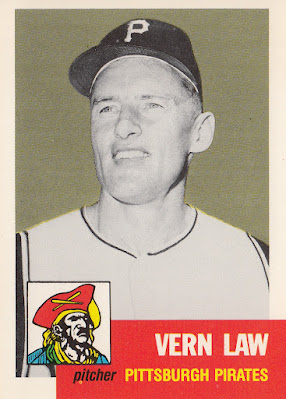
1991 Topps Archives '53 #324 Vern Law

Now, this isn't really a vintage card, even though it looks like a '53. Experts of these early Topps checklists (including our favorite Tim Wallach supercollector, who is nearing 1953 set completion) will know that Vern Law never made it into the original 1953 set. Neither did 56 other players who made up "The Cards That Never Were" subset at the end of the 1991 Topps Archives checklist.

Topps really took this theme seriously, writing a paragraph for the card back as though we were in early 1953 looking forward at the upcoming season. We're told, "This strong righthanded hurler rejoins the Pirates this year after spending the 1952 campaign in military service." 

Those who don't know the 274-card checklist of 1953 Topps by heart can use several other cues to place this subset as an revisionist augmentation to the set rather than a pure reproduction of the original. 

First, the images are black-and-white photographs rather than the full-color paintings we'd see on the originals. I have a mostly complete run of this set, and the only exception I could find was Hank Aaron's card #317. He did get a color painting, but it's not nearly up to the more lifelike standard found in the originals. The next clue is the background. It's usually a one of a few plain solid colors like this, or sometimes it might overlay a faint black-and-white background.

On the back, you could just check whether the card number is #281 or above. There's no red-colored facsimile signature behind the write-up like you'd see on an original. And finally, the card back will have "The Cards That Never Were" printed on the very bottom.

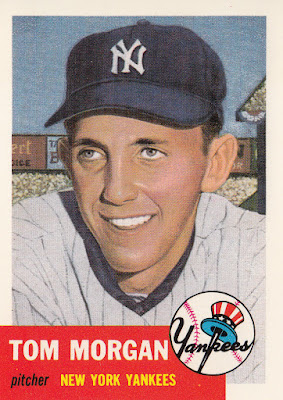
1991 Topps Archives '53 #132 Tom Morgan

Here's a reproduction of an original '53, and the difference is quite obvious. The colors are vibrant, and there's even some festive little bunting in the background on the facade of the stadium. 

This card is more of a review of Tom Morgan's 1952 season, as he served in the military during 1953, which the card back mentions. He was back in (baseball) action in 1954, wrapping up his career with the Los Angeles Angels in 1963.

I don't know anyone who would call a 1991 card from the heart of the overproduction era "vintage", although one has to wonder. As disconcerting as this fact is, that was thirty-one years ago. And when I really got my collection going in 1993, I'd have to find something from 1962 to have something as old then as this is right now.

But still, 1991 is not vintage.

Is it?

Or is "vintage" an ever-receding landmark in the rearview mirror, something that became fixed in place at some point, an idea that somehow manages never to keep pace with our world that's rapidly becoming more and more unpredictable?

Maybe let's just not think about that.

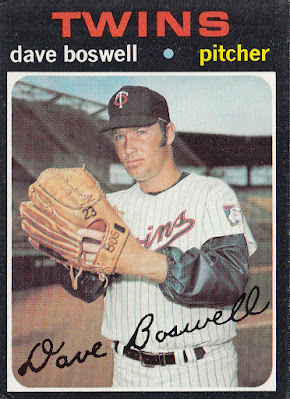
1971 Topps #675 Dave Boswell

Here's 1971. This is vintage.

This shouldn't be very surprising, but when I go through cards from this long ago, there are a lot of names I don't know. Tons. Dave Boswell is among them. 

He's pictured here as a Twin, which is where he spent his career from 1964-1970. However, the Twins released him in early 1971. He appeared in a handful of games for the 1971 Tigers and Orioles, but that was the end of his career. It was also the end of the line for his Topps issues, meaning this is his sunset card. He appeared in a few oddball sets after that, but Topps never documented either of his final pair of teams.

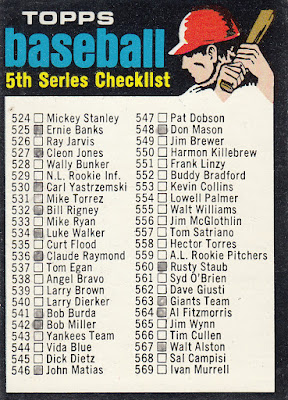
1971 Topps #499 Checklist 5

Jay threw in a checklist from 1971, and it's stops just a little short of including Dave Boswell's card #675, ending at #643. Whoever had this before me had a long way to go before completing the black-bordered 1971 set, but they certainly had a few of the big names checked off. Hall-of-Famers like Ernie Banks, Carl Yastrzemski, Roberto Clemente, and quite a few others. It's marked in pencil, and it looks like #531 Mike Torrez was possibly erased. Maybe part of a trade?

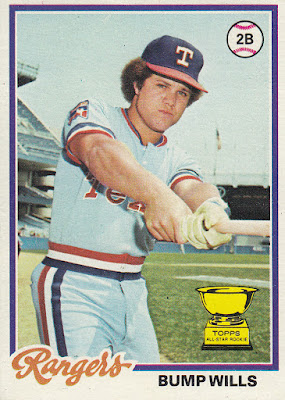
1978 Topps #23 Bump Wills

Fast forwarding a few years to 1978, perhaps a bit closer to that blurry vintage/modern dividing line, we come to "Bump" Wills, the son of Dodger great Maury Wills.

Wills's true Rookie Card is a four-player card from 1977. This is his first solo card. He finished third in 1977 AL Rookie of the Year voting, losing out to Eddie Murray, but he did earn himself a Topps All-Star Rookie cup, clearly shown on the lower right of the card. It's a nice addition to this posed photo, taken inside the newly-renovated (old) Yankee Stadium.

1967 Topps #76 Jim Barbieri (RC)

Jim Barbieri is another name I don't know, but this 1967 card was the oldest one in this shipment, so up it goes on the blog. The posed photo looks similar to Bump Wills's card, but this checks the box for the always-trusty bat barrel shot.

The card back says that Barbieri threw out the ceremonial first pitch in the 1954 World Series, the very same World Series where Willie Mays gave us "The Catch" in Game 1, so it's very likely that this Dodgers rookie was on hand to witness that legendary defensive play as a thirteen-year-old. The card doesn't specify for which game Barbieri got the honors, but I'll go ahead and believe it was Game 1, because why not? Maybe the ceremonial first pitch used to be exclusive to Game 1 back then, anyway.

Barbieri's career spanned all of thirty-nine regular-season games in 1966, so this Topps card ends up being a combo Rookie Card and Sunset Card. 

There was a 40th game before his career truly ended, though. Apparently no stranger to Game 1 of the World Series, he appeared as a pinch-hitter for the Dodgers in the '66 Fall Classic. He struck out swinging in the 4th inning and that was that.

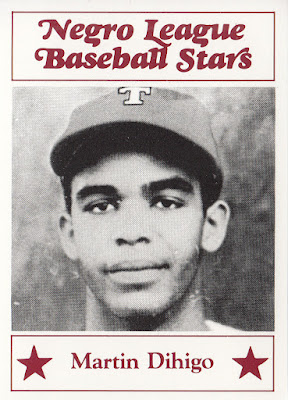
1986 Negro League Fritsch #19 Martín Dihigo

Jay included a few oddball cards focused on Negro League stars, including Cuban-born Hall-of-Famer Martín Dihigo, "a talented second baseman who was a superior hitter". And despite what you might think from this grainy black-and-white photo, he wasn't a 19th century contemporary of Cy Young or Old Hoss Radbourn. Dihigo played and managed right up through the mid-1940s.

Sadly, by and large, oddballs like this release from Larry Fritsch Cards are about all that's out there for many Hall-of-Famers who played only in the Negro Leagues. Players like Dihigo, Oscar Charleston, Turkey Stearnes, and many others have been as ignored by the card industry as by pre-1947 Major League Baseball itself. For example, Dave Boswell has 28 search results on Beckett. Martín Dihigo has 26. Only one of them is in the Hall of Fame.

Perhaps now that the various Negro Leagues have finally been recognized as Major Leagues, that will start to change. Maybe there would be numerous legal difficulties Topps/Fanatics would encounter if they tried, but I'd buy a retro-themed Negro Leagues set if it were on the market.

Just saying, if there's room for the thousandth Dustin May card, maybe there's room for some Hall-of-Famers that remain far too obscure.

1991 Swell Baseball Greats #9 Joe Black

Another oddball came from the Swell Baseball Greats set, a 1991 release from a brand of the Philadelphia Chewing Gum Corporation. Joe Black, pictured here as a Brooklyn Dodger, joined the National League in 1952, winning Rookie of the Year honors thanks to a 15-4 record. He kept playing through 1957. He got his start with the Baltimore Elite Giants, playing for them from 1943-48.

We'll keep the World Series history going with a fact from the card back, which is that he was the first Black pitcher to win a World Series game. That happened in 1952 versus the Dodgers' crosstown rivals, the Yankees. It was a seven-game battle, as were most of the matchups that decade between the Yankees and Dodgers.

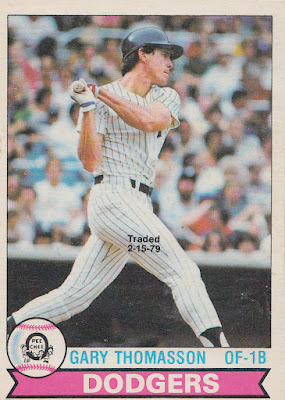
1979 O-Pee-Chee #202 Gary Thomasson

To close, we'll head north of the border. This looks quite like a 1979 Topps card, but look closely inside the little baseball element and you'll see a fun O-Pee-Chee logo! The Canadian brand that licensed and distributed Topps sets for years throughout Canada actually made some noticeable changes to Gary Thomasson's 1979 Topps card.

In the USA set, Topps simply pictured and listed Gary Thomasson as a Yankee, but by the time O-Pee-Chee got around to it, they had time to switch the listed team to the Dodgers, as well as provide the date that Thomasson was traded. The Dodgers acquired Thomasson for catcher Brad Gulden, who bounced around the league until 1986.

I learn a lot when I get stacks of vintage cards. So many of these guys I've never heard of, but there's always a wealth of knowledge to uncover, from small offseason trades to World Series history.


Monday, April 6, 2020

Mr. Tiger

The last time I did a single-card post from 1962 Topps, it was a much happier occasion. That was the day I acquired a real Mickey Mantle card, and I couldn't wait to share my find with the community. Today, however, we mourn the passing of Al Kaline, one of the all-time greats in Detroit Tigers history. He was 85.

1962 Topps #150 Al Kaline
Prior to that Mantle, the most money I'd ever spent on a single baseball card was this, Al Kaline's card from 1962 Topps. It was $40 at Jerry's Sportscards, which once stood on a nearby street corner that is now occupied by a Walgreens. It's no longer there, of course, but if it were, it would be within walking distance of my front door.

How times have changed.

Judging by how much I've spent on 1962 cards, one could easily make the argument that this is my all-time favorite set. This particular example is in pretty good shape, and though it's ungraded, it's probably about a sharp as that Mantle. And even on a vintage card like this, I can't help but notice the slight oddities in the photo, like the fact that Kaline is "swinging" someone else's bat. Kaline clearly wore #6, which was retired by the Tigers in 1980, the same year he was inducted into the Hall of Fame. But the bat appears to have #24 on the knob, belonging to rookie Frank Kostro.

Speaking of that retired uniform number, he was so beloved by Detroit that he was the first Tiger to ever be honored in such a fashion. Greenberg's and Gehringer's numbers were both still in circulation until 1983.

On the card back, Topps has a cartoon showing a left-handed batter ready to step up to the plate, framed by a pitcher holding a ball. Kaline was a righty, so clearly the cartoon isn't truly personalized, unless they're trying to show him in the on-deck circle or something. Under that, we're told that Kaline had played in ten All-Star games. He was at that magical age of 27 in 1962, right in the prime of his career and a year after leading the AL in doubles. He'd go on to play in a whopping eighteen All-Star games before calling it quits in 1974.

We've lost a few baseball stars in the past couple weeks. Jimmy Winn. Ed Farmer. And now Al Kaline. Under normal circumstances, I'd probably think that was a group of three, and we'd get a reprieve for a little while. But given the current state of the world, these kinds of posts might sadly become a bit more common in the months ahead.

Rest In Peace, Mr. Tiger.

Monday, October 28, 2019

Thrifted

I'm not sure how far you are from your nearest Local Card Shop, but odds are you aren't too far from a thrift store. There can be some real gems out there if you don't mind sorting through a whole bunch of overproduction-era cardboard. Sometimes it's 1992 Donruss, sometimes it's a random mix with the yellow beacon of 1991 Fleer peeking out, and sometimes it's a grab bag that's just a bit older than usual.

1984 Topps #676 Brian Giles
The way cards are often packaged at Arc Thrift Stores found throughout Colorado make it fairly easy to see what you're getting. They usually come in clear plastic bags, not great for maintaining good condition and sharp corners, but ideal if you want to ensure you're not simply adding to your duplicates pile. My collection of 1984 Topps is on the small side, and two large bags of cards my girlfriend found added to that count significantly, along with many other sets.

I'm pretty confident in my knowledge of baseball history, but if I look through a set produced on or before my birth year, I'm surrounded by common cards of players I've never heard of. I always knew there was a Brian Giles who played for the Pirates, Padres, and Indians. He had a cameo on a Mike Lansing card. He was even teammates with his brother Marcus in 2007.

So imagine my surprise when I saw the same name pop up in 1984 Topps. The senior Brian Giles manged to keep his big league career going until 1990, despite a several-year gap in his late twenties. Unfortunately for him, he was no longer a Met by the time they won the World Series in 1986. He actually didn't appear in the Majors at all in 1984, but I still like this photo of him with the classic cap-under-the-helmet look.

Sometimes I wonder if MLB has a safety-minded rule in place about that now, since I haven't seen anybody sport this look in years.

1984 Topps #138 Al Holland / Dan Quisenberry LL
You're least likely to find cards of relief pitchers in your typical baseball card set, but there's an exception for the all-important closer role. "Closer" is still an unofficial position, despite how frequently the term is used. I always thought the term "Fireman" was more of a casual phrase to refer to a closer, but here it is on a League Leader card from 1984. There's a whole points system on the back that counts more than just Saves; relief wins and relief losses are also part of the calculation. There was even an unofficial Sporting News award from 1960-2000, the Fireman of the Year award. It was briefly called the Reliever of the Year award before being discontinued in 2010.

MLB finally started recognizing this position with an official award in 2005, which has evolved into the current awards named after Mariano Rivera and Trevor Hoffman.

Al Holland and his muttonchops took the NL Fireman award in 1983, and Dan Quisenberry took home the award in five out of six years in the early '80s, winning his final award in 1985, the same year the Royals won the World Series. Lots of other firemen can be found on the back, such as Rich "Goose" Gossage, Lee Smith, and Bruce Sutter.

1984 Topps #415 Tommy John
Tommy John earned a grand total of three saves in his 26-year career. He was a starter through and through, falling just 12 wins short of the magical 300-win mark. He was 41 years old in 1984 with several seasons yet to play. His tiny stats on the card back go all the way back to 1963, but it's the blank line that speaks to his biggest impact. Those many lines of statistics show a gap in 1975, simply noted with "On Disabled List".

1975, of course, was the year in which he recovered from the elbow surgery that now bears his name. It's a procedure that extended not only his career, but also the careers of hundreds of other Major Leaguers. It has even crossed over to position players, as Aaron Hicks of the Yankees is set to go under the knife any day now.

You just don't get that context with only five years of stats on the card back, as we saw with 1988 Donruss the last time Tommy John appeared on the blog. I'm glad Topps ended that little experiment for 2019.

1981 Topps #370 Dave Winfield
Drifting back a few more years into the Topps archives, we come to 1981, the year of the little ballcap in the lower left. It was also the final year of the old Topps logo, the one with the large arc under the T, which is visible only on the back. This card has a great bat rack shot in the background, but I'm not sure who's in the on-deck circle.

It goes without saying that I enjoy getting cards of Hall of Famers, especially from earlier in their careers. Even by 1981, Winfield was in the middle of a lengthy streak of consecutive All-Star selections, although he signed with the Yankees to begin the 1981 season. This print run was a bit behind, so collectors had to wait for the Traded set to see Winfield exchange his mustard-and-brown uniform for pinstripes.

Topps did a pretty good job replicating the team colors on the ballcap design element, even getting the yellow stripe on the front roughly accurate. The yellow area on the real cap was just a bit larger than pictured.

1984 Donruss #284 Tim Lollar
Of all the baseball uniforms, the early Padres jerseys are the ones that scream 1970s the most. Even the Pirates didn't fully adopt the strange color palette of that decade. You can expect the Padres to return to using brown in 2020. The 2016 Home Run Derby was just a taste.

Donruss gave us a good look at the Padres colors on this 1984 card, which shows how the hat design differs a little from the Topps ballcap. It's a thin card, but actually has some of the sharpest corners of the entire haul.

Obviously I know who Dave Winfield is, but as with the first Brian Giles, Tim Lollar is a name I am unfamiliar with. Sometimes I wonder about these older sets and who was kind of a nobody versus who was something of a minor star of the day. If I were following baseball then, would I know Tim Lollar's name as well as I remember, say, Morgan Ensberg?

1980 Topps #518 Nelson Norman (RC)
Nelson Norman is another unfamiliar player, but I couldn't resist showing this action shot from 1980 Topps. It looks like the Rangers shortstop is turning a double play, but the baserunner is diving headfirst into the base, making it look more like a steal. Interestingly, the Topps logo appears nowhere on this card, front or back. There's just the copyright notice below the cartoon.

1979 was Norman's best year, and he's another player who had a massive gap between seasons, wrapping up his career in 1987 without a home run to his name.

1980 Topps #285 Don Baylor
Fresh off his MVP award in 1979, Don Baylor joins his Kellogg's card from the same year in my collection. The photo Topps used overexposed his helmet a bit, but maybe they were trying to give him a halo of sorts to match the Angels. The card back mentions his three-homer game as an Oriole on July 2nd, 1975.

Little did he know that he'd one day be managing the Colorado Rockies. Little did he know that there would even be a baseball team called the Colorado Rockies. If he was following hockey, he'd know that there was briefly an NHL team called the Colorado Rockies during most of his tenure with the Angels, but I'm guessing that wasn't on his radar while he was leading the league in hit-by-pitches a whopping eight times.

1980 Topps #289 Bruce Bochy
Bruce Bochy, the most famous French-born baseball player, began his playing career with the Houston Astros. One of many catchers to eventually become a manager, he's been at the helm of either the Padres or the Giants for most of my baseball-watching life. He "retired" from his managerial position with the Giants this year, but is already talking about coming back in 2021 or later after taking some time off.

1979 Topps #82 New York Mets CL / Joe Torre MG
Our manager theme continues with Joe Torre as the skipper of the 1979 New York Mets. Clearly, there was a good mix of early-'80s and late-'70s cards in this thrifting adventure, but I have to admit that realizing Joe Torre's managerial career began in the '70s came as a surprise. He spent a bunch of years as a catcher, starting with the Milwaukee Braves in 1960. He acted as a player/manager in 1977 for the Mets, led the Yankees to four titles during their years of dominance, and managed the Dodgers as recently as 2010. He's still active in the MLB, currently serving as the Chief Baseball Officer.

If ever there were a job title I'd want on my business card, that would be it.

1979 Topps #136 Jim Kaat
I recently showed a Jim Kaat card from much earlier in his career, and by the time 1979 rolled around, he had plenty of service time to squeeze onto the card's green back, flanked by a trivia question about what happened on June 5th, 1911. On that day, "Smoky" Joe Wood of the Red Sox struck out three pinch hitters in the 9th inning, preserving a one-run lead and earning the win.

At the age of 40, Kaat still had two team changes left in his career, joining the Yankees later in 1979, then retiring with the Cardinals in 1983.

I haven't run across much 1979 Topps in my travels, but this design really appeals to me. I already mentioned the green back, they used the chevron/pennant banner as they did several other times in the '70s and early '80s, and that happy-looking Topps logo appears right on the front inside a little baseball. I'm sure the 1970s experts will disagree, but I think this is a great design.

1976 Topps #545 Sparky Lyle
1976 marked the deepest layer I was able to dig to in this batch of cards. The condition of this Sparky Lyle card left a bit to be desired, but it's certainly an upgrade over not having one at all. The 1976 design clearly influenced the 1979 set, carrying over the green back and two-banner design on the bottom. 1976 had just a bit more color, no Topps logo, and a little player graphic that varies with the player's position.

Lyle served his entire career out of the bullpen. He never started a game, not once. When this was printed, he was the all-time leader in saves, with 136. His career total of 238 is still enough to keep him in the Top-40 list. And speaking of The Sporting News Fireman award, he won it in 1972, according to the card back. He'd even win the Cy Young award a year after this card, just the second reliever to do so, and first in the American League.

1984 Fleer #566 Mickey Hatcher
That was about it for Topps, but you can't get a complete look at the early 1980s in card collecting without seeing more of the competing brands.

Come to think of it, you can't get a complete look at all when you run across cards miscut this badly. It makes the already poorly-cropped photo look even worse, and several things are cut off on the card back, including one numeral in the card number, the years of each stat line, and even part of the team name, though "dgers" is more than enough to go on. It was only because the years on the adjoining card's stat lines made it on to the card back that I knew what year this was from. I'm not that good with the early Fleer sets.

Mickey Hatcher bookended his time on the Minnesota Twins with the L.A. Dodgers, starting there in 1979 and retiring in 1990. His Dodgers card in 1991 Topps entered my collection early, and what an amazing set in which to have your sunset card!

1988 Donruss #546 Mike Devereaux (RC)
1991 was a bit too new to make it into these grab bags. 1988 Donruss was the newest set I found. I've yet to merge this stack with the rest in my collection, but I hope I'll finally be able to put a dent in that set that seems to resist completion more than any other.

In choosing a card for the blog, I had a large stack to pick from, but I selected Mike Devereaux, who had just begun his career with the Dodgers. Mickey Hatcher surely showed him the ropes for a couple years, and Devereaux followed in his old teammate's footsteps, as his career was also bookended by two stints on the Dodgers. His nine games in early '98 were his last.

I mentioned him a month or so ago in the context of Cal Ripken Jr.'s record-breaking game in September 1995, and I could have sworn up and down that Mike Devereaux was still an Oriole then.

He was not.

Mike Devereaux returned to the Orioles in 1996, but in late 1995, when I started 6th grade, he was an Atlanta Brave. That would mean my memory of my 6th grade teacher correcting a student's pronunciation of Devereaux's surname was off a bit. It couldn't have happened when multiple students brought a newspaper article of Ripken's feat, so it must have been a month or so later when he won his first and only World Series with the Braves. The Braves beat the Rockies in the NLDS that year, likely the correct explanation, meaning that nearly quarter-century-old memory has been shifted in my timeline ever since.

The baseball record does not lie, but memory is fallible. I was so sure about that memory that I'd have testified to it in court had the situation called for it, but the reality is that I would have been off by at least a month.

1987 Cubs David Berg #23 Ryne Sandberg
I even found a few oddballs in here. The Cubs cards had been pretty well picked over, but this slightly oversized Ryne Sandberg card survived long enough to make it to me. It's 4 1/4" x 2 7/8", certainly an odd size. The card back contains Ryno's Major and Minor League stats, a count of his Game-Winning RBI, a stat that is no longer tracked, and most importantly, a delicious-looking Chicago dog on a poppy seed bun, courtesy of David Berg Pure Beef Hot Dogs.

Beckett says this promo set was given out on July 29th, 1987. It's a 26-card set, one for each member of the roster, plus one more card for the coaching staff. Obviously that was a day game, as Wrigley Field was still a year away from being retrofitted with lights. Sadly, if that Beckett date is accurate, the Cubbies suffered an 11-3 blowout at the hands of the Montreal Expos.

1987 Topps #637 Bip Roberts (RC)
Frankly, it's impossible not to find 1987 Topps in an assortment of cards like this. There were hundreds, probably accounting for almost half of the entire haul. Bip Roberts's Topps Rookie Card, complete with a gum stain on the back, is a particularly good selection. We can see the evolution of the Padres uniform colors, as they finally abandoned the yellow by this time. He did have a Topps card in 1986 Topps Traded, but according to Beckett, this one gets the "RC" label.

This card reminds me of one of my favorite commercials, one where Roberts is in the dugout showing off his nondescript rookie card while Tony Gwynn sits nearby with a price guide. Bip mistakenly thinks his card is worth hundreds, when it turns out he's actually seeing a price for a Robin Roberts card. Tony corrects him, causing Bip to look at the camera in disbelief.

The actual card Bip is holding in the ad doesn't appear to be anything real, unless it's maybe some oddball or Minor League issue. But Tony got it right; this card is probably only worth about four cents. The gum stain on this one absolutely destroys the possibility of this being worth a dime.

The commercial as a whole is a great illustration of baseball card mania. Even during Bip's playing days, vintage cards commanded a pretty penny, but modern cards of regular guys weren't worth much of anything at all. Still, we all thought we'd be taking our 1987 Topps to the bank rather than the thrift store.

I referred to this '87 Topps as "collateral damage" a few weeks ago. There's a lot of it, but it's totally worth it if it means I get to add to my vintage collection for an extremely reasonable price. And what collector isn't up to their necks in 1987 Topps? Just about everyone except the ones who just dropped cards off at the thrift store.


Saturday, October 12, 2019

An LCS Survivor: Bill's Sports Collectibles (Part 1)

Playoff baseball affords such a great opportunity to get a bunch of posts hammered out. In past years I've gotten some big organization projects done, but this year is a writing year. On tap for today, this two-game LCS day (that's League Championship Series, not Local Card Shop as in the title), I'm diving into my dollar box finds from what might be the oldest card shop in the Denver area, Bill's Sports Collectibles on South Broadway.

This trip was actually quite some time ago, and I found a great variety in both the dollar box and on their shelves, so be sure to come back for Part 2!

1992 Triple Play Gallery #GS-3 Jack Morris
Last time I saw a card from 1992 Triple Play Gallery was when Wes was still regularly blogging. He sent me the Cal Ripken, Jr. card from the lone insert set found in packs of '92 Triple Play. Jack Morris, who had just joined the Blue Jays following his MVP performance with the Twins in the 1991 World Series, also appeared in the 12-card set. Gallery obviously featured the artwork of Dick Perez and a healthy amount of silver foil.

Morris reached three World Series with three different teams, and won them all. At the time this card was printed, he had a 4-0 record in his World Series starts. He'd drop a couple games in the 1992 Series with the Jays, spoiling that perfect record, but still came out on top. Some years later, he found himself in Cooperstown, but not everyone in the set was so lucky. Sharing this small checklist with Ripken and Morris were some lesser stars, guys like Ryan Klesko, Frank Viola, and Bobby Bonilla. They're still in the conversation after their retirements, but are more likely to be found in the proverbial Hall of the Very Good.

2011 Topps Update Diamond Anniversary #US80 José Bautista
2011 really doesn't seem that long ago, but most of the participants in the 2011 Home Run Derby have since retired. That seems to include José Bautista, who did not play during the 2019 season. He is unlikely to make it to Cooperstown, but he made quite a name for himself as a power hitter in the early 2010s, punctuated with the Greatest Bat Flip of All Time™. Any time the subject of either bat flips or Division Series Game 5s come up, he's sure to be mentioned.

He didn't advance past the first round in the 2011 Derby held in Phoenix, but his participation earned him a Topps Update card and all the sparkly, shiny variants that go with it. Not quite a Liquorfractor, but still cool. Regardless, the hunt for Mike Trout's Rookie Card makes this a tough set to unearth, at least cheaply. Although, Charlie Blackmon's Rookie Card finds its way to me surprisingly often.

2017 Topps '87 Topps #87-52 Jose Canseco
One thing that's decidedly easier to unearth is 1987 Topps and its various reprint offshoots. I have a giant stack of it sitting near my duplicates box that was basically collateral damage in a recent thrift store find. I was more interested in the 1984 and older Topps, plus (gasp) 1988 Donruss.

Anyway, back in 2017, Topps took advantage of the 30th anniversary of the iconic set, and this reprint set grew to a cavernous 200 cards across the two flagship series that year. I've seen it at least three times, and I clearly can't stop myself.

The A's logo was a bit different on the originals, and Jose Canseco actually had a Topps Rookie Cup on his real 1987 card. The Jackie Robinson patch on his right sleeve dates this photograph to 1997 during his second brief stint with the A's. The Red Sox traded him back to Oakland that year for a real pitcher, John Wasdin.

John Wasdin, of all people, joined the Rockies as part of a trade-deadline deal in 2000 for Mike Lansing, the headliner from a couple posts ago. There are a few guys in that trade who I never knew were Rockies.

1991 Upper Deck #HH1 Hank Aaron Hologram
Upper Deck was still sort of feeling things out in 1991, which led to things like a single-card insert set. It seems a little bit like cheating to put this Heroes of Baseball card on my "Completed Sets" list, but it really is the only one with this type of card number. Beckett lists it as part of the 1991 UD main set, but I am choosing to ignore that.

I'm glad it scanned reasonably well, because it's a full hologram of a later-career Hank Aaron, complete with a Heroes of Baseball logo in the lower right. It's quite stunning, as full hologram cards tend to be. The card was created as a promo for the Heroes of Baseball series, basically an Old-Timer's game that Upper Deck sponsored. They made quite a big deal about it on the card back, which feels almost like a sticker. Supposedly, these Upper Deck Heroes of Baseball games were played in Major League stadiums prior to actual games, but I can find very little information about them. If they did happen, they may have been lost to history.

There are a small handful of similar non-hologram cards out there, but it seems that the Heroes of Baseball series was much less of a big deal than Upper Deck wanted it to be. Does anyone know more about these games, or better yet, did you see one in person?

1993 Bowman #27 Shawn Green
While you're very unlikely to find a Mike Trout rookie card in a dollar box (or 12-for-$10, whatever this was), finding early cards of players who went on to become big stars isn't too difficult. Most of us remember Shawn Green as a Dodger or maybe a Met, but he began his career with the Blue Jays. He wore the number 15 for most of his career, but he appeared in three games with Toronto in 1993 wearing #56, which we can see on the card back. It looks like he has that number written on the knob of his bat, but a closer look reveals that it's actually his initials, the similar-looking "SG".

When Bowman told us "he owns plenty of power potential", I doubt even they knew he would one day put himself on the very short list of players who hit four home runs in a game. That feat is roughly the hitter's equivalent of pitching a perfect game, and the list of perfect games is actually slightly longer. On the 4-HR list, you'll find a wide variety of players who had lightning strike four times. Hall of Famers like Lou Gehrig and Willie Mays, bigger stars of their day like Bob Horner and Carlos Delgado, and complete surprises like Scooter Gennett and Mark Whiten. Whiten, for example, hit around 4% of his career home runs just in that one game.

The Perfect Game list reads pretty much the same way. There aren't too many lists you'll find that contain both Randy Johnson and Philip Humber.

2003 Topps Traded #T181 Hanley Ramírez FY (RC)
I noticed Topps' 1st Year Card logo the other day on a Clint Barmes card, and here it is again on Hanley Ramírez's Rookie Card. Most of us remember the splash he made with the Florida Marlins (pun not intended), winning the 2006 NL Rookie of the Year. He made headlines more recently after signing a massive and ill-fated contract with the Boston Red Sox. But few realize that was technically his second stint with the Red Sox, as he debuted as a substitute in a pair of blowout wins for Boston late in the 2005 season. He struck out twice.

His performance fell off a cliff, and while he did get some playing time with Cleveland this year, his future as a big-leaguer remains uncertain.

1990 Fleer #644 Tom Drees (RC) (AU) / Dann Howitt (RC)
With all these players so far being at least in the Hall of the Very Good, you might wonder why I picked a random prospects card from 1990 Fleer. I usually do go for on-card autographs when I find them in a discount box, but this one is special.

I've talked a lot over the years about my first pack being from 1987 Topps (there it is again), and that I can recall the couple dozen cards in it from memory. Well, my second-ever pack was 1990 Fleer, and this prospect card was in it. I don't have quite the same recollection of that 1990 pack, but I just thumbed through that factory set and recognized around a dozen with 100% certainty, including former Rockies Joe Girardi and Gary Wayne.

On the left, and whose signature graces this card, is Tom Drees. Drees appeared in a grand total of four games with the White Sox at the age of 28. He retired with a career ERA of 12.27, and that was that. His cardmate, Dann Howitt, spent a few years as a utility player in the American League, but didn't play past 1994. Both players had a career WAR of -0.3, but unfortunately Drees got there much more quickly.

I knew nothing about either player all this time until looking them up, but I love the sense of nostalgia I get from seeing this card enter my collection a second time.

2017 Topps Allen & Ginter Sport Fish and Fishing Lures #SFL-4 Bass
Departing the world of baseball entirely, we find ourselves in the land of Allen & Ginter insert sets. They've done some real oddballs over the years, and you might think that a set about fishing lures would take the cake. But this has a real connection to the early A&G tobacco cards from the 19th Century. They released a set in 1889 entitled "Fish from American Waters", so this pays homage to what an A&G set really looked like long ago.

I don't know much about fishing, but I do have a few good friends who tie their own flies and fish the high waters of the Rocky Mountains. I haven't done much beyond casting off a dock with live bait and a red and white bobber when I was about ten. I totally get the appeal of being outside and potentially catching your dinner, though. I've never been bass fishing, but this card is quite educational.

All fishermen have tales, and here's the closest one I can relate. At my previous job, I took a call from a prospective customer in New York. Interestingly, he was calling from Altenkirch, a sport fishing rod company that once counted none other than Babe Ruth and Lou Gehrig as customers. I'm unsure if they're still in business, but that was certainly one of the most memorable calls I took in over seven years at that job.

2008 Topps Allen & Ginter #92 Dan Jansen
2008 was fairly early in the life of the resurrected Allen & Ginter brand, and many of the non-sport cards were still fairly well-known figures. Think more Harriet Tubman and Albert Einstein than Guy Fieri. 2008 was the year of the Beijing Olympics, and Topps included a few former Olympians in the set that year. I found the card of Dan Jansen, the speed skater who finally won his gold medal in Norway in 1994.

Jansen was always a favorite, but despite competing in Olympic Games since 1984, he didn't have a single Olympic medal to his name. As the card back states, he competed in the 1988 Calgary games shortly after learning that his sister had died of leukemia. His string of bad luck in competition carried through 1992 and right into 1994, where he finally won a medal in his last race, and it was gold.

It would make an excellent 30 for 30 episode.

1971 Topps #210 Rod Carew
The final few cards are going to slot in nicely with my rather limited vintage collection. First up is Rod Carew's 1971 Topps card. Condition-wise, it's seen better days, and the black borders of 1971 are such that most cards don't hold up so well over the years. But still, a Rod Carew card for a buck? Yes, please.

Carew was an All-Star in every year of his career except the last. He won the AL MVP award in 1977, and held the Stolen Base record before Rickey Henderson demolished it in 1991. I haven't found great stats yet for how many times these players stole a base other than second, but this card says that Carew stole home a whopping seven times in 1969. You'd surely have to count back quite a few seasons to find seven recent steals of home.

The patch Carew is wearing isn't a memorial patch, rather it's the standard patch worn by the Twins for much of their early existence. It depicts the two twins, Minnie and Paul, shaking hands across the river with a large baseball in the background.

I had always assumed that Topps didn't include any player photos on the card back until 1993, but buying a little vintage corrected my thinking on that, as that design element was first used way back in 1971.

1961 Topps #63 Jim Kaat
Backing things up a full decade, here's the oldest one I found that day, from 1961. This is the first 1961 card in my whole collection, but actually my second Jim Kaat card. I don't know why the sudden influx of vintage Twins cards, but that's what came out of the discount box.

Kaat pitched well into his forties, and finally got his ring with the 1982 Cardinals, but his career began in 1959 with the original Washington Senators. 1961 was actually the first year of the Twins, so this card is a lot like like a 1993 Rockies or Marlins card. There's no team logo to be found, but this card may have been the first-ever look a 1961 collector got at the Twins. They weren't an expansion team, so maybe it would be better to compare it to a 2005 Nationals card.

Other than a little paper loss on the back (thankfully not over the cartoons), this is in surprisingly good condition for being almost sixty years old.

1967 Topps #355 Carl Yastrzemski
In conclusion, here is Carl Yastrzemski's 1967 Topps card.

The end.

No seriously, I can say a few words. Mainly that this is a Carl Yastrzemski card! And it's from his Triple Crown year, no less! Who cares that it's creased and looks like someone took a bite out of it? It's a Carl Yastrzemski card!

Before Miguel Cabrera in 2012, no one had won the Triple Crown since Yaz in 1967. It's not officially recognized, but some say he won the Quadruple Crown that year, because he also led the league in hits, on top of the usual Home Runs, RBI, and batting average statistics. He's the only Triple Crown winner in MLB history to do so.

We're even getting extra practice in how to spell his last name, because his grandson, Mike, currently plays for the San Francisco Giants.

The card back is a wealth of vertically-oriented mid-century goodness. There are a couple cartoons, a mention of his two batting titles, and even a bit about what Yastrzemski was up to in the offseason—a job with a Boston printing firm. Which blows my mind. We're in the $400 million contract era now, and one of not that many players who are still ahead of Mike Trout in career WAR worked for a printing firm in the offseason. In the Sixties!

You never know what you'll find in the dollar box.

And you also never know what you'll find on the shelves of a card store that's been in business since 1981. That'll be Part 2.

Sunday, December 30, 2018

The Trading Post #122: Night Owl Cards

As 2018 draws to a close, along with the NFL regular season, it's a good time to continue to chip away at my perpetually-growing backlog of cards. It's been an extremely busy time of year, as I'm sure is true for most of you. Hanukkah and Christmas have come and gone, the quarterly chaos at work is wrapping up, and I attended my first-ever NFL game a couple weeks ago, watching the Denver Broncos lose by a single point to the Cleveland Browns. The NFL puts on a good show, but it was pretty chilly at that night game, and I still prefer baseball.

My next few posts will probably be of the one-or-two card variety. They're quick to write, and the thanks owed to the senders of these cards is no less diminished.

Night Owl Cards has been at this little hobby-within-a-hobby for over a decade, and he ran a very generous giveaway contest a couple months ago. Somehow I managed to get an entry in early, which was sheer luck. Often, I don't have a chance to keep up with the community other than once a week, and sometimes, once every two weeks. I just happened to see that post at the right time to get an entry, and the randomizer was extra-kind to me, putting me 4th on the list of over 30 entrants.

So after a couple short prints of legendary Hall of Famers went first, the vintage started going next. A 1933 Goudey card was snapped up one pick ahead of me, which would have instantly become the oldest card in my collection by far. But there were still great prizes left on the table, and I selected an early Bowman card with that 4th pick.

1954 Bowman #154 Don Newcombe
That's how great this community is. One of the top bloggers in our midst hit an impressive milestone, so he decided to give back to his readers with great cards like this. I have a few 1955 Bowman cards, but none from 1954 until now.

Don Newcombe, the 1949 NL Rookie of the Year, was a star pitcher for the Brooklyn Dodgers, and had his best year in 1956. Following the Dodgers finally winning the World Series in '55, 1956 saw Newcombe win the NL MVP award and the inaugural Cy Young Award. Back in those days, the Cy Young Award was given league-wide, and it wasn't until 1967 that the award was split, one for each league. The AL needed to have a chance to win the award, since most of the early ones were won by the NL, and especially by the Dodgers.

Newcombe is at the beginning of a very short list of players who have won both the MVP and Cy Young in the same season, a list that contains all-time greats like Sandy Koufax, Bob Gibson, Justin Verlander, and Clayton Kershaw. Verlander, by the way, is only the second player in history besides Newcombe to have Rookie of the Year, Cy Young, and MVP awards to his name.

I'd venture to say he's much more worthy of being in the Hall of Fame than Harold Baines.

Card designs don't get a whole lot simpler than this. A facsimile signature backed by a bold color, and a color painting of the player. It's a small set, just 224 cards, and there are some variations to chase if that's your thing. Real variations, not those artificial gimmicks they produce today.

Flip the card over and you'll get a reminder of just how old this card is. The language is just a touch archaic, referring to fans as "Brooklyn rooters", and Newcombe's hard-to-hit pitches as "slants". It also mentions his military service, as he served in Korea during the 1952 and 1953 seasons.

Like many of his contemporaries, Newcombe got his start in the Negro National League. He briefly played for the Newark Eagles, and then for the Class-B Nashua Dodgers, which was the first professional team to be racially integrated, a year before Jackie Robinson played in Brooklyn. As with night games, the slow pace of change in baseball took root in the Minor Leagues first.

As with most of the early-'50s cards, this one is just a tiny bit bigger than the dimensions we're used to today. It will probably go in the same 8-card page that's designed for this size, along with the handful of 1955 Bowman already in my collection.

Slowly but surely, my vintage collection is growing, and I have lots of my fellow bloggers to thank for that.

Congratulations to Night Owl on his first decade of blogging, and thanks for this vintage treasure!