Showing posts with label Hall of Famer. Show all posts

Sunday, January 23, 2022

The Trading Post #167: Card Hemorrhage (Part 2: Vintage)

I don't know what feels normal anymore. Back pain is normal. Uncertainly is normal. 

Writing a blog post with an NFL playoff game on in the background used to feel a lot more normal than it does right now. It's nice to still be able to bring that back every once in a while, although this blog is starting to take a back seat to other priorities. I did twenty-three posts in 2021, and while I still haven't missed a month, that is about half of what I was doing around 2017.

Not that I don't have enough material to cover, it's just that there is a lot that steals my attention these days. One example of that would be the Marshall Fire that tore through nearby Louisville, Colorado on December 30th. You may have seen it on the news, but unfortunately I got a much closer look at it. My home is still standing, but I was caught in a smoky highway closure as the fire was spreading, was easily within walking distance of a frightening view of the flames that night, and found myself alarmingly close to the outer areas of the evacuation zone.

Seeing your hometown on the national news for this kind of thing is pretty unsettling. Watching the news crews broadcast from an intersection you've driven through a couple thousand times is quite scary. Trying to go about your workday while not being particularly confident that your home will still be there in a few hours is a very unpleasant experience. Knowing the office building you haven't been to in nearly two years (for obvious reasons) is directly in the path of destruction makes it very personal. That survived, although so much nearby was lost. Two lives. Pets. Homes. Businesses.

So, that has given me a lot of emotions to work through, on top of everything else.

In any case, I was reminded of my collection a week or so ago when I got a direct message on Twitter asking about an old 2011 Topps Opening Day hit. A fellow Twitter user inquired as to whether I still had this Justin Germano autograph from a 2015 blog post, and seeing as how it didn't go up in flames last month (one concern among a thousand others I had that day), I was able to help out his autograph collection. It might have been worth a solid amount in better condition, but Topps quality control being what it is, I shipped it off for $7 and got confirmation yesterday that it arrived safely.

Following that, I still want to review some vintage cards I got from Jay at Card Hemorrhage, which made up the remainder of a shipment he sent my way toward the end of 2021.
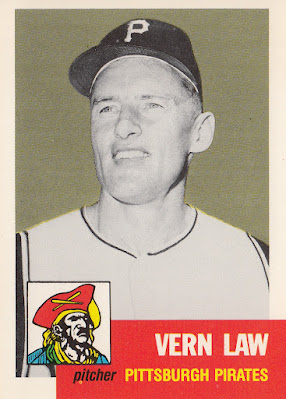
1991 Topps Archives '53 #324 Vern Law

Now, this isn't really a vintage card, even though it looks like a '53. Experts of these early Topps checklists (including our favorite Tim Wallach supercollector, who is nearing 1953 set completion) will know that Vern Law never made it into the original 1953 set. Neither did 56 other players who made up "The Cards That Never Were" subset at the end of the 1991 Topps Archives checklist.

Topps really took this theme seriously, writing a paragraph for the card back as though we were in early 1953 looking forward at the upcoming season. We're told, "This strong righthanded hurler rejoins the Pirates this year after spending the 1952 campaign in military service." 

Those who don't know the 274-card checklist of 1953 Topps by heart can use several other cues to place this subset as an revisionist augmentation to the set rather than a pure reproduction of the original. 

First, the images are black-and-white photographs rather than the full-color paintings we'd see on the originals. I have a mostly complete run of this set, and the only exception I could find was Hank Aaron's card #317. He did get a color painting, but it's not nearly up to the more lifelike standard found in the originals. The next clue is the background. It's usually a one of a few plain solid colors like this, or sometimes it might overlay a faint black-and-white background.

On the back, you could just check whether the card number is #281 or above. There's no red-colored facsimile signature behind the write-up like you'd see on an original. And finally, the card back will have "The Cards That Never Were" printed on the very bottom.
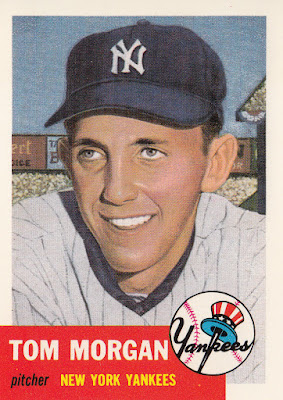
1991 Topps Archives '53 #132 Tom Morgan

Here's a reproduction of an original '53, and the difference is quite obvious. The colors are vibrant, and there's even some festive little bunting in the background on the facade of the stadium. 

This card is more of a review of Tom Morgan's 1952 season, as he served in the military during 1953, which the card back mentions. He was back in (baseball) action in 1954, wrapping up his career with the Los Angeles Angels in 1963.

I don't know anyone who would call a 1991 card from the heart of the overproduction era "vintage", although one has to wonder. As disconcerting as this fact is, that was thirty-one years ago. And when I really got my collection going in 1993, I'd have to find something from 1962 to have something as old then as this is right now.

But still, 1991 is not vintage.

Is it?

Or is "vintage" an ever-receding landmark in the rearview mirror, something that became fixed in place at some point, an idea that somehow manages never to keep pace with our world that's rapidly becoming more and more unpredictable?

Maybe let's just not think about that.
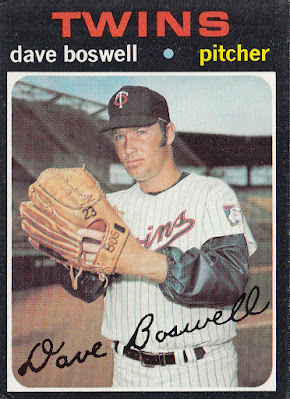
1971 Topps #675 Dave Boswell

Here's 1971. This is vintage.

This shouldn't be very surprising, but when I go through cards from this long ago, there are a lot of names I don't know. Tons. Dave Boswell is among them. 

He's pictured here as a Twin, which is where he spent his career from 1964-1970. However, the Twins released him in early 1971. He appeared in a handful of games for the 1971 Tigers and Orioles, but that was the end of his career. It was also the end of the line for his Topps issues, meaning this is his sunset card. He appeared in a few oddball sets after that, but Topps never documented either of his final pair of teams.
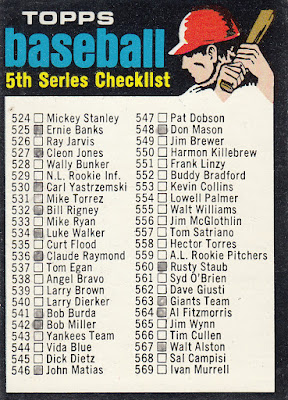
1971 Topps #499 Checklist 5

Jay threw in a checklist from 1971, and it's stops just a little short of including Dave Boswell's card #675, ending at #643. Whoever had this before me had a long way to go before completing the black-bordered 1971 set, but they certainly had a few of the big names checked off. Hall-of-Famers like Ernie Banks, Carl Yastrzemski, Roberto Clemente, and quite a few others. It's marked in pencil, and it looks like #531 Mike Torrez was possibly erased. Maybe part of a trade?
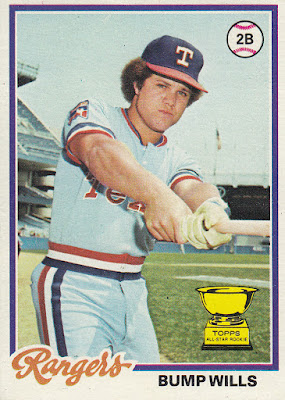
1978 Topps #23 Bump Wills

Fast forwarding a few years to 1978, perhaps a bit closer to that blurry vintage/modern dividing line, we come to "Bump" Wills, the son of Dodger great Maury Wills.

Wills's true Rookie Card is a four-player card from 1977. This is his first solo card. He finished third in 1977 AL Rookie of the Year voting, losing out to Eddie Murray, but he did earn himself a Topps All-Star Rookie cup, clearly shown on the lower right of the card. It's a nice addition to this posed photo, taken inside the newly-renovated (old) Yankee Stadium.

1967 Topps #76 Jim Barbieri (RC)

Jim Barbieri is another name I don't know, but this 1967 card was the oldest one in this shipment, so up it goes on the blog. The posed photo looks similar to Bump Wills's card, but this checks the box for the always-trusty bat barrel shot.

The card back says that Barbieri threw out the ceremonial first pitch in the 1954 World Series, the very same World Series where Willie Mays gave us "The Catch" in Game 1, so it's very likely that this Dodgers rookie was on hand to witness that legendary defensive play as a thirteen-year-old. The card doesn't specify for which game Barbieri got the honors, but I'll go ahead and believe it was Game 1, because why not? Maybe the ceremonial first pitch used to be exclusive to Game 1 back then, anyway.

Barbieri's career spanned all of thirty-nine regular-season games in 1966, so this Topps card ends up being a combo Rookie Card and Sunset Card. 

There was a 40th game before his career truly ended, though. Apparently no stranger to Game 1 of the World Series, he appeared as a pinch-hitter for the Dodgers in the '66 Fall Classic. He struck out swinging in the 4th inning and that was that.
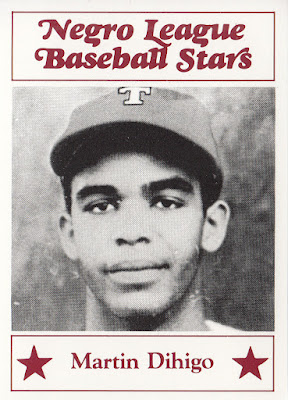
1986 Negro League Fritsch #19 Martín Dihigo

Jay included a few oddball cards focused on Negro League stars, including Cuban-born Hall-of-Famer Martín Dihigo, "a talented second baseman who was a superior hitter". And despite what you might think from this grainy black-and-white photo, he wasn't a 19th century contemporary of Cy Young or Old Hoss Radbourn. Dihigo played and managed right up through the mid-1940s.

Sadly, by and large, oddballs like this release from Larry Fritsch Cards are about all that's out there for many Hall-of-Famers who played only in the Negro Leagues. Players like Dihigo, Oscar Charleston, Turkey Stearnes, and many others have been as ignored by the card industry as by pre-1947 Major League Baseball itself. For example, Dave Boswell has 28 search results on Beckett. Martín Dihigo has 26. Only one of them is in the Hall of Fame.

Perhaps now that the various Negro Leagues have finally been recognized as Major Leagues, that will start to change. Maybe there would be numerous legal difficulties Topps/Fanatics would encounter if they tried, but I'd buy a retro-themed Negro Leagues set if it were on the market.

Just saying, if there's room for the thousandth Dustin May card, maybe there's room for some Hall-of-Famers that remain far too obscure.

1991 Swell Baseball Greats #9 Joe Black

Another oddball came from the Swell Baseball Greats set, a 1991 release from a brand of the Philadelphia Chewing Gum Corporation. Joe Black, pictured here as a Brooklyn Dodger, joined the National League in 1952, winning Rookie of the Year honors thanks to a 15-4 record. He kept playing through 1957. He got his start with the Baltimore Elite Giants, playing for them from 1943-48.

We'll keep the World Series history going with a fact from the card back, which is that he was the first Black pitcher to win a World Series game. That happened in 1952 versus the Dodgers' crosstown rivals, the Yankees. It was a seven-game battle, as were most of the matchups that decade between the Yankees and Dodgers.
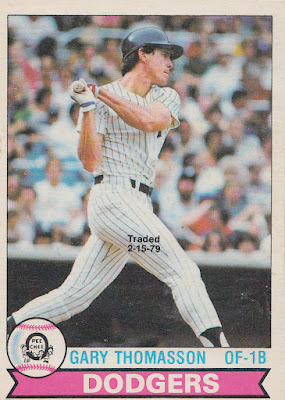
1979 O-Pee-Chee #202 Gary Thomasson

To close, we'll head north of the border. This looks quite like a 1979 Topps card, but look closely inside the little baseball element and you'll see a fun O-Pee-Chee logo! The Canadian brand that licensed and distributed Topps sets for years throughout Canada actually made some noticeable changes to Gary Thomasson's 1979 Topps card.

In the USA set, Topps simply pictured and listed Gary Thomasson as a Yankee, but by the time O-Pee-Chee got around to it, they had time to switch the listed team to the Dodgers, as well as provide the date that Thomasson was traded. The Dodgers acquired Thomasson for catcher Brad Gulden, who bounced around the league until 1986.

I learn a lot when I get stacks of vintage cards. So many of these guys I've never heard of, but there's always a wealth of knowledge to uncover, from small offseason trades to World Series history.


Monday, April 6, 2020

Mr. Tiger

The last time I did a single-card post from 1962 Topps, it was a much happier occasion. That was the day I acquired a real Mickey Mantle card, and I couldn't wait to share my find with the community. Today, however, we mourn the passing of Al Kaline, one of the all-time greats in Detroit Tigers history. He was 85.

1962 Topps #150 Al Kaline
Prior to that Mantle, the most money I'd ever spent on a single baseball card was this, Al Kaline's card from 1962 Topps. It was $40 at Jerry's Sportscards, which once stood on a nearby street corner that is now occupied by a Walgreens. It's no longer there, of course, but if it were, it would be within walking distance of my front door.

How times have changed.

Judging by how much I've spent on 1962 cards, one could easily make the argument that this is my all-time favorite set. This particular example is in pretty good shape, and though it's ungraded, it's probably about a sharp as that Mantle. And even on a vintage card like this, I can't help but notice the slight oddities in the photo, like the fact that Kaline is "swinging" someone else's bat. Kaline clearly wore #6, which was retired by the Tigers in 1980, the same year he was inducted into the Hall of Fame. But the bat appears to have #24 on the knob, belonging to rookie Frank Kostro.

Speaking of that retired uniform number, he was so beloved by Detroit that he was the first Tiger to ever be honored in such a fashion. Greenberg's and Gehringer's numbers were both still in circulation until 1983.

On the card back, Topps has a cartoon showing a left-handed batter ready to step up to the plate, framed by a pitcher holding a ball. Kaline was a righty, so clearly the cartoon isn't truly personalized, unless they're trying to show him in the on-deck circle or something. Under that, we're told that Kaline had played in ten All-Star games. He was at that magical age of 27 in 1962, right in the prime of his career and a year after leading the AL in doubles. He'd go on to play in a whopping eighteen All-Star games before calling it quits in 1974.

We've lost a few baseball stars in the past couple weeks. Jimmy Winn. Ed Farmer. And now Al Kaline. Under normal circumstances, I'd probably think that was a group of three, and we'd get a reprieve for a little while. But given the current state of the world, these kinds of posts might sadly become a bit more common in the months ahead.

Rest In Peace, Mr. Tiger.

Thursday, January 23, 2020

Hall Bound

For the first time ever, a Rockie is headed to Cooperstown. In his final year on the ballot, Larry Walker earned 76.6% of the vote, just squeaking past the 75% threshold.

I watched the announcement live, and must admit that my heart skipped a beat when his name came up. For too long my hometown team has been denied a presence in the Baseball Hall of Fame, and I can't wait to finally make a trip there and see a Rockies cap on a plaque.

I certainly can't think of a better reason for a one-card post than a Hall of Fame election. But which card to use? He's had some great ones over the years. As I was making my selection, I thought something from 1997 would be most appropriate. That was his MVP year, which remains the only time a Rockie has won the award. Night Owl's recent “Best MVP-year cards” post omitted Walker's 1997 Topps card, as he came out on the wrong end of a split hair, to paraphrase.

As one of the few Rockies fans in this community, I'm glad I have the chance to put a candidate forward for that list. Here's what I came up with:

1997 Bowman International Best #BBI7 Larry Walker
This one checks all my usual boxes. Rockies card. Shiny card. Topps card, the brand that leads off every one of my annual binders. Granted, Bowman falls toward the back of the pack in the Topps section, mainly because I've never been able to keep the designs straight, and because the numbering system is far too counterintiutive.

Bowman's Best, on the other hand, gave us designs that I consistently enjoyed and can recall from memory better than the base Bowman sets. And in 1997, both the base and Best sets included the inaugural version of International parallels, where the card background was modified in some way to match the player's country of origin. The 1999 set channeled the card backs from 1993 Leaf by including photographs of local landmarks. But in 1997, International cards simply had the flag of the player's home country. I have the normal version of this card, but because Walker is just the second-ever Canadian to reach the Hall of Fame, after Fergie Jenkins, choosing the parallel containing the flag seemed especially appropriate.

We strongly associate this red maple leaf on a white background with our neighbors to the north, but it's really a relatively recent creation. Prior to 1965, the Canadian flag included the Union Jack with a red field, as well as a coat of arms. Quite a Canadian form of rebellion against the British Empire, if you ask me. No wars, no riots, just a polite, "we'd like a new flag, please."

Anyway, on the card back, underneath a United Nations-esque banner of various flags, there's a small paragraph featuring Walker's best season, for which they selected 1995. He hit 36 home runs and had 101 RBI, stole 16 bases, and slugged .607. He also led the NL in outfield assists, and his arm was truly something to behold. Just ask Metal Universe. Those 36 homers were also a record for a Canadian-born player.

Of course, he'd break his own record just a couple years later. Bowman couldn't have known it yet, but 1997 was undoubtedly his best year. As I mentioned before, he won the NL MVP, and led the Majors in home runs, on-base percentage, total bases, and slugging percentage. He was second in batting average behind the great Tony Gwynn, and third in RBI behind Jeff Bagwell and Andres Galarraga, his own teammate who took the league lead.

Like his shirt said, he ain't no ordinary sponge.

As amazing as that season was, if he had managed to eke out just a dozen or so more hits, he might have won the Triple Crown, which would have completely changed the conversation about his Hall of Fame candidacy.

Congratulations are of course in order for Derek Jeter as well, a nearly unanimous inductee and one of the many greats to wear the Yankee pinstripes. Ted Simmons and Marvin Miller will join them, thanks to the Veterans Committee.

I doubt I'll be able to witness Walker's induction speech in late July, but I do plan on seeing the Rockies retire his uniform number 33 prior to the game on April 19th. Todd Helton blazed that trail in Rockies history, and here's hoping he'll also get the call before too long.


Saturday, October 20, 2018

The Case Hit Group Break (Part 2: Pirates)

A nice bonus in most group breaks is an extra, random team in addition to your selected team. I picked the Rockies, no surprises there. And I believe I have the Mets in Nachos Grande's current break, but in Trevor's midsummer break at Bump and Run Football Card Blog, I ended up with the Pirates. No problems with that; in fact if I had to rank favorite teams, they'd probably be up in the top ten or twelve. They usually have some pretty interesting characters, and a rich but often overlooked history going all the way back to Honus Wagner. My Topps Opening Day blaster in 2017 was filled with Pirates, and I had fun with that post.

2018 Stadium Club #255 Gregory Polanco
Gregory Polanco also seems to be having plenty of fun on his 2018 Stadium Club card, flashing a couple peace signs at the camera. This is a view few of us get, a shot looking up the dugout steps that's usually reserved for players. The piercing gaze of cameras look down the dugout regularly, and sometimes even into the clubhouse tunnel, but very rarely out onto the field from this perspective. The full-bleed design lets us see the stadium lights turned on against a rapidly approaching dusk.

A fun fact on the back tells us that Polanco was the first-ever opening day DH for the Pirates, meaning they must have opened the 2017 season on the road for an interleague game. Sure enough, they opened last year in Fenway Park, and took a loss to this year's AL pennant winners.

2018 Stadium Club Black Foil #226 Starling Marte
A more commonly-seen view of the dugout greets us on Starling Marte's card, which is a Black Foil parallel. It doesn't pop quite as well as the Red Foil variety, but it's nice to get a look at the various colors to be found in 2018 Stadium Club.

I can't say I know much about Polanco or Marte, but they're both from the Dominican Republic. Santo Domingo, to be exact, which is the birthplace of a slew of famous ballplayers, including David Ortiz, Pedro Martinez, Albert Pujols, Jose Bautista, and many, many others. It's a pretty small country, but they've sent a significant share of famous ballplayers to the MLB.

2018 Diamond Kings #18 Paul Waner
Same goes for the state of Oklahoma. Hailing from that midwestern state are Johnny Bench, Mickey Mantle, Joe Carter, Willie Stargell, and Paul Waner, a Hall of Famer and the 1927 NL MVP. The Pirates won the pennant that year, but ended up with the misfortune of facing the 1927 Yankees, arguably the best baseball team of all time. It was the only postseason appearance of Waner's career, and his Pirates were swept by those invincible Yankees.

Those of you who read my previous post will notice that this is a new design, as I didn't get any Rockies from the box of 2018 Diamond Kings. That was more than offset by a case hit of Jon Gray (also from Oklahoma), but the box gave up a few treasures for the Pirates stack. The set has that same playing card finish I've pointed out in past years, and a similar oil painting look as you've seen before.

The white-on-yellow text is a touch hard to read, but the back of the card tells us that Waner made the most of growing up on a farm. He honed his craft learning to hit corncobs with a stick, which apparently makes hitting a nice sphere with a thick bat a walk in the park. Of course, being in the Hall of Fame often leads a team to retire your number, and if you look closely on Marte's card, you'll see Waner's #11 on the facade of the third deck, just to the right of Marte's cap.

2018 Diamond Kings Brown Frame #13 Lloyd Waner
The Pirates also brought Paul's younger brother Lloyd aboard, and they played together throughout the 1930s. Lloyd is also in the Hall of Fame, but didn't have quite the high performance as his older brother. And the Pirates #10 is still in circulation, currently worn by Jordy Mercer.

Diamond Kings yielded a hit for me, balancing out the lack of my preferred team. This is a framed border parallel, the Brown version, which is numbered to just 49 copies. It's most likely a bit more plentiful than a Photographer's Proof in 2018 Stadium Club, but 49 is pretty darn scarce.

I'm sure the Waner family back home in Oklahoma was delighted to have a couple pro ballplayers bringing home the bacon during the 1930s while the topsoil was blowing away in the midst of severe drought.

2018 Diamond Kings #19 Roberto Clemente
Moving a bit further down the Pirates timeline, we come to the great Roberto Clemente, Hall of Famer, MVP, 15-time All-Star, and two-time World Series champion. He's also in the 3,000 hit club with Paul Waner.

As this is an unlicensed set, there can't be any MLB logos, but somehow that's a bit less noticeable on older photos. The blocky yellow "P" is pretty conspicuously absent from Clemente's batting helmet, the kind without ear flaps. But on the Waner cards, It's not clear how much image editing Panini had to do.

2015 Topps Chrome #126 Gregory Polanco
Gregory Polanco makes another appearance, but he's all business this time around, and with a degree more shininess. I don't hear much talk about Topps Chrome anymore, which maybe has something to do with the lack of borders in Topps flagship. But I'll always take a shiny card.

I'm always partial to cards that show special patches on the player's sleeves. I kind of got hooked on that mini collection while hunting for cards for Highly Subjective and Completely Arbitrary. In 2014, the Pirates wore a #4 patch, memorializing Ralph Kiner. Kiner, yet another Hall of Famer, led the NL in home runs for his first seven years. He only played ten seasons, retiring at just 32 due to a back injury. He stayed involved with baseball for the rest of his life, getting into broadcasting in the early 1960s, and he was the voice of the Mets right up until his death in 2014.

2018 Topps #591 Daniel Nava
Game 7 of the NLCS is drawing to a close as I write this, so I'll wrap things up with one for my Coors Field Frankenset, newly released onto the market by Topps this year. This happens to be a zero-year card, because while Daniel Nava is technically part of the Pirates organization, he hasn't appeared in a Major League game with them, let alone one at Coors Field. He's bounced around the big leagues since he left Boston in 2015, and it remains to be seen when his next appearance will be.

That looks like Bud Black in the Rockies dugout, occupying his usual spot on the top step. That would place this card in 2017 when Nava was a Phillie, narrowing this down to early August 2017 in an entirely different uniform.

This has been my most prolific month of blogging since April, and it feels good to be writing again and giving proper thanks to the great members of the Cardsphere. Thanks for sticking around, and enjoy the World Series! I'll be trying to figure out which team I can tolerate more.


Sunday, August 13, 2017

BUNTing into the shift

It was a successful shopping trip to Target when I checked the shelves a second time for Topps Bunt 2017. This purchase was actually made prior to my blaster of 2017 Stadium Club, a set I chose to feature first, partially to keep my content more relevant, and partially because it pretty much blows any other Topps product out of the water.

2017 Topps Bunt #51 Chris Archer
Regardless of whether I buy Stadium Club or Bunt, I've been pulling plenty of Chris Archer cards this year. Archer, a strikeout master who earned his second All-Star selection this year, is still hovering around a .500 win percentage, about the same as when I last wrote about him.

I've been much less active in the Topps Bunt mobile app than in past years, but I still log in from time to time. I even got a 5-card pack of National Baseball Card Day virtual cards, which share the same design with the cards that were handed out at card shops across the country yesterday. But as they did last year, the Bunt base cards inside the app vary a little bit from this printed product.

2017 Topps Bunt #96 Marcus Stroman
Marcus Stroman, one of my fantasy team members this year, took a no-hitter into the 7th inning during the World Baseball Classic final this spring, where he teamed up with Chris Archer to bring the title home for Team USA. This card says he has a "sunny future", and based on this day-game image, the photo selection for this card ties right in. Even that double stripe in the background seems to evoke some sun rays, shining down on Toronto's ace.

I don't know if we're giving names to non-flagship Topps sets these days, but I'm offering up "the racing stripes set" for 2017 Bunt, which looks just like what you'll find on the fender of a Corvette Grand Sport.

Yes, I'm a car guy, in case you couldn't tell from that and yesterday's Jaguar reference.

2017 Topps Bunt #41 Jason Heyward
Jason Heyward, or J-Hey, as he'll be known on his Player's Weekend jersey, is decked out in Cubbie Blue at the plate. This color-coded set matches his jersey very well, and we get a glimpse of the jaw extension on Heyward's batting helmet, which he started wearing after suffering a broken jaw in 2013. Giancarlo Stanton, Keon Broxton, and many others throughout the league have been opting to wear a bit of extra protection when coming to the plate, and rightly so.

I took a little league pitch off the elbow once, and it remains some of the worst pain I've ever experienced. Taking a Major League fastball off the face, or worse, a line drive back at your head, is easily the scariest moment that can occur in a ballgame. Helicoptering broken bats are dangerous, but you usually have lots of time to get out of the way. It's dangerous enough out there, with a slippery base nearly destroying Bryce Harper's knee last night, to a hit-by-pitch today that caused Nolan Arenado to immediately remove himself from the game for a hand x-ray. Baseball should do all it can to avoid potentially life-threatening head injuries.

2017 Topps Bunt #155 Noah Syndergaard
Noah Syndergaard, aka "Thor", perhaps overdid it a bit with his training and conditioning, by his own admission. He's been out for most of the season with a torn muscle, adding to the Mets' injury woes that have plagued them for much of the past couple seasons. Somehow, they're still in third place, despite having one of the best rotations in the league stuck on the disabled list. But there are still long, flowing, blond locks everywhere you turn, accented by the Topps BUNT Racing Stripes.

By the way, Mets, you can't have Jon Gray.

Game of Thrones spoilers to follow.

Despite his injury (well, likely long before it), Syndergaard still found time for a cameo appearance in last week's Game of Thrones episode. In a medieval world where baseball does not exist, I'd probably pick a fireballer like Thor to be my chief spear-thrower. All seemed to be going well in the battle until a dragon showed up and char-broiled everyone to ash. That's not an injury you're likely to recover from, and even if there are dangerous flying objects, I vote for living in a time where competition on an open field is done with bats and balls rather than swords and spears.

2017 Topps Bunt Blue #194 Mike Moustakas
I pulled a few of the Blue parallels in this value pack of Bunt, but this one of Mike Moustakas looked the best. The Royals have so much blue in their logo and uniform, you can hardly tell this is a monochrome card. It almost looks like a cyan printing plate. In this insert set, I also pulled now-Rockie Jonathan Lucroy, and Thor's long-haired rotation mate, Jacob deGrom. Moustakas was the pick, partially because I wanted to throw his awesome Instagram handle out there again, @MooseTacos8.

This third baseman has two All-Star selections and a World Series ring to his name, and he needs just a few more long balls to take the Royals' season record, which currently stands at a surprisingly low 36. Even the great George Brett never had more than 30 in a season. They are an expansion team, and the winner of the only World Series ever between two expansion teams, but they've played almost fifty seasons. You'd expect someone to at least have passed 40 by now.

2017 Topps Bunt #195 Jorge Alfaro (RC)
Blue, blue, blue, blue, and a blue parallel. That's a lot of blue, so I felt the need to throw in a random Phillie I've never heard of, just to break up the monotony. Alfaro, apparently a top prospect in the Phillies organization, joined the farm system as part of the Cole Hamels trade. He hails from Colombia, a somewhat rare origin for a Major Leaguer, compared to Venezuela, which borders it on the west. I'm not sure whether this is a posed shot, or perhaps from batting practice, but I find it surprising that Alfaro is just wearing a backwards cap here, as I'm pretty sure catchers are required to wear a helmet when behind the plate.

2017 Topps Bunt Infinite #I-KM Kenta Maeda
I got a nice variety of insert cards in this value pack, starting off with another mostly-blue card, this one of Dodgers starter Kenta Maeda, who hails from Japan. According to the card, Maeda idolized Ichiro as a boy, which Vin Scully had a bit to say about last year. In their first meeting, Maeda retired Ichiro three times, holding his idol hitless, which is all the more impressive when you remember that Ichiro has amassed thousands and thousands of hits in his career, helping pave the way for more guys like Maeda to even play in the MLB in the first place.

There's a faint photograph of Dodger Stadium layered over Maeda's bust, bringing to mind the card backs of 1992 Topps. I don't really know what makes this "Infinite", unlike the very obvious Power Zone insert card from this year's Stadium Club. But it's a nice enough card.

2017 Topps Bunt Perspectives #P-RK Ralph Kiner
I'm definitely not liking that this year's insert cards aren't getting numeric card numbers, as that pendulum seems to be swinging the wrong way again. But this yellow Pirates card gives us another color to look at, and the only horizontal card in the whole pack.

I hate to admit this, but I don't really know that much about this Hall-of-Famer. Thanks to this card, I now know that he was an avid golfer, and frequently played with celebrities like James Garner and Jack Lemmon. Thanks to my other research, I discovered that he was a Navy pilot in WW2, led the National League in home runs during several consecutive postwar years, and even hit 54 home runs in 1949, the highest mark seen in the National League between Hack Wilson and Mark McGwire.

Kiner had to retire at 32 due to a back injury, but not long after that, he began a long career as a broadcaster for the New York Mets. Other than his final season in 1955 as a Cleveland Indian, Kiner didn't have much to do with the American League during his long life. He passed away in 2014 at the age of 91. He was inducted into the Hall of Fame in 1975, making it in by the skin of his teeth, thanks to a single vote in his favor on his final ballot. He never missed an induction ceremony after that.

2017 Topps Bunt Programs #PR-OS Ozzie Smith
Unlike Kiner, this Hall-of-Famer isn't so far before my time. I saw him in person on August 26th, 1995, during my first-ever visit to Coors Field. Ozzie went 0-4 that day, but the Cardinals rallied in the 9th to scratch out a win at 20th and Blake. I don't remember if The Wizard dazzled us with one of his trademark backflips, but he was one of many players now in the Hall of Fame that I got to see as a boy. And a few more that should be.

Bunt Programs are pretty much the same as last year, giving us a close-up action shot on the front, and some cleverly worded story titles on the back, complete with fake page numbers. Ozzie gets gems like "Conjuring up 'The Wizard'", "Ace in the Hole," and from his 1985 NLCS walkoff highlight, "Go Crazy, Folks, Go Crazy."

I doubt that Topps has the editorial staff to actually build articles behind these tantalizing headlines, but I'd love a QR code or something where I can quickly find out what these features are referring to, especially for other colorful characters found in this insert set, like Goose Gossage, George Brett, Johnny Cueto, and Bartolo Colon.

This pack couldn't have cost me more than $3, and even if it's not quite as awesome as Stadium Club, I think Bunt has a real place in the market. I hope they keep it around, even if it's just so I can open current product at a low price point when the urge arises.


Sunday, July 30, 2017

Going Clubbing (Part 1: Base Cards)

This just in: I still love Stadium Club.

The midsummer release of the premium set is as good as ever, and I was fortunate to find a blaster at my local Target recently. I scored some nice hits, as you'll see in part 2 of this post. But the key aspect of this set is the stellar photography, lovingly selected by Sooz herself.

While all you Chicago-area dwellers are having a grand old time at The National, (I know Nick picked up a few cards for me at the show), I'm just soaking in the glory that a $10,000 camera setup can capture.

2017 Stadium Club #231a Giancarlo Stanton
Horizontal cards look particularly good in a full-bleed design like this, and Giancarlo Stanton, the 2016 Home Run Derby champion, is shown grabbing one at the wall in Marlins Park, the same wall he clears so many times with his bat. Stanton is now sitting at 33 home runs this season, tied with Aaron Judge, who hasn't done much since the break.

Stanton hit a home run earlier this year that just cleared the center field wall at his home park, and it's about the sweetest sound you ever heard a bat make while contacting the ball. Have a listen.

Capturing a sound like that on cardboard is about all they could do to improve this set. Unless they slashed the price a little. Granted, these photos aren't cheap to license, but it is a pricey set to collect.

2017 Stadium Club #170 Ryne Sandberg
As beautiful as it is, another plus to this set is all the retired stars that make appearances, often with photos we haven't seen before. A relatively young-looking Ryne Sandberg is shown in the ageless Wrigley Field, with what looks to be a Phillies catcher off to the side. Pretty tough to say for sure, but assuming this image is from Sandberg's MVP year of 1984, which is the subject of the paragraph on the back, that could be Ozzie Virgil with a cameo.

The Phillies, of course, was where Sandberg spent his rookie season in 1981, playing in just 13 games before being traded to the Cubs. He finished his career in the Windy City, retiring in 1994, then returning in 1996 to play two more seasons.

Interestingly, I have a very specific memory of Sandberg's first retirement announcement, which happened on June 13th, 1994. That was the day I purchased my very first factory set, 1994 Topps, after calling every card shop in the Denver area Yellow Pages to find the best price. That was an all-day project back then, as opposed to about a five-minute task today. Anyway, on the car ride back after transacting the astronomical sum of $45 for a box of cardboard awesomeness, Sandberg's retirement was mentioned on the radio.

Judging by the late spring date of June 13th, I wasted no time that summer vacation in lining up a baseball-related activity to keep me occupied. And while it is nice for $45 not to feel like the jackpot on a game show anymore, having three straight months of perfect weather and no obligations sure sounds nice right about now.

2017 Stadium Club #49 Masahiro Tanaka
Even though Sandberg looks great in Cubbie Blue, they're not the only team to wear pinstripes. The Yankees are probably the team most associated with that, and Japanese pitcher Masahiro Tanaka displays them perfectly. Tanaka was the winningest Yankees pitcher last year, and seems to have found his groove following some elbow problems earlier in the decade. He even took a perfect game into the 6th inning yesterday, helping the Yankees take first place in the AL East. It's like my dad always says, "You don't have to check where the Yankees are in the standings until about August."

2017 Stadium Club #17 Didi Gregorius
Didi Gregorius concurs, and is clearly thrilled to be following in the footsteps of great Yankee shortstops like Phil Rizzuto and Derek Jeter, both of whom are mentioned on the back of this card. It's a bit unusual to read "Rizzuto" and "Wins Above Replacement" in the same paragraph, but Didi had 2.7 last year. And he's been way better than Brandon Crawford on my fantasy team since I picked him up, helping me squeak out a 10-point victory in an extended week following the All-Star break.

The Dutch-born player has a long way to go to stay in the same breath as the Monument Park legends, but if the Yankees hold on to first place, he's sure to get a chance to play some October baseball, just like so many of his predecessors.

2017 Stadium Club #70 Ken Griffey, Jr.
Albert Pujols recently reached the rarefied air of the 600-home-run club, leaving him perhaps a season or so short of passing Ken Griffey, Jr. on the career home run list. Pujols is also the next in line to reach the 3,000 hit club, which Adrian Beltre just joined today. But the next group of active players have hundreds to go to tie Griffey, so we might not see another player join the 600-homer club for a very long time.

I'm guessing that this is a pre-Interleague photo, right when Griffey and Frank Thomas were dominating the Beckett Hi/Lo columns. But I can't figure out which stadium Griffey is playing in. The yellow railings are distinctive enough, but it's not ringing any bells. Before interleague play, I pretty much never saw an AL game other than during the playoffs.

2017 Stadium Club #283 Willie McCovey
Stadium Club is a treasure trove for mini-collection hits, and those who like the batting practice shots ought to track down this one of Willie McCovey. He's leaning on a particularly narrow bat behind the cage, which is really little more than a chain-link backstop. The game has certainly changed, as my sister and I both played on fields about like this. Patchy grass in front of the plate, the grass by the fence in need of a weed whacker, bats lying around, etc.... It's almost like we have a glimpse into a Hall of Famer's little league career. The 1959 Rookie of the Year and 1969 NL MVP played almost his entire career in the National League, save for an 11-game stretch in Oakland at the end of 1976. What a great unfamiliar uniform card that would be.

2017 Stadium Club #99 Paul Goldschmidt
Autograph seekers are after Paul Goldschmidt in another mini-collection candidate, including one fan holding a slightly creepy poster off to the right. I don't go to great lengths to seek them out, but I've only gotten one autograph on the sidelines, and that was Rockies pitcher Kevin Ritz, a starter who is 7th on the Rockies all-time Wins list. I came pretty close to getting Ben Petrick, too, but he headed back to the dugout just before my spot in line came up. A friend of mine got Edwin Jackson before a Cubs game a couple years ago, and if there's one thing I've learned, it helps to have your own pen.

2017 Stadium Club #175 Mark McGwire
There's not a lot of Mark McGwire love in the Cardsphere these days, as he's pretty much the poster child for steroid use in baseball. Still, the 1998 home run race made for a pretty exciting season, PEDs or not. There always seem to be asterisks attached to that record, whether it was McGwire's PED use, Barry Bonds' PED use coupled with his elbow armor (I can't blame him—getting hit on the elbow hurts!), or Roger Maris taking 162 games compared to Babe Ruth's 154, coupled with hitting just ahead of Mickey Mantle. And I've written about this before, but as part of Ken Burns' The Tenth Inning follow-up to his Baseball documentary, Chris Rock pointed out that Babe Ruth had 714 "affirmative action" home runs, noting that Babe Ruth didn't play in an era when guys like Torri Hunter were "snatching home runs out of the sky."

It's definitely a feat, hitting over 60 home runs in a season. When you think about it, of course there will be unusual circumstances surrounding it. Otherwise it would be a lot more common.

Asterisk or no, it's still a great mini-collection card on a couple fronts: dugout shots, and throwback uniforms. I wish I could nail down the date of this card, and if the lineup card posted on the dugout wall was legible, I'm sure that would have been a much easier task. Maybe McGwire even hit a home run on that day.

2017 Stadium Club #9 Greg Maddux
As powerful as he was, belting a home run was never known as "hitting a McGwire". But Greg Maddux has an unofficial stat all his own, a complete game shutout with 99 pitches or less. Maddux threw 13 of those in his career, and may have been on his way to one here. He was a master on the hill, and it was a sign of doom when he was slated to start against your team. You always hoped Maddux's spot in their five-man rotation skipped your three-game series. And the Braves, more than any other team, gave the Rockies fits in their early days. You don't hear the phrase "season sweep" very often, but that's exactly what the Braves did to the Rockies in 1993.

I guess the font on all the Stadium Club cards this year have a little extra flourish on the final letter of the last name, but I didn't really notice it until Maddux's card. The "E" on McGwire's card looks a bit overwrought, but it works very well with the unusual "X" on this card.

2017 Stadium Club #245 Chris Sale
This looks like a modern interpretation of a Studio card to me. With image stabilization, ultra-fast telephoto lenses, and ever-improving low-light performance, not to mention improved printing methods, action shots are relatively easy to obtain these days. Outside of retro sets like Heritage and Allen & Ginter, posed shots are pretty uncommon on cards. That makes this one of Chris Sale, bathed in the warm red glow of his new team in Boston, stand out even from the rest of these cards. It's just another reason why I keep reading bloggers who say they're considering abandoning Flagship entirely and just pursuing Stadium Club.

2017 Stadium Club #254 Maikel Franco
And I can't say I blame them. I'm pretty far from that point, but I do wish it was easier to find this set in larger quantities. Despite my obvious fanboy feelings about this set, I've yet to complete any of the four in this latest rebirth. I did find a full 900-card set of 1992 Stadium Club at a card show, and I completed Series 2 of the inaugural 1991 set thanks to a hobby box and a few Eight Men Out successes, but unlike Bowman, this brand tends not to show up in discount boxes.

Maikel Franco has been putting up some pretty consistent performance for the Phillies the last few years. Not great, but consistent. And whatever happened on this card, it looks like he made quite a defensive play. Probably not like what Nolan Arenado does on a daily basis, but anytime you end up on the tarp, you can safely assume you went above and beyond.

What particularly caught my eye in this photograph are the three young fans watching this play unfold right before their eyes. I've never had front-row tickets down the line before, and even after a two-hour rain delay in a 10-1 game, the best I could find was somewhere in the fourth. But these young ladies look quite curious about the play that just transpired, and don't seem to be shielding themselves from a potential impact. And that curiosity about the game doesn't seem to be terribly common among kids anymore. When I hear about what kids are up to, whether its Minecraft, fidget spinners, slime, or Snapchat, baseball doesn't seem to be high on the list.

2017 Stadium Club #159 Johnny Bench
All-time great Johnny Bench, perhaps the best catcher to ever don the gear, looks rather alarmed in this close-up. It was one of my favorite cards in the whole blaster (notice the lack of a throat guard), but I can't help but tie it to my concern about the future of baseball.

It's no secret that the current baseball card hobby is pretty much made up of middle-aged white men, myself included. But not that long ago, I was trading cards with the neighborhood kids and my schoolmates, playing on a little league team, watching the Rockies most Friday and Saturday nights, riding my bike to Wal-Mart to buy trifold hanger packs of 1993 Fleer (and Micro Machines), and getting 89-cent packs of 1991 Score at Toys R Us, whose card backs were practically short stories.

Of course, there are many more ways to nurture a love of baseball than through cardboard, but I don't know that the current game is translating that well among kids. Having a star like Griffey helps, and there isn't necessarily a fan-friendly superstar like that in the game today. Bryce Harper, for example, seems to be much better at losing his temper and getting ejected than engaging with fans. And Mike Trout, as good as he is, comes off as rather dull.

Distribution is a big part of it too. When I was growing up, all the Rockies games were on broadcast TV, Denver's channel 2. They shifted to cable many years ago, and with the growing rise of cord-cutting, being able to watch your local team is a whole lot tougher these days, and reserved only for those families who are both willing and able to pay the ever-growing prices for TV packages. Sure, there is MLB.TV, but you're still blacked out of watching your hometown team's live games, regardless of where they're played.

And I think this has a lot to do with why the NFL is so popular. Concussion risks aside, you can tune to your local CBS or Fox affiliate and see your city's football game every Sunday in the fall. And all the playoff games too. Monday and Thursday night games have migrated to cable, so it's a little tougher to see what's going on around the league, but your local affiliate will carry the feed if your city's team is playing in a cable-only game. Bottom line, it's free to follow your local NFL team, assuming you have a digital TV and an antenna. All else equal, why would fans pay extra for hometown baseball when what's already the nation's most popular sport is a channel flip away? I do, but that's partially because I could watch it for free when I felt like Scrooge McDuck spending my $45 at a baseball card shop.

MLB's recent move to broadcast games on Facebook, blackout free, is one of the smartest things they've done, distribution-wise, in a long time. This week's matchup between the Phillies and Braves wasn't fantastic, but its a step in the right direction. And if they're not blanketing Snapchat with top plays from the highlight reel, they're missing an entire genertaion.

I'll hop off my soapbox and enjoy these beautiful cards. I'm just saying, in a sport that still sort of feels like it's being played in black-and-white at Ebbets Field, it seems like they're taking the current level of interest for granted.

Saturday, August 20, 2016

Next Year in Wrigleyville

The Chicago Cubs are visiting the Rockies for their annual trip to Denver. They still have two weekend games to play, but the Rockies took the first game at about 1am this morning, following a two-hour rain delay and an 11-inning nail biter. The Rockies rallied to tie it in the 8th by winning a challenge. They couldn't plate a winning run in either the 9th or the 10th against a pair of Cubs rookie pitchers, allowing the Cubs to take the lead in the bottom of the 11th, despite some impressive defense by Gerardo Parra.

The Cubs brought on their shiny new closer, Aroldis Chapman. The Rockies got a baserunner on, who scored on a double by Ryan Raburn. Raburn ended up scoring the winning run on that same play after being awarded home plate when an errant throw ended up in the Cubs dugout. The rules say that all runners get two bases when a ball is thrown out of bounds, making it twice as bad as a balk, especially at the end of a game.

Regardless of how this weekend goes, the Cubs have the biggest division lead of any team in the Majors right now, and have a real shot at doing well in the playoffs this year, perhaps even a chance to Reverse the Curse, something the Red Sox did in 2004 after their own lengthy drought.

2012 Panini Cooperstown #115 Ernie Banks
Many excellent players have gone through Chicago since 1908, the last time the Cubs won a World Series. Even casual fans who might not know the exact year are still aware that, well, it's been a while. "Next Year" has become almost a religious mantra among Cubs fans, a bit like the "Next Year in Jerusalem" phrase that's recited at the end of a Passover Seder.

The Cubs' last World Series appearance predates the creation of Israel, and their last overall victory came before Charles Lindbergh, World War I, and the construction of the Titanic. The "Next Year in Jerusalem" phrase, at least from a geopolitical standpoint, has become more of a tradition than a prayer.

But the Cubs are still waiting.

With Ernie Banks' passing last year, as well as the plot of Back to the Future 2, there was a real buzz in 2015, when the Cubs got to the NLCS. But they couldn't win it for Mr. Cub, who appears on Panini's Cooperstown set from 2012. I got that, as well as a lot of other cards at a show quite some time ago, which I'm just now starting to write about. More to come on that card show haul.

2013 Topps Archives #48 Ryne Sandberg
Ryne Sandberg, one rookie season short of being a lifetime Cub, ended his career without a ring, and he hasn't had much success as a manager either. With 30 teams, a World Series victory is hard to come by, and isn't necessarily the measure of a stellar career. Ryno has quite the resume, from a raft of Silver Sluggers and Gold Gloves, to an MVP award and a plaque in Cooperstown.

Ken Griffey, Jr., Barry Bonds, Carlton Fisk, Ted Williams, and Ty Cobb are all members of that list, indicating that a World Series win is truly a team achievement, and even the best in history can't do it all by themselves.

Those guys all probably have Topps Archives cards too. Sandberg looks good on a 1972 Topps design. I'll go ahead and guess that this photo was taken on the road, seeing as how Wrigley Field didn't even have lights for the earlier part of Sandberg's career. That happened in August 1988, a whopping eighty years since their last championship.

108 years is a long, long time.

2014 Topps Archives #152 Anthony Rizzo
They have a solid group of players now, and Anthony Rizzo is one of the best. 1989 Topps is a familiar design for all of us, and I feel like this photo is period-correct. There were a lot of unexciting posed shots to be found in Topps before that epic 1991 40th-Anniversary set full of Sports Illustrated photos, but 1988 through 1990 left a bit to be desired, opening the door for Upper Deck to shake things up.

2013 Bowman Gold #181 Dexter Fowler
Dexter Fowler, who was once a Rockie, now patrols the outfield at The Friendly Confines. He hit the third pitch of yesterday's game for a home run, finishing the game 2-for-5 with two RBIs and a walk. Thanks to that shot, the Rockies never actually led the game, only winning after the walkoff error. Fowler was a fan favorite during his six seasons with the Rockies, and his speed was a great asset in the outfield and on the basepaths, as pictured on this Gold parallel Bowman card from...2014? No, 2013. I'm getting better at at least narrowing these Bowman cards down to the right era.

His speed trailed off a bit after this, but the card mentions his four straight seasons with double-digit triples, a stat in which he led the league in 2010. Topps also threw a million-dollar word on here, referring to Fowler as an ebullient personality.

If 2016 turns out to be the year, Fowler is sure to be a reason for it.

2012 Panini Cooperstown #33 Joe Tinker
Joe Tinker, long ago shortstop of the Cubs, was part of the inspiration for the most poetic 6-4-3 double play combination in history. The poem, mentioned on this card, and penned from the perspective of a sorrowful Giants fan, recalls the most recent time when the Cubs were consistently a threat to win the World Series. The Giants were their main rival at the time, and Christy Mathewson never relished having to pitch to Joe Tinker.

2012 Panini Cooperstown #34 Johnny Evers
Johnny Evers, the second man in that historic infield, had extraordinary plate discipline. The tidbits offered on the back of this Panini card tell us that Evers retired with three times as many walks as strikeouts. Even a century-plus ago, and despite all the changes that have occurred since the end of the dead-ball era, being a good hitter still requires not wildly flailing at pitches.

He was also a smart defender, and was the fielder who helped cement the Cubs' 1908 pennant after catching Fred Merkle in a forceout at second to end the first game Merkle ever started for the New York Giants. The Cubs won a make-up game after that disputed game ended in a tie, and in the tight 1908 NL Pennant race, ended up costing the Giants dearly.

2012 Panini Cooperstown #35 Frank Chance
Frank Chance, the player-manager first baseman, still holds the Cubs' career record for stolen bases. That's not something you'd expect from a first baseman, perhaps the least speed-sensitive position on the diamond. It's where they stick you when your knees have been acting up. So that part of the game has clearly changed. If he played today, he might have a different spot in that double play trio, all part of the Hall of Fame class of 1946.

Russell to Baez to Rizzo doesn't have quite the same ring to it as Tinker to Evers to Chance, but the Giants are still (barely) leading the NL West and it's an even-numbered year. It's entirely possible that the Cubs and Giants will be renewing their rivalry a century later.