Showing posts with label 1953 Topps Archives. Show all posts

Sunday, January 23, 2022

The Trading Post #167: Card Hemorrhage (Part 2: Vintage)

I don't know what feels normal anymore. Back pain is normal. Uncertainly is normal. 

Writing a blog post with an NFL playoff game on in the background used to feel a lot more normal than it does right now. It's nice to still be able to bring that back every once in a while, although this blog is starting to take a back seat to other priorities. I did twenty-three posts in 2021, and while I still haven't missed a month, that is about half of what I was doing around 2017.

Not that I don't have enough material to cover, it's just that there is a lot that steals my attention these days. One example of that would be the Marshall Fire that tore through nearby Louisville, Colorado on December 30th. You may have seen it on the news, but unfortunately I got a much closer look at it. My home is still standing, but I was caught in a smoky highway closure as the fire was spreading, was easily within walking distance of a frightening view of the flames that night, and found myself alarmingly close to the outer areas of the evacuation zone.

Seeing your hometown on the national news for this kind of thing is pretty unsettling. Watching the news crews broadcast from an intersection you've driven through a couple thousand times is quite scary. Trying to go about your workday while not being particularly confident that your home will still be there in a few hours is a very unpleasant experience. Knowing the office building you haven't been to in nearly two years (for obvious reasons) is directly in the path of destruction makes it very personal. That survived, although so much nearby was lost. Two lives. Pets. Homes. Businesses.

So, that has given me a lot of emotions to work through, on top of everything else.

In any case, I was reminded of my collection a week or so ago when I got a direct message on Twitter asking about an old 2011 Topps Opening Day hit. A fellow Twitter user inquired as to whether I still had this Justin Germano autograph from a 2015 blog post, and seeing as how it didn't go up in flames last month (one concern among a thousand others I had that day), I was able to help out his autograph collection. It might have been worth a solid amount in better condition, but Topps quality control being what it is, I shipped it off for $7 and got confirmation yesterday that it arrived safely.

Following that, I still want to review some vintage cards I got from Jay at Card Hemorrhage, which made up the remainder of a shipment he sent my way toward the end of 2021.
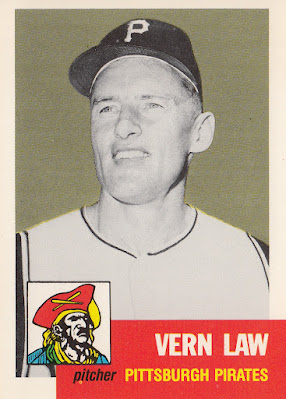
1991 Topps Archives '53 #324 Vern Law

Now, this isn't really a vintage card, even though it looks like a '53. Experts of these early Topps checklists (including our favorite Tim Wallach supercollector, who is nearing 1953 set completion) will know that Vern Law never made it into the original 1953 set. Neither did 56 other players who made up "The Cards That Never Were" subset at the end of the 1991 Topps Archives checklist.

Topps really took this theme seriously, writing a paragraph for the card back as though we were in early 1953 looking forward at the upcoming season. We're told, "This strong righthanded hurler rejoins the Pirates this year after spending the 1952 campaign in military service." 

Those who don't know the 274-card checklist of 1953 Topps by heart can use several other cues to place this subset as an revisionist augmentation to the set rather than a pure reproduction of the original. 

First, the images are black-and-white photographs rather than the full-color paintings we'd see on the originals. I have a mostly complete run of this set, and the only exception I could find was Hank Aaron's card #317. He did get a color painting, but it's not nearly up to the more lifelike standard found in the originals. The next clue is the background. It's usually a one of a few plain solid colors like this, or sometimes it might overlay a faint black-and-white background.

On the back, you could just check whether the card number is #281 or above. There's no red-colored facsimile signature behind the write-up like you'd see on an original. And finally, the card back will have "The Cards That Never Were" printed on the very bottom.
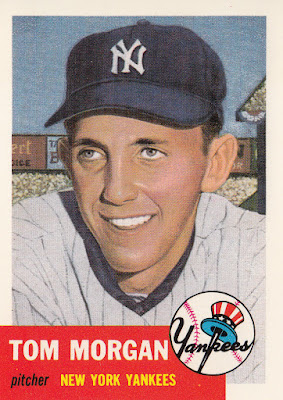
1991 Topps Archives '53 #132 Tom Morgan

Here's a reproduction of an original '53, and the difference is quite obvious. The colors are vibrant, and there's even some festive little bunting in the background on the facade of the stadium. 

This card is more of a review of Tom Morgan's 1952 season, as he served in the military during 1953, which the card back mentions. He was back in (baseball) action in 1954, wrapping up his career with the Los Angeles Angels in 1963.

I don't know anyone who would call a 1991 card from the heart of the overproduction era "vintage", although one has to wonder. As disconcerting as this fact is, that was thirty-one years ago. And when I really got my collection going in 1993, I'd have to find something from 1962 to have something as old then as this is right now.

But still, 1991 is not vintage.

Is it?

Or is "vintage" an ever-receding landmark in the rearview mirror, something that became fixed in place at some point, an idea that somehow manages never to keep pace with our world that's rapidly becoming more and more unpredictable?

Maybe let's just not think about that.
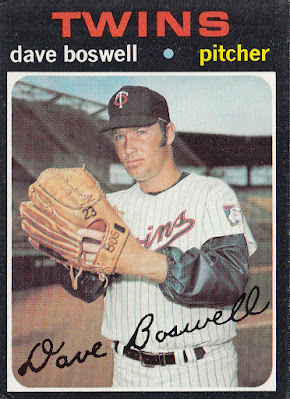
1971 Topps #675 Dave Boswell

Here's 1971. This is vintage.

This shouldn't be very surprising, but when I go through cards from this long ago, there are a lot of names I don't know. Tons. Dave Boswell is among them. 

He's pictured here as a Twin, which is where he spent his career from 1964-1970. However, the Twins released him in early 1971. He appeared in a handful of games for the 1971 Tigers and Orioles, but that was the end of his career. It was also the end of the line for his Topps issues, meaning this is his sunset card. He appeared in a few oddball sets after that, but Topps never documented either of his final pair of teams.
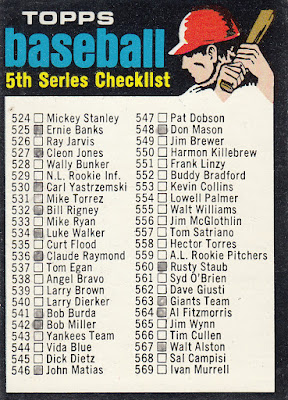
1971 Topps #499 Checklist 5

Jay threw in a checklist from 1971, and it's stops just a little short of including Dave Boswell's card #675, ending at #643. Whoever had this before me had a long way to go before completing the black-bordered 1971 set, but they certainly had a few of the big names checked off. Hall-of-Famers like Ernie Banks, Carl Yastrzemski, Roberto Clemente, and quite a few others. It's marked in pencil, and it looks like #531 Mike Torrez was possibly erased. Maybe part of a trade?
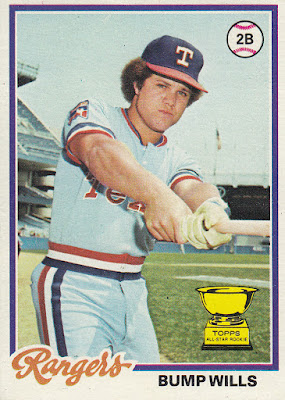
1978 Topps #23 Bump Wills

Fast forwarding a few years to 1978, perhaps a bit closer to that blurry vintage/modern dividing line, we come to "Bump" Wills, the son of Dodger great Maury Wills.

Wills's true Rookie Card is a four-player card from 1977. This is his first solo card. He finished third in 1977 AL Rookie of the Year voting, losing out to Eddie Murray, but he did earn himself a Topps All-Star Rookie cup, clearly shown on the lower right of the card. It's a nice addition to this posed photo, taken inside the newly-renovated (old) Yankee Stadium.

1967 Topps #76 Jim Barbieri (RC)

Jim Barbieri is another name I don't know, but this 1967 card was the oldest one in this shipment, so up it goes on the blog. The posed photo looks similar to Bump Wills's card, but this checks the box for the always-trusty bat barrel shot.

The card back says that Barbieri threw out the ceremonial first pitch in the 1954 World Series, the very same World Series where Willie Mays gave us "The Catch" in Game 1, so it's very likely that this Dodgers rookie was on hand to witness that legendary defensive play as a thirteen-year-old. The card doesn't specify for which game Barbieri got the honors, but I'll go ahead and believe it was Game 1, because why not? Maybe the ceremonial first pitch used to be exclusive to Game 1 back then, anyway.

Barbieri's career spanned all of thirty-nine regular-season games in 1966, so this Topps card ends up being a combo Rookie Card and Sunset Card. 

There was a 40th game before his career truly ended, though. Apparently no stranger to Game 1 of the World Series, he appeared as a pinch-hitter for the Dodgers in the '66 Fall Classic. He struck out swinging in the 4th inning and that was that.
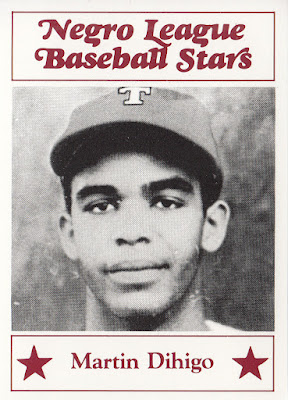
1986 Negro League Fritsch #19 Martín Dihigo

Jay included a few oddball cards focused on Negro League stars, including Cuban-born Hall-of-Famer Martín Dihigo, "a talented second baseman who was a superior hitter". And despite what you might think from this grainy black-and-white photo, he wasn't a 19th century contemporary of Cy Young or Old Hoss Radbourn. Dihigo played and managed right up through the mid-1940s.

Sadly, by and large, oddballs like this release from Larry Fritsch Cards are about all that's out there for many Hall-of-Famers who played only in the Negro Leagues. Players like Dihigo, Oscar Charleston, Turkey Stearnes, and many others have been as ignored by the card industry as by pre-1947 Major League Baseball itself. For example, Dave Boswell has 28 search results on Beckett. Martín Dihigo has 26. Only one of them is in the Hall of Fame.

Perhaps now that the various Negro Leagues have finally been recognized as Major Leagues, that will start to change. Maybe there would be numerous legal difficulties Topps/Fanatics would encounter if they tried, but I'd buy a retro-themed Negro Leagues set if it were on the market.

Just saying, if there's room for the thousandth Dustin May card, maybe there's room for some Hall-of-Famers that remain far too obscure.

1991 Swell Baseball Greats #9 Joe Black

Another oddball came from the Swell Baseball Greats set, a 1991 release from a brand of the Philadelphia Chewing Gum Corporation. Joe Black, pictured here as a Brooklyn Dodger, joined the National League in 1952, winning Rookie of the Year honors thanks to a 15-4 record. He kept playing through 1957. He got his start with the Baltimore Elite Giants, playing for them from 1943-48.

We'll keep the World Series history going with a fact from the card back, which is that he was the first Black pitcher to win a World Series game. That happened in 1952 versus the Dodgers' crosstown rivals, the Yankees. It was a seven-game battle, as were most of the matchups that decade between the Yankees and Dodgers.
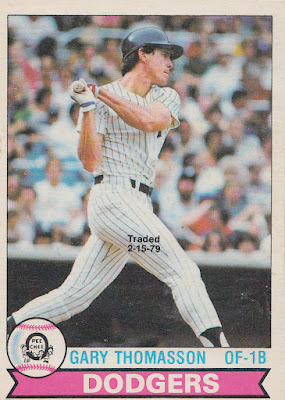
1979 O-Pee-Chee #202 Gary Thomasson

To close, we'll head north of the border. This looks quite like a 1979 Topps card, but look closely inside the little baseball element and you'll see a fun O-Pee-Chee logo! The Canadian brand that licensed and distributed Topps sets for years throughout Canada actually made some noticeable changes to Gary Thomasson's 1979 Topps card.

In the USA set, Topps simply pictured and listed Gary Thomasson as a Yankee, but by the time O-Pee-Chee got around to it, they had time to switch the listed team to the Dodgers, as well as provide the date that Thomasson was traded. The Dodgers acquired Thomasson for catcher Brad Gulden, who bounced around the league until 1986.

I learn a lot when I get stacks of vintage cards. So many of these guys I've never heard of, but there's always a wealth of knowledge to uncover, from small offseason trades to World Series history.


Saturday, August 10, 2019

The Trading Post #131: Nachos Grande

You're about to see a rare event on Infield Fly Rule. This is a post with precisely zero Rockies in it. I'm not certain, but I'm pretty sure that none of these guys ever even suited up for the Rockies. That is surprising, both because the current nature of the game dictates that players are traded almost like stocks, and because this is the largest-ever Trade Stack ever claimed from the recently-redesigned Nachos Grande, at a whopping 35 cards.

I've had Trade Stack #93 on my desk for quite some time, and while everyone's favorite Barry Larkin collector documented his end of the trade in short order, it's taken several months for me to get to it. I've travelled a lot this year, and have seen quite a few MLB games, even one in another city! I had the good fortune to see Billy Joel play at Coors Field on Thursday, who is simply excellent in concert. He even peppered in a couple of Eagles songs.

I haven't been to a Rockies game in a couple months. In fact, my most recent game was the one in San Diego almost a month ago, which is appropriate for our first card.

2017 Topps Heritage #81 Adam Rosales
Adam Rosales is currently in the Cleveland Indians organization, and hasn't played in the big leagues this year. But not long ago, he played a full season with the Padres. That was in 2016, the same year the All Star Game was in San Diego, as noted on Rosales's uniform patch. Topps included him in 2017 Heritage on the '68 design.

Rosales is listed as a third baseman, but he has the versatility to play all over the field. His 13 homers in 2016 was the highest mark of his career, and his signature move is sprinting around the bases after sending one deep. I love seeing hustle like that. He's like the anti-Machado, for a whole bunch of reasons.

One other thing I'll mention about Rosales is that one of my good friends knew him growing up. He's less than a year older than me, and my friend says he and some other buddies "used to take swings in his basement in Park Ridge." How cool would that be for one of your childhood friends to make it in the big leagues? I don't personally know any Major Leaguers, but my sister knows Deck McGuire and his wife. They have kids around the same age, and have all been to storytime at the library together.

2018 Topps Gypsy Queen #130 Michael Fulmer
There were many retro sets represented in this trade, so it's going to take a while to find a glossy card, and even longer to get to the gold foil. Gypsy Queen may be one of the many retro sets out there, but even it is embracing Sabermetrics. The card back tells us that Michael Fulmer had a 0.71 HRA in 2017. I'll admit, I had to look that one up. It stands for Home Runs Allowed (per 9 IP), and Fulmer had the lowest rate in the league that year.

I'm not the type to downplay the importance of advanced statistics, unlike many old-school announcers. This is a game of numbers, and there are some valuable insights to be gained by slicing the numbers a different way. The only trouble I have with them, as I was still raised on batting average and ERA, is that I don't have that innate sense for what a "good" number is. 0.71 HRA sure sounds good, but I'm not at the point where I can, at a glance, know whether that's better or worse than other players. I'm sure it will come with time, but it's a bit like the metric system. I know the math behind what, say 90 km/h represents, but probably couldn't pilot my vehicle to that exact speed without having to convert it in my head. It's a bit like a second language, I suppose.

Even with all this talk of Sabermetrics, I'm reminded of a post I ran across on reddit today. Since the dawn of Major League Baseball there have been nearly precisely as many hits as there have been half-innings. Well over a hundred years of play across hundreds of thousands of games has produced a sport that generates, on average, one hit per every three outs.

2009 Upper Deck Goudey 4-in-1 #35-56 Russell Martin / Brian McCann / Ryan Doumit / Geovany Soto
Upper Deck gave us plenty of entrants into the retro set library, including their brief resurrection of the Goudey brand. The 2009 set offered an insert set modeled on the 1935 design, which featured four players per card. This grouping of four catchers, two of whom are still playing, unintentionally foreshadowed Upper Deck losing their MLB license the following year. These four close-ups of armored catchers doesn't feature a single team logo.

This is actually a fantastic card for fans of catchers on the defensive side of the game. Current sets don't give us many catchers who aren't simply batting, and I'd love to see more cards like this, especially with catchers still wearing their masks, as Ryan Doumit is here. Remember that Johnny Bench card from 2017 Stadium Club? Catcher's gear cards are awesome, and might even be mini-collection worthy.

1999 Upper Deck Retro #90 George Brett
Most catchers on cards just happen to be partially in the frame, like this unknown American Leaguer behind George Brett. The mask is there, along with a left-handed mitt, but there's not much else to go on. Some of the coloration in the background is making me lean Blue Jays, but that's just a guess.

Like in the previous Trade Stack I claimed, there was some Upper Deck Retro. This base card is from 1999, the final year of the set's two-year run, and this is the first base card from the '99 set to enter my collection.

The card back has no picture, but includes about half of his annual stats, a color palette similar to the front, the usual Upper Deck diamond hologram, and a fun fact about this Hall of Famer. You may have heard this before, but we're told that George Brett is the only player to win batting titles in three different decades. One of those years, 1980, also was his MVP year.

Back on the front, in tiny print on the lower left, Upper Deck has the slogan "A Guaranteed Hit". I doubt that meant UD was promising a rare card in every box, and more likely referred to their certainty that this set would be a top seller. As "nineteen 99" (also spelled out in the lower left) was the final year of Upper Deck Retro, that did not come to pass.

1998 Upper Deck Retro #115 Mark Kotsay FUT
I've yet to see a base card from the prior year, 1998 Upper Deck Retro, but Nachos Grande has become my sole supplier for 1998's Futurama subset. This marks my fourth card from that subset, one from very early in Mark Kotsay's career. The journeyman outfielder played for seven teams before retiring, and shifted to first base later in his career.

I didn't really notice the sepia-toned photographs last time I saw these, but when you know Kotsay is wearing the bright teal jersey of the early Florida Marlins, it's slightly jarring to see that taken away.

1991 Topps Archives 1953 #25 Ray Boone
A major part of this trade stack was a batch of Cleveland Indians from the 1953 Archives set. Ray Boone, who took over at shortstop in Cleveland for Hall of Famer Lou Boudreau, would be traded to Detroit partway through the 1953 season, leaving the city where he began his career and earned a World Series ring in his rookie year of 1948. His one and only postseason at-bat was a strikeout in Game 5.

1948, of course, was the last time that the Indians won the World Series. That's 71 years, but that number becomes particularly impactful when you remember that was Ray Boone's rookie year, and his son Bob and grandsons Bret and Aaron have all concluded their MLB careers by now. Aaron Boone is now managing the Yankees, and had to argue against Brett Gardner's completely unwarranted ejection during Friday night's game in Toronto.

2018 Topps Allen & Ginter World's Greatest Beaches #WGB-5 South Beach
Boone's card is the glossiest one we've seen yet, but as retro as this post is, let's include some Allen & Ginter, shall we? Every year around this time, the hobby erupts in either appreciation for the set, or indignation for the so-called quality of non-baseball topics in the set. I still enjoy it, and the History of Flight insert set in 2019 A&G interests me, although I will question the skipping of card numbers 301-350.

Anyway, here's a card of a beach. I made sure to get some beach time in during my trip to San Diego, and even managed to avoid a sunburn. I haven't been to South Beach, the subject of this insert card, or even Miami. My beach visits in Florida have been limited to the Cape Canaveral region. It sure looks enticing, though I doubt you'll find three perfect scallop shells like you see on this card.

1994 Post #30 Orlando Merced
I've hunted for them more carefully than seashells, but try as I might, I have yet to find an Utz potato chips oddball card this year. Fortunately, I love potato chips even when they don't include baseball cards, so that's not a huge disappointment. Perhaps I'll just have to keep searching. However, I'm not really much of a breakfast guy. I'll have an apple for breakfast most days, or perhaps the occasional granola bar. I can't remember the last time I bought a box of cereal, so completing a Post cereal oddball set would be out of the question. Fortunately, I have trading partners looking out for me.

Long before Upper Deck lost their MLB license, companies like Post were putting out sets with the logos airbrushed out. Pirates outfielder Orlando Merced was the final card in the 30-card checklist that year, and this is the third card I have from the set. Andres Galarraga is in my collection, which I thought I posted about once upon a time, but I couldn't find anything in the archives.

There was another logo-less cereal oddball in this stack, the Kirby Puckett card from the 1989 Cap'n Crunch set. Bob Walk the Plank added that to my collection long ago in The Trading Post #4.

1995 Collector's Choice #26 Paul Shuey
I was a big fan of Collector's Choice as a kid, and I bought plenty of this 1995 release. I didn't notice until recently, though, how strange these Rookie Class subset cards are. The bubbly pink background wouldn't be at all out of place in 1995 Fleer. Maybe it's just Paul Shuey's card, because a few others in my collection have a much smoother background in the pink area.

I also question whether this is a true action shot, because that is certainly a strange look on this reliever's face, which goes along with a comically high leg kick.

Pitchers.

Incidentally, he is one of the few pitchers to pull off the error-assisted feat of striking out four batters in an inning.

1994 Topps Gold #351 Gary DiSarcina
We're finally at the point of gold foil, and what better way to introduce it than on 1994 Topps Gold? There's an anthem shot on the card back for you mini-collectors, and Gary DiSarcina is wearing the same California Angels uniform that was used in Angels in the Outfield, one of the baseball movies I grew up watching.

DiSarcina spent is whole career with the California/Anaheim Angels, and is now the third base coach for a New York Mets team that is heating up at a good time. Their walkoff win on Friday night saw Rookie of the Year candidate and Home Run Derby winner Pete Alonso (aka Polar Bear) hit his 38th home run of the season.

2001 Topps Gold Label Class 1 #23 Darin Erstad
Gary DiSarcina retired in 2000 without any Postseason experience, but his teammate Darin Erstad was present in 2002 for the first World Series title won by the Angels.

Really, he was more than just "present" in that Series. His leadoff home run in the 8th inning of Game 6 kickstarted a rally that would not only see the Angels stave off elimination, but go on to win the whole thing in Game 7 over the Giants, with Erstad himself catching the final out.

This Topps Gold Label card was printed a year before that, with a photo from 2000, their 40th Season. Erstad is sporting an anniversary patch on his right sleeve documenting that milestone, back when the team was still known as the Anaheim Angels and was laying it on a little thick with the heavenly wings motif.

There's another reason I remember Darin Erstad besides his World Series heroics. He was the subject of a trivia question I missed. One day in high school, my teacher asked a question about her alma mater: "Which Angels player went to the University of Nebraska?" I guessed Chad Curtis, drawing on my encyclopedic knowledge of the 1994 Topps set many years too late. Curtis hadn't been an Angel since then, and the correct answer was, of course, Darin Erstad.

Whether they're a friend of a friend or the answer to a trivia question, these baseball players are more than just athletes.

Thanks to Nachos Grande for the swap!


Saturday, January 19, 2019

Rockin' Retro Group Break the Second (Part 1: Rockies)

Nachos Grande is one of the greats when it comes to putting group breaks together. His first Rockin' Retro group break was quite a hit, and during the 2018 Postseason, he put together a second. There was some really good stuff in here, and seeing this huge variety of old brands is such a refreshing break from the monopolistic market we have today. There's even some Pacific. Topps was then, and remains my favorite brand, but a little variety is nice too.

Of course I picked the Rockies as my primary team, ending up with the New York Mets as my second, randomized team. That selection is unsurprising, but my first card from the box of 2001 Topps Gold Label surprised both myself and Nachos Grande.

2001 Topps Gold Label MLB Award Ceremony Relics #GLR-AG2 Andres Galarraga HR Bat (MEM)
How about that to kick things off? Usually I save the highlights for the end, but this warranted top billing. Andres Galarraga led the NL in home runs in 1996, and he was rewarded with this beautiful bat relic in 2001 Topps Gold Label. Their relic collection was labeled as MLB Award Ceremony, profiling various award-winning years of players' careers.

The Big Cat hit 47 that year, the first season at Coors Field which wasn't strike-shortened. The AL was really heating up that year, as five other players hit 47 or more dingers, led by Mark McGwire with 52. McGwire was included in this relic set, though it's unclear which of his many league leader stats Topps picked to feature. It's also surprising to remember that McGwire retired in 2001. Seems like quite a while ago.

The handwritten note from Nachos Grande that accompanied my cards said that this pull alone made the entire break worth it for him.

2001 Topps Gold Label Class 1 #47 Jeff Cirillo
Clearly, Nachos Grande likes Topps Gold Label. A more recent release of Topps Gold Label was included in the last group break, ensuring that you have lots of thick, shiny cards to show for your buy-in. They even have some raised lettering. Todd Helton and Larry Walker were included in this stack, as was lesser-known third baseman Jeff Cirillo, who is not on the Hall of Fame ballot this year.

Cirillo was a Rockie for two seasons in the early 2000s, being elected to his second of two All-Star appearances in 2000. Like the rest of the Gold Label base cards I received, this is a Class 1 card, the most common of the three in the fractured set. He played for a few more teams as his career drew to a close, and his only taste of Postseason baseball came in 2007 with the Diamondbacks. The Rockies clinched the NL pennant that year, meaning that Jeff Cirillo's final game was Game 4 of the 2007 NLCS, which took place at Coors Field.

2002 Topps Total Total Topps #TT48 Larry Walker
The 2019 Hall of Fame class is just days away from being announced, and it finally seems like Larry Walker is getting the recognition he earned in his 17-year career. 2002 Topps Total included him in this awkwardly-named 50-card Total Topps insert set, mentioning his 1997 MVP award and three batting titles in four years. The elongated red oval that was integral to the Topps Total logo is used heavily in this shiny insert set.

Larger insert sets tend to bug me slightly, but they make a lot of sense in Topps Total, which had 990 cards in the base set.

2002 Topps Total #238 Pete Harnisch
990 cards means you can include guys like Pete Harnisch, a free agent the Rockies signed for 2002, but who never played. That makes this a rare zero-year card, one on which Topps billed him as "a top member of the Rockies rotation when healthy". Unfortunately, that never came to pass.

He got a card in the 2002 Topps flagship set with the same photograph, but other than that and its associated parallels, this is the only evidence that the Rockies once planned to put Pete Harnisch on the hill. I remember him mainly as a member of the Astros, which is who he played for in 1993 at the height of the overproduction era. This is why I think of Charlie Hough as a Marlin, or Dave Winfield as a Twin. 1993 Topps was gospel and those synapses are strong.

2002 Topps Total #204 Terry Shumpert
Just the same, in my mind, Terry Shumpert was a Royal who played for the Rockies, even though he played in quite a few more games as a Rockie. Unlike Harnisch, Shumpert didn't get a card in 2002 Topps, proving the value of an all-encompassing set like Topps Total. It's what allows him to make his debut on Infield Fly Rule five years after its creation, as opposed to being lost to history. Whichever player's left side is on this card is also probably making his debut, too.

Speaking of that, there are numerous players whose names I know from 1993 Topps that never really had much of a career, especially in the Rockies and Marlins team sets. Surely this also goes for years in which I wasn't collecting, and I'm unlikely to ever hear of them just because of the changing nature of the hobby. A fleeting career from 1999-2000 is something I probably missed. Yet I just recalled the name of Travis Buckley off the top of my head, #732 in '93 Topps, a pitcher who never progressed past Triple-A.

At that age, and especially in pre-interleague days, if someone had a card, their name was worth remembering.

2002 Topps Total #700 Mike Hampton
A set including everyone naturally includes the bigger names as well, including a bunting Mike Hampton. Topps Total tells us on the back about his 1999 season with Houston, a 22-4 year which nearly earned him the NL Cy Young Award, finishing second to Randy Johnson. Yes, the Astros were still in the National League back then, and if not for their recent excellence, I'd still probably think of them that way.

Appropriately for this card, Hampton was no slouch at the plate. He walloped seven home runs in 2001, and before you comment with "pre-humidor Coors!", three of those were on the road.

1998 Paramount Copper #152 Ellis Burks
What's more of a liability for an unlicensed set? A lack of logos or a lack of team names? 1998 Pacific Paramount is technically unlicensed, including the fine print of "Pacific baseball player cards are not manufactured, sponsored, or authorized by any team or league." I checked a few other 1998 Pacific sets and some had this disclaimer, others didn't. Research shows that Pacific's license required them to print Spanish-language cards. This was their first English-only set, so by not fulfilling those terms of the license, they couldn't use team names. They didn't do any airbrushing, as the team logos are in full view. It's just like 2010 Upper Deck in that regard, however none of the 1999 Pacific cards I checked had any such licensing issue.

What a difference a decade or so makes. 1998 Pacific skirted the rules and got flexibility in their license a year later, but 2010 Upper Deck landed in legal hot water and remains absent from the baseball side of the hobby.

Anyway, Ellis Burks got a "Colorado" card in Pacific Paramount's inaugural '98 set, and thus all the colored parallels too. This pleasing shade of copper is a one-per-pack parallel, but the design is one of the least-readable foil designs I can recall seeing. Any printing issues and this would be completely illegible. This is not a set I would particularly enjoy sorting.

1998 Paramount #156 Jeff Reed
Catcher Jeff Reed has been showing up a lot around here lately, and by that I mean twice. The silver foil is the base design and somehow seems a touch more legible, maybe since my eye is so trained to see silver foil. It looks like Reed is in Wrigley Field, which must be where Pacific sent their photographers that year. Dante Bichette's card has part of a "WGN Sports" logo on the brick wall behind the plate.

1998 Paramount #151 Dante Bichette
WGN Sports was one of the great places to watch daytime baseball before MLB broadcasting rules got all screwy. The Braves were occasionally on TBS, but the Cubs played lots more day games.

1995 Score Summit #42 Andres Galarraga
Not every card of Andres Galarraga can be a relic, but it's one of just a few I received from 1995 Score Summit. It's surprisingly thick, and a rarely-seen set in these parts. The team logo scans even a little better than it looks in person, an eye-catching gold medallion on a white background.

The card back is unusual. It breaks down his monthly statistics into a grid, which is then overlaid on a baseball diamond. It's a bit hard to decipher, and is a bit depressing, because the months of August and September 1994 are conspicuous strike-impacted columns of zeroes. Of all the years to give out monthly stats, 1994 is a terrible pick. Galarraga experienced a season-ending injury in late July 1994, so his August looks even worse than other players in this set, but in effect, he only lost a couple weeks of playing time.

1995 Score Summit #42 Andres Galarraga (Reverse)
At least the photo on the back is a good one. It shows Galarraga in the dugout holding a "Catch the Fever" pennant, likely an item of fan memorabilia he was asked to sign. He also has those wraparound shades that everyone was sporting in the 1990s.

1995 Score Summit #149 Juan Acevedo (RC)
As was common with Score sets, the Rookies got a little bit of a different design. Check Juan Acevedo's card in 1995 Score Select to see what I mean. In Summit, the gold team logo shifted toward the left, which partially covers a rocky-looking silhouette at the bottom. It looks a little like a canyon wall but it could just be houses.

Both Beckett and much of the hobby seem to have a convention of dropping the main brand from sets like these. It's just listed as "Summit", even though Score's logo is clearly displayed. Same thing goes for Pacific "Paramount", and most famously, Fleer "Ultra". Even Topps "Finest" can't escape that fate, yet Topps Chrome seems to retain its full name. I tend to go back and forth, but I'm not above overriding an official Beckett listing from time to time. Like right now.

1991 Topps Archives 1953 #332 Eleanor Engle
Obviously, the Rockies were nowhere to be found in 1991 Topps Archives, one of Topps' earlier offerings to resurrect an old design, in this case, the 1953 set. Nachos Grande was nice enough to include one anyway, since the Mets are absent, too. It's somewhat rare as overproduction-era sets go. The final grouping of cards in the set are all part of a "The Cards that Never Were" subset, noted as such on the back, and can be differentiated by their strangely-colored backgrounds.

Quite a few huge names that didn't make it into the original '53 release are here, such as Hoyt Wilhelm, Richie Ashburn, Hank Aaron as a prospect, Ted Williams, and Don Newcombe. Also included toward the end of the checklist is Eleanor Engle, the first woman to sign a contract to play pro baseball. She signed with the Harrisburg Senators in June 1952. Unfortunately, that lasted about a day before the powers that be decided it was still 1952.

There are always little glimmers of gender integration in pro sports, such as Manon Rhéaume, who played in a couple exhibition games for the NHL's Tampa Bay Lightning in the early '90s. But anything more still seems to be a long way off. Perhaps not coincidentally, Larry Doby, the second African-American player in the MLB, and first in the American League is directly after her in the checklist.

Sooz wrote about this card once, and noted Engle's own comments about this card, who said "I look like a skunk at a picnic." It's a shame, because it was reported that she could hit better than some of the guys out there. Time will tell; I just think it would be nice to see more women on the diamond than Jennie Finch once a year in the Celebrity Softball game after the Home Run Derby. Or even in the broadcast booth. Jenny Cavnar called a few games for the Rockies last season, and I was sure to voice my support before NLDS Game 3 back in October.

2016 Donruss #173 DJ LeMahieu
These are mostly older sets, so there are obviously no current players depicted. But even DJ LeMahieu in 2016 Donruss won't be back next year. The paragraph on the back tells us that "If LeMahieu had started the 2015 season any hotter he would have spontaneously combusted." Trevor Story did about the same a year later.

DJ became a Rockie thanks to one of the best trades the team has ever pulled off. He came over from the Cubbies with Tyler Colvin in exchange for prospect Casey Weathers, who did not make it past Double-A, and third baseman Ian Stewart. The New York Yankees see plenty of value in him, signing him to a two-year, $24 million deal. Add in Adam Ottavino, whom they just inked for three years at $27 million, and Troy Tulowitzki, and it looks like the Yankees are stockpiling lots of ex-Rockies talent.

I continue to hope that Nolan Arenado is not among them, because I'd really like to see him stick around. But I'd also like to see him win a World Series, and with top Rockies players heading elsewhere, that's looking less likely to happen in Denver.

1998 Fleer Tradition #443 Pedro Astacio
We still have a couple more sets to go, continuing with 1998 Fleer Tradition. After a couple years of matte finish, Fleer decided to go back to glossy. They also selected an, ah, interesting photo of Astacio leaning in to see a pitch. He's 6'2" but he looks like he'd be taller. Maybe it's just the angle.

Like DJ, Pedro Astacio became a Rockie via a trade, a late-season straight-up swap with the Dodgers for Eric Young. He spent five years as a Rockie, and still stands atop the leaderboard in a few categories, including complete games.

1998 Fleer Tradition #561 Dante Bichette
Dante Bichette was a big guy. He's listed as 6'3", 235 lbs. It became a bit of a running joke in Denver every February how much he had bulked up in the offseason. This article from 1998 says he put on 44 pounds by the time that year's Spring Training began. And since this is Series 2, we might be looking at a card from precisely that time. What really caught my eye, though, is that the bat looks just about ready to stand on end, something Martin Prado once managed to magically do.

1998 Fleer Tradition Vintage '63 #89 Darryl Kile
You might think this is an insert from 1998 Fleer, but it's actually a one-per-pack partial parallel set. The photos are the same as the full-bleed base cards, overlaid with the classic 1963 Fleer design. Unlike Topps, Fleer has far fewer iconic sets in the archives, so they return to this one a lot. In fact, the flagship 2003 Fleer Tradition set just reproduced it entirely, not even bothering to make it a parallel.

The Rockies put a lot of resources into their rotation in 1998, signing Darryl Kile in the offseason. Astacio fared better at elevation than did Kile, who led the Majors in losses his first year as a Rockie, with 17. The card back tells us that he won the NL Pitcher of the month in July 1997, but neglects to mention that was with the Astros. Fleer was serious about this being a parallel set; even the write-up is identical to his base card, which was also included.

1997 Donruss Limited #14 Matt Williams / Vinny Castilla C (Reverse)
This break was a monster. We're down to our final set, which is 1997 Donruss Limited. It's pretty, but it's a strange one. The cards are all two-sided, and there are short-printed subsets, but they're scattered all throughout the checklist instead of grouped.

Counterparts are the primary card type, featuring a star player on the front, and a not-quite-as-good player on the back, with a little statistic at the bottom. Vinny Castilla, whose 113 RBI in 1996 was second among NL third baseman, appears on the card back of a Counterparts card. Andres Galarraga, by the way, led all the Majors that year, with 150.

Castilla is considered the secondary player on this card, so who was the primary player?

1997 Donruss Limited #14 Matt Williams / Vinny Castilla C
It's Matt Williams, who had just become an Indian in a monster offseason trade. His side is much shinier than Castilla's, at least in person, and also color-coded differently. Williams, you'll recall, is the player whom Castilla replaced in the starting lineup of the 1995 All-Star Game.

1997 Donruss Limited #87 Larry Walker / Eric Young D
The Double Team subset consists of 40 cards, and while they're not serial numbered, these have been calculated to consist of 4,400 copies based on the total production run. We get to see Larry Walker on the shiny front side, and rather than an alternate team on the back, Double Team cards are shared with another teammate, in this case Eric Young. The reverse side has the non-shiny appearance, along with the usual card number and logos you'd expect to see on a card back. We're also told how long each player has been with that team at the bottom, instead of a stats-based tidbit.

1997 Donruss Limited #169 Larry Walker S /1100
Our final card of this marathon post is an even rarer subset called Star Factor, also 40 cards large. Again, there is no serial number, but this is one of just 1,100 copies. The same player, in this case Hall of Fame candidate Larry Walker, appears on both sides with more statistics at the bottom. This one happens to mention his six straight extra base hits, precisely the same series of hits documented on his 1998 Fleer Unforgettable Moments card.

So there you have it. Another 3,000-word post about an awesome group break run by Nachos Grande.

And that's just part one.


Saturday, September 20, 2014

Adam, you won!

I just got back from quite an enjoyable afternoon at the monthly 5280 card show. You might recall that I did a couple posts earlier this summer documenting a previous trip. The girlfriend is out in Seattle this weekend for the International Food Blogger Conference (We both blog...how cute!), so that left my afternoon open to mingle with fellow collectors and sports nuts.

I've been to quite a few shows, but this may have been one of the best trips ever. So get ready for my longest post thus far.

As usual, I headed for Christian's table first. As we were chatting and catching up, he suddenly exclaimed "Oh, Adam. You won last month's drawing!" and proceeded to hand me a sleeve of three autographed cards.

2007 Topps Moments & Milestones Milestone Autographs #MA-GA Garrett Atkins (AU)
This autograph is a little faded, and this is the first card I've seen from the gargantuan Moments and Milestones set that didn't have a serial number, but it's a Rockie and was free! To give a bit of background, every $30 you spend with a dealer gets you a raffle ticket. The other two were of a basketball player and a Denver Bronco. I promptly flipped these to another dealer at the show, which covered 20% of a stack of singles I picked out.

Christian is getting a pretty good idea of what I collect, as he had a showcase of late-80s mini-sets in their original packaging; mostly Donruss Rookies, Topps Traded, Fleer Update, things of that nature. Common, sure, but inexpensive, small, and mint! I hardly had any of these as a kid, as they just didn't seem to show up in my LCS or the Wal-Mart card aisle at the time.

1987 Donruss Rookies #5 Ellis Burks (XRC)
More interestingly, he had a 400-count box with a near-complete set of 1953 Topps Archives, which I believe is only the second reprint set in Topps history. I remember one of these was the front card in a "collector's kit" at Wal-Mart when I was a kid, and was impressed enough at the time to follow through with a purchase of that repack which came with one of those 80-card mini binders.

1991 Topps Archives 1953 #37 Eddie Mathews
While perusing Christian's table, he introduced me to another one of his regulars, a Cubs fan named Paul, who carried a black binder full of autographed cards. Most of that binder contained Rockies and Cubs, but every last one of those cards he got autographed in person, with a story to tell for each one. This Bill Mueller was at the Cubs Convention last year, that Addison Reed was after such-and-such Spring Training game, etc.... It certainly sounded like spring training is the place to be if you're after autographs.

There was plenty more to see at the show, and this time I ventured to a few other tables besides my regular spots. I picked up a 1990 Upper Deck factory set and a 1993 Rangers Stadium Club team set from a gentleman named Tom for $13. And at another table, a real highlight. These are now the oldest cards in my collection by four years, and they're 1955 Bowmans!

1955 Bowman #201 Allie Reynolds
I can't wait to show this to my dad. He collected these as a child, and as a Yankees fan, it's entirely possible he had Yankee righty Allie Reynolds in his own collection. The other three were Don Newcombe, Preacher Roe, and Carl Furillo. Not quite Hall-of-Famers, but well-known stars from an iconic set at $5 each.

Next, Adam had a table full of ten-cent cards, and I parked myself in front of one of the baseball boxes, right next to a fellow collector named Vince who I've seen for each of the past few months. Adam keeps his cards pretty well divided by sport, which is fortunate since Vince only collects football, and I only baseball. That allows us to sit and chat while digging for gems without having to be on top of each other the whole time. Of course, there are always a handful of stowaways from other sports in a baseball box, and vice-versa, so Vince and I separate those out and make sure that the other has a chance to see them before they go into the correct box. It's quite a sight, really.

Anyway, I had picked out a pretty large stack of cards, and even at the "disregard the price tag" prices that Adam offers, I was really getting up there. I thought it might be worth asking for a price on the entire 5000-count box, and after a little haggling, I walked away with the whole thing for $80.

2007 Topps Own The Game #OTG15 Justin Morneau
Given that this box seemed to have everything from shiny inserts like the above to foil-laden commons from the '90s below, I figured that it would save time (and potentially help out the collections of my dear readers) to just get the whole thing. Adam was happy to let me mix-and-match from a couple other boxes, since I really didn't have much interest in the giant stacks of Bowman. That brand has lost quite a bit of its allure for me since the 1955 set.

1993 Marlins Team Stadium Club #13 Jeff Conine
Coincidentally, while I was at Adam's table, I saw a tweet pop up in my feed from Nick at Dime Boxes, who confirmed that a shipment I sent arrived to him today. It's the first shipment I've sent his way since I won his contest back in January, and I can't wait to see what he chooses to highlight from that "UD-dominated" box.

And to top it all off, when I got home and checked the mail, there was another box of cards waiting for me from Pat at Hot Corner Cards. Night Owl recently referred to a team set giveaway that Pat was doing, so I promptly clicked over and picked the Cubs in exchange for a shipment of Tigers. Pat even threw in a few Rockies for me! More importantly, the contents of that box gives me the material for my first-ever trade post, coming soon! Yes, I did two posts from the spoils of Nick's giveaway, but that wasn't really a trade post. All I did was put my name into a virtual hat, and now Infield Fly Rule exists.

This hobby is really fun. And now that the craze of twenty years ago died down long ago, the few that are left in it are the ones who really want to be here.

1992 Topps Gold Winners #61 Paul O'Neill
Just like this Topps Gold card, I feel like a winner.