Showing posts with label Card Hemorrhage. Show all posts

Sunday, July 31, 2022

The Trading Post #171: Card Hemorrhage

Every once in a while, for no particular reason, one of my longtime readers will send me an envelope full of cards. There is always a nice mix of Rockies when that happens, but sometimes it includes vintage goodies that are great additions to my collection but that I would be unlikely to buy for myself.

That exact thing happened last December (sorry) with Jay from Card Hemorrhage, who sent cards ranging from active Rockies to vintage all the way back to 1967.

1972 Topps #330 Jim Hunter

Vintage cards of Hall of Famers don't just grow on trees, especially when they predate the overproduction era by well over a decade. This 1972 card of Jim Hunter is certainly not what I expected to find in my mailbox that day. Jim Hunter, better known as "Catfish", was a Cy Young Award winner, five-time World Series champion, 1987 inductee into Cooperstown, and made an appearance on my second-ever blog post.

The card back from this '72 does refer to him by his commonly known nickname (in fact his Baseball-Reference page doesn't even list his birth name), and mentions that he never played in the minors. He joined up with the Kansas City Athletics as a fresh-faced 19-year old, and stayed in the Majors up to his retirement in 1979. Sadly, he was diagnosed with Lou Gehrig's Disease (ALS) and died at the young age of 53 in 1999.

The cartoon and trivia question on the card back digs deep into the baseball vault, "before baseball was even baseball" as one of my favorite sportswriters puts it when referring to the game in the 19th century. We're asked, "How many runs did Guy Hecker score, 8-15-86?"

Now, when I see a date like that, I of course jump to 1986, but since this card is from 1972, clearly they mean 1886. Card companies do like to make predictions about who will end up in the Hall of Fame, but even they wouldn't look at a specific date that far in the future.

In any case, seven. The answer is seven.

Even in 1972, I can't imagine there were many who had a vivid enough memory to recall 1886.

1972 O-Pee-Chee #229 Steve Blass WS

On the other hand, the 1971 World Series was fresh in everyone's mind when Topps printed the psychedelic tombstone set. And it still was when O-Pee-Chee printed their Canadian equivalents that same year, and this is indeed an OPC card.

Card #229 in both sets featured a photo of Steve Blass, who went the distance in Game 7 to secure the championship for the Pittsburgh Pirates. Notching the W in complete fashion during Game 7 of the World Series is something that hasn't been done since Jack Morris in 1990, and Blass is in some very elite company for turning in that kind of performance. Names like Bob Gibson (twice), Sandy Koufax, Johnny Podres who finally sealed the deal for Brooklyn in 1955, Dizzy Dean, and others. 

Remembering that the flamethrowing closer Aroldis Chapman appeared in 2016's Game 7 with two outs in the 8th inning (only to immediately lose a three run lead), I think it's safe to say we have seen the last of complete games in Game 7.

The card back simply contains the box score (as well as a couple section headings in both English and French). On it, you'll find names like Clemente, Stargell, and two Robinsons on the Baltimore side.

Simple and timeless.

2021 Topps Heritage #151 Josh Naylor

Topps reused the 1972 design in the 2021 Heritage set, and to my eye, they did a pretty nice job. Jay threw in a copy of Josh Naylor's card, Cleveland's Canadian-born first baseman/right fielder. Naylor suffered a bad leg injury last season, but has recovered well and has proven to be an entertaining, high-energy player for the Guardians.

The trivia question on the back is a bit closer to the realm of recent history than we saw on Catfish Hunter's card. "How many intentional walks did Roger Maris get when he hit 61 homers in 1961?"

Famously, it was zero, because he had Mickey Mantle protecting him in the lineup. And Mantle hit 54 of his own that year, a career high. There was no easy way through that lineup.

1980 Topps #104 Manny Mota

Moving forward a few years in the Topps timeline, we come to 1980. This was near the end of Manny Mota's career, leaving his mark with a 20-year career. He spent most of that with the Dodgers and Pirates, along with brief stints as a Giant and Expo. His final season was 1982, if you can call it a season. Really it was just one at-bat in a September game against the Cardinals.

Manny went on to coach the Dodgers until 2013. His sons Andy and José both played in the Major Leagues in the early 1990s. You'll find each of them in a few of the many overproduction-era sets you have stashed away. Try 1992 Fleer.

1980 O-Pee-Chee #38 John Milner DP

Crossing the border again brings us to another Canadian-printed O-Pee-Chee card, this one of Pirates outfielder John Milner. He was fresh off winning his first and only World Series ring as a member of the 1979 "We Are Family" team that sported these bright yellow uniforms.

His cousin Eddie played for the Reds and Giants throughout the 1980s, and his 1987 card looks so familiar that I'm almost certain it was in the first pack of cards I ever got.

1967 Topps #56 José Tartabull

The oldest card in this envelope was of Cuban-born outfielder José Tartabull. He's pictured here on the 1967 set as a member of the Boston Red Sox, when he was teammates with Carl Yastrzemski. He was also teammates with Catfish Hunter for a few seasons during his time with the Kansas City Athletics. After his time in Boston, he wrapped up his career by joining the Athletics again, this time after they moved to Oakland. 

He, too, is a baseball dad, as his son Danny played with the Mariners, Royals, Yankees, and others during the '80s and '90s, who is also in that 1992 Fleer set if you still have it out. Danny Tartabull was Derek Jeter's teammate during th 1995 rookie season, and I can definitely recommend the Jeter documentary "The Captain" on ESPN. I'm not entirely caught up, but I'd imagine you can see the younger Tartabull in some of that footage.

1993 Rockies Team Stadium Club #8 Roberto Mejía

My baseball fandom began in earnest in 1993. Based on that, anyone in this community can probably guess I like the early 1990s influx of gold foil that overtook the hobby. That includes this Team Stadium Club card, a set that was a very early acquisition in my collection. It's from the same team set I completed a while ago with help from the blog community.

As stated on the card back, Roberto Mejía hadn't yet made his Major League debut. That would come a little later in 1993, specifically on July 15th while visiting the Cubbies. That is foreshadowed by what I think is a "WGN Sports" banner in the background, the longtime TV home of the Cubs.

1981 Fleer #498 Broderick Perkins (AU)

Our final two cards are graced by on-card autographs. They're not certified or anything, but will still be good additions to a special page I have in one of my first binders.

I must admit that I've never heard of Broderick Perkins. He played in the late '70s and early '80s for the Padres and Indians, but I can't recall crossing paths with one of his cards in my collecting career. Nevertheless, both Fleer and Donruss included him in their 1981 sets following the dissolution of the Topps monopoly. Which, of course, we now have again.

1994 Leaf #172 Gerónimo Peña (AU)

Gerónimo Peña, on the other hand, I do remember. As pictured, he was a member of the Cardinals for nearly his entire career, and he was on the roster during my first visit to Coors Field on August 25th, 1995. I just ran across some family photos from that trip during this tremendous photo organization project I spent most of July on, and while Peña didn't appear in any of those pictures, I did find some distant snaps my dad took of Galarraga, Bichette, and lots of other Blake Street Bomber-era Rockies, along with Ozzie Smith's scoreboard graphic.

I remember Peña's 1994 Topps card, where on the back they mentioned a series of freak injuries he suffered. He once tripped over his glove in spring training and broke his collarbone. Things like that.

He's healthy enough to be dancing down the third base line on his 1994 Leaf card, another strong candidate in the 1990s gold foil festival. The busy card back contains another action photo, a couple lines of statistics, a tiny rainbow foil Cardinals logo, a ticket stub design element that puts us in the Field Box at Busch Stadium, and a wide shot of said stadium with the Gateway Arch in the background. And the card number.

More is more with 1990s card backs.

Thanks very much to Jay for thinking of me!


Sunday, January 23, 2022

The Trading Post #167: Card Hemorrhage (Part 2: Vintage)

I don't know what feels normal anymore. Back pain is normal. Uncertainly is normal. 

Writing a blog post with an NFL playoff game on in the background used to feel a lot more normal than it does right now. It's nice to still be able to bring that back every once in a while, although this blog is starting to take a back seat to other priorities. I did twenty-three posts in 2021, and while I still haven't missed a month, that is about half of what I was doing around 2017.

Not that I don't have enough material to cover, it's just that there is a lot that steals my attention these days. One example of that would be the Marshall Fire that tore through nearby Louisville, Colorado on December 30th. You may have seen it on the news, but unfortunately I got a much closer look at it. My home is still standing, but I was caught in a smoky highway closure as the fire was spreading, was easily within walking distance of a frightening view of the flames that night, and found myself alarmingly close to the outer areas of the evacuation zone.

Seeing your hometown on the national news for this kind of thing is pretty unsettling. Watching the news crews broadcast from an intersection you've driven through a couple thousand times is quite scary. Trying to go about your workday while not being particularly confident that your home will still be there in a few hours is a very unpleasant experience. Knowing the office building you haven't been to in nearly two years (for obvious reasons) is directly in the path of destruction makes it very personal. That survived, although so much nearby was lost. Two lives. Pets. Homes. Businesses.

So, that has given me a lot of emotions to work through, on top of everything else.

In any case, I was reminded of my collection a week or so ago when I got a direct message on Twitter asking about an old 2011 Topps Opening Day hit. A fellow Twitter user inquired as to whether I still had this Justin Germano autograph from a 2015 blog post, and seeing as how it didn't go up in flames last month (one concern among a thousand others I had that day), I was able to help out his autograph collection. It might have been worth a solid amount in better condition, but Topps quality control being what it is, I shipped it off for $7 and got confirmation yesterday that it arrived safely.

Following that, I still want to review some vintage cards I got from Jay at Card Hemorrhage, which made up the remainder of a shipment he sent my way toward the end of 2021.

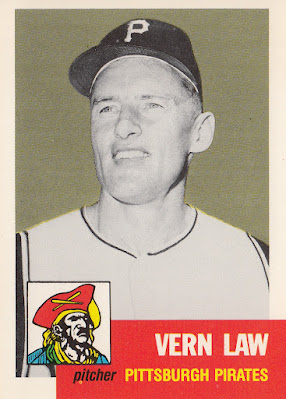
1991 Topps Archives '53 #324 Vern Law

Now, this isn't really a vintage card, even though it looks like a '53. Experts of these early Topps checklists (including our favorite Tim Wallach supercollector, who is nearing 1953 set completion) will know that Vern Law never made it into the original 1953 set. Neither did 56 other players who made up "The Cards That Never Were" subset at the end of the 1991 Topps Archives checklist.

Topps really took this theme seriously, writing a paragraph for the card back as though we were in early 1953 looking forward at the upcoming season. We're told, "This strong righthanded hurler rejoins the Pirates this year after spending the 1952 campaign in military service." 

Those who don't know the 274-card checklist of 1953 Topps by heart can use several other cues to place this subset as an revisionist augmentation to the set rather than a pure reproduction of the original. 

First, the images are black-and-white photographs rather than the full-color paintings we'd see on the originals. I have a mostly complete run of this set, and the only exception I could find was Hank Aaron's card #317. He did get a color painting, but it's not nearly up to the more lifelike standard found in the originals. The next clue is the background. It's usually a one of a few plain solid colors like this, or sometimes it might overlay a faint black-and-white background.

On the back, you could just check whether the card number is #281 or above. There's no red-colored facsimile signature behind the write-up like you'd see on an original. And finally, the card back will have "The Cards That Never Were" printed on the very bottom.

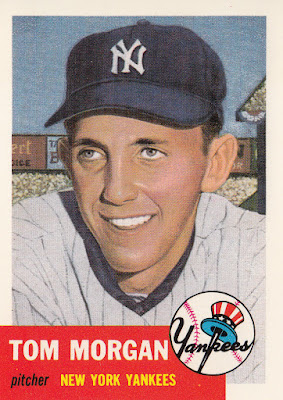
1991 Topps Archives '53 #132 Tom Morgan

Here's a reproduction of an original '53, and the difference is quite obvious. The colors are vibrant, and there's even some festive little bunting in the background on the facade of the stadium. 

This card is more of a review of Tom Morgan's 1952 season, as he served in the military during 1953, which the card back mentions. He was back in (baseball) action in 1954, wrapping up his career with the Los Angeles Angels in 1963.

I don't know anyone who would call a 1991 card from the heart of the overproduction era "vintage", although one has to wonder. As disconcerting as this fact is, that was thirty-one years ago. And when I really got my collection going in 1993, I'd have to find something from 1962 to have something as old then as this is right now.

But still, 1991 is not vintage.

Is it?

Or is "vintage" an ever-receding landmark in the rearview mirror, something that became fixed in place at some point, an idea that somehow manages never to keep pace with our world that's rapidly becoming more and more unpredictable?

Maybe let's just not think about that.

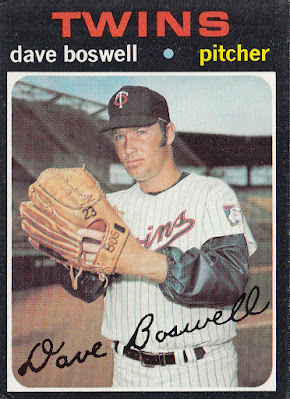
1971 Topps #675 Dave Boswell

Here's 1971. This is vintage.

This shouldn't be very surprising, but when I go through cards from this long ago, there are a lot of names I don't know. Tons. Dave Boswell is among them. 

He's pictured here as a Twin, which is where he spent his career from 1964-1970. However, the Twins released him in early 1971. He appeared in a handful of games for the 1971 Tigers and Orioles, but that was the end of his career. It was also the end of the line for his Topps issues, meaning this is his sunset card. He appeared in a few oddball sets after that, but Topps never documented either of his final pair of teams.

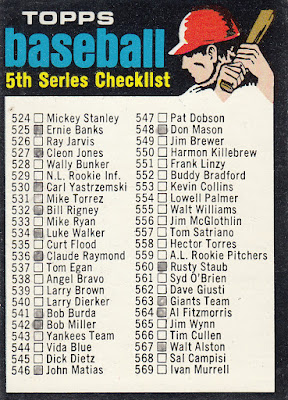
1971 Topps #499 Checklist 5

Jay threw in a checklist from 1971, and it's stops just a little short of including Dave Boswell's card #675, ending at #643. Whoever had this before me had a long way to go before completing the black-bordered 1971 set, but they certainly had a few of the big names checked off. Hall-of-Famers like Ernie Banks, Carl Yastrzemski, Roberto Clemente, and quite a few others. It's marked in pencil, and it looks like #531 Mike Torrez was possibly erased. Maybe part of a trade?

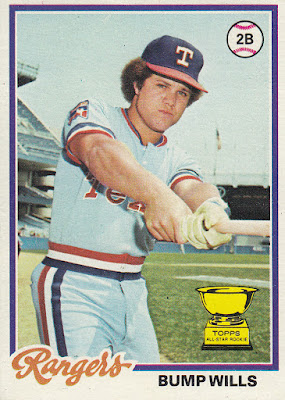
1978 Topps #23 Bump Wills

Fast forwarding a few years to 1978, perhaps a bit closer to that blurry vintage/modern dividing line, we come to "Bump" Wills, the son of Dodger great Maury Wills.

Wills's true Rookie Card is a four-player card from 1977. This is his first solo card. He finished third in 1977 AL Rookie of the Year voting, losing out to Eddie Murray, but he did earn himself a Topps All-Star Rookie cup, clearly shown on the lower right of the card. It's a nice addition to this posed photo, taken inside the newly-renovated (old) Yankee Stadium.

1967 Topps #76 Jim Barbieri (RC)

Jim Barbieri is another name I don't know, but this 1967 card was the oldest one in this shipment, so up it goes on the blog. The posed photo looks similar to Bump Wills's card, but this checks the box for the always-trusty bat barrel shot.

The card back says that Barbieri threw out the ceremonial first pitch in the 1954 World Series, the very same World Series where Willie Mays gave us "The Catch" in Game 1, so it's very likely that this Dodgers rookie was on hand to witness that legendary defensive play as a thirteen-year-old. The card doesn't specify for which game Barbieri got the honors, but I'll go ahead and believe it was Game 1, because why not? Maybe the ceremonial first pitch used to be exclusive to Game 1 back then, anyway.

Barbieri's career spanned all of thirty-nine regular-season games in 1966, so this Topps card ends up being a combo Rookie Card and Sunset Card. 

There was a 40th game before his career truly ended, though. Apparently no stranger to Game 1 of the World Series, he appeared as a pinch-hitter for the Dodgers in the '66 Fall Classic. He struck out swinging in the 4th inning and that was that.

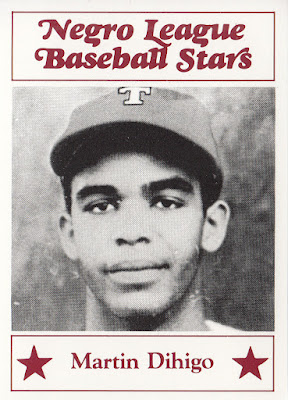
1986 Negro League Fritsch #19 Martín Dihigo

Jay included a few oddball cards focused on Negro League stars, including Cuban-born Hall-of-Famer Martín Dihigo, "a talented second baseman who was a superior hitter". And despite what you might think from this grainy black-and-white photo, he wasn't a 19th century contemporary of Cy Young or Old Hoss Radbourn. Dihigo played and managed right up through the mid-1940s.

Sadly, by and large, oddballs like this release from Larry Fritsch Cards are about all that's out there for many Hall-of-Famers who played only in the Negro Leagues. Players like Dihigo, Oscar Charleston, Turkey Stearnes, and many others have been as ignored by the card industry as by pre-1947 Major League Baseball itself. For example, Dave Boswell has 28 search results on Beckett. Martín Dihigo has 26. Only one of them is in the Hall of Fame.

Perhaps now that the various Negro Leagues have finally been recognized as Major Leagues, that will start to change. Maybe there would be numerous legal difficulties Topps/Fanatics would encounter if they tried, but I'd buy a retro-themed Negro Leagues set if it were on the market.

Just saying, if there's room for the thousandth Dustin May card, maybe there's room for some Hall-of-Famers that remain far too obscure.

1991 Swell Baseball Greats #9 Joe Black

Another oddball came from the Swell Baseball Greats set, a 1991 release from a brand of the Philadelphia Chewing Gum Corporation. Joe Black, pictured here as a Brooklyn Dodger, joined the National League in 1952, winning Rookie of the Year honors thanks to a 15-4 record. He kept playing through 1957. He got his start with the Baltimore Elite Giants, playing for them from 1943-48.

We'll keep the World Series history going with a fact from the card back, which is that he was the first Black pitcher to win a World Series game. That happened in 1952 versus the Dodgers' crosstown rivals, the Yankees. It was a seven-game battle, as were most of the matchups that decade between the Yankees and Dodgers.

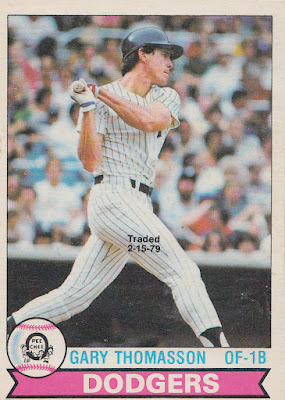
1979 O-Pee-Chee #202 Gary Thomasson

To close, we'll head north of the border. This looks quite like a 1979 Topps card, but look closely inside the little baseball element and you'll see a fun O-Pee-Chee logo! The Canadian brand that licensed and distributed Topps sets for years throughout Canada actually made some noticeable changes to Gary Thomasson's 1979 Topps card.

In the USA set, Topps simply pictured and listed Gary Thomasson as a Yankee, but by the time O-Pee-Chee got around to it, they had time to switch the listed team to the Dodgers, as well as provide the date that Thomasson was traded. The Dodgers acquired Thomasson for catcher Brad Gulden, who bounced around the league until 1986.

I learn a lot when I get stacks of vintage cards. So many of these guys I've never heard of, but there's always a wealth of knowledge to uncover, from small offseason trades to World Series history.


Sunday, December 19, 2021

The Trading Post #166: Card Hemorrhage (Part 1: Rockies)

Trading volume is down quite a bit. Intuitively I knew that, but in preparing to write this post, I was surprised to see that I hadn't added anything new to The Trading Post page in nearly eleven months. Not that I've done much from my end either. Perish the thought of setting foot inside a post office unless absolutely necessary. But I have sent a few PWEs out, or at least I think I have. It's pretty much all a blur these days.

One blogger who's keeping that flame lit is Jay at Card Hemorrhage, winner of the most-difficult-to-spell blog superlative, stealing the crown from Highly Subjective and Completely Arbitrary. He's sent a couple stuffed PWEs my way in the past couple months, full of a wide range of familiar Rockies and unknown oddballs. We'll start things off with a familiar face from the Rockies, the player who joined Dinger in the making of this year's official team video holiday card.

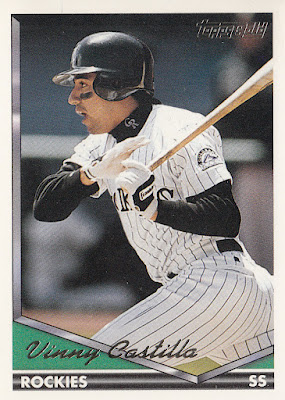
1994 Topps Gold #163 Vinny Castilla

Vinny Castilla was the cameo player in my previous post, but here he gets a parallel all his own. It's from 1994, the same year as my Hanukkah gift, and it's the Topps set I can most easily recognize at a glance. Longtime readers will know that 1994 Topps was the first factory set I ever bought, and a $50 expenditure at the young age of 10 is one that is seared into your memory for all time.

Even better, this is the Topps Gold variety, a one-per-pack parallel that felt like holding the actual metal in my hands back then. It hasn't really lost its luster after a quarter-century. Someday I might consider putting the whole 792-card set together, and I'm already about a third of the way there.

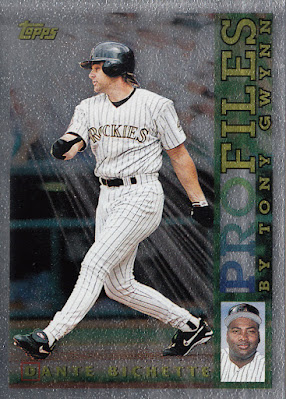
1996 Topps Profiles #NL-11 Dante Bichette

A couple years later and a lot shinier, Topps featured some of Castilla's teammates from the Blake Street Bombers squad in the Profiles insert set. Twenty players from each league were gathered for the set, and then Topps sought opinions about each National League player from Tony Gwynn. Kirby Puckett provided the commentary for AL players. Sadly, both of those Hall of Famers passed away far too young, but their keen insight on their fellow players (and likely fellow All-Stars more than a few times), is documented for all to see on this shiny Topps set.

In particular, Gwynn says about Bichette, 

"[I]t looks like confidence has made all the difference to him...Dante can put it out of any stadium...If he gets big numbers, they say it's because of [Coors] Field. If he doesn't, they say he can't hit. Well, he can hit, Period."

Tony Gwynn, arguably the greatest contact hitter in the expansion era, is certainly in a position to know. And that came a bit before we all really understood what a launching pad pre-humidor Coors was. He knew. But he also knew a great hitter when he saw one, regardless of the park. Hall of Fame voters are just now coming around to understand that, with Larry Walker finally entering the Hall of Fame and Todd Helton gaining some steam.

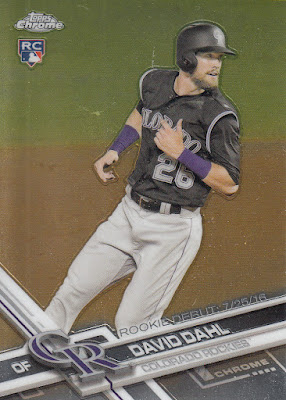
2017 Topps Chrome Update #HMT100 David Dahl RD

Shinier still was 2017 Topps Chrome Update, a Target exclusive. The card number has an "HMT" prefix, something I've seen before but still don't know what it stands for. Dahl, who will be reuniting with Jon Gray on the Texas Rangers next season (I'm hesitant to call it the 2022 season at this point, given the state of the current labor dispute), is pictured here running the bases as a Rockie. His card has both the Rookie Card logo and the specific date of his MLB debut, July 25th, 2016. The Rockies lost that one in extras, but as the card back tells us, it was the beginning of a record-tying 17-game hitting streak for Dahl.

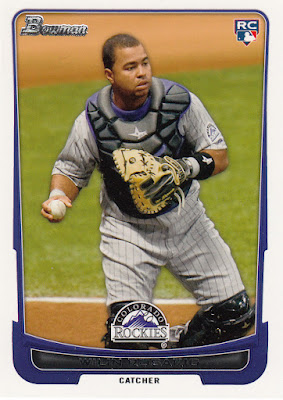
2012 Bowman #218 Wilin Rosario (RC)

2012 Bowman popped up again as it does from time to time. This one is another Rookie Card, picturing catcher Wilin Rosario behind the plate. A little over two years ago, the autographed black-bordered version of this card made an appearance here, and now I have the regular base card to go along with it.

Wilin Rosario was the everyday Rockies catcher for four seasons or so, and he was on a whole slew of cards at the time, but seemed to disappear rather rapidly. He wasn't a great hitter, but fans of cards showing catchers in defensive mode might find a few to their liking.

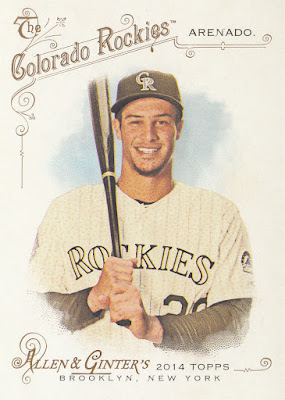
2014 Topps Allen and Ginter #314 Nolan Arenado SP

Jay included a couple 2014 Allen & Ginter cards, and this design is just different enough to make me think that I've never really seen it before. I do have a partially filled page in my 2014 binder, but the only record of it I can find in the blog archives was Anthony Bourdain's card, may he rest in peace.

A visibly younger Nolan Arenado entered the A&G checklist for the first time in '14, and the high card number of #314 puts this into short print territory. It's definitely a generous inclusion into this PWE.

The overall design looks similar to most A&G sets, but the one thing that really jumps out at me is the storybook fairy tale "The" preceding the "Colorado Rockies" team name. It gives it a feel of "Once upon a time in the land of 20th and Blake Street, Nolan Arenado played for The Colorado Rockies and slayed many dragons with his armory full of gold and platinum gloves."

Not all fairy tales have a happy ending, though, as we came to find out. At least not for fans of The Colorado Rockies.

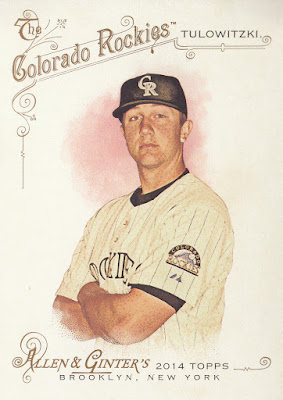
2014 Topps Allen and Ginter #104 Troy Tulowitzki

Don't give me that look, Tulo. Times have been hard.

At least Tulowitzki got his own storybook ending, hitting his final home run in the Major Leagues as a Yankee shortstop, playing right where Derek Jeter played all those years. Tulo idolized Jeter, which is why he wore #2 for almost his entire career.

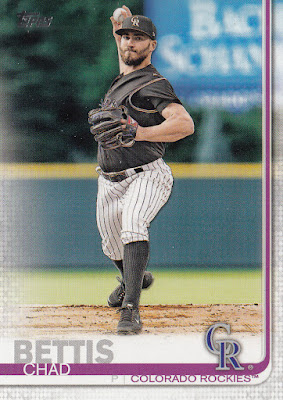
2019 Topps #74 Chad Bettis

Chad Bettis got a card in the 2019 Topps Series 1 checklist, and it's a very similar photo to this insert from Topps Update. This base card gives us a slightly different angle on a different pitch (his grip is slightly different), and we get a bit of an extra look at the Coors Field forest and advertising banners behind the center field wall. That blue banner is an ad for Bachus & Schanker, a local injury law firm that definitely makes the most of their marketing budget.

Chad Bettis announced his retirement in the summer of 2020, following a seven-season career with the Rockies. He finished with an even 31-31 record, although he had a rough 2019 season. He signed with the Yankees in 2020, but announced his retirement about a month before the pandemic-shortened season got underway. Topps didn't include him in any 2020 product, so this is effectively a sunset card. You'll just have to go online to read his 2019 stat line.

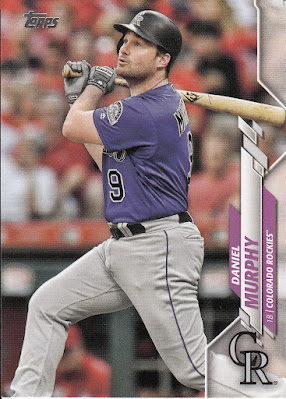
2020 Topps #116 Daniel Murphy

Daniel Murphy fared a bit better. He retired in February, deciding to make the shortened 2020 campaign his last. The fun-loving three-time All-Star was certainly enjoyable to watch during his brief time in Denver, although he put up a -1.0 fWAR during his two seasons here. At least Topps included him in the 2021 set, allowing Murphy fans to add a true sunset card to their collections.

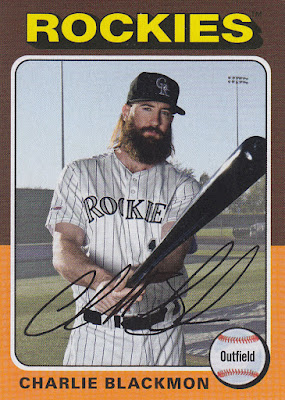
2019 Topps Archives #157 Charlie Blackmon

Charlie Blackmon is pretty much the only well-known Rockies position player left, at least among those who have reached free agency. Topps picked the iconic 1975 design for his card in 2019 Archives. Other than this Robin Roberts card, I completely skipped that set. I can't keep up with them all. 

Speaking of, did they ever release 2021 Big League?

In any case, Topps tried make this card somewhat period-correct, as though it were really released in 1975. I'm sure 1975 Topps superfans can tell me whether this is a legitimate color combination, or at least as close as it can be for the six current franchises that didn't exist then. But what caught my eye was the trivia question and cartoon on the back. The card asks "Which future Hall of Famer won the first Outstanding DH Award?"

First of all, I learned that there's such a thing as the Outstanding DH Award, which is now known as the Edgar Martínez Award. It's not league-official, and especially as a National League fan, I can't remember ever hearing about it. 2021's winner was AL MVP Shohei Ohtani. 

But the way they phrased this made it sound like it was a new thing and that they're referring to an active or recently-retired player destined for the Hall. David Ortiz maybe, or an early and bold prediction on Ohtani. But no, that award has been in place since 1973, the first year of the DH. The recipient of the inaugural DH Award was Orlando Cepeda, who reached the Hall of Fame in 1999. In that sense, Cepeda was a future Hall of Famer when this design hit shelves, but obviously not at any point during Charlie Blackmon's adulthood.

The 1975 design overall will be a good segue into Part 2, which included plenty of vintage. It was a stuffed PWE, believe me.


Sunday, January 10, 2021

The Trading Post #163: Card Hemorrhage (Part 2: Rockies)

I'm doing my best to pull myself away from the news to write this, but it's clear that 2021 is not getting off to a great start. Needless to say, what happened Wednesday in Washington was abhorrent. So as I eagerly await what I hope are swift and harsh consequences for those responsible, allow me to present this, Part 2 of a recent PWE receipt that arrived from Jay at Card Hemorrhage.

1991 Fleer #307 Dante Bichette

None of the cards found in Part 1 involved any Rockies. They're all reserved for this Part 2, starting with one of the original Blake Street Bombers, Dante Bichette.

Now, it's honestly somewhat rare for me to receive unsolicited cards printed prior to 1993. That was the inaugural season for the Rockies and Marlins, and even in 1993, few brands gave us Rockies pictured in their new uniforms. And I'd imagine that collecting one of the four most recent MLB teams cuts down the incoming duplicates considerably, so there is that benefit if anyone out there ever decides to collect the Marlins.

But Jay knew Rockies history well enough to include a card of Dante Bichette in the visible-from-space 1991 Fleer set. He was a Brewer in 1991 and 1992, but he began his career with the California Angels. He was still pretty young then, and the highlights Fleer gives us on the card back mostly highlight his minor league performance. He had yet to emerge as a power-hitting slugger, but he clearly has the stance and forearm strength to be one.

Note the sliver of the catcher's mitt in the lower left, if you can safely look that near to the yellow borders.

2017 Topps Heritage #96 Gerardo Parra

The 1968 Topps design, used for 2017 Heritage, is much more muted. But there is one little flash of color in Gerardo Parra's neon Franklin batting gloves. I miss having this lefty around. He was a great clubhouse presence, as we saw when he won the 2019 World Series with the Nationals. He played in Japan last year, and it remains to be seen where 2021 will take him.

I do still enjoy this Heritage design, and I've shown it so many times that I just might have a complete team set by now. Maybe 2017 Heritage was just a really big deal for some reason? It's come in from all corners of the country.

2019 Topps Heritage #85 Chris Iannetta

A bit less so with 2019 Heritage. We're skipping a year of Heritage, jumping straight into the 1970 design. I did buy a value pack of it, but haven't seen it as frequently. And the colors here are even quieter. Gray borders, no neon sports apparel, just a little yellow and dark red in the lettering.

A stern-looking Chris Iannetta (with his name spelled correctly), looks ready for the most boring game of catch ever. He hung up the catchers mitt after the 2019 season, retiring as a Rockie.

2019 Topps Heritage #256 David Dahl

David Dahl recently signed with the Texas Rangers, but maybe we haven't seen the last of him in Denver. Iannetta played elsewhere in the league before returning to the Rockies, so perhaps Dahl will do the same someday.

The card back has his minor-league stats going all the way back to the Pioneer League in 2012, where he crushed 10 triples and 9 home runs with a .379 average. He clearly rocketed past that step in his minor league development. That's fairly unsurprising, because a lot of these guys who end up in the Majors spent much of their school and minor league careers being the best player around. 

The card back tells us in the little cartoon that Dahl hit his first career grand slam on September 24th, 2018, but it looks like Topps got this wrong. I happened to be there that day, and while Dahl did hit a two-run homer, I don't recall a grand slam. They must have meant his game a couple weeks earlier, September 10th, 2018.

2019 Topps Heritage #253 Kyle Freeland

Our next entrant in the Very Serious Portraits category is the first current Rockie of the post, Kyle Freeland. He was fresh off his stellar 2017 season, in which he earned a 17-7 record with an under-3.00 ERA, the first Rockie to do so. His cartoon on the back shows a batter with a broken bat, as though his fastball is cutting through the wood like a lightsaber. The stat associated with that cartoon is that he only allowed one homer per 50 batters faced, no small feat inside Coors Field.

2020 Topps Heritage #123 Dom Nunez / Sam Hilliard (RC)

This has been a Topps Heritage-heavy post, and the 2020 set will take us across the finish line. It's based on the iconic black-bordered 1971 set, and so far the borders are holding up well. It remains to be seen how much chipping we'll see in the coming years. 2007 Topps hasn't really presented major problems, although the glossy finish of that one might help out. 

This Rookie Stars two-player card features Dom Nunez, who briefly appeared late in the 2019 season, and Sam Hilliard, who has had playing time in 2019 and 2020. This is already Hilliard's third Infield Fly Rule appearance. I'm assuming that this photo was taken at the same shoot as his Turkey Red insert card from 2020 Topps. It might even be the same photo, just edited differently.

As the card back tells us, Dom Nunez became one of the few players to hit a home run in his first Major League at bat. It went into the visitor's bullpen, so the grounds crew should have had no trouble retrieving it for his trophy case. Hilliard showed good power too, putting up an OPS above 1.000 during his debut 2019 partial season.

2020 Topps Heritage #151 Jon Gray

Jon Gray and his flowing locks will wrap this post up. He's pretending to look at the catcher for his signs, much like Chris Iannetta is pretending to prepare to catch a pitch. I believe this, and probably most other photos in this post, were taken at the team's Spring Training site in Arizona. I especially like how you can see the tarp deployed across the field in the lower right.

I'm not sure this post is among my best. That might have something to do with my state of distraction with the deteriorating state of the world, or that I just don't have much to say about these posed photographs. Probably a bit of both. 

In any case, I can't believe that all this came from one single PWE. Thanks, Jay!

Sunday, January 3, 2021

The Trading Post #162: Card Hemorrhage (Part 1: Assorted Goodies)

I'm all the way up to #162 in The Trading Post theme. That's a lot of trades, and many of them I've split up into two or even three parts. This one will be a two-parter, but the unusual thing this time is that this was all from a single PWE.

Yes, Jay at Card Hemorrhage expertly crafted a bespoke PWE, stuffed two dozen cards inside, affixed three stamps to it, and sent it on its way. According to the postmark, it took a little over two weeks to complete its journey through the mail system, but it was worth the wait. Especially because I had no idea I was even waiting at all. 

2001 Topps Archives Reserve #63 Satchel Paige

Usually I lead off the two-part posts with the Rockies, but I'm flipping it around this time. Mainly because there was an excellent and timely Archives Reserve card in here, but also because I have to admit that I'm getting a little disillusioned with the Rockies. Yet another offseason is going by without much happening, although free agent Trevor Bauer was asking for Denver restaurant recommendations on Twitter the other day, so what do I know? 

Sushi Den, by the way.

In any case, I've gone on record before as saying that Topps Archives Reserve is my favorite reprint set ever. The iconic cards, the wide representation of sets, the shininess. It can't be beat. So Jay took note of that and sent Satchel Paige's card from this 100-card set. I'm not quite sure where Topps got the extra "L" in his name, but on the back, they did acknowledge the travesty of segregation, referring to his Major League career as "long deferred and much interrupted". That's language from 1953, one small step on a very long path. Another thing that was "long overdue" was recognizing the Negro Leagues as a bona fide Major League, something MLB finally decided to do on December 16th. Coincidentally, that's the same day this PWE was postmarked. 

Next comes the long process of including all those years of incomplete record keeping into the official statistics, and I'm waiting for the day when Paige's Baseball-Reference page shows more than the 28 wins he earned after he reached his forties.

Now's a great time to learn more about Paige, and Buck O'Neil, and Cool Papa Bell, and Oscar Charleston, and Martín Dihigo, and many more. Joe Posnanski has taught me quite a bit since last year, such as this tidbit gleaned from O'Neil, that so many Negro League teams were called the Giants as sort of a code word. It was often difficult to get proper press coverage when a Negro League team was in town, but if you heard tell that "the Giants" were playing, those who were clued in would know what was up, and potentially had the opportunity to witness these greats in their prime.

2014 Topps Chrome #14 Alex Guerrero (RC)

A decade or so later, things became much more difficult for Cuban players for an entirely different set of reasons, but that started to change in the early '90s. Today, Cuban-born players are well-represented in MLB, including some of the latest hot rookies like Luis Robert and Randy Arozarena. Álex Guerrero was once among them, and signed with the Dodgers in late 2013. He ended up with playing time in 2014 and 2015, all with the Dodgers. 

He got a card in 2014 Topps Series 2, as well as in this smaller Chrome set, and it's a great photo. It fits into the all-dirt "Tatooine" mini-collection, and I'm guessing this is a spring training shot. The photo is cropped too tightly to identify either his teammate or the opposing runner, but I'm guessing that's an Angel.

1995 Leaf Cornerstones #5 Will Clark / Dean Palmer

This mid-'90s insert isn't quite as shiny as the first two, but it does have that sparkly rainbow look around the border. New to my collection, the Cornerstones insert set features the primary corner infielders from a tiny selection of six teams. Most of us remember Will Clark as a Giant, but he spent most of the later part of his career with the Texas Rangers. Joining him across the diamond was Dean Palmer. 

On both the front and the back, this card shows a nice right-handed/left-handed symmetry, typical for their respective positions. There are defensive stats on the back as well, such as putouts and errors. Maybe I'm spoiled by Nolan Arenado, but Palmer's .912 fielding percentage at the hot corner is really, um, not that great.

It's a nice design, though. The colors and theme work well, and I'd love to see Topps do a current 30-team version of this set. The only odd thing here besides the tiniest crease on the front is the numbering. Leaf was inconsistent in their use of numerals and words, noting this card as "5 of six".

2014 Bowman Chrome Draft Top Prospects #CTP-83 Clayton Blackburn

The last shiny card before we get into more normal-looking cardboard comes from Bowman Chrome. It's from a year. 

Seriously, it's from 2014. I'll never be good at Bowman.

Of the zillions of Bowman Prospect cards out there, this one in particular makes me think that Jay might be an extremely diligent reader of Infield Fly Rule. As I documented in 2016, I've been to one single Minor League game in my life. I saw the Sacramento River Cats host the Salt Lake Bees, and guess who the home team's starter was that day? Yep, Clayton Blackburn.

Like the many prospects who fill Bowman checklists, Blackburn never saw Major League action, although he did spend some brief time on active MLB rosters. He just never had the chance to actually take the mound.

I did enjoy the Minor League experience, and it's nice to keep tabs on these guys as they progress through the farm system. Players you happen to see in person take on a whole new life and you really find yourself rooting for them to make it to The Show. It's just not something that's as easy to keep tabs on when you have a Major League team a short drive away. Maybe that's why I'm so terrible at Bowman.

2020 Topps Heritage Minors #25 Heliot Ramos

Another enjoyable aspect of Minor League Baseball is just how fun the team names are. One level down from the River Cats in the Giants farm system, you'll find the Richmond Flying Squirrels. Just have a look at this logo. Elsewhere in MiLB you'll find the Isotopes, the Yard Goats, the RubberDucks, the Jumbo Shrimp, and best of all, the Trash Pandas.

Heliot Ramos plays for the Flying Squirrels, or at least he did in 2019. Minor League Baseball was entirely shut down in 2020, and I have to wonder how much career development has simply been derailed. To lose a whole season at a young age certainly can't bode well for many Major League hopefuls. But maybe one day, Ramos will make his way through Sacramento and on to San Francisco. At that point, odds are good I'll see him play an NL West game at Coors Field someday. 

That is, assuming the MLB divisions aren't massively realigned. Expect the unexpected.

2015 Topps Gypsy Queen Glove Stories #GS-10 Pablo Sandoval

In case you haven't been caught up with meme culture or Guardians of the Galaxy, a Trash Panda is a humorous name for a raccoon (see also: danger noodle, aka snake). This is not to be confused with Kung Fu Panda, the nickname for third baseman Pablo Sandoval. He was featured in a long-running but defunct Gypsy Queen insert set called Glove Stories. It featured some of the best defensive plays on the diamond, and this one in particular is from the 2014 NL Wild Card game, in which Panda went over the railing (at 1:28 in video) to snag a foul pop. If you leave the field of play as part of a catch, you run the risk of allowing runners to advance one base, but as I understand the rules, there's no danger when there's no one on base. 

Other than falling into the concrete dugout, of course.

1976 Topps #101 Pete LaCock

We'll take a brief foray into vintage before continuing. I don't have much 1976 Topps in my collection, but I am just a little bit closer to filling a complete page in my vintage binder. Pete LaCock retired several years before I was born, and if not for his name that doesn't pass the playground test, he'd probably just be another unknown in the vast expanse of 1970s commons. But he's been embraced by the Cardsphere, so that's why I now have a -1.9 rWAR player in my collection. And it's actually in really nice shape for being 45 years old, even though the centering isn't perfect. It's very 1970s.

So what can we find out about Pete LaCock? Well, he played in Japan in 1981, but his final 1980 season was enough to earn a trifecta of sunset cards all three sets that year. Topps, of course, and the inaugural Donruss and Fleer sets. In more recent years, he coached various Minor League teams like the Blacksnakes and the Saltdogs. And he happens to be the son of the original Hollywood Squares host, Peter Marshall, whose real name is Ralph LaCock.

1994 Stadium Club #109 Gregg Jefferies

On to the wonderful world of Stadium Club, where we see Gregg Jefferies trying to steal second base in Wrigley Field. The cameo here is unclear, but I'm guessing that's a "6" on this Cubs uniform. I'm not entirely confident in this, but my best guess is that it's José Vizcaíno, who wore #16 in Chicago. Oddly enough, Vizcaíno was the cameo player on another Stadium Club card that Jay sent me last time

Cue Twilight Zone Music...

1994 Stadium Club doesn't get enough love. After three years, Topps changed the brand's logo and started using the "TSC" abbreviation. They also changed the card backs from what had been a pretty consistent design since the brand's inception in 1991. Gone was the tiny image of the player's first Topps card, replaced by a second photo and all sorts of different typefaces and colors. 

On the front, the color of the player's first name denotes which division the team is in. The same color coding is also used on the card number. 1994 was the first season where MLB used the six divisions we know now, so Topps decided it would be helpful to guide fans into understanding the new alignments. As we all know, 1995 Fleer took that idea to the extreme. 

Also on the back, Topps gave us a word or two to describe the player or his season, in this case "efficient". Fleer also borrowed that idea for their Emotion brand. Topps did it a year before, though with much less emphasis. And the red foil I never see enough of was something Pacific ran with for years before their demise. It turns out this was a pretty influential set.

Out of curiosity, I glanced through a few of my other '94 Stadium Club cards to see what Topps came up with for the player's phrase. Robin Ventura was "rockin' robin". Barry Larkin was "cin-tillating", pun and hyphen intended. These are all lower-case. Wade Boggs was "better than pie", referencing his lifetime batting average being higher than Pie Traynor's, which held true into retirement.

I was ten when this was all happening. It was fun.

2014 Stadium Club #79 Brandon Phillips

So you can imagine my excitement when Topps brought the brand back in 2014, the same year I started this blog. I'm not saying I caused it, but I'm also not saying I didn't. In those ensuing decades, the brand grew up a lot, developing yet another logo, toning down the card back tremendously and using words like "loquacious", and focusing even more on the photography.

Here, Brandon Phillips has a Brewer caught in a rundown, but I can't see the numbers clearly enough to know who it is. That might be Jonathan Lucroy watching from the safety of second base, which is a wild guess based on the first digit of the uniform number. Whoever the trail runner is, Phillips has good speed, and I definitely wouldn't expect him to win this footrace.

2015 Stadium Club #99 Chase Utley

2015 Stadium Club is just as good, if not better. I only have a page or so of it in my collection, which is odd. Usually I buy at least a blaster of it, but I only have enough to equal a value pack or two. So I'm glad to add this Chase Utley card to the pages. As posed shots go, this is one of the best, showing him in the dugout at Nationals Park, with his reflection in a glass door. 

Utley is wearing the "CB" memorial patch from the 2014 Phillies season, honoring Claire Betz, a part-owner of the team who died earlier that year. You can also see the banners on the structure beyond the left field wall, over Utley's left shoulder. There's a big banner with the Curly W, and under 5x magnification a Nats player is visible on it. It's very hard to say for sure, but I think it's #28, Jayson Werth.

In the reflection, the angles play a little differently, so Utley's bat mostly obscures that banner. But look closely, and you'll be able to see a mirror image of the Geico Gecko in the window, sitting right on Chase Utley's shoulder like a little cartoon angel.

1992 Stadium Club #800 Jose Rijo

José Rijo is trying to get a better look at all that through his goofy sunglasses. Despite all his fun cards, the only other time he's been on the blog was just a normal pitching card. For mini-collections, he's a frequent subject. He fits into the signing autographs mini-collection, the sunglasses mini-collection, and he's pretty much all by himself in the squirt gun mini-collection.

He was also a pretty good pitcher. He was both an All-Star and a World Series MVP, and probably would have put up even better numbers if his elbow didn't give him fits for years on end.

We'll see some Rockies in Part 2. In the meantime, have a Happy New Year and thanks for reading!


Friday, October 9, 2020

The Trading Post #153: Card Hemorrhage (Part 2: Stadium Club)

The Division Series round of the 2020 Postseason will come to an end tonight. So, too, will this two-part post of a trade with Card Hemorrhage. There will be no Rockies in this part, but I have Stadium Club cards to show going all the way back to its inaugural year.

2019 Stadium Club #279 Rougned Odor

Stadium Club has always been known for great photography, and for fans of double-play shots, it is peerless. Here, Rougned Odor of the Rangers is turning two in Petco Park, which happens to be the neutral site of the ALDS series between the Yankees and Rays. The Bronx Bombers (San Diego Bombers?) are playing to win for Whitey Ford, the Yankee great who passed away yesterday at the age of 91. I was hoping that Seaver, Brock, and Gibson would be the end of this particular rule of threes, but it seems that 2020 isn't over yet.

The card back mentions Odor's 5-for-5 day on July 28th, 2018, appropriate because Will Smith of the Dodgers had just such a performance last night, the first time a Dodger has done so in the Postseason.

In case you're curious, the cameo on this 2019 Stadium Club card is Padres catcher Francisco Mejía, who was not included on the active roster for San Diego's 2020 playoff run. Odor has been a Ranger for a while, but Mejía might be our key to figuring out the date here. He had only recently become a Padre in late 2018, and faced the Rangers in his home park in mid-September. After drawing a walk in the bottom of the first on September 14th, 2018, Wil Myers grounded into a 5-4-3 double play. We're seeing the ball in motion between the "4" and the "3".

Cameos do more than look cool. They can be the source of useful information.

1999 Stadium Club #269 Al Martin

Generally speaking, no one dives into second to break up a double play, so on this 1999 card, we're probably seeing Al Martin steal a base. He was a Pirate at this point in his career, confirmed by the extremely faint Pirates team logo in the upper left. 

As far as action shots go, this is a great one, and somehow Martin's airborne helmet sailing into left-center makes it even better. If you didn't have the raised-lettering nameplate or that tiny team logo, it would be pretty difficult to tell who the primary player in this picture is. I believe the cameo this time is journeyman infielder José Vizcaíno.

1992 Stadium Club #444 Lance Johnson

Delving into the early Stadium Club days, here's Lance Johnson taking some BP in the brand-new Comiskey Park. Currently known as Guaranteed Rate Field, it opened in 1991, replacing the original Comiskey Park which dated all the way back to 1910. It's changed a bit over the years, but the famous pinwheels are clearly visible above the center field scoreboard. I always enjoy when this set takes its name so literally, and I'd go so far as to call this one of the best wide-angle shots ever to appear on a card.

Lance Johnson was a blazing-fast center fielder, leading the league in triples five times in six years. His final year of that run came in 1996 as a Met, which was also his only All-Star appearance. He was also included in a small batch of 1993 Leaf that I just sent to The Collector.

1992 Stadium Club was one of the first premium sets I collected as a kid, along with the readily available Fleer Ultra. I remember that early TSC set (before they abbreviated it to TSC) was the first hobby box I ever bought. I don't remember pulling this card, but I spent a lot of time going through the duplicates to find the copy whose gold foil lined up most accurately around the black Stadium Club logo. When it comes to centering a full-bleed card, that's one way to do it.

1992 Stadium Club #495 Kirk Gibson

This Kirk Gibson copy isn't quite as perfect. The gold foil isn't centered just right, but nothing too bad. More important is this dark, low-key portrait of Kirk Gibson, the Dodger hero of the 1988 World Series. He's known for hitting one of the most famous home runs in World Series history, but he didn't really spend that much time in L.A., only three seasons. His tenure in Kansas City was even shorter, just a single season in 1991. This card was outdated before it even hit the shelves. He'd play even fewer games as a Pirate in 1992, before returning to his original team, the Tigers, where he retired in 1995.

Gibby went on to manage the Arizona Diamondbacks for five seasons in the early 2010s, and I'm sure I saw him from a distance during one of my many visits to Coors Field. It was a well-lit day game, nowhere near as dark as this photo that wouldn't be out of place in an early Studio set.

1991 Stadium Club #138 Eric Show

We can't go back any earlier than 1991 in a post like this, and that's where we end up. Pitcher Eric Show in a hammock with an electric guitar. It's pretty out there, and keep in mind this was Stadium Club's debut set. It might have influenced the fashion-shoot cards found in 1992 Bowman, and this is so distanced from baseball itself that you'd barely notice this is an Oakland Athletics card. Show spent nearly his entire career with San Diego, but signed with the A's for his final season of 1991.

He looks happy and comfortable, and in this moment he may have been, but he had a rough life. He was the pitcher who surrendered Pete Rose's record-breaking 4,192nd hit in 1985, and off the diamond, he struggled a lot with drug addiction. He had back surgery in 1989, and his career was never really the same. He passed away in 1994 at the age of 37.

It reminds me a lot of the sad saga of Roy Halladay, arguably the best player to hail from the state of Colorado. He, too, struggled with addiction, as recounted in this ESPN piece. Life isn't all hammocks and guitars, even for pro athletes. Sometimes especially for pro athletes. Performing at that level for that long puts a strain on the body, and it can be difficult to bounce back. Athletes who are fortunately still with us, like Bobby Jenks, have opened up about their struggles, and I'm glad the world seems to have turned into a place where we're ready to listen.

Thanks again to Jay for this horizontally-oriented trip through the history of Stadium Club, right back to the brand's beginning.