Showing posts with label 1967 Topps. Show all posts

Sunday, July 31, 2022

The Trading Post #171: Card Hemorrhage

Every once in a while, for no particular reason, one of my longtime readers will send me an envelope full of cards. There is always a nice mix of Rockies when that happens, but sometimes it includes vintage goodies that are great additions to my collection but that I would be unlikely to buy for myself.

That exact thing happened last December (sorry) with Jay from Card Hemorrhage, who sent cards ranging from active Rockies to vintage all the way back to 1967.

1972 Topps #330 Jim Hunter

Vintage cards of Hall of Famers don't just grow on trees, especially when they predate the overproduction era by well over a decade. This 1972 card of Jim Hunter is certainly not what I expected to find in my mailbox that day. Jim Hunter, better known as "Catfish", was a Cy Young Award winner, five-time World Series champion, 1987 inductee into Cooperstown, and made an appearance on my second-ever blog post.

The card back from this '72 does refer to him by his commonly known nickname (in fact his Baseball-Reference page doesn't even list his birth name), and mentions that he never played in the minors. He joined up with the Kansas City Athletics as a fresh-faced 19-year old, and stayed in the Majors up to his retirement in 1979. Sadly, he was diagnosed with Lou Gehrig's Disease (ALS) and died at the young age of 53 in 1999.

The cartoon and trivia question on the card back digs deep into the baseball vault, "before baseball was even baseball" as one of my favorite sportswriters puts it when referring to the game in the 19th century. We're asked, "How many runs did Guy Hecker score, 8-15-86?"

Now, when I see a date like that, I of course jump to 1986, but since this card is from 1972, clearly they mean 1886. Card companies do like to make predictions about who will end up in the Hall of Fame, but even they wouldn't look at a specific date that far in the future.

In any case, seven. The answer is seven.

Even in 1972, I can't imagine there were many who had a vivid enough memory to recall 1886.

1972 O-Pee-Chee #229 Steve Blass WS

On the other hand, the 1971 World Series was fresh in everyone's mind when Topps printed the psychedelic tombstone set. And it still was when O-Pee-Chee printed their Canadian equivalents that same year, and this is indeed an OPC card.

Card #229 in both sets featured a photo of Steve Blass, who went the distance in Game 7 to secure the championship for the Pittsburgh Pirates. Notching the W in complete fashion during Game 7 of the World Series is something that hasn't been done since Jack Morris in 1990, and Blass is in some very elite company for turning in that kind of performance. Names like Bob Gibson (twice), Sandy Koufax, Johnny Podres who finally sealed the deal for Brooklyn in 1955, Dizzy Dean, and others. 

Remembering that the flamethrowing closer Aroldis Chapman appeared in 2016's Game 7 with two outs in the 8th inning (only to immediately lose a three run lead), I think it's safe to say we have seen the last of complete games in Game 7.

The card back simply contains the box score (as well as a couple section headings in both English and French). On it, you'll find names like Clemente, Stargell, and two Robinsons on the Baltimore side.

Simple and timeless.

2021 Topps Heritage #151 Josh Naylor

Topps reused the 1972 design in the 2021 Heritage set, and to my eye, they did a pretty nice job. Jay threw in a copy of Josh Naylor's card, Cleveland's Canadian-born first baseman/right fielder. Naylor suffered a bad leg injury last season, but has recovered well and has proven to be an entertaining, high-energy player for the Guardians.

The trivia question on the back is a bit closer to the realm of recent history than we saw on Catfish Hunter's card. "How many intentional walks did Roger Maris get when he hit 61 homers in 1961?"

Famously, it was zero, because he had Mickey Mantle protecting him in the lineup. And Mantle hit 54 of his own that year, a career high. There was no easy way through that lineup.

1980 Topps #104 Manny Mota

Moving forward a few years in the Topps timeline, we come to 1980. This was near the end of Manny Mota's career, leaving his mark with a 20-year career. He spent most of that with the Dodgers and Pirates, along with brief stints as a Giant and Expo. His final season was 1982, if you can call it a season. Really it was just one at-bat in a September game against the Cardinals.

Manny went on to coach the Dodgers until 2013. His sons Andy and José both played in the Major Leagues in the early 1990s. You'll find each of them in a few of the many overproduction-era sets you have stashed away. Try 1992 Fleer.

1980 O-Pee-Chee #38 John Milner DP

Crossing the border again brings us to another Canadian-printed O-Pee-Chee card, this one of Pirates outfielder John Milner. He was fresh off winning his first and only World Series ring as a member of the 1979 "We Are Family" team that sported these bright yellow uniforms.

His cousin Eddie played for the Reds and Giants throughout the 1980s, and his 1987 card looks so familiar that I'm almost certain it was in the first pack of cards I ever got.

1967 Topps #56 José Tartabull

The oldest card in this envelope was of Cuban-born outfielder José Tartabull. He's pictured here on the 1967 set as a member of the Boston Red Sox, when he was teammates with Carl Yastrzemski. He was also teammates with Catfish Hunter for a few seasons during his time with the Kansas City Athletics. After his time in Boston, he wrapped up his career by joining the Athletics again, this time after they moved to Oakland. 

He, too, is a baseball dad, as his son Danny played with the Mariners, Royals, Yankees, and others during the '80s and '90s, who is also in that 1992 Fleer set if you still have it out. Danny Tartabull was Derek Jeter's teammate during th 1995 rookie season, and I can definitely recommend the Jeter documentary "The Captain" on ESPN. I'm not entirely caught up, but I'd imagine you can see the younger Tartabull in some of that footage.

1993 Rockies Team Stadium Club #8 Roberto Mejía

My baseball fandom began in earnest in 1993. Based on that, anyone in this community can probably guess I like the early 1990s influx of gold foil that overtook the hobby. That includes this Team Stadium Club card, a set that was a very early acquisition in my collection. It's from the same team set I completed a while ago with help from the blog community.

As stated on the card back, Roberto Mejía hadn't yet made his Major League debut. That would come a little later in 1993, specifically on July 15th while visiting the Cubbies. That is foreshadowed by what I think is a "WGN Sports" banner in the background, the longtime TV home of the Cubs.

1981 Fleer #498 Broderick Perkins (AU)

Our final two cards are graced by on-card autographs. They're not certified or anything, but will still be good additions to a special page I have in one of my first binders.

I must admit that I've never heard of Broderick Perkins. He played in the late '70s and early '80s for the Padres and Indians, but I can't recall crossing paths with one of his cards in my collecting career. Nevertheless, both Fleer and Donruss included him in their 1981 sets following the dissolution of the Topps monopoly. Which, of course, we now have again.

1994 Leaf #172 Gerónimo Peña (AU)

Gerónimo Peña, on the other hand, I do remember. As pictured, he was a member of the Cardinals for nearly his entire career, and he was on the roster during my first visit to Coors Field on August 25th, 1995. I just ran across some family photos from that trip during this tremendous photo organization project I spent most of July on, and while Peña didn't appear in any of those pictures, I did find some distant snaps my dad took of Galarraga, Bichette, and lots of other Blake Street Bomber-era Rockies, along with Ozzie Smith's scoreboard graphic.

I remember Peña's 1994 Topps card, where on the back they mentioned a series of freak injuries he suffered. He once tripped over his glove in spring training and broke his collarbone. Things like that.

He's healthy enough to be dancing down the third base line on his 1994 Leaf card, another strong candidate in the 1990s gold foil festival. The busy card back contains another action photo, a couple lines of statistics, a tiny rainbow foil Cardinals logo, a ticket stub design element that puts us in the Field Box at Busch Stadium, and a wide shot of said stadium with the Gateway Arch in the background. And the card number.

More is more with 1990s card backs.

Thanks very much to Jay for thinking of me!


Sunday, January 23, 2022

The Trading Post #167: Card Hemorrhage (Part 2: Vintage)

I don't know what feels normal anymore. Back pain is normal. Uncertainly is normal. 

Writing a blog post with an NFL playoff game on in the background used to feel a lot more normal than it does right now. It's nice to still be able to bring that back every once in a while, although this blog is starting to take a back seat to other priorities. I did twenty-three posts in 2021, and while I still haven't missed a month, that is about half of what I was doing around 2017.

Not that I don't have enough material to cover, it's just that there is a lot that steals my attention these days. One example of that would be the Marshall Fire that tore through nearby Louisville, Colorado on December 30th. You may have seen it on the news, but unfortunately I got a much closer look at it. My home is still standing, but I was caught in a smoky highway closure as the fire was spreading, was easily within walking distance of a frightening view of the flames that night, and found myself alarmingly close to the outer areas of the evacuation zone.

Seeing your hometown on the national news for this kind of thing is pretty unsettling. Watching the news crews broadcast from an intersection you've driven through a couple thousand times is quite scary. Trying to go about your workday while not being particularly confident that your home will still be there in a few hours is a very unpleasant experience. Knowing the office building you haven't been to in nearly two years (for obvious reasons) is directly in the path of destruction makes it very personal. That survived, although so much nearby was lost. Two lives. Pets. Homes. Businesses.

So, that has given me a lot of emotions to work through, on top of everything else.

In any case, I was reminded of my collection a week or so ago when I got a direct message on Twitter asking about an old 2011 Topps Opening Day hit. A fellow Twitter user inquired as to whether I still had this Justin Germano autograph from a 2015 blog post, and seeing as how it didn't go up in flames last month (one concern among a thousand others I had that day), I was able to help out his autograph collection. It might have been worth a solid amount in better condition, but Topps quality control being what it is, I shipped it off for $7 and got confirmation yesterday that it arrived safely.

Following that, I still want to review some vintage cards I got from Jay at Card Hemorrhage, which made up the remainder of a shipment he sent my way toward the end of 2021.

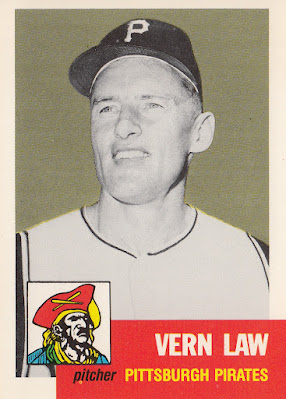
1991 Topps Archives '53 #324 Vern Law

Now, this isn't really a vintage card, even though it looks like a '53. Experts of these early Topps checklists (including our favorite Tim Wallach supercollector, who is nearing 1953 set completion) will know that Vern Law never made it into the original 1953 set. Neither did 56 other players who made up "The Cards That Never Were" subset at the end of the 1991 Topps Archives checklist.

Topps really took this theme seriously, writing a paragraph for the card back as though we were in early 1953 looking forward at the upcoming season. We're told, "This strong righthanded hurler rejoins the Pirates this year after spending the 1952 campaign in military service." 

Those who don't know the 274-card checklist of 1953 Topps by heart can use several other cues to place this subset as an revisionist augmentation to the set rather than a pure reproduction of the original. 

First, the images are black-and-white photographs rather than the full-color paintings we'd see on the originals. I have a mostly complete run of this set, and the only exception I could find was Hank Aaron's card #317. He did get a color painting, but it's not nearly up to the more lifelike standard found in the originals. The next clue is the background. It's usually a one of a few plain solid colors like this, or sometimes it might overlay a faint black-and-white background.

On the back, you could just check whether the card number is #281 or above. There's no red-colored facsimile signature behind the write-up like you'd see on an original. And finally, the card back will have "The Cards That Never Were" printed on the very bottom.

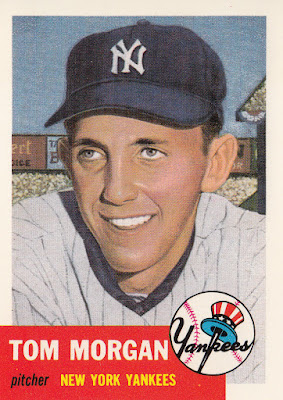
1991 Topps Archives '53 #132 Tom Morgan

Here's a reproduction of an original '53, and the difference is quite obvious. The colors are vibrant, and there's even some festive little bunting in the background on the facade of the stadium. 

This card is more of a review of Tom Morgan's 1952 season, as he served in the military during 1953, which the card back mentions. He was back in (baseball) action in 1954, wrapping up his career with the Los Angeles Angels in 1963.

I don't know anyone who would call a 1991 card from the heart of the overproduction era "vintage", although one has to wonder. As disconcerting as this fact is, that was thirty-one years ago. And when I really got my collection going in 1993, I'd have to find something from 1962 to have something as old then as this is right now.

But still, 1991 is not vintage.

Is it?

Or is "vintage" an ever-receding landmark in the rearview mirror, something that became fixed in place at some point, an idea that somehow manages never to keep pace with our world that's rapidly becoming more and more unpredictable?

Maybe let's just not think about that.

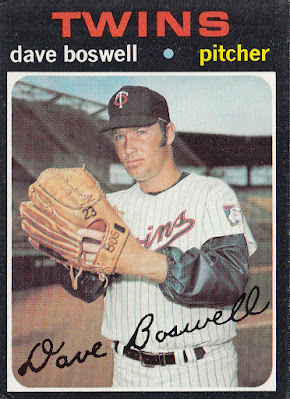
1971 Topps #675 Dave Boswell

Here's 1971. This is vintage.

This shouldn't be very surprising, but when I go through cards from this long ago, there are a lot of names I don't know. Tons. Dave Boswell is among them. 

He's pictured here as a Twin, which is where he spent his career from 1964-1970. However, the Twins released him in early 1971. He appeared in a handful of games for the 1971 Tigers and Orioles, but that was the end of his career. It was also the end of the line for his Topps issues, meaning this is his sunset card. He appeared in a few oddball sets after that, but Topps never documented either of his final pair of teams.

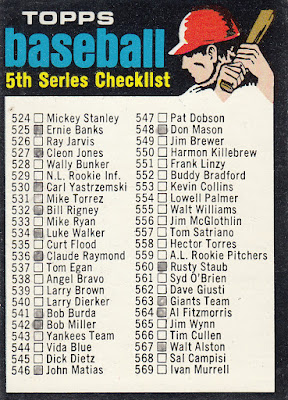
1971 Topps #499 Checklist 5

Jay threw in a checklist from 1971, and it's stops just a little short of including Dave Boswell's card #675, ending at #643. Whoever had this before me had a long way to go before completing the black-bordered 1971 set, but they certainly had a few of the big names checked off. Hall-of-Famers like Ernie Banks, Carl Yastrzemski, Roberto Clemente, and quite a few others. It's marked in pencil, and it looks like #531 Mike Torrez was possibly erased. Maybe part of a trade?

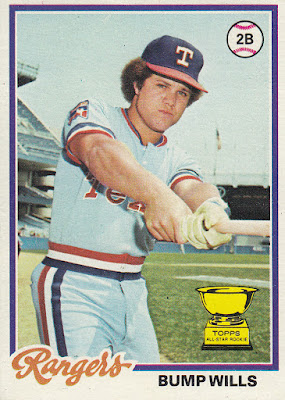
1978 Topps #23 Bump Wills

Fast forwarding a few years to 1978, perhaps a bit closer to that blurry vintage/modern dividing line, we come to "Bump" Wills, the son of Dodger great Maury Wills.

Wills's true Rookie Card is a four-player card from 1977. This is his first solo card. He finished third in 1977 AL Rookie of the Year voting, losing out to Eddie Murray, but he did earn himself a Topps All-Star Rookie cup, clearly shown on the lower right of the card. It's a nice addition to this posed photo, taken inside the newly-renovated (old) Yankee Stadium.

1967 Topps #76 Jim Barbieri (RC)

Jim Barbieri is another name I don't know, but this 1967 card was the oldest one in this shipment, so up it goes on the blog. The posed photo looks similar to Bump Wills's card, but this checks the box for the always-trusty bat barrel shot.

The card back says that Barbieri threw out the ceremonial first pitch in the 1954 World Series, the very same World Series where Willie Mays gave us "The Catch" in Game 1, so it's very likely that this Dodgers rookie was on hand to witness that legendary defensive play as a thirteen-year-old. The card doesn't specify for which game Barbieri got the honors, but I'll go ahead and believe it was Game 1, because why not? Maybe the ceremonial first pitch used to be exclusive to Game 1 back then, anyway.

Barbieri's career spanned all of thirty-nine regular-season games in 1966, so this Topps card ends up being a combo Rookie Card and Sunset Card. 

There was a 40th game before his career truly ended, though. Apparently no stranger to Game 1 of the World Series, he appeared as a pinch-hitter for the Dodgers in the '66 Fall Classic. He struck out swinging in the 4th inning and that was that.

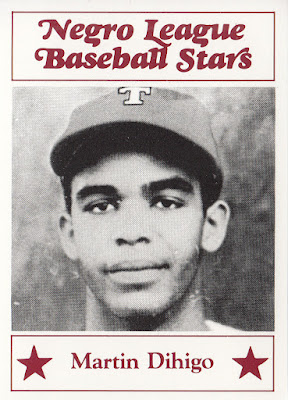
1986 Negro League Fritsch #19 Martín Dihigo

Jay included a few oddball cards focused on Negro League stars, including Cuban-born Hall-of-Famer Martín Dihigo, "a talented second baseman who was a superior hitter". And despite what you might think from this grainy black-and-white photo, he wasn't a 19th century contemporary of Cy Young or Old Hoss Radbourn. Dihigo played and managed right up through the mid-1940s.

Sadly, by and large, oddballs like this release from Larry Fritsch Cards are about all that's out there for many Hall-of-Famers who played only in the Negro Leagues. Players like Dihigo, Oscar Charleston, Turkey Stearnes, and many others have been as ignored by the card industry as by pre-1947 Major League Baseball itself. For example, Dave Boswell has 28 search results on Beckett. Martín Dihigo has 26. Only one of them is in the Hall of Fame.

Perhaps now that the various Negro Leagues have finally been recognized as Major Leagues, that will start to change. Maybe there would be numerous legal difficulties Topps/Fanatics would encounter if they tried, but I'd buy a retro-themed Negro Leagues set if it were on the market.

Just saying, if there's room for the thousandth Dustin May card, maybe there's room for some Hall-of-Famers that remain far too obscure.

1991 Swell Baseball Greats #9 Joe Black

Another oddball came from the Swell Baseball Greats set, a 1991 release from a brand of the Philadelphia Chewing Gum Corporation. Joe Black, pictured here as a Brooklyn Dodger, joined the National League in 1952, winning Rookie of the Year honors thanks to a 15-4 record. He kept playing through 1957. He got his start with the Baltimore Elite Giants, playing for them from 1943-48.

We'll keep the World Series history going with a fact from the card back, which is that he was the first Black pitcher to win a World Series game. That happened in 1952 versus the Dodgers' crosstown rivals, the Yankees. It was a seven-game battle, as were most of the matchups that decade between the Yankees and Dodgers.

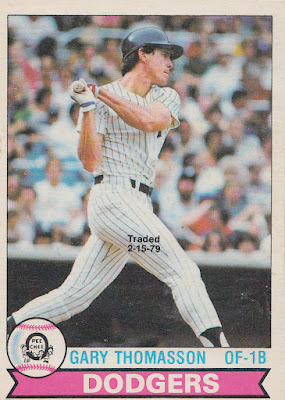
1979 O-Pee-Chee #202 Gary Thomasson

To close, we'll head north of the border. This looks quite like a 1979 Topps card, but look closely inside the little baseball element and you'll see a fun O-Pee-Chee logo! The Canadian brand that licensed and distributed Topps sets for years throughout Canada actually made some noticeable changes to Gary Thomasson's 1979 Topps card.

In the USA set, Topps simply pictured and listed Gary Thomasson as a Yankee, but by the time O-Pee-Chee got around to it, they had time to switch the listed team to the Dodgers, as well as provide the date that Thomasson was traded. The Dodgers acquired Thomasson for catcher Brad Gulden, who bounced around the league until 1986.

I learn a lot when I get stacks of vintage cards. So many of these guys I've never heard of, but there's always a wealth of knowledge to uncover, from small offseason trades to World Series history.