Showing posts with label Cincinnati Reds. Show all posts

Sunday, November 28, 2021

It's Early This Year

There have been the slightest of dustings in parts of town, but as of today, Denver has yet to record its first measurable snowfall of the winter. We've blown past the prior early 1930s record of November 21st, and there's nothing in the forecast that shows any sign of this changing soon.

So with Thanksgiving over and December looming, the fact that Hanukkah starts at sundown tonight (Sunday) caught me a bit off guard. I do have potatoes on hand for the appropriate seasonal treat, but it just doesn't feel like I'm quite ready for the holiday to appear so early this year.

Mom, on the other hand, had this all squared away and ready for takeoff. As usual, she found a card from my Eight Men Out want list and presented it to me inside a greeting card. 

I know she always worries about whether she got me "the right card". Frankly, the fact that she frequently takes the time to check my specific want list in the first place is plenty generous all on its own. And getting baseball cards in general is no small feat in this supply-constrained era.

So is it "the right card"?

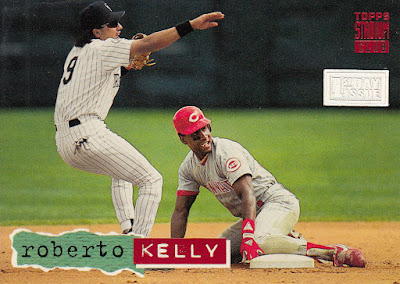
1994 Stadium Club First Day Issue #372 Roberto Kelly /2,000

Well, technically no, but (and I told her this), it's way better. All I did was put an overproduction-era Stadium Club card on the list, and she goes and finds me a First Day Issue parallel. They're quite scarce for the era, having a stated print run of 2,000. They aren't serial numbered, but as overproduction-era parallels go, this is a needle in a haystack. In checking my 1994 binder, this is is the fifth one I've been able to add to the collection after all these years, and it remains one of my favorite parallels of the entire era.

My main motivation for wanting this card was the cameo. That's Vinny Castilla on the left, covering second base in an inaugural-year Mile High Stadium. I did see the Reds play the Rockies in 1993, but that was the final home game of the season. Unfortunately, Roberto Kelly, the main subject of this card, suffered a separated shoulder in mid-July and missed the rest of the season. That would mean this photo couldn't have been from a game I attended, but that does at least narrow it down to one particular series in June.

Roberto Kelly and his Reds had back-and-forth slugfests that week with the young Rockies, and I believe this photo is from the third and final game of the series, a 15-5 blowout win for Colorado. In the top of the 4th on June 23rd, 1993, Kelly stole 2nd base with Chris Sabo at the plate. Castilla was playing short that day, and it looks like Kelly beat the throw quite easily. There might not have been a throw at all, actually. The speedy center fielder stole third base a few pitches later, but was stranded there.

Interestingly, the card back mentions that Kelly, a two-time All-Star, stole third base nine times in his injury-shortened 1993 season, but doesn't quite manage to tell us that one of those SBs came mere moments after this photo was snapped. 

That's the value I'm adding here at Infield Fly Rule.

That's all to report for today, a quick one-card post (thanks, Mom!) and the weather forecast. Thank you for stopping by!


Sunday, January 3, 2021

The Trading Post #162: Card Hemorrhage (Part 1: Assorted Goodies)

I'm all the way up to #162 in The Trading Post theme. That's a lot of trades, and many of them I've split up into two or even three parts. This one will be a two-parter, but the unusual thing this time is that this was all from a single PWE.

Yes, Jay at Card Hemorrhage expertly crafted a bespoke PWE, stuffed two dozen cards inside, affixed three stamps to it, and sent it on its way. According to the postmark, it took a little over two weeks to complete its journey through the mail system, but it was worth the wait. Especially because I had no idea I was even waiting at all. 

2001 Topps Archives Reserve #63 Satchel Paige

Usually I lead off the two-part posts with the Rockies, but I'm flipping it around this time. Mainly because there was an excellent and timely Archives Reserve card in here, but also because I have to admit that I'm getting a little disillusioned with the Rockies. Yet another offseason is going by without much happening, although free agent Trevor Bauer was asking for Denver restaurant recommendations on Twitter the other day, so what do I know? 

Sushi Den, by the way.

In any case, I've gone on record before as saying that Topps Archives Reserve is my favorite reprint set ever. The iconic cards, the wide representation of sets, the shininess. It can't be beat. So Jay took note of that and sent Satchel Paige's card from this 100-card set. I'm not quite sure where Topps got the extra "L" in his name, but on the back, they did acknowledge the travesty of segregation, referring to his Major League career as "long deferred and much interrupted". That's language from 1953, one small step on a very long path. Another thing that was "long overdue" was recognizing the Negro Leagues as a bona fide Major League, something MLB finally decided to do on December 16th. Coincidentally, that's the same day this PWE was postmarked. 

Next comes the long process of including all those years of incomplete record keeping into the official statistics, and I'm waiting for the day when Paige's Baseball-Reference page shows more than the 28 wins he earned after he reached his forties.

Now's a great time to learn more about Paige, and Buck O'Neil, and Cool Papa Bell, and Oscar Charleston, and Martín Dihigo, and many more. Joe Posnanski has taught me quite a bit since last year, such as this tidbit gleaned from O'Neil, that so many Negro League teams were called the Giants as sort of a code word. It was often difficult to get proper press coverage when a Negro League team was in town, but if you heard tell that "the Giants" were playing, those who were clued in would know what was up, and potentially had the opportunity to witness these greats in their prime.

2014 Topps Chrome #14 Alex Guerrero (RC)

A decade or so later, things became much more difficult for Cuban players for an entirely different set of reasons, but that started to change in the early '90s. Today, Cuban-born players are well-represented in MLB, including some of the latest hot rookies like Luis Robert and Randy Arozarena. Álex Guerrero was once among them, and signed with the Dodgers in late 2013. He ended up with playing time in 2014 and 2015, all with the Dodgers. 

He got a card in 2014 Topps Series 2, as well as in this smaller Chrome set, and it's a great photo. It fits into the all-dirt "Tatooine" mini-collection, and I'm guessing this is a spring training shot. The photo is cropped too tightly to identify either his teammate or the opposing runner, but I'm guessing that's an Angel.

1995 Leaf Cornerstones #5 Will Clark / Dean Palmer

This mid-'90s insert isn't quite as shiny as the first two, but it does have that sparkly rainbow look around the border. New to my collection, the Cornerstones insert set features the primary corner infielders from a tiny selection of six teams. Most of us remember Will Clark as a Giant, but he spent most of the later part of his career with the Texas Rangers. Joining him across the diamond was Dean Palmer. 

On both the front and the back, this card shows a nice right-handed/left-handed symmetry, typical for their respective positions. There are defensive stats on the back as well, such as putouts and errors. Maybe I'm spoiled by Nolan Arenado, but Palmer's .912 fielding percentage at the hot corner is really, um, not that great.

It's a nice design, though. The colors and theme work well, and I'd love to see Topps do a current 30-team version of this set. The only odd thing here besides the tiniest crease on the front is the numbering. Leaf was inconsistent in their use of numerals and words, noting this card as "5 of six".

2014 Bowman Chrome Draft Top Prospects #CTP-83 Clayton Blackburn

The last shiny card before we get into more normal-looking cardboard comes from Bowman Chrome. It's from a year. 

Seriously, it's from 2014. I'll never be good at Bowman.

Of the zillions of Bowman Prospect cards out there, this one in particular makes me think that Jay might be an extremely diligent reader of Infield Fly Rule. As I documented in 2016, I've been to one single Minor League game in my life. I saw the Sacramento River Cats host the Salt Lake Bees, and guess who the home team's starter was that day? Yep, Clayton Blackburn.

Like the many prospects who fill Bowman checklists, Blackburn never saw Major League action, although he did spend some brief time on active MLB rosters. He just never had the chance to actually take the mound.

I did enjoy the Minor League experience, and it's nice to keep tabs on these guys as they progress through the farm system. Players you happen to see in person take on a whole new life and you really find yourself rooting for them to make it to The Show. It's just not something that's as easy to keep tabs on when you have a Major League team a short drive away. Maybe that's why I'm so terrible at Bowman.

2020 Topps Heritage Minors #25 Heliot Ramos

Another enjoyable aspect of Minor League Baseball is just how fun the team names are. One level down from the River Cats in the Giants farm system, you'll find the Richmond Flying Squirrels. Just have a look at this logo. Elsewhere in MiLB you'll find the Isotopes, the Yard Goats, the RubberDucks, the Jumbo Shrimp, and best of all, the Trash Pandas.

Heliot Ramos plays for the Flying Squirrels, or at least he did in 2019. Minor League Baseball was entirely shut down in 2020, and I have to wonder how much career development has simply been derailed. To lose a whole season at a young age certainly can't bode well for many Major League hopefuls. But maybe one day, Ramos will make his way through Sacramento and on to San Francisco. At that point, odds are good I'll see him play an NL West game at Coors Field someday. 

That is, assuming the MLB divisions aren't massively realigned. Expect the unexpected.

2015 Topps Gypsy Queen Glove Stories #GS-10 Pablo Sandoval

In case you haven't been caught up with meme culture or Guardians of the Galaxy, a Trash Panda is a humorous name for a raccoon (see also: danger noodle, aka snake). This is not to be confused with Kung Fu Panda, the nickname for third baseman Pablo Sandoval. He was featured in a long-running but defunct Gypsy Queen insert set called Glove Stories. It featured some of the best defensive plays on the diamond, and this one in particular is from the 2014 NL Wild Card game, in which Panda went over the railing (at 1:28 in video) to snag a foul pop. If you leave the field of play as part of a catch, you run the risk of allowing runners to advance one base, but as I understand the rules, there's no danger when there's no one on base. 

Other than falling into the concrete dugout, of course.

1976 Topps #101 Pete LaCock

We'll take a brief foray into vintage before continuing. I don't have much 1976 Topps in my collection, but I am just a little bit closer to filling a complete page in my vintage binder. Pete LaCock retired several years before I was born, and if not for his name that doesn't pass the playground test, he'd probably just be another unknown in the vast expanse of 1970s commons. But he's been embraced by the Cardsphere, so that's why I now have a -1.9 rWAR player in my collection. And it's actually in really nice shape for being 45 years old, even though the centering isn't perfect. It's very 1970s.

So what can we find out about Pete LaCock? Well, he played in Japan in 1981, but his final 1980 season was enough to earn a trifecta of sunset cards all three sets that year. Topps, of course, and the inaugural Donruss and Fleer sets. In more recent years, he coached various Minor League teams like the Blacksnakes and the Saltdogs. And he happens to be the son of the original Hollywood Squares host, Peter Marshall, whose real name is Ralph LaCock.

1994 Stadium Club #109 Gregg Jefferies

On to the wonderful world of Stadium Club, where we see Gregg Jefferies trying to steal second base in Wrigley Field. The cameo here is unclear, but I'm guessing that's a "6" on this Cubs uniform. I'm not entirely confident in this, but my best guess is that it's José Vizcaíno, who wore #16 in Chicago. Oddly enough, Vizcaíno was the cameo player on another Stadium Club card that Jay sent me last time

Cue Twilight Zone Music...

1994 Stadium Club doesn't get enough love. After three years, Topps changed the brand's logo and started using the "TSC" abbreviation. They also changed the card backs from what had been a pretty consistent design since the brand's inception in 1991. Gone was the tiny image of the player's first Topps card, replaced by a second photo and all sorts of different typefaces and colors. 

On the front, the color of the player's first name denotes which division the team is in. The same color coding is also used on the card number. 1994 was the first season where MLB used the six divisions we know now, so Topps decided it would be helpful to guide fans into understanding the new alignments. As we all know, 1995 Fleer took that idea to the extreme. 

Also on the back, Topps gave us a word or two to describe the player or his season, in this case "efficient". Fleer also borrowed that idea for their Emotion brand. Topps did it a year before, though with much less emphasis. And the red foil I never see enough of was something Pacific ran with for years before their demise. It turns out this was a pretty influential set.

Out of curiosity, I glanced through a few of my other '94 Stadium Club cards to see what Topps came up with for the player's phrase. Robin Ventura was "rockin' robin". Barry Larkin was "cin-tillating", pun and hyphen intended. These are all lower-case. Wade Boggs was "better than pie", referencing his lifetime batting average being higher than Pie Traynor's, which held true into retirement.

I was ten when this was all happening. It was fun.

2014 Stadium Club #79 Brandon Phillips

So you can imagine my excitement when Topps brought the brand back in 2014, the same year I started this blog. I'm not saying I caused it, but I'm also not saying I didn't. In those ensuing decades, the brand grew up a lot, developing yet another logo, toning down the card back tremendously and using words like "loquacious", and focusing even more on the photography.

Here, Brandon Phillips has a Brewer caught in a rundown, but I can't see the numbers clearly enough to know who it is. That might be Jonathan Lucroy watching from the safety of second base, which is a wild guess based on the first digit of the uniform number. Whoever the trail runner is, Phillips has good speed, and I definitely wouldn't expect him to win this footrace.

2015 Stadium Club #99 Chase Utley

2015 Stadium Club is just as good, if not better. I only have a page or so of it in my collection, which is odd. Usually I buy at least a blaster of it, but I only have enough to equal a value pack or two. So I'm glad to add this Chase Utley card to the pages. As posed shots go, this is one of the best, showing him in the dugout at Nationals Park, with his reflection in a glass door. 

Utley is wearing the "CB" memorial patch from the 2014 Phillies season, honoring Claire Betz, a part-owner of the team who died earlier that year. You can also see the banners on the structure beyond the left field wall, over Utley's left shoulder. There's a big banner with the Curly W, and under 5x magnification a Nats player is visible on it. It's very hard to say for sure, but I think it's #28, Jayson Werth.

In the reflection, the angles play a little differently, so Utley's bat mostly obscures that banner. But look closely, and you'll be able to see a mirror image of the Geico Gecko in the window, sitting right on Chase Utley's shoulder like a little cartoon angel.

1992 Stadium Club #800 Jose Rijo

José Rijo is trying to get a better look at all that through his goofy sunglasses. Despite all his fun cards, the only other time he's been on the blog was just a normal pitching card. For mini-collections, he's a frequent subject. He fits into the signing autographs mini-collection, the sunglasses mini-collection, and he's pretty much all by himself in the squirt gun mini-collection.

He was also a pretty good pitcher. He was both an All-Star and a World Series MVP, and probably would have put up even better numbers if his elbow didn't give him fits for years on end.

We'll see some Rockies in Part 2. In the meantime, have a Happy New Year and thanks for reading!


Sunday, March 26, 2017

The Trading Post #94: Cardboard Clubhouse

Adam was a fairly common name when I was growing up. Starting in the first year or two of elementary school and throughout my public school career, there were lots of Adams. Adam W., Adam T., Adam G., Adam B., and of course myself as Adam K. There's even another Adam K. at my current place of employment, so our colleagues have to come up with other ways to differentiate us, primarily that the other Adam K. is a talented dancer and soccer player, of which I am neither.

Even in Boy Scouts, there were two Adam S.'s in my patrol, leading to this particular exchange shouted between tents one dark night at a mountain campsite:

"Hey, where's Adam?"
"Which Adam?"
"S!"
"Which S?"
[frustrated pause] "<other S.'s last name>!"

Even in the Cardsphere, there are a couple of Adam S.'s, entirely different from the ones I knew in my Boy Scout days. Giants fan Adam (aka arpsmith) writes "ARPSmith's Sportscard Obsession", and Adam Sanders writes Cardboard Clubhouse, the sender of this particular PWE.

2010 Topps #51 Eric Young Jr (RC)
The Adam S. in question, a Reds fan, found this Rockies card of Eric Young, Jr. sliding into home plate at Coors Field against a Cincinnati Reds catcher. We might have enough information here to date this card. Ryan Hanigan was the regular catcher for the Reds in 2009, and Cincinnati visited Denver in early September 2009. Young, Jr. scored multiple times during that series, but the most likely candidate is September 9th, 2009. Eric Young, Jr. got on base to lead off the third inning, advanced to third on a Carlos Gonzalez single (wow, CarGo was a Rockie way back in 2009?), and scored on a sacrifice fly by Seth Smith.

He is facing away from the catcher, but that sliding position is fairly dangerous, the way his spikes are up like that. It's a good Nike ad, at least, but it's probably best that the pitcher wasn't nearby.

2015 Topps Rainbow Foil #94 Tommy Kahnle
Tommy Kahnle is now part of the Chicago White Sox organization. I might even get to see this ex-Rockie when the White Sox come to town in July, as part of my quest to see every Major League team in person. Even though Kahnle didn't make a huge splash for the Rockies (originally drafted as a Yankee), I'm still glad to have this Rainbow Foil parallel from 2015 Topps.

The stucco set (is that what we settled on calling it?) already seems like a distant memory, but if it's to be the last-ever bordered Topps base set, then I think they did a great job with it.

1995 Stadium Club #109 Doug Million
That's about it for the new cards, as the rest were mostly from the 1990s. 1995 Topps Stadium Club introduced a new brand logo that would stick around for a couple years, and it appears on this Draft Picks subset card. I've written about Doug Million's sad story before, and this promising lefty never had a chance to pitch in the Majors before his tragic death. The Rockies pitching staff is facing something similar today, as starter Chad Bettis will likely be missing most of the 2017 season as he is treated for testicular cancer.

I hope that I'll be seeing Chad Bettis cards long into the future, regardless of which team he's on.

1995 Stadium Club #94 Walt Weiss
Walt Weiss also got a card in that same Topps Stadium Club set, which was generally being referred to as TSC during this period. I can't quite tell if he's sliding into third or diving back to first base to avoid a pickoff attempt. Probably the former, unless the first baseman is playing far behind the runner. Either way, we can see that the former Rockies manager wore his cap underneath his batting helmet. I don't see anyone do this anymore, but it wasn't that uncommon in the 1990s. When I played my two seasons of little league, I used to do exactly that when I strolled up to the plate. Always wanted to be like the big guys. Unfortunately for me, that is slightly more difficult when your helmet has ear flaps on both sides. I guess I just didn't have the leverage at the age of ten to demand a right-handed batting helmet. But a switch-hitter in the Majors got a choice of either.

1995 Collector's Choice SE #260 Dante Bichette FT
1995 Collector's Choice SE came out in the final month of 1994, and the blue foil made it one of my favorites at the time. I have seen these Fantasy Team subset cards countless times, but I never really looked that closely at them. This was a decade before I knew anything about fantasy baseball, but the back of this card gives a look at per-position fantasy rankings, based on the standard 5-category scoring. Those 5 categories were based on statistics that you'd find in a box score in the newspaper, since this was long before any sort of live scoring you could check on an automatically refreshing webpage.

Strangely, the column for batting average shows a zero in front of the usual three-digit number, as in 0.284. More strangely, there is no column for runs scored, one of the key statistics in 5-category scoring. And perhaps strangest of all, Dante Bichette's fantasy stats don't even appear on the back of his own card. Luis Polonia is at the top of the AL outfielder rankings, and Derrick May atop the NL rankings. Rockies outfielder Mike Kingery shows up midway down the NL ranks, but Bichette is nowhere to be found.

That seems to be an error, as I checked the back of several other cards in this subset. Greg Maddux, Craig Biggio, and Jeff Bagwell are all listed at the top of their league table, in bold no less. Bichette and his stellar seasons as a Blake Street Bomber surely put him as a top-ranked outfielder. Which is pretty much where Carlos Gonzalez and Charlie Blackmon can be found today.

1995 Donruss #383 Roberto Mejia
Continuing our flashback to 1995, Roberto Mejia, an expansion draft pick, appears in this 1995 Donruss set. The front is pretty standard for a mid-1990s card, with a full-bleed photo and lots of illegible silver foil. But I do think I finally know whose batting helmet Charlie Hayes was wearing on his 1994 Upper Deck card.

1995 Donruss #383 Roberto Mejia (Reverse)
Over twenty years later, the back of 1995 Donruss clearly influenced the 2016 Topps Bunt set, with its huge team logo, a touch of color coding, and a general gray color.

Fake-finger-gun back at you, Roberto. I'm sure that was a nice throw.

1994 Score #528 David Nied
David Nied, the Rockies first pick in the Expansion Draft, was featured in the fragile 1994 Score set. The little yellow 1993 Rookie label isn't quite accurate, as Nied pitched three games for the Braves before the Rockies and Marlins poached rosters from the rest of the Major Leagues.

This photo is probably from 1993, making the blurry foreground catcher likely either Joe Girardi or Danny Sheaffer, both of whom also got cards in 1994 Score. Surprisingly, for as much 1994 Score as I collected when it was new, and for as many early Rockies cards as I get via trade, this Nied looks to be a newcomer to my collection.

Thanks again to Adam S. for sending this Adam K. some great Rockies cards, and I hope he enjoys the upcoming baseball season, which kicks off one week from today!


Thursday, August 25, 2016

Buster Posey's Good Friend

Last month, I entered a contest at Red Cardboard, where four others and I came out as winners, giving us the opportunity to draft for about 115 cards. It was an interesting and thoughtful process, once I was kindly informed by the blog owner that I had actually won. Sorry for the delay on that. Anyway, I obviously didn't end up with all my top choices, but still got a nice little stack of cards, mostly of the Reds, but with a few other teams mixed in.

2011 Topps Update Gold #US207 Jay Bruce /2011
I've always liked Topps Gold, and I jumped at the chance for a few serial-numbered Topps cards, including this one from 2011 Update. There are always lots of All Star game cards to be found in Update, and that often means cameos. Behind Jay Bruce, who was recently traded to the Mets, Andrew McCutchen can be seen celebrating with Buster Posey's Good Friend Hunter Pence.

Why would I say it like that? This was from a broadcast blunder by Jon Miller earlier this year, when he misattributed a home run call and then changed it at the last second. It's quite amusing. Pence was on the Astros when this card was printed, but now is palling around with the Giants catcher, who didn't miss a beat on his Instagram.

2014 Topps Opening Day Blue #211 Mat Latos /2014
I miss Opening Day blue parallels that include serial numbers, so I picked one from 2014, the last time Topps did that. I've seen this card a lot, but I never really looked very closely at his tattoos. The first thing that jumps out at me is the baseball stitching on his left wrist. He's pitched with four different teams since then. No word on whether he's added to his tattoo collection.

2014 Topps Gold #277 Mike Leake /2014
Another serial numbered Reds pitcher (now on St. Louis) from 2014, only this one is at the plate! He may have actually put this one in play, judging from his reaction. The back has a fun fact that Leake skipped the minor leagues entirely before reaching the big leagues, and he's in the rare company of Jim Abbott and John Olerud on that count.

2010 Bowman Draft Gold #BDP59 Drew Stubbs
One more gold card, only this one doesn't have a serial number. Drew Stubbs was on the Rockies for about a season and a half, but originally came up with the Reds. He's actually had a few playoff appearances; and he might get another this year if the Rangers keep it up. Bowman Gold cards are always nice and thick, and this has a nice green border signifying it's one of the prospect cards.

1995 Ultra Gold Medallion #367 Hal Morris
In the card draft, I ended up with a few Reds that were contemporaries of the Blake Street Bombers. First baseman Hal Morris played in only 112 games in 1994, according to the back. That might not seem like much, but he only missed two games all season, as the rest got cancelled due to the strike. Fleer Ultra dialed back the gold foil for 1995, although the Gold Medallion seal does clash a little bit with the silver foil on the rest of the card. This parallel set has been popping up a lot lately, and there were two more I chose not to scan.

1997 Score Premium Stock #242 Barry Larkin
Mid-'90s parallels actually made up a significant portion of this contest win, and Score didn't miss out on the fun. It's a bit hard to read, but that seal says it's "Premium Stock", and this card does indeed feel thicker than a regular Score '97 card. I know I say this about a lot of sets, but I am pretty sure that 1997 Score was the last product I added to my collection before stepping away from the hobby. They sold it in a tin that my parents bought for me at an outlet mall, and even though it did have some neat team dividers, it was not a complete set as I had expected, and a dozen or so cards were damaged with that same ruffled pattern I found on the bottom of that miscut Tulo card.

This Score card seems to be a tiny bit off-center, which is more apparent when looking at the back. Not a big deal though, as a Hall of Famer on a premium insert card is nothing to sneeze at.

1994 Pinnacle Museum Collection #322 Jose Rijo 
Jose Rijo often gave the young Rockies fits, and he was sort of an antithesis to Barry Bonds. Rijo was always up to some antics of some kind, and this is reflected on his baseball cards, where he's often found with stethoscopes and Super Soakers (child of the '90s here). It depends on whom you ask, but Rijo underwent Tommy John surgery anywhere between two and five times. Looking at the stress a pitcher's elbow experiences during a game, its a wonder they don't all need it every other year. There's even a growing trend of preemptive TJ surgery, which sounds radical, but makes sense in a twisted way. Better to do it in college or the minors than when it can potentially affect a Major League pennant race or a multi-million dollar contract.

Rijo literally shines on one of Pinnacle's parallels with a Dufex pattern, the beacon of the Pinnacle pyramid illuminating the entire scene. If baseball cards existed during the Renaissance, they'd probably look something like that.

Munnatawket Custom #100 Ichiro Suzuki
One of the items I put pretty high in my draft selection was a small stack of custom Munnatawket Minis. I've received a few of these before, and Nachos Grande is typically involved, another Reds fan.

Card #100 is obviously a recent creation, as Ichiro has only been a Marlin since 2015. There's really no player-specific information on the back, but I continue to be impressed at the quality of these custom minis.

Munnatawket Custom #20 Mr. Met
This set even has mascots. Dinger's probably too obscure to appear in this small set, but Mr. Met gives it two thumbs up. By the way, you've heard the song, right? It's a little surprising he isn't an apple, but I'm sure that decision was made long ago.

Munnatawket Custom #32 Hunter Pence
Buster Posey's Good Friend (tm) even makes an appearance on a custom card, and this time it's as a Giant. That looks like the 2012 Champions patch on his sleeve, so I'm guessing this card came before Ichiro's. But Pence was probably buddies with Posey by then.

Serial numbered cards, 1990s parallels, and custom minis. What could be left?

1962 Topps #46 Jack Baldschun (RC)
Vintage!

The older cards I got weren't of players pictured on the Reds (or even the Redlegs, as old as one of these was), but still some great additions. I must admit that I've never heard of Jack Baldschun. The back of the card says plenty about his performance as a relief pitcher, and his cartoon mentions that he appeared in eight straight games out of the bullpen in 1961. The centering isn't great, but it's in really good shape otherwise, and will go well with my other 1962 cards, which remains my most complete vintage set at about seven cards. So I have a long way to go if I want to get that one out of the way.

At least the Mantle is off the list.

1958 Topps #409 Frank Thomas
Even older is this 1958 card of Frank Thomas. No, not the Hall of Famer that appeared in almost every insert set of the 1990s, but rather the third baseman that played for teams all over the National League, including the inaugural New York Mets. I believe this is my sixth-oldest card, and though it's in pretty rough shape, the thing is almost sixty years old. I might even stick it in a binder, since there's not much point in putting it in a toploader at this point.

In looking this card up on Beckett, the more recent Frank Thomas, aka The Big Hurt, was also given card #409 in the related 2007 Topps Heritage set. Obviously not a coincidence, but a nice nod back to the past set (unlike those infuriating short prints).

1975 Topps #204 Frank Robinson / Roberto Clemente MVP
Finally this is the card I spent my highest draft pick on that I ended up getting. That two-color design is a dead giveaway for the epic 1975 Topps set, and it features each league's MVPs from 1966, Frank Robinson and Roberto Clemente, both Hall-of-Famers.

We've all seen Topps push their Anniversary cards on us pretty strongly, 40 years in 1991, 50 years in 2001, and the ubiquitous Diamond Anniversary celebration in 2011. 1975 marked Topps' 25th anniversary, and while I never really thought of that before since this was long before my collecting career began, Topps has clearly always been pretty big on their anniversaries. They're really celebrating their 25th set rather than 25th anniversary (depends how you count it, I guess).

This was just a couple years after Clemente's tragic death in 1972, so Topps saw fit to honor his and Robinson's accomplishments with this dual-player card. 1966 marked Robinson's second MVP award, who remains the only player to win it in both leagues. He won the Triple Crown, something only Carl Yastrzemski and Miguel Cabrera have done since. And the Orioles were World Series champs that year.

Clemente had a pretty good year himself, ranking near the top of the leaderboard in RBIs, hits, triples, and average. There is a very slight error on this card, saying that Clemente played in "all" 154 Pirates games. Clemente did indeed play in 154 games in 1966, but MLB moved to a 162-game schedule in the early 1960s as part of expansion. So while the game count is correct, he must have sat out eight games. The 162-game season was still a new development in 1975, about as new as our concept of the All-Star Game winner having home field advantage in the World Series. Especially when viewed through the lens of 1966, it's an understandable mistake.

It's fun to win contests! Especially when there are five winners and you're not shut out when you're randomized to #4. Thanks to Reds Cardboard for running the contest!