Showing posts with label Jose Canseco. Show all posts

Sunday, May 10, 2020

The Trading Post #141: A Cracked Bat

As I was scrolling through my blog feed this morning, I saw a few posts about one of my most frequent trading partners, Julie from A Cracked Bat, including a post on her own blog from yesterday. That inspired me to put this post together, covering some cards she sent as part of her generous Pick Pockets page. There are still a few items left there, so head over and make some selections before it's all picked over (pun intended).

2019 Stadium Club #252 Dee Gordon
Starting things off is Dee Gordon of the Seattle Mariners on his 2019 Stadium Club base card. Last time Julie sent a shipment, she included another Dee Gordon card from Stadium Club, back from his time on the Marlins. This time, he's on the most geographically isolated team in the Majors, and is giving us one of the greatest displays of athleticism ever captured on a baseball card. At first glance, you might think the speedy center fielder is diving for a ball here, but this is actually his follow-through on a throw back to the infield (or maybe across three or four parking lots) in which he's using every ounce of effort he can muster. In all two seasons of my little league career, I never inverted myself in this fashion to complete an outfield assist, but somehow Gordon makes it possible, with video evidence to prove it.

Not only that, but Gordon is even sporting a throwback Mariners uniform.

His outfield assists are something to behold, but since he arrived in Seattle, his once-stratospheric stolen base count has dropped significantly, which also means that his string of five straight seasons of at least 30 SBs mentioned on the card back came to an end in 2019.

2019 Stadium Club #185 Jose Canseco
Here's another from 2019 Stadium Club, a well-composed shot of Jose Canseco heading down the tunnel into a well-lit atmosphere, perhaps to fulfill some sort of destiny. If they ever make a Jose Canseco biopic, this would make a great closing shot.

I'm all about tiny details. So here's the tiny detail I'm noticing on this card. There's no MLB logo on the back of Canseco's cap.

When I was a kid, the holy grail of sports apparel at the top of my list, even more than a Starter jacket, was a fitted hat. I had plenty of hats at that age, but they all had the snap-back adjustable plastic strap that I eventually outgrew. Former Rockies bullpen coach Darren Holmes even signed one of them. But it didn't make sense to get me a fitted hat when I was growing like a weed, so it wasn't until I reached adulthood that I got one of the official New Era hats, size 7 1/2.

My dad often wore a Yankees hat, and I remember the little MLB logo on the back at the seam. We all know that logo from any non-action photo you've ever seen of Ken Griffey, Jr. wearing his cap backwards. And come to think of it, it wouldn't surprise me at all if MLB added that logo in direct response to Griffey's then-unique style. Griffey's rookie year was in 1989, and Canseco's best years were just slightly before that. This photo might even be from the '89 World Series itself. But it shows a time before the cool kids wanted to be like Griffey.

2019 Topps Archives #212 Robin Roberts
And way, way before that, Robin Roberts was a Philadelphia Phillie. Topps chose him for their 2019 Archives set and put him on the 1993 Topps design. 1993 Topps is one of those designs I know quite well, and this reproduction isn't quite perfect. The typeface is a little different, and more noticeably, the Phillies team name should be in red, not blue. But overall, it's a pretty nice card.

I don't want to turn this into a "here are all the barely-noticeable ways the reproduction isn't exactly accurate" post, but I will point out that Topps wasn't able to squeeze in Roberts's complete career record on the vertically-oriented card back. His career began in 1948, and these stats only go back to 1954. That's a shame, because some of his career-highs happened in the early '50s. 198 strikeouts and 28 wins in 1952, for example, and a whopping 346.2 innings pitched in 1953. Over half his All-Star appearances occurred in that part of the decade, too.

For comparison, 2019's IP leader was Justin Verlander, with 223. I don't know, I just think if you're going to create all these Archives cards, it makes sense to include full statistics, because they can give collectors a great insight into how the game has changed over the decades. Just because Baseball-Reference exists doesn't mean I don't want full stats on my card backs.

I guess I'll have to find my real 1959 Roberts card to see those prior years.

1992 Pinnacle Team 2000 #37 Jim Thome
Following a retro 1993 card, here's an actual card from that era, a 1992 Jim Thome insert from the Pinnacle brand. It's from the same Team 2000 set as a Larry Walker card I found at an LCS last year, and Hall-of-Famer-elect Walker will soon be joining Thome in Cooperstown.

I probably didn't have any of these cards when I was a kid, but it's quickly becoming one of my favorite insert sets of the era. I now have three cards from it, and along with John Smoltz, all three are Hall-of-Famers.

77 cards to go to complete this one. A young Jim Thome is card number #37 of 80, one of the few elements on the card back that doesn't use gold foil. Pinnacle correctly picked Thome to be a superstar, but they had him projected as the Indians third baseman for years to come. He did play the hot corner through 1996, but shifted over to first base in 1997 to make room for Matt Williams.

2000 Topps Hands of Gold #HG6 Omar Vizquel
Jim Thome and Omar Vizquel spent quite a few years together in the same infield, sometimes even on the left side during Thome's early years. Thome was more of a power hitter, smashing over 600 home runs by the time his career was over, but Vizquel was the defensive star, racking up eleven gold gloves.

Vizquel was about halfway through his career when this die-cut card was printed (and cut), and the card back says he has the highest career fielding percentage in history. That held true for the rest of his career, and his .9847 mark as a shortstop has never been beaten, and certainly not over nearly a quarter-century of playing time. Troy Tulowitzki came close, but with nearly a decade less service time. We'll see him later on in this post.

The card back lists Vizquel's six consecutive Gold Gloves from 1993-98, and he'd add on three more to that streak through 2001. He won two more in 2005 and 2006 for a total of eleven, and that isn't even the most in this small seven-card insert set. He has many of his contemporaries in this set beat, but not Iván Rodríguez's thirteen nor Greg Maddux's eighteen.

In case you're wondering about the patch Vizquel is wearing, I believe it's the "AL Central Champs" patch the Indians wore in 1999, documenting their first-place finish in their division the previous year. They made it as far as Game 6 of the ALCS before succumbing to the buzzsaw that was the late-'90s New York Yankees.

Anyway, I found Tony Gwynn's card from this insert set at that very same LCS last year, and it's a pleasing coincidence to have Team 2000 and Hands of Gold back-to-back in a post from an entirely different source.

2000 Crown Royale #107 Doug Glanville
Pacific gives us more die-cut fun from the turn of the millennium. I've run across the base gold variety before, but this and most of the other 2000 Crown Royale in my collection is of the red variety. Few besides Pacific were using red foil on anything, let alone a die-cut with a design like this.

Doug Glanville, now a sportscaster, put together a nine-season career, mostly as a center fielder. The card back tells us that 1999 was his best statistical year in many categories, and even had a five-hit extra-innings game against the then-NL Astros on September 15th, 1999. That was toward the very end of the Astrodome's life as an MLB stadium, and Glanville's performance that night helped end a 12-game winning streak the Astros had been on.

2019 Panini Prizm Illumination #I-5 Charlie Blackmon
Our first Rockie of the post is Charlie Blackmon on a colorful and kaleidoscopic Panini card. This is a 12-card insert set from Prizm, and while I know very little about Prizm, I know it's shiny. The same photo is used on both sides, but between Blackmon's arm position and wizardly beard, you almost don't notice that this is an unlicensed photo.

Almost.

This is my first time seeing this insert set, and I don't know about you, but I can't read this set's name without thinking of the Minions doing a movie production logo intro.

The card back tells us where Panini was going with this theme, in that "The scoreboard in Denver is always well lit thanks in large part to Blackmon." It's true, and especially so after the Rockies invested in a new mountain-shaped scoreboard for the 2018 season.

2019 Topps Rainbow Foil #460 Trevor Story
During these strange times, along with Blackmon's beard and Arenado's defensive prowess, I am definitely missing watching Trevor Story hit monster home runs at Coors Field. This photo from 2019 Topps may be just such a card. It's actually the rainbow foil parallel, or at least that's the most likely candidate in the truly insane list of parallels Topps makes for even the simplest base cards now. Regardless, it looks pretty good in this sunlit room I'm writing in.

This card also gives us a really clear look at the Rockies 25th Anniversary patch from 2018, which we've seen before. I assume they have a Coors Field 25th Anniversary patch ready to go for the 2020 season, should it actually happen. If there is a season without fans, I wonder how much media coverage and photography will be allowed. 2021 cards might be very strange and might have to repurpose a lot of old photographs, just like they used to do in the early days of the hobby.

2019 Diamond Kings Artist Proof Blue #53 Kyle Freeland
Speaking of Coors Field, I ran across a stat the other day that there's only one pitcher who has more than five starts at Coors Field while keeping his ERA there under 3.00. That pitcher is Adam Wainwright.

I bring this up because the back of this 2019 Diamond Kings card says that Kyle Freeland was just the second Rockies pitcher, after Ubaldo Jimenez in 2010, to make at least 30 starts and post an ERA under 3.00. Of course, many of those great starts were on the road. Even Ubaldo's no-hitter in 2010 happened in Atlanta. But it's really a sign of excellence for any pitcher associated with the Rockies.

This is an Artist Proof parallel, and even though I'm not a Diamond Kings expert, I'm assuming this is the Blue version of that parallel. Again, Panini is relying on the player's arm position to distract you from the fact that they still do not have an MLB license.

Freeland's card is the last of the nine I picked from Julie's Pick Pockets page, but she didn't stop there. She found three more higher-end Rockies cards to include, and they all have serial numbers!

2012 Topps Museum Collection Blue #28 Carlos González /99
I have no idea where she gets them all, but it seems like every time she sends me something, there's invariably something from an ultra-expensive set like Triple Threads or something. This time was no different, as she found this Museum Collection parallel of Carlos González from the 2012 set. This is the Blue parallel, numbered to /99. On "base cards", such as they are in Museum Collection, the area behind the team logo and "National League" is a dark gray. This elegant blue color signifies it as the second-rarest parallel in the set, other than the 1-of-1 Red parallel.

I'm sure most Museum Collection buyers aren't reading the card backs, but this mentions that CarGo was involved in trades for a couple stars before finding a more permanent home. He was originally part of the Diamondbacks organization, but went to Oakland as part of a trade for Dan Haren. Less than a year later, the Rockies picked him and a couple others up in exchange for Matt Holliday, and the rest is history.

Three Gold Gloves, two Silver Sluggers, a batting title, and ten seasons later, and he earned a heartfelt cheer from the home crowd upon his return to Denver as a Cub last June. I was there that day, and have had the good fortune to see both Troy Tulowitzki and CarGo play their first games back in Denver after they wound up on another team.

2013 Topps Triple Threads Sapphire #97 Carlos González /25
A year later, CarGo appeared in Topps Triple Threads. If you know the set, you'll know the base cards have silver foil. Clearly, this is a parallel, but no, it's not blue. That's far too pedestrian for a set like this. No, this is Sapphire. And it's numbered to just 25 copies. It does looks like there's a little printing dot on the photo, but this is a beautiful card. Even the back has a nice sky blue background, and it mentions his "fluid, picturesque swing".

I always loved González's swing. If you have a moment to spare, take a look at this walk-off, cycle-completing home run from 2010, which is one of the classic games that the Rockies TV network has been playing to keep fans entertained.

2007 Topps Co-Signers Silver Gold #102 Troy Tulowitzki /100 (AU)
Troy Tulowitzki was on deck when that happened, and here he is on our final card of the day, a sticker autograph from Topps Co-Signers. I have a few base cards from this set, and even one with a pair of facsimile signatures that came from Wes, but this is my first actual autograph from a set that sounds like it should be all about autographs. Julie pointed out in her note that this isn't in perfect shape since there are some noticeable creases on the back, but she said she only paid $2 for it! Sounds like a bargain to me!

When checking Beckett, I assumed this was the Gold parallel, which has a print run of 200. On that slightly damaged card back, this one clearly has a /100 print run, so it's not the Gold. I scrolled down a bit further until I ran across something called the Silver Gold parallel, which does indeed have a print run of /100. Even for parallel-happy Topps, that's stretching it.

There's one other thing I'll point out, inspired by one of Nick's posts last week about unfamiliar uniform numbers. Tulo is wearing #63 on this card. Fans who follow him know that he always admired Derek Jeter, which is why he wore #2 throughout his career (until he joined the Yankees, of course). He wore #12 as a Yankee in his final five games.

Interestingly, this isn't even the first card in my collection with Tulowitzki wearing an unfamiliar number. In a 2015 Topps insert set, he's shown wearing #14, which was his official uniform number for his rookie call-up at the end of 2006.

Thanks, as always, to Julie for this awesome selection of cards. I definitely got more than I bargained for (which is to say, more than I picked for free), and she's one of my favorite people in this whole community. If you don't have a trading relationship with her, start one!


Tuesday, October 29, 2019

A more local LCS (Part 1)

Tonight, Justin Verlander's World Series record dropped to 0-6. This is his fourth World Series, and half of those decisions came with the Detroit Tigers, a 114-loss team that was a Postseason contender not too long ago.

2010 Topps Chrome #134 Justin Verlander
Even before most of those appearances, he was established as a top-notch strikeout pitcher, putting his name on the list with other Detroit greats like Hal Newhouser, Virgil Trucks, and Mickey Lolich, as mentioned on the card back. That dominance has continued in Houston, as he whiffed 300 batters in 2019 for the first time in his career.

Accordingly, Topps selected him for their 2010 Chrome set. The giant Tigers logo in the corner is as shiny as ever, but I've yet to see a card from this set that didn't have at least some rather serious curling. At least this one is curled along the x-axis, which is slightly less annoying than how most of the other 2010 Chrome cards in my collection are curled. It's not even straight on a couple of them.

This and the rest of the cards in this post came from Colorado Sports Cards, a newly-established card shop just a few miles from where I live. It's only a couple years old, so it isn't packed to the brim with Zephyrs-vintage memorabilia like Bill's. I'm sure that will come with time, though. And even if the pickings are a little slimmer, at least it's a much shorter drive.

Clearly they're not that much slimmer, as I found more than enough there to turn into two posts. Have a look at what else came out of the dollar box.

1992 Topps McDonald's #3 Rickey Henderson
In 1992, even McDonald's saw that gold foil was about to sweep across the card industry, so they partnered with Topps for a 44-card Baseball's Best promo set, putting "Limited Edition", the player's name, and the Golden Arches in a very appropriate gold foil. These were distributed at McDonald's in 1992 as an add-on purchase with a meal.

Happy Meal, indeed.

The black borders have held up well over time, and there don't seem to be any grease stains or lingering salt crystals anywhere. The McDonald's colors carry over to the back, with lots of red and yellow to be found. Stats-wise, it's pretty standard for a Topps card of the era, and it does mention Rickey's 1990 AL MVP award.

1992 Pinnacle Team 2000 #21 Larry Walker
Pinnacle took the gold foil trend even further, putting about as much on the back as on the front. "Team 2000" is in gold on both sides, as is Larry Walker's name. Pinnacle reserved their gold foil logo only for those who flipped the card over. They didn't overpower the photograph and just left "Pinnacle" in white on the card front.

Pinnacle thought Larry Walker would be a star in the year 2000, and were they ever right! He put up some truly amazing numbers throughout the '90s, even winning the NL MVP award in 1997. This card talks a lot about his defense, saying he has "sure hands, good range, and a rocket arm." He had a cannon in right field, inspiring Skybox to put a cartoon flame on one of his cards. Walker won seven Gold Gloves in his career, definitely earning all the gold foil Pinnacle gave him.
2000 Topps Hands of Gold #HG5 Tony Gwynn
By the time the year 2000 actually arrived (and what a party it was!), gold had blanketed the industry with a King Midas touch. Everything but Tony Gwynn on this die-cut card is either gold foil, gold colored, or the actual word gold itself. Hands of Gold is a seven-card insert set highlighting players with at least five Gold Gloves. I'm not sure why Larry Walker was skipped, as he had earned five of his seven by the time this card was printed.

Besides Gwynn, other defensive wizards can be found in this small set, including Roberto Alomar, Ken Griffey, Jr., and Omar Vizquel, who still has it in his early fifties.

I haven't run across a card like this in a while. Die cuts don't seem to be all that common anymore, especially ones with curved edges and an embossed design.

2018 Topps Gold Label Class 3 #65 Mike Piazza
Gold wasn't reserved just for insert sets back then, either. In the late-'90s, Topps gave a full set the same name as one of the higher-end Johnnie Walker products, Gold Label. Mike Piazza appeared in those early Gold Label sets, but this is actually from a much more recent set that resurrected the name.

Unlike in past years, there doesn't seem to be any particular pattern in the three different Classes of this fractured set. Class 1 was a hitting photo, Class 3 a baseruning photo, that sort of thing. From what I can find about 2018 Gold Label, I can't figure out a theme that weaves the three Classes together.

Regardless, the primary photo shows a clean-shaven Piazza at the plate, and there's an All-Star Game patch on his right sleeve. The Mets didn't host the Midsummer classic during his career, so this must be from an actual All-Star Game. That looks like the 2005 logo to me, held at Comerica Park in Detroit. That happened to be Justin Verlander's debut year, by the way. But more importantly to Piazza, that was his last of a dozen All-Star appearances, including 1996 in which he won MVP honors.

2000 E-X #49 Jose Canseco
E-X from Fleer/Skybox was a contemporary of the original Gold Label, but they abandoned the use of acetate for the 2000 set. Jose Canseco and everyone else in the 90-card set got plenty of shininess, regardless of the actual card material. It's a set that's color-coded by team, and the colors Skybox used for Tampa Bay reminds me of the EPA logo. The (Devil) Rays were still trying to figure out their identity a couple years in.

The card back includes a mirror image of Canseco's photo on the front, trying to maintain the illusion that E-X was still a transparent card set. Back on the front, the position is spelled out vertically in the lower left, which escaped my attention many times before I looked more closely. I was quite distracted by the vaguely shark-looking curved area in the center.

1997 Topps Screenplays #8 Tony Gwynn
After finishing up at the dollar box, I checked a shelf of unusual items toward the back of the store. There were some lapel pins back there, a Rockies team magazine from the early days, and a few of these Topps Screenplays cards, each packaged in a player-specific round tin. Inside the tin was a single card, safely tucked inside a foam protective case. They had three on offer. I passed over Juan Gonzalez and Mark McGwire in favor of another Tony Gwynn.

I've never seen one of these before, and it's awesome.

Picture a horizontal Sportflics card with the usual lenticular surface, but with a clear back. Hold it up to the light, give it a little tilt, and be amazed at how they managed to pack a couple dozen smooth frames into this surface. As cool as we always thought Sportflics cards were, they were basically just two frames. Sure, they figured out some smoother transitions for the 1994 set in the nameplate area, but nothing like this. Not even close. Thanks to Kodak's Kodamotion patent, it's like a tiny highlight reel.

Tony Gwynn's name even appears and disappears inside a blue filmstrip element, and the Topps Screenplays logo alternates with the Padres logo in the lower left. Whatever my scanner decides this looks like, trust me, it is better in person.

The tin itself was a little beat up and showing signs of rust, but I might have to go back and see if they have any of these left. You'll definitely want to show this off next time you are highlighting some favorite pieces of your collection; it's that cool.

2014 Topps #378 Ryan Zimmerman
Elsewhere around the store, I found a box of unopened packs. Nothing earth-shattering, so I simply picked a five-card pack of 2014 Topps Series 2, hoping for an insert card. I only found five base cards, but the one on top was Ryan Zimmerman, the Washington Nationals veteran who went deep in his first-ever World Series at bat. It was also the first World Series home run in franchise history. Gerrit Cole was none too happy about giving that up, but it went a long way (no pun intended) in getting the Nationals to seven games.

I started this blog in 2014, and that year of Topps flagship is the recent design I find most familiar. I was collecting a lot in 2014, and I played a lot of Topps Bunt that year, too. Odds are it will go down as the last Topps base set with a traditional white border.

1991 Score Rookies #33 Mickey Morandini
My final stop (before finding the dime boxes for Part 2) was at the glass cases along the side. They had a bunch of small sets for sale for just a dollar each. Topps Traded, Donruss Rookies, that sort of thing. The newest one I found was 1991 Score Rookies, not to be confused with the larger Score Rookie & Traded set. This one is 40 cards, and the cardboard inside is much glossier than anything Score would do for a few more years.

Mickey Morandini, a September 1990 call-up, was described as "gung-ho and hard-nosed" on the card back, and was the top Phillies prospect at the time. He was on the 1993 Phillies World Series roster, and made it to the All Star team in 1995, but he's known for one particular play in 1992.

On September 20th, 1992 at Pittsburgh, Morandini found himself playing close to the second base bag with nobody out and runners on first and second. Normally, that situation is ripe for an Infield Fly Rule to be called, but every so often, the stars align and a fielder spears a liner with runners in motion.

Yes, Morandini turned an unassisted triple play, catching the liner off of Jeff King's bat, stepping on second base to double up Andy Van Slyke, and finally tagging out Barry Bonds to suddenly get the Phillies out of the inning.

This play is so rare that there's usually some confusion when it happens. This particular announcer was telling Morandini to throw to first, which he didn't need to do. Troy Tulowitzki did exactly that when he turned his, throwing to Todd Helton at first just to be on the safe side after stepping on second base a second time. The announcers in Fenway had no idea what was going on when John Valentin got his until they watched the slow-motion replay.

Sadly, despite that amazing feat, the Phillies would lose anyway.

1986 Fleer Sluggers/Pitchers #33 Mike Schmidt
The next set I found was one of Fleer's 44-card Sluggers/Pitchers sets, this one from 1986. It featured 22 cards of each, with Sluggers in red and Pitchers in blue. Mike Schmidt has almost exactly the same pose as Rickey Henderson's McDonalds card, right down to the bat doughnut. Also like the McDonalds card, "Baseball's Best" appears on the card front without being part of the set name.

The card back has the usual look of mid-'80s Fleer, except it's horizontal. It's strange to see that orientation, although they did keep the colored columns for easy reading.

The career Phillie would retire in 1989, so Mickey Morandini never got the privilege to play with the Hall of Famer.

1986 Fleer Sluggers/Pitchers #39 Rick Sutcliffe
The other side of the perennial pitcher-hitter battle takes the form of Rick Sutcliffe. He was the 1979 NL Rookie of the Year and the 1984 NL Cy Young winner, so he's clearly worthy of the title "Baseball's Best", not just the title "Pitcher".

Clearly this is a posed shot of Sutcliffe on the mound at Wrigley Field, as you'll never see a pitcher begin his windup without a hat. I know they call it the Windy City, but it can't be that windy on a sunny summer day like this.

1987 Fleer Limited Edition #7 Joe Carter
The last small set I found was a year newer, 1987 Fleer Limited Edition. They reoriented the 44 card backs to the usual vertical position this time around, and used a festive-looking colorful design on the front. They call it Limited Edition, with a fancy cursive font front and back, but seeing as this was 1987, I question just how "Limited" this Edition was.

Tonight was Game 6 of the World Series, and Joe Carter knows all about Game 6. The most important hit of his career came in Game 6 of the 1993 Series, a walkoff home run that gave the Blue Jays their second straight championship. Tonight's Game 6 saw its share of home runs, including one by Anthony Rendon after a questionable interference call.

1987 Fleer Team Stickers #20 Houston Astros/Logo
The Nationals existed only as the Montreal Expos in 1987, so I wouldn't have found a sticker of them. I did pull this one of the Houston Astros. It contains their old logo, their old stadium, and their old league. Since then they've used several different logos, moved to a new park that was once called Enron Field, and switched leagues in 2013. They won their first World Series title in 2017, and they certainly have their hands full trying to win a second.

The Washington Baby Sharks have made a heck of a run. I'll be pulling for them in Game 7.


Saturday, October 12, 2019

An LCS Survivor: Bill's Sports Collectibles (Part 1)

Playoff baseball affords such a great opportunity to get a bunch of posts hammered out. In past years I've gotten some big organization projects done, but this year is a writing year. On tap for today, this two-game LCS day (that's League Championship Series, not Local Card Shop as in the title), I'm diving into my dollar box finds from what might be the oldest card shop in the Denver area, Bill's Sports Collectibles on South Broadway.

This trip was actually quite some time ago, and I found a great variety in both the dollar box and on their shelves, so be sure to come back for Part 2!

1992 Triple Play Gallery #GS-3 Jack Morris
Last time I saw a card from 1992 Triple Play Gallery was when Wes was still regularly blogging. He sent me the Cal Ripken, Jr. card from the lone insert set found in packs of '92 Triple Play. Jack Morris, who had just joined the Blue Jays following his MVP performance with the Twins in the 1991 World Series, also appeared in the 12-card set. Gallery obviously featured the artwork of Dick Perez and a healthy amount of silver foil.

Morris reached three World Series with three different teams, and won them all. At the time this card was printed, he had a 4-0 record in his World Series starts. He'd drop a couple games in the 1992 Series with the Jays, spoiling that perfect record, but still came out on top. Some years later, he found himself in Cooperstown, but not everyone in the set was so lucky. Sharing this small checklist with Ripken and Morris were some lesser stars, guys like Ryan Klesko, Frank Viola, and Bobby Bonilla. They're still in the conversation after their retirements, but are more likely to be found in the proverbial Hall of the Very Good.

2011 Topps Update Diamond Anniversary #US80 José Bautista
2011 really doesn't seem that long ago, but most of the participants in the 2011 Home Run Derby have since retired. That seems to include José Bautista, who did not play during the 2019 season. He is unlikely to make it to Cooperstown, but he made quite a name for himself as a power hitter in the early 2010s, punctuated with the Greatest Bat Flip of All Time. Any time the subject of either bat flips or Division Series Game 5s come up, he's sure to be mentioned.

He didn't advance past the first round in the 2011 Derby held in Phoenix, but his participation earned him a Topps Update card and all the sparkly, shiny variants that go with it. Not quite a Liquorfractor, but still cool. Regardless, the hunt for Mike Trout's Rookie Card makes this a tough set to unearth, at least cheaply. Although, Charlie Blackmon's Rookie Card finds its way to me surprisingly often.

2017 Topps '87 Topps #87-52 Jose Canseco
One thing that's decidedly easier to unearth is 1987 Topps and its various reprint offshoots. I have a giant stack of it sitting near my duplicates box that was basically collateral damage in a recent thrift store find. I was more interested in the 1984 and older Topps, plus (gasp) 1988 Donruss.

Anyway, back in 2017, Topps took advantage of the 30th anniversary of the iconic set, and this reprint set grew to a cavernous 200 cards across the two flagship series that year. I've seen it at least three times, and I clearly can't stop myself.

The A's logo was a bit different on the originals, and Jose Canseco actually had a Topps Rookie Cup on his real 1987 card. The Jackie Robinson patch on his right sleeve dates this photograph to 1997 during his second brief stint with the A's. The Red Sox traded him back to Oakland that year for a real pitcher, John Wasdin.

John Wasdin, of all people, joined the Rockies as part of a trade-deadline deal in 2000 for Mike Lansing, the headliner from a couple posts ago. There are a few guys in that trade who I never knew were Rockies.

1991 Upper Deck #HH1 Hank Aaron Hologram
Upper Deck was still sort of feeling things out in 1991, which led to things like a single-card insert set. It seems a little bit like cheating to put this Heroes of Baseball card on my "Completed Sets" list, but it really is the only one with this type of card number. Beckett lists it as part of the 1991 UD main set, but I am choosing to ignore that.

I'm glad it scanned reasonably well, because it's a full hologram of a later-career Hank Aaron, complete with a Heroes of Baseball logo in the lower right. It's quite stunning, as full hologram cards tend to be. The card was created as a promo for the Heroes of Baseball series, basically an Old-Timer's game that Upper Deck sponsored. They made quite a big deal about it on the card back, which feels almost like a sticker. Supposedly, these Upper Deck Heroes of Baseball games were played in Major League stadiums prior to actual games, but I can find very little information about them. If they did happen, they may have been lost to history.

There are a small handful of similar non-hologram cards out there, but it seems that the Heroes of Baseball series was much less of a big deal than Upper Deck wanted it to be. Does anyone know more about these games, or better yet, did you see one in person?

1993 Bowman #27 Shawn Green
While you're very unlikely to find a Mike Trout rookie card in a dollar box (or 12-for-$10, whatever this was), finding early cards of players who went on to become big stars isn't too difficult. Most of us remember Shawn Green as a Dodger or maybe a Met, but he began his career with the Blue Jays. He wore the number 15 for most of his career, but he appeared in three games with Toronto in 1993 wearing #56, which we can see on the card back. It looks like he has that number written on the knob of his bat, but a closer look reveals that it's actually his initials, the similar-looking "SG".

When Bowman told us "he owns plenty of power potential", I doubt even they knew he would one day put himself on the very short list of players who hit four home runs in a game. That feat is roughly the hitter's equivalent of pitching a perfect game, and the list of perfect games is actually slightly longer. On the 4-HR list, you'll find a wide variety of players who had lightning strike four times. Hall of Famers like Lou Gehrig and Willie Mays, bigger stars of their day like Bob Horner and Carlos Delgado, and complete surprises like Scooter Gennett and Mark Whiten. Whiten, for example, hit around 4% of his career home runs just in that one game.

The Perfect Game list reads pretty much the same way. There aren't too many lists you'll find that contain both Randy Johnson and Philip Humber.

2003 Topps Traded #T181 Hanley Ramírez FY (RC)
I noticed Topps' 1st Year Card logo the other day on a Clint Barmes card, and here it is again on Hanley Ramírez's Rookie Card. Most of us remember the splash he made with the Florida Marlins (pun not intended), winning the 2006 NL Rookie of the Year. He made headlines more recently after signing a massive and ill-fated contract with the Boston Red Sox. But few realize that was technically his second stint with the Red Sox, as he debuted as a substitute in a pair of blowout wins for Boston late in the 2005 season. He struck out twice.

His performance fell off a cliff, and while he did get some playing time with Cleveland this year, his future as a big-leaguer remains uncertain.

1990 Fleer #644 Tom Drees (RC) (AU) / Dann Howitt (RC)
With all these players so far being at least in the Hall of the Very Good, you might wonder why I picked a random prospects card from 1990 Fleer. I usually do go for on-card autographs when I find them in a discount box, but this one is special.

I've talked a lot over the years about my first pack being from 1987 Topps (there it is again), and that I can recall the couple dozen cards in it from memory. Well, my second-ever pack was 1990 Fleer, and this prospect card was in it. I don't have quite the same recollection of that 1990 pack, but I just thumbed through that factory set and recognized around a dozen with 100% certainty, including former Rockies Joe Girardi and Gary Wayne.

On the left, and whose signature graces this card, is Tom Drees. Drees appeared in a grand total of four games with the White Sox at the age of 28. He retired with a career ERA of 12.27, and that was that. His cardmate, Dann Howitt, spent a few years as a utility player in the American League, but didn't play past 1994. Both players had a career WAR of -0.3, but unfortunately Drees got there much more quickly.

I knew nothing about either player all this time until looking them up, but I love the sense of nostalgia I get from seeing this card enter my collection a second time.

2017 Topps Allen & Ginter Sport Fish and Fishing Lures #SFL-4 Bass
Departing the world of baseball entirely, we find ourselves in the land of Allen & Ginter insert sets. They've done some real oddballs over the years, and you might think that a set about fishing lures would take the cake. But this has a real connection to the early A&G tobacco cards from the 19th Century. They released a set in 1889 entitled "Fish from American Waters", so this pays homage to what an A&G set really looked like long ago.

I don't know much about fishing, but I do have a few good friends who tie their own flies and fish the high waters of the Rocky Mountains. I haven't done much beyond casting off a dock with live bait and a red and white bobber when I was about ten. I totally get the appeal of being outside and potentially catching your dinner, though. I've never been bass fishing, but this card is quite educational.

All fishermen have tales, and here's the closest one I can relate. At my previous job, I took a call from a prospective customer in New York. Interestingly, he was calling from Altenkirch, a sport fishing rod company that once counted none other than Babe Ruth and Lou Gehrig as customers. I'm unsure if they're still in business, but that was certainly one of the most memorable calls I took in over seven years at that job.

2008 Topps Allen & Ginter #92 Dan Jansen
2008 was fairly early in the life of the resurrected Allen & Ginter brand, and many of the non-sport cards were still fairly well-known figures. Think more Harriet Tubman and Albert Einstein than Guy Fieri. 2008 was the year of the Beijing Olympics, and Topps included a few former Olympians in the set that year. I found the card of Dan Jansen, the speed skater who finally won his gold medal in Norway in 1994.

Jansen was always a favorite, but despite competing in Olympic Games since 1984, he didn't have a single Olympic medal to his name. As the card back states, he competed in the 1988 Calgary games shortly after learning that his sister had died of leukemia. His string of bad luck in competition carried through 1992 and right into 1994, where he finally won a medal in his last race, and it was gold.

It would make an excellent 30 for 30 episode.

1971 Topps #210 Rod Carew
The final few cards are going to slot in nicely with my rather limited vintage collection. First up is Rod Carew's 1971 Topps card. Condition-wise, it's seen better days, and the black borders of 1971 are such that most cards don't hold up so well over the years. But still, a Rod Carew card for a buck? Yes, please.

Carew was an All-Star in every year of his career except the last. He won the AL MVP award in 1977, and held the Stolen Base record before Rickey Henderson demolished it in 1991. I haven't found great stats yet for how many times these players stole a base other than second, but this card says that Carew stole home a whopping seven times in 1969. You'd surely have to count back quite a few seasons to find seven recent steals of home.

The patch Carew is wearing isn't a memorial patch, rather it's the standard patch worn by the Twins for much of their early existence. It depicts the two twins, Minnie and Paul, shaking hands across the river with a large baseball in the background.

I had always assumed that Topps didn't include any player photos on the card back until 1993, but buying a little vintage corrected my thinking on that, as that design element was first used way back in 1971.

1961 Topps #63 Jim Kaat
Backing things up a full decade, here's the oldest one I found that day, from 1961. This is the first 1961 card in my whole collection, but actually my second Jim Kaat card. I don't know why the sudden influx of vintage Twins cards, but that's what came out of the discount box.

Kaat pitched well into his forties, and finally got his ring with the 1982 Cardinals, but his career began in 1959 with the original Washington Senators. 1961 was actually the first year of the Twins, so this card is a lot like like a 1993 Rockies or Marlins card. There's no team logo to be found, but this card may have been the first-ever look a 1961 collector got at the Twins. They weren't an expansion team, so maybe it would be better to compare it to a 2005 Nationals card.

Other than a little paper loss on the back (thankfully not over the cartoons), this is in surprisingly good condition for being almost sixty years old.

1967 Topps #355 Carl Yastrzemski
In conclusion, here is Carl Yastrzemski's 1967 Topps card.

The end.

No seriously, I can say a few words. Mainly that this is a Carl Yastrzemski card! And it's from his Triple Crown year, no less! Who cares that it's creased and looks like someone took a bite out of it? It's a Carl Yastrzemski card!

Before Miguel Cabrera in 2012, no one had won the Triple Crown since Yaz in 1967. It's not officially recognized, but some say he won the Quadruple Crown that year, because he also led the league in hits, on top of the usual Home Runs, RBI, and batting average statistics. He's the only Triple Crown winner in MLB history to do so.

We're even getting extra practice in how to spell his last name, because his grandson, Mike, currently plays for the San Francisco Giants.

The card back is a wealth of vertically-oriented mid-century goodness. There are a couple cartoons, a mention of his two batting titles, and even a bit about what Yastrzemski was up to in the offseason—a job with a Boston printing firm. Which blows my mind. We're in the $400 million contract era now, and one of not that many players who are still ahead of Mike Trout in career WAR worked for a printing firm in the offseason. In the Sixties!

You never know what you'll find in the dollar box.

And you also never know what you'll find on the shelves of a card store that's been in business since 1981. That'll be Part 2.

Saturday, September 3, 2016

Target Made Me Pay in Dollars

Topps comes out with quite a few baseball products this time of year. Stadium Club, Archives, Chrome, Allen & Ginter, even Bowman Platinum is making a comeback. Update will be out right smack in the middle of the postseason. I haven't purchased packs of many of them, but they're starting to trickle in via trade.

Still, I do like a low price point. And Topps Bunt, a new physical product based on their smartphone app, fit the bill pretty well. A 24-card value pack set me back a mere $3 at Target recently. I haven't looked over the whole 200-card checklist yet, but the pack I got was pretty full of players like this:

2016 Topps Bunt #179 Jose Canseco
Jose Canseco was one of the first cards to fall out of this pack. Canseco, of course, was baseball's steroid poster child, and the first of only four players in the 40-40 club (three of which are tainted by steroid scandal). The back of this card has a paragraph about his 1988 season in which he set that mark, but nothing about how "clean" he is. Nor his hilarious Twitter account, which would be perfect for a digital-themed set like this. 

2016 Topps Bunt #138 Nomar Garciaparra
Nomah (sorry, Boston) was in here too, and this turned out to be a bit of a Red Sox hot pack. He's on the Dodgers broadcasting team now, and I heard a bit of him earlier this week as the Rockies regular channel didn't televise either game of Wednesday's split doubleheader. The Rockies and Dodgers were rained out on Tuesday night, and the Rockies came darn close to sweeping L.A., if not for a 9th-inning grand slam.

There were two grand salamis in that game (way better than calling it a Papa Slam), the first from rookie Stephen Cardullo, who recently broke into the majors at the ripe old age of 28, turning 29 the same day he hit his first Major League home run in Game 1. And as I write this, Nick Hundley just hit one to left-center for his first Major League grand slam, helping the Rockies trounce the Diamondbacks to begin the holiday weekend!

If you want Papa John's at a discount today, don't miss out.

2016 Topps Bunt #83 Roger Clemens
Roger Clemens, a 300-game winner, doesn't pop up in sets too frequently anymore. He's definitely not as well-liked a guy as Ken Griffey, Jr., who still gets more cards than most active players. For multiple-team stars like these past three, Topps is definitely using their most well-known team for the photo and logo. You probably won't find too many unfamiliar uniforms in Bunt, but the product could continue to evolve if Topps decides they like the physical/virtual crossover.

2016 Topps Bunt #139 Stan Musial
Stan Musial was always a Cardinal, winning a whopping seven batting titles during his career. As you'd expect, Ty Cobb holds that career record with an amazing twelve, exactly what you'd expect from the all-time batting average leader. Musial won three World Series in his career, and even threw a pitch in 1952 in what amounted to a publicity stunt.

I like the action shot, but I'd put his Archives card from this year above it. The design of 2016 Bunt, which is now starting to show up in the app itself, is pretty plain and logo-dominated. It's been compared to 2011 Topps Lineage, and minus the foil, I can see the similarity. It even has the same 45-degree bend in the bottom design element.

2011 Topps Lineage #33 Tony Perez
Topps was a few years ahead of putting accent marks on player's names, something the MLB is finally taking seriously on uniforms. Tony Pérez, a key member of the Big Red Machine, got a great batting cage shot in 2011 Lineage. I'm fairly close to completing Lineage, but I still need to go through the checklist and figure out which ones I'm missing. It can't be more than a dozen.

Lineage has another similarity to Bunt, and that's the team logos. Logos in Bunt are a dominating element in the design, but Topps was careful to use period-correct logos, just like they did in Lineage.

2016 Topps Bunt #166 Carl Yastrzemski
In a set with all these legendary retired players (which aren't too common in Bunt outside of the insert sets), I think it's the least they could do. No one wants to see Jackie Robinson with a big "LA" logo behind him.

2016 Topps Bunt #180 Robin Yount
So far, it's been a lot of the same players as I pulled in those packs of Archives and Stadium Club. This shot of a young Robin Yount isn't quite as interesting as his dirt bike card, but those 1980s Milwaukee jerseys are pretty cool, back from their American League days. This photo would fit well in one of the insert sets, as we'll see soon.

2016 Topps Bunt #48 Dwight Gooden
Dwight "Doc" Gooden has been in the news lately following his 30 for 30 episode, along with Darryl Strawberry, the darlings of the 1986 Mets. Strawberry's name is even burned into my little league baseball bat. And I love those 1980s Mets uniforms. This pack is worth it for the throwbacks alone.

2016 Topps Bunt #23 Xander Bogaerts
Yes, I actually did pull a few active players, too. The Red Sox streak continues, this time with the third different logo in four cards. Bogaerts is from Aruba, one of only five Major Leaguers to hail from the island nation. The only other one I've heard of is Sydney Ponson. Xander is only in his fourth year, but he's becoming a fan favorite in Boston, and earned his first All-Star selection this year.

2016 Topps Bunt #62 Starlin Castro
Ex-Cub Starlin Castro is now in the same division as Bogaerts, and though the Yankees are in a rebuilding year, they're going all-in on the youth movement. It's been working for the Cubs, and it's good to see the Yankees turning an eye toward the future instead of clinging to aging players. Of course, the Yankees still honor their past, as we can see the memorial #8 patch of Castro's sleeve in honor of the great Yogi Berra.

A lot of bloggers have been suggesting that Topps Bunt could possibly replace Topps Opening Day. Personally, I think just because they're both on the lower-end of the pricing spectrum doesn't mean they don't both have a place in the market. Sure, Opening Day could be better differentiated from Topps Base, but if the market can support numerous high-end products like Museum Collection, Triple Threads, and Tier One, then why not more than one set for the low-end crowd and kids without money to burn on "hits"? Opening Day has all those awesome insert sets, and doesn't focus on retired players the way Bunt does.

At a buck or two a pack, I don't see a problem with keeping them both around.

2016 Topps Bunt #144 Yasiel Puig
Yasiel Puig has gone through some transaction drama in the last month, first being demoted to Triple-A, then placed on waivers, then claimed by the Brewers, only to end up right back on the Dodgers after the transaction fell through. Not many players in this small set have spent recent time in the minors, but the back of this card has it right—Puig has a "flamboyant style".

The back of each card also reminds us how this set blurs the lines between physical and digital. It's physical enough that I couldn't buy it with digital coins at the Target checkout lane, but Topps was sure to print "Collect and Trade this card in the Topps Bunt app today!" on the back of every card. Below that are logos for both the Apple and Google Play App Stores.

It would be cool if I could actually add this card to my digital Bunt collection just by virtue of owning a physical copy, but that's not the case (yet). At least they gave me a scratch-off code for a digital pack, and I won another code in a recent contest at Sport Card Collectors.

I'd also love to see Topps develop a web app for Bunt, as the mobile apps are a bit clunky and hard to navigate, especially when your collection grows.

2016 Topps Bunt Unique Unis #UU-3 Shin-Soo Choo
And now we come to the inserts. I only found two, so I can't quite say whether these are up to par with the awesomeness found in Opening Day, but I find them pretty appealing. Fans of throwback uniforms are sure to like this one, Shin-Soo Choo is sporting some 1970s-era Rangers gear, and Topps even gave us the date of this card for us! I always appreciate that. It's a hint of 1997 Upper Deck, and also their Topps Now product.


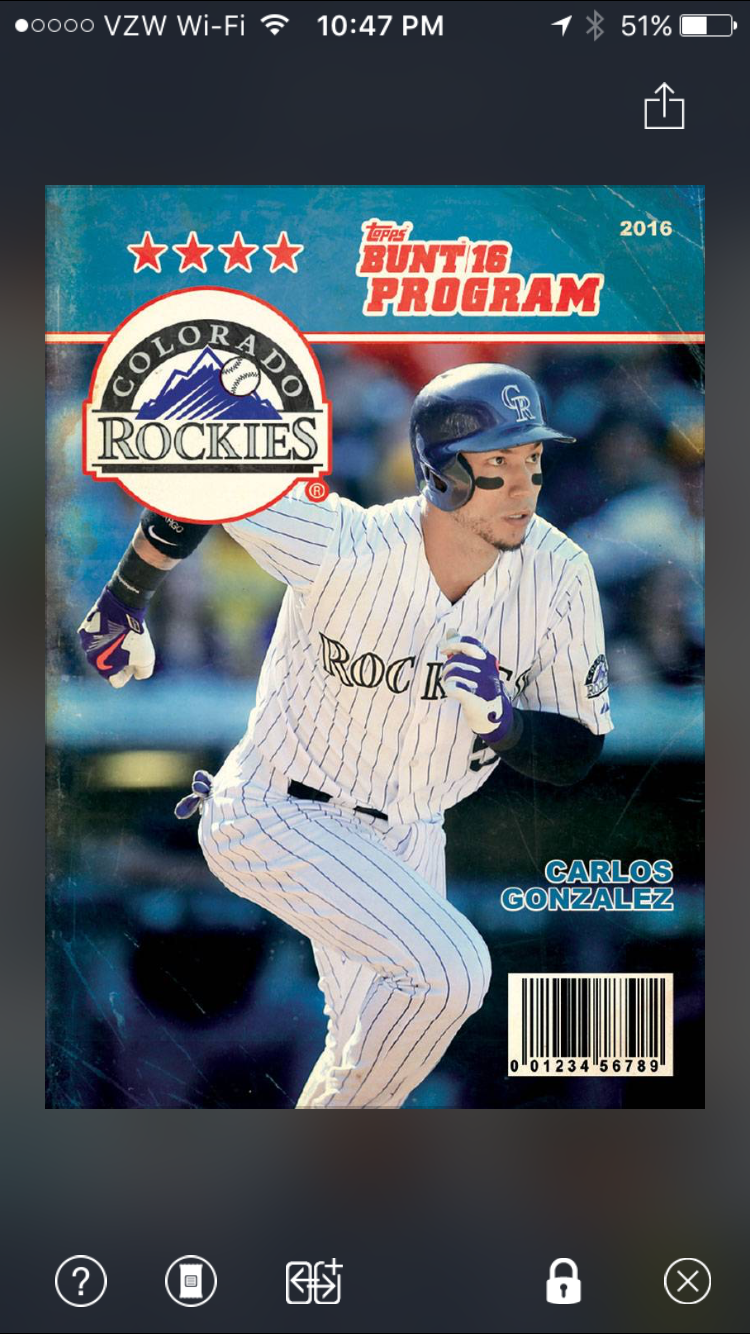
2016 Topps Bunt Programs #33,924 / #P-30 Carlos Gonzalez
Using that code I won from Sport Card Collectors, I was lucky enough to pull Carlos Gonzalez' card from the Programs insert set, which even has the same card number on the virtual back. It also has a Digital card number up in the 30,000 range (amazing how many digital cards they've released). The base cards of retired players have the same backs as their printed counterparts, but active players that can score points in the app's fantasy scoring system get the same card back as normal Bunt digital cards. Last time I posted a Bunt card, I was on an iPhone 4S with a different aspect ratio, and Topps was about 30,000 cards from designing this one.

I'm sure this makes a lot more sense if you've actually used the app. My collection of digital Pokémon is coming along nicely, too. 

2016 Topps Bunt Light Force #LF-8 Luis Gonzalez
The final (physical) insert card from the pack is dubbed "Lightforce", and I must admit that I don't really get the theme here. It definitely has sort of a spacey galaxy thing going on, and it seems to be color coded to the old Diamondbacks uniforms. Which is nice, because it looks like it could actually be a shot from the Hubble Space Telescope. 

After looking at eBay, it seems like all the cards from this insert set have the same color scheme, it just happened to coincide perfectly with Arizona's old colors. Which by the way, are light years (sorry) better than their current dark gray monstrosities. That link opens a PDF, by the way, in case you are still running Acrobat 6 on Windows 98 and are worried about program startup times.

I guess that tongue-in-cheek sentence above really does indicate that maybe, just maybe, digital cards aren't so crazy after all. It wasn't so long ago that it was quite a lengthy ordeal to open a PDF on an underpowered computer over a dial-up connection. But now I can go walk around outside and collect Pokémon, open PDFs in multiple tabs in barely more than the blink of an eye, have my car read me a text message, deposit a check through my phone, and now carry around on that phone the same cards that I put in my 9-pocket pages.

Welcome to the future.