Showing posts with label Fractured Set. Show all posts

Saturday, February 3, 2018

The Trading Post #115: Nachos Grande (Part 2: Rockies)

Let's say you're me and you run across a mid-1990s insert set that is completely new to you. Knowing my history, which master set do you think it might be from?

1995 Stadium Club Ring Leaders #9 Howard Johnson
If you guessed 1995 Stadium Club, you'd be correct.

I've written at length about how I keep running across various insert sets and subsets from 1995 Stadium Club, and apparently there's still more out there, because my initial spoken reaction to seeing this card was, "what the hell is this thing?"

I don't quite know where to begin, but the giant eagle grasping a baseball in its talons is as good a place as any. Even with the starburst, the championship rings, the stained glass look, and oh yeah, the baseball player, it manages to stand out in this crazy design. 1995 Fleer would be a footnote if someone made this a base set instead of just an insert set.

There are a whopping 40 cards to be found in this insert set, and this, obviously, is the first one I've seen. It's just as well, because I'd be concerned about some sort of chain reaction if I had them all in one place at the same time.

If you can break the spell this card holds over you and flip it over, you'll learn that Howard Johnson collected a few rings throughout his career, which began as a Tiger in 1982. I wasn't aware (and am not sure Topps didn't just make this up) that players earned rings for All-Star appearances and leading the league in various statistics. Howard Johnson, a Rockie only in the strike-shortened 1994 season, was a two-time All Star, and had a pretty solid 1991 season, leading the NL in RBIs and home runs, the latter stat with just 38. What this card neglects to mention, and what you certainly do earn rings for, is that Johnson was a member of two World Series-winning teams, the '84 Tigers, and the '86 Mets.

But I guess the eagle snatched those two rings away.

1999 Upper Deck MVP #69 Kirt Manwaring
As jarring as that card was, it's a bit jarring just to return to a bit of normalcy, provided by Nachos Grande in part 2 of his Season of Giving shipment. Granted, this Upper Deck card is missing their trademark hologram, but that's a minor thing compared to large birds of prey. It looks to me like catcher Kirt Manwaring (who had a cameo on a 1994 Dante Bichette card) got under this one a little bit, making it unlikely that it's the home run mentioned on the card back. That shot, his first one of the 1998 season, came on July 12th against his former team, the San Francisco Giants.

The photo is clearly from the 1998 season, based on that All-Star Game commemorative patch. In fact, that very All-Star Break took place less than a week before Manwaring's first of only two homers that year. But that was a night game, and Coors field looks far too sunny, even for a mid-July night game.

1998 Sports Illustrated Then and Now #70 Vinny Castilla
Turn back the clock another year to 1997, and you'll find the league-wide Jackie Robinson 50th Anniversary patch on Vinny Castilla's uniform. This one is from the same Sports Illustrated set that we saw with Larry Walker a few posts ago. However, Vinny Castilla didn't fare as well on the Killebrew-Brock-Robinson ratings as Walker did. Castilla earned four baseballs out of a possible five on Power and Fielding, classified as "Above Average". On Speed, he just got a middling three baseballs, only worth "Average". Castilla only stole two bags in 1997, so perhaps even that is generous.

I still don't have many from this set, but at least now I know they're not all horizontal.

1999 Private Stock #75 Edgard Clemente
The Giants and Rockies were at it again at Coors Field on September 25th, 1998, a game whose box score is on the back of this rarely-seen and slightly shiny Pacific card. Edgard Clemente, who had three partial seasons as a Major Leaguer, got his first career extra-base hit in that game, an RBI triple off of future Rockie Shawn Estes. The Rockies would go on to lose this game, but that early fall date in 1998 caught my eye.

I'm pretty sure I was in California when this game happened, possibly even watching it during dinner at a Northern California restaurant with my dad. Shortly after I started high school, he took me on a trip up the West Coast, starting in L.A., going north up the coast to the redwoods and wine country, and departing from San Francisco. I recall watching a Rockies/Giants game among a handful of Giants fans one evening, which must have been this game, since the other two in that series, which concluded the 1998 season, were day games. I recall a couple sitting behind us throwing up their hands in frustration at a particular play, and that very well could have been this RBI triple from Mr. Clemente.

Some say the sense of smell is the best sense at triggering old memories. For me, it's my sense of baseball.

1999 Fleer Tradition Warning Track #353W Mark Brownson
However, I have no memory of this Mark Brownson guy. The red foil tells us that he made his MLB debut in 1998. The red foil, in conjunction with the "W" in the card number and the "Warning Track Collection" seal in the bottom right, identifies this as a parallel, which I've seen only once before.

That debut game, interestingly, was a complete game four-hit shutout against the Astros. Unfortunately, lightning only struck once, as he appeared in just 11 games during the rest of this three-season career. At least he had some solid defense to back him up, as he never had to suffer watching an unearned run cross the plate.

1998 Topps Rookie Class #R3 Todd Helton
Moving along to rookie cards of Guys You've Heard Of, Todd Helton was appearing left and right in the Hobby during 1998. Topps gave him a card in 1998's Rookie Class insert set, a 10-card affair that looks very familiar to me, thanks to Travis Lee's card that I pulled long ago, one of the first Diamondbacks cards to make its way into my collection. Topps did a decent job selecting those ten players, also giving us Derrek Lee and Paul Konerko.

1998 Flair Showcase Row 3 #12 Todd Helton
Fleer went even shinier than Topps in 1998 Flair Showcase, a fractured set that I'll elaborate little more on other than to say this is the most common of four varieties. The redundantly named Flair Showcase Flair (Row 3) cards are easier to find than the even more redundantly named Flair Showcase Showcase (Row 0) cards.

When players are in the dugout, does that mean they're sitting in Row 0?

While pondering that deep thought, I read the back, which mentions Helton's time as a quarterback at the University of Tennessee, along with Peyton Manning and a guy named Branndon Stewart, who made his name at Texas A&M, though didn't go into the pros.

1998 Pinnacle Performers Swing for the Fences #30 Ellis Burks
If ever there were a perfect time to do a home run leader promotion, it was 1998. Following up their Swing for the Fences promotion in 1997, Pinnacle brought it back for '98, but unfortunately went out of business before McGwire and Sosa finished their record-setting season with 70 and 66, respectively.

If you can't keep the lights on while running a home run promotion in 1998, then perhaps the industry just isn't for you.

Ellis Burks, one of fifty players found in this contest, did not come close to McGwire or Sosa, hitting just 21 for the Rockies and later the Giants.

2013 Pinnacle #65 Carlos Gonzalez
After their disastrous 1998, it would take a long time before Panini would bring the Pinnacle name back from the dead, though that was just for 2013. Panini has focused most of its efforts on bringing back Donruss since then, but I wouldn't mind seeing this black-bordered set around a bit more often. Besides, batting helmets these days have so many vents and contours it's not as blatantly obvious as it used to be that it's an unlicensed set.

The longtime Rockie still doesn't have a place to land in this year's strange offseason, and the word "strike" is already being thrown around thanks to the extreme lack of free-agent signings. I'm just going to stick my fingers in my ears and pretend I didn't hear any of that. But on the bright side, bullpen carts are possibly going to make a comeback.

2003 Topps Heritage #270 Aaron Cook
Pretty much every trade package has something retro in it, usually Topps Heritage. However, 2003 Heritage isn't one I run across very often, despite the '54 design being one of my favorites ever. It's surprisingly tough to find, and I only have about two pages' worth. The black-and-white action shot is tiny, but you can still see a glimpse of the Rockies' 10th Anniversary patch on Aaron Cook's pitching arm.

I'm curious if the green-and-white backs on 1954 Topps contributed significantly to my love of green cards, because they're great. Even the cartoons have such a distinctive art style that I hesitate to call them cartoons. Really, they're more like comics. The 1930s Superman style is quite visibly different from the cartoony look that was common in the '70s and on (perish the thought) Topps Big.

2007 Upper Deck Goudey Red Backs #199 Brad Hawpe
Speaking of comics, what we now recognize as the first modern comic book was published in 1933, the same year as the original Goudey set. Upper Deck followed Topps' lead with the Allen & Ginter brand and brought back the famed 1933 set, right down to the accurate 2-3/8" x 2-7/8" dimensions. The hologram was of course new when UD brought it back, as were the Rockies and about half the other big league ballclubs.

Brad Hawpe doesn't make it to the blog very often, which is surprising, since he was a key player in the 2007-2009 era when the Rockies were doing well in the playoffs. He spent seven seasons in Colorado before keeping his career going with a few other teams and retiring in 2013. The right fielder was a fan favorite, and the PA announcer at Coors Field somehow managed to make his name sound like a single syllable when it was his turn to bat.

2003 Fleer Box Score #87 Larry Walker
Here's another new-to-me set, 2003 Fleer Box Score. Fleer was cranking out whatever they could in 2003, and not giving a whole lot of thought to the design. This card of Larry Walker is nice enough, but you have to flip the card over to get the actual box score highlighting Walker and his three-homer, eight-RBI day in St. Louis (note to BBWAA: that's a road game) on April 28th, 1999, although we don't get the equivalent box score for the Cardinals.

The front is graced by a random box score between the Pirates and the Brewers, neither of whom Walker ever played for. I assume that appeared on everyone's card, much like how the 2003 Fleer Authentix set had a section map of Yankee Stadium on every card. It's probably the first and last time you'll see Rob Mackowiak's, Scott Sauerbeck's, and Brian Boehringer's names on this blog. Josh Fogg was here once before, though, and he was a Rockie for three seasons, so he may yet appear again.

1998 Fleer Tradition #340 Larry Walker TT
Larry Walker had more than enough multi-homer games to give Fleer plenty of material, such as Tale of the Tape, a sparkly subset from 1998 Fleer Tradition. The Fleer logo has a similar look to Electric Foil parallels from 2014 Stadium Club, and it would be just as hard to spot if not for the same sparkly finish on the giant white banner.

The multi-homer game in question is from August 31st, 1997, during Walker's MVP season. It was just their second interleague game at home against the Oakland A's, one of five teams I still haven't seen, though I plan on remedying that at the end of July. Walker took Mike Oquist deep twice, chasing him from the game before he recorded an out in the 5th inning. Fleer tells us that the longer of the two went a whopping 493 feet, which remains one of the longest ever hit at Coors Field, and the first one to end up in the upper deck (odd not to capitalize that).

2012 Bowman Chrome #156 Michael Cuddyer
Chris threw in quite a bit of Bowman in this package, but it took a star rather than a prospect to really capture my attention. That and the shiny Chrome brand. Michael Cuddyer is listed as an outfielder, but he played quite a few games in Colorado as a first baseman, paving the way for Justin Morneau and Mark Reynolds in future seasons. And even for an established veteran who had just made his first All-Star appearance, Bowman, in true form, reached way back to his high school days for one of the tidbits on the back. We're told that he was Gatorade National Baseball Player of the Year, which, upon further research, is not quite correct. Cuddyer did indeed win such an award, but it was the Gatorade award for the state of Virginia, not the National award.

2015 Topps Rainbow Foil #208 Wilin Rosario
We'll wrap up this year's Season of Giving with Baby Bull, aka Wilin Rosario. You can't tell from the scan, but this is a shiny card. It's not a Chrome card, so it can't be a refractor, but it looks like one. That means it must be the Rainbow Foil parallel, which I haven't seen in a while, and frankly, I sort of forgot about them.

I've yet to pick up any 2018 Topps, but I've seen plenty on the blogs. Point being, it's a bit strange to see a Topps base card with borders, as Topps is on their third straight year of embracing full bleed. I wouldn't say the design looks dated; in fact, it's continuing to grow on me. It's just noticeably not the latest and greatest.

I'm still recovering from that Howard Johnson card, but I appreciate Chris taking the time to grow my collection and further expand my knowledge of the enigma that is 1995 Stadium Club.

Perhaps the eagle and all those championship rings are foreshadowing of the upcoming Super Bowl.


Tuesday, April 5, 2016

The Trading Post #59: Play at the Plate

I can barely keep up with all the #SuperTrader packages stuffing my mailbox. Well, I can barely keep up with anything, but that's a whole different story. Play at the Plate is pretty active on Twitter, and also a longtime veteran of the Cardsphere. He's clearly no stranger to trading, as he put together a pretty nice bundle of cards, starting with that rarest of All-Stars, a Rockies pitcher.

2004 Topps Gold #257 Shawn Chacon /2004
Chacon is obviously pitching in AT&T Park. Or maybe it was SBC Park at the time. Whichever Baby Bell owned naming rights to the stadium at the time, that's where Chacon is pitching.

This is a gold parallel marking the milestone that was Topps' fifty-third year. Not exactly a nice round number, (a prime, in fact), but this was when Topps was still using actual gold lettering on serial numbers for this set. They moved to a plain black quite a few years ago, and dropped them entirely from Opening Day the past couple years.

Whether base or parallel, this 2004 card has a tiny foil outline in the lower left, duplicating in miniature the actual card's photograph.

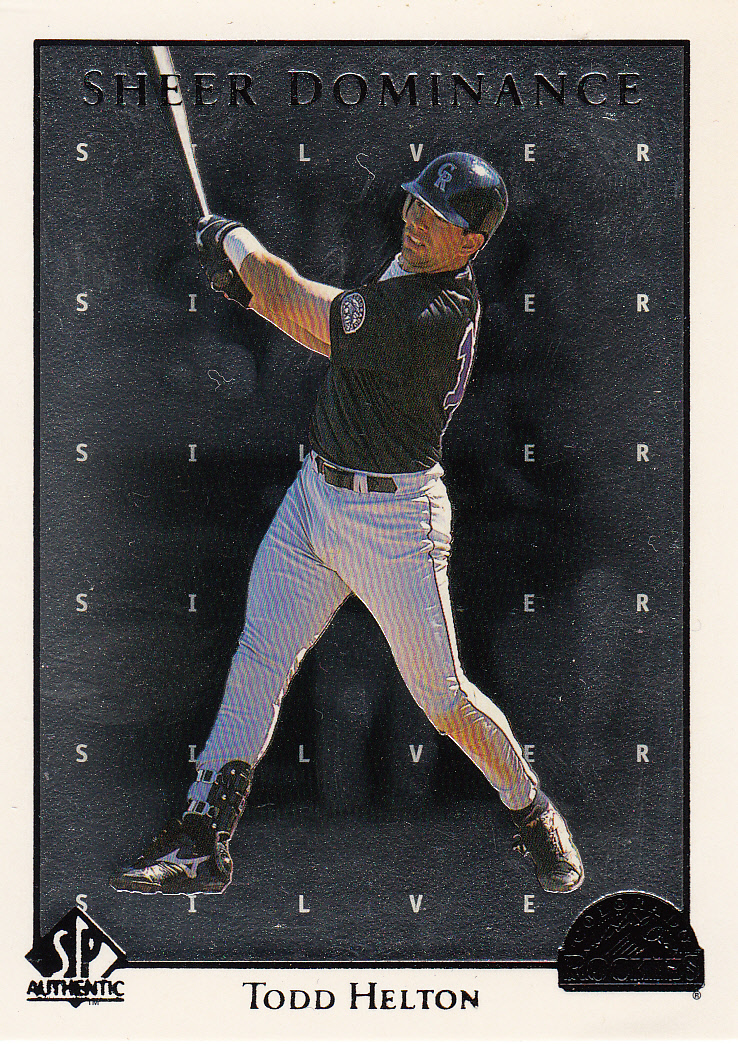
1998 SP Authentic Sheer Dominance Silver #SD27 Todd Helton
This shiny Todd Helton card doesn't have exactly the same treatment in the corner, although it does have a pretty bold-looking black Rockies team logo. Basically black foil, if there is such a thing. I assume that since this has "silver" lettering in the background repeated several times, that there are also Gold and maybe even Platinum parallels.

After a trip to Beckett, turns out the rarest of the three varieties is actually Titanium.

1999 Fleer Tradition Warning Track #123W Mike Lansing
I had to look this one up at Beckett, too. I see a fair bit of Fleer Tradition come across my desk, but I'd never heard of the Warning Track Collection before. It's just a one-per-pack parallel, so they can't be too scarce, but this is definitely a first for me.

Rockies 2B Mike Lansing has some great wraparound shades on this photo, but what I really like about this card is that the card number is different from the base set! Fleer added a "W" after the card number, clearly indicating that it's something unusual. I'd really love to see Topps do that, and the new-for-2016 "OD" prefix on Opening Day card numbers bodes well for this element finding its way back into the Hobby.

1998 Topps Stars Gold #131 Todd Helton /2299
I blogged about 1998 Topps Stars once before, and like Ellis Burks' card, this one has lots of texture on the front. Like that SP card above, this one comes in three different levels of scarcity, this time matching the Olympic medal metals—bronze, silver, and gold. There's also a pretty rare Gold Rainbow variety, much scarcer than this one-of-2,299 example.

There's even a trivia question on the back, mentioning Helton's QB days at the University of Tennessee, and asking which then-active American League first baseman was a kicker for the University of Nebraska. Unfortunately, we have to look at card #132 to find the answer. I know of absolutely no one who has completed 1998 Topps Stars, so I'll just have to Google that one.

Survey says...Darin Erstad. Actually I knew that at one point. My high school psychology teacher was a Cornhusker and asked this question in class one day, even giving us the clue that he was an Angel. I incorrectly guessed Chad Curtis. Sorry, class. I don't think we got to leave early that day.

Incidentally, if you own card #130 in this set and have been wracking your brain for two decades for the answer to whatever trivia question your card contains, the answer is Jim Sundberg.

2000 Topps Tek Pattern 2 #23-2 Larry Walker
And here's a set that answered a question no one asked (automotive journalists love that phrase), Topps Tek. I've ranted about the sheer insanity of fractured sets before, so I won't rehash that again. But any trade that's heavy on the crazy late-1990s basically turns into a research project. I've consulted Beckett and Google plenty so far in this post.

Topps Tek actually reeled it in a bit for 2000, offering only 20 possible background variations, compared to earlier years that had up to 90. Still, completing a set like this would be an exercise in madness. It reminds me a bit of those gigantic jigsaw puzzles seen toward the end of Citizen Kane.

1998 Topps Gold Label Class 1 #81 Todd Helton
My fellow supertrader threw in a few cards from another fractured set, 1998 Topps Gold Label. I've seen him pepper the cardsphere with Topps Gold Label, and I benefited too.

These always reminded me of 1993 Flair. Soft focus, really thick card stock, thin foil lettering. Pretty much the only difference is the rainbow finish.

1998 Topps Gold Label Class 2 Black Label #81 Todd Helton
Well, that, and the set's near incomprehensible numbering scheme.

Does this one look familiar to you? It's sort of the same card. But not. It's kind of like a parallel, but it isn't entirely so. It has the same card number (and the same back), but this is a "Class 2" version of Helton's card, offering us a different foil color and a different action shot (baserunning instead of fielding). But the "Black Label" makes it a parallel of Class 2 (a color actually found in all three classes), whereas Class 2 itself is more of a variation. And the Black Label only refers to the logo, not the player's name.

To sum up, it's definitely a parallel of something that is a quasi-parallel.

I don't know. It's late. I ought to hire a theoretical physicist to explain this thing.

Also, it took me a really long time to notice that the foreground shot (the smaller, post-swing photo) doesn't change between classes.

1998 Topps Gold Label Class 3 #81 Todd Helton
And let's go ahead and print up a third class while we're at it. Here we have a batting shot to go along with the mini-batting shot that was already there. And of course there are varying levels of scarcity to go along with all this. Topps was still fleshing this idea out in 1998. Within a couple years they actually realized it would be a good idea to label which Class you had on the back.

I know we all gripe about how many colored parallels there are these days, along with all sorts of things that make it hard to please us collectors, like recycled photos, general design elements, under-representation of our preferred team. But for me, the key question this: is it easy for me to understand what I am holding? Topps' photo variations and Bowman are key offenders here. On their own, photo variations are an OK concept, but unless you know the base set like the back of your hand, it's pretty tough to know whether you have a variation or just a common card. More often than not, they could probably just make the base set as a whole better by just using the variation as the primary photo. And don't even get me started on all those Bowman Chrome Prospect cards.

I know I said I wasn't going to rehash all the fractured set nonsense. But it's such a convoluted thing that I can't help but try to talk it out, even for my own understanding.

Regardless, they're nice-looking cards, and I more-or-less have a rainbow of these Helton cards thanks to this trade.

But the late 1990s were clearly a crazy time. Y2K was just around the corner.

On a final note, Opening Day is no longer around the corner! Every team has a game under its belt now, including the Rockies with a 4-hour marathon 10-5 win over Zack Greinke and the Diamondbacks. Not great for my Fantasy team, but Trevor Story is on pace for 324 home runs this year, after hitting two home runs in his first three Major League at bats!

And Happy Birthday, dad!