Showing posts with label SuperTraders. Show all posts

Monday, July 25, 2016

The Trading Post #72: Off Hiatus Baseball Cards

This marks the second time that Tony at Off Hiatus Baseball Cards has sent me a trade (supertrade?), and based on what I got from him last time, he clearly has a fondness for Topps Minis.

2012 Topps Mini #219 Jordan Pacheco (RC)
I got a few 2013s in our previous trade, and now I get to add to my 2012 collection. Jordan Pacheco, one of the Rockies' homegrown players, was one of a crop of exciting young stars the Rockies had a few years ago. He was released in 2014 and is now with the Reds, but as Todd Helton's retirement neared, Pacheco and Josh Rutledge were both candidates to take over at first base.

The Rockies are on the road in this one. Possibly they're in San Francisco, based on the spot of orange on the fan's hat. But his runny eye black indicates this is later in the game on a hot day, and a good illustration of Pacheco's hustle.

2012 Topps Mini #154 Ty Wigginton
Ty Wigginton only spent a year with the Rockies, holding down the hot corner until Arenado could take over a couple years later. Wigginton was a journeyman, playing with eight teams in his twelve-year career. He played for Tampa Bay when they were still known as the Devil Rays in 2006 and 2007. A year after Wigginton's departure, they dropped the "Devil" and just became the Rays, launching themselves into the World Series that very same season. They lost to the Phillies, but it marked the second straight season in which an expansion team won their first and so far only pennant. Of course, the Rockies were the team do to it the year prior. But both the Rays and Rockies are still chasing their first championship.

Also, whenever I see "TBD" as the team abbreviation on Baseball Reference, I'm always thrown off for a second until I remember they're referring to the "Devil Rays," and not that his stats from a decade ago are "To Be Determined."

2012 Topps Mini #140 Troy Tulowitzki
Troy Tulowitzki is a common fixture around here, and he got a great Coors Field card in 2012 Topps, acrobatically turning two, and we even get a Mark Kotsay cameo, who was then on the Milwaukee Brewers. Like Pacheco, Tulowitzki is sporting some eye black, but his is in pristine shape.

I tried dating this card, likely to a four-game set just after the 2011 All-Star Break. But Mark Kotsay mostly came off the bench in that series, and the only possible candidate seems to be a weird fielder's choice on July 14th, 2011. The play doesn't seem to describe this photograph just right, but I can't find any other candidate play that places Mark Kotsay anywhere near second.

2012 Topps Mini Gold #431 Guillermo Moscoso /61
I have precisely zero recollection of Guillermo Moscoso. He was a Rockie for 2012 only, mostly in middle relief, though he did start three games. He was out of baseball a year later, but he was around long enough to get a card in a Topps base set, impressive for a Rockies pitcher with minimal name recognition.

Topps Mini parallels the main set, and that means he gets a gold parallel, numbered to just 61 copies in this fairly scarce set. This Venezuelan originally came up in the Tigers organization, but only appeared in the Majors for teams in either the AL West or NL West. He managed to get two hits in his career, both as a Rockie. One of them was even a double.

I guess he was inspired by Todd Helton.

2014 Donruss #55 Michael Cuddyer
That brings us to the second set included in this trade, 2014 Donruss. Former Twin Michael Cuddyer looks to be playing in San Francisco as well, judging again by the orange logo on a spectator's cap. Technically that's a logo, Panini. I guess it's so out of focus that it's not easily recognizable, or could potentially be confused with an Orioles cap.

Cuddyer spent three years as a Rockie from 2012-2014, before playing one final year as a Met. "Cuddy", as the Rockies TV guys liked to call him, had some of his best seasons as a Rockie, even winning the NL batting title in 2013, the same year he had his second of two All-Star appearances. I can't quite recall, but it's very likely that I sent my 35 votes his way that year.

2014 Donruss #29 Troy Tulowitzki DK
If it's Donruss, that means Diamond Kings are likely to be lurking nearby. The 2014 set pops up here on occasion, but this is the first time I've used a Rockie from that set for a post. Diamond Kings from 2014 are part of the base set, although they're short-printed. Perhaps no one really cares, since Panini's resurrection of Donruss doesn't seem to be high on anyone's favorite list, but they're common enough where I've gotten at least two via trade.

Two I've blogged about, that is. All these trades throughout my blogging career have just been going into a nearly-full 5,000-count box with little organization. There are probably more in there.

Today's Diamond Kings are a bit different from the overproduction era. Other than the short-print thing, they aren't painted anymore, though they still have sort of a painted look. Early Diamond King subsets were 26 cards at the beginning of the set (plus a checklist for card #27), but the subset has ballooned to 30 cards to coincide with two rounds of expansion.

I wouldn't be opposed to a couple more teams, perhaps to match the 32 teams in the NFL. The NHL and NBA, like Major League Baseball, also have 30 teams, albeit with a much different playoff and division structure.

Where else would such a team go? I can think of a few candidates. Maybe a booming tech hub like San Jose, Portland, or Austin. I wouldn't be opposed to Canada getting a team back. Maybe a return to Montreal, or even another team in the west in Vancouver. As diverse as baseball is, it might even make sense to expand into Latin America, such as the Dominican Republic, Puerto Rico, or even (gasp!) Cuba.

Wouldn't that be something?

2009 O-Pee-Chee #354 Manny Corpas
Panama, where Manny Corpas hails from (along with countryman Mariano Rivera), is probably a bit far away to be a realistic candidate for expansion. But players from all over the world come to play in the Majors, including this occasional closer, who is looking quite alone out there on the mound. Unlike Moscoso, I do remember Manny Corpas, who spent almost his whole career with the Rockies, other than a one-year stint with the Cubbies.

The Cubs bullpen is certainly in the news today, as they traded a handful of prospects to the Yankees for fire-throwing closer Aroldis Chapman. Chapman's fastballs regularly push 105 mph, and MLB had to install a "Chapman Filter" on the fastest-pitches-of-the-season page just to be able to show anyone besides him on the list. Turning that filter on pretty much just displays pitches from a Braves rookie named Mauricio Cabrera, who has appeared in all of twelve games in the Majors.

Amazingly, Chapman has avoided Tommy John surgery, despite his superhuman fastball. And according to an interesting thought experiment, he could theoretically throw a baseball fourteen giraffes high.

Corpas never threw that hard, but he played at the right time to get a card in one of Upper Deck's final throwback efforts, the well-loved 2009 O-Pee-Chee.

2009 O-Pee-Chee Black #596 Dexter Fowler
So did Dexter Fowler, then a rookie, now a Cub who has a real shot at a World Series championship this year, especially with Mr. 105-mph now closing out games in the Windy City. This is a one-per-pack Black parallel, and I definitely prefer these to the white-bordered base cards.

The Black parallels have quite a history, as UD's original idea for the one-per-pack parallel was a card styled nearly identically to 1971 Topps. Topps didn't like that one bit, and successfully sued for an injunction. UD complied and just printed up these black parallels, still a nod to 1971 Topps, but not a direct copy. It was the beginning of the end for Upper Deck, who lost their MLB license the following year and ended up in more legal hot water.

It's an interesting set to get from Tony, who happens to be a lawyer. But he's also a SuperTrader, finding some sets you don't see every day.

I'll note that none of the players in this post are currently with the Rockies. Most are retired by now, but a few are still swinging bats around the league. They've cleared the way for the farm system, as longtime prospect David Dahl finally got the call-up tonight at Baltimore, getting a hit and scoring a run in his first Major League game. When you add that to Jon Gray, who settles down very well after the first inning, star rookie Trevor Story who currently leads the NL in home runs, and a talented prospect or two from the Tulowitzki trade, it looks like the Rockies have some promising years ahead.

Tuesday, April 26, 2016

The Trading Post #63: Cooperstown Exit 3:16

Like Andy at Ain't Nobody Got Time for Cardboard, Brett at Cooperstown Exit 3:16 is a newcomer to the Cardsphere. He represents the Nationals in the #SuperTraders group, and though he didn't have a blog when the group was conceived, he started one up just a couple months ago. Already he's making his presence known in the community.

2015 Topps Archives #38 Carlos Gonzalez
Brett started off the package with a few cards from Topps Archives, including this 1957-themed CarGo card. Like most Archives cards, this has a distinct smooth matte surface, definitely not one of the glossy cards we've been seeing for a couple decades, but smoother and higher-quality than just standard cardboard.

This is definitely a photograph of Gonzalez, but somehow it looks ever so slightly painted, though nowhere near a Gypsy Queen card. Perhaps it's the unusual surface that gives it a different look.

2014 Topps #290 Chad Bettis (RC)
Of course, Topps base cards usually find their way into these trade packages, and though I don't often feature them, I've always liked this 2014 Rookie Card of Chad Bettis. Bettis has been a bright spot in the Rockies' short season, with a perfect 2-0 record so far. Tyler Chatwood has as many wins, but also has two losses and got off to a rough start last Saturday against the Dodgers.

By now, this design is very familiar to me. 2014 marks the year that Infield Fly Rule debuted, and I was highly active on Topps Bunt that year. "The Wave Set" (or was that 2010?) wasn't universally loved, but the sets I spend the most time with tend to be my favorites. Whether one causes the other, I can't say, but I'll be able to place this one in the correct pile with barely a glance.

1994 Score Samples #8 Andres Galarraga
1994 Score is also an easily recognizable set, partially because they're the only ones to ever use a dark blue border like this, but also because it fit easily into my budget as a ten-year-old. And there were Rockies cards in it, like this Galarraga, a card I could almost reproduce from memory. I'd probably miss the batting glove he's holding in his left hand, but I'd know this card anywhere. 

Except, of course, for the large black "SAMPLE" lettering, which appears front and back. Never saw one of those before. These pop up on occasion, though more often on Leaf/Donruss products, and occasionally Topps. But Pinnacle/Score was in the preview game too, providing cards for dealers to display. They're a relic from a time when the industry was hot, and the real thing had to be kept under lock and key.

Call it a Beta version, to use a modern tech term. I rarely see significant changes from a preview to a final release, but there are occasionally subtle differences. The card back of this sample card feels rougher than a standard 1994 Score card from the actual print run. 1994 Topps Pre-Production cards had the same basic design as the final product, but the fonts on the back and the background colors on both sides were changed.

1994 Topps #180 George Brett
We all know how awesome George Brett's card from 1994 Topps is, and that's the second time I've used this scan. But the Pre-Production example is rather different.

1994 Topps Pre-Production #397 George Brett
It's clearly the same photo, but cropped much differently. Making a card horizontal is often nice, but doing so here takes away the legendary status of this card. The action is still there, but the ambiance of Kauffman Stadium is completely lost, along with the information we need to specifically date this photo. If Topps went with this version, I doubt we'd still be talking about it today. The lack of a nice green behind the player's name also makes the final version less appealing to my eye.

1995 Select Certified #68 Dante Bichette
The cards just keep getting shinier and glossier as this post evolves. Pinnacle made some really shiny cards in the mid- to late-90s. Some even seemed to have a mirror finish. This one reflects back a slightly distorted image (unlike the perfect reflection I saw in the blue paint of an Acura NSX many years ago), but it's an eye-catching specimen. The gold border around Bichette's outline accentuates it even more.

Rather than consolidated statistics, the reverse breaks out his performance by team in the strike-shortened 1994 season. That means we get a tiny logo of the other thirteen NL teams. Yes, this was before Interleague play, and before the Diamondbacks. Bichette loved to face the Cardinals that year, racking up 20 of his 95 RBIs, and 5 of his 27 home runs. 

2006 Artifacts AL/NL Artifacts Blue #NL-TH Todd Helton Jsy /325 (MEM)
The breadth of the Rockies existence was well-represented in this trade, concluding with a serial-numbered swatch relic of Todd Helton! It's a fairly rare solid purple (matching the uniforms the Rockies are wearing as I write this), though not matching Helton's photo on this Upper Deck card. As it's a UD relic, that means I get another tiny printed signature of Richard P. McWilliam on the back. And a nice blue serial number on the front.

You can see it quite clearly on this particular photo of Helton, but this Artifacts card also lists the player's uniform number, always a nice touch. It's one of the pieces of information cluttering up the "loincloth" on 1996 Donruss, but the fact that the Rockies retired #17 in Helton's honor makes it just a bit more special.

Thank you, Brett, and welcome to the Cardsphere!

Sunday, April 17, 2016

The Trading Post #61: Night Owl Cards

Well, it finally happened. I completed a trade with the great Night Owl Cards. He is a legend in our community, and I don't know of another (active) blogger with such universal appeal. Granted, as a Dodger blogger, he's not much of a fan of the rest of the NL West, but he nearly always has interesting things to say about our little hobby. And I know no bigger fan of 1975 Topps.

1995 Flair #344 Dante Bichette
1975 predated the Rockies by quite some time, and even Hockey's Colorado Rockies by a year, the franchise that is now the New Jersey Devils. But baseball's Rockies have been around for long enough to have a wealth of great baseball cards. And with the rise of retro sets, finding Rockies on old designs isn't that tough anymore, as we'll see later.

The more I look at these Flair cards, the more I see where Topps Gold Label got its inspiration. In fact, Flair pretty much singlehandedly invented this type of super-premium card printed on thick card stock. Topps Museum Collection, Triple Threads, Panini Immaculate Collection, and plenty of others can trace their lineage to this brand right here. 1995 was a couple years into Flair's run, but they had the formula down by then. This one's still thin enough to fit in a standard top-loader, but it's as sturdy as a sheet of metal compared to its competition in 1995.

2009 Upper Deck Icons #41 Garrett Atkins
Icons is one of the numerous sets UD released throughout much of the '00s, but this is the first time I can remember seeing it. They were certainly going after player collectors with all those products, but with more innovation and product development than just a bunch of colored parallels. UD became big on color-coding once they exhausted their supply of copper, and that much purple behind Atkins' batting helmet strongly reinforces that this is a Rockies card. Atkins looks a little late on this swing, but he's clearly swinging for the fences here.

That was something I remember the Rockies doing a lot of in their last couple playoff appearances, especially once they reached the World Series, and in 2009. Later in the game, everyone who got up to the plate was clearly trying to hit a home run, and it usually resulted in a lot of strikeouts. Just putting the ball in play and getting guys on base is enough, as the Padres reminded the Rockies of last weekend, scoring 29 runs in the first two games of the series.

2004 Fleer Ultra #293 Vinny Castilla
Night Owl sent cards from all throughout the Rockies' existence, including this one, from Vinny Castilla's second of three stints as a Rockie. Vinny looks like he just hit one out, and we can see catcher Charles Johnson (and I believe Royce Clayton on the left) waiting to congratulate him at the plate. Castilla hit over 40 home runs in three straight seasons in the early years of Coors Field, and he was always welcomed back into the fold when he rejoined the Rockies in 2004 and 2006. I saw him pinch hit in 2006 against the Nationals (for which I had some awesome seats behind the Nats' dugout) in one of his last games in Denver.

2002 Upper Deck #720 Larry Walker
Here's more post-Run action at the plate, as Larry Walker calmly fist-bumps his teammate. Looks like that's a Cardinal in the visitor's dugout, which gives me a clue. The Rockies hosted the Cards six times in 2001, but the only game in which Larry Walker hit a home run against them was on Opening Day, April 2nd, 2001. It's as good a guess as any.

But now I'm second-guessing myself, since Walker doesn't have batting gloves on. More likely he nonchalantly trotted home from third on someone else's extra-base hit.

By the way, that's a fairly rare occurrence for the Rockies, to begin the season at home. more often than not, especially in recent seasons, they open up on the road and come back to Coors for a weekend series.

1993 Leaf #312 Alex Cole
There were lots of 1993 Leaf cards in here, including one of Night Owl's favorite non-Dodgers, Alex Cole. He spent the 1993 season as a Rockie before moving back to the American League. He was more of a contact hitter than a power hitter, having hit only seven home runs in his career, none of which came in a Rockies uniform. He was well-known for his goggles, and chased down lots of long fly balls in Mile High Stadium.

1993 Leaf #312 Alex Cole (Reverse)
We get a shot of the Denver skyline on the back, one of my favorite features of 1993 Leaf, a set that appears here quite often. Though not as breathtaking as the snowy Rocky Mountains found on other 1993 cards, it's a nice photo of my home city (or at least my home Metro area). That is Republic Plaza on the right, the tallest building in Denver. It's among the tallest buildings in the entire Western USA, not counting the cities on the Pacific Coast.

The skyline in Denver has changed quite a bit in the last few years. Coors Field was still under construction when this was printed, and looking at an aerial photo from 1993's home opener (also a season they started on the road), you can see that Denver has grown significantly since then. So has satellite mapping technology, for that matter. McNichols Arena and the old Mile High are gone, but Coors Field, the Pepsi Center, an amusement park, an aquarium, an expanded transit hub, residential high rises, and lots more have gone up since 1993, with more under construction.

1996 Score #74 Vinny Castilla
I can't remember an action shot with more displaced infield dirt than this. Deion Sanders was a force of nature, and it was a good idea for Vinny Castilla to wear eye-shielding shades here. Score used the torn paper look in the upper left just a year after Topps did something similar for their own border in 1995. With photography like this, it's a shame Score didn't stick around longer. Perhaps it's the next brand that Panini will reinstate.

1996 Pinnacle #107 Walt Weiss
Walt Weiss sure had a lot of double play cards! Seems like everyone spent years trying to recreate his 1991 Topps rookie card. Here's another, with Jason Bates and an unidentified Cub making cameos.

In all these years of looking at 1996 Pinnacle, I never noticed the tiny silhouette of a batter in the center of the gold pyramid. And I didn't even need my magnifying glass to finally spot it. I pulled out my 1996 binder and confirmed that they all seem to have it, even the pitcher cards. It never ceases to amaze me the things I still manage to unearth after a lifetime of collecting.

2008 Topps Update #UH286 Aaron Cook AS
Like Shawn Chacon, Aaron Cook is one of just six pitchers to go to the All Star game in a Rockies uniform. Though the AL ended up winning in 2008, as they usually do, Cook pitched three solid innings of relief, giving up a few walks but no runs.

Since the early 1960s, the National and American leagues alternated the host city of the All-Star Game until 2007, when the Giants hosted a year after the Pirates. This was done to ensure the All-Star Game in 2008 would be held in Yankee Stadium, its final year of existence before being replaced. In that research, I learned that there were two All-Star Games each year between 1959 and 1962. My first thought is that they played one on each coast to accommodate the teams that had recently moved out West, so players wouldn't have to schlep out to the East Coast for a single exhibition game. But the real reason turns out to be pretty dumb.

And that alternating trend will be broken for the foreseeable future, as NL parks are scheduled to host through 2018, marking four consecutive years including last year in Cincinnati. I don't know if that's because the AL always seems to win and they want to level the playing field a bit, or just because the NL has been building more new stadiums lately.

Probably the latter.

2008 Topps Heritage #548 Glendon Rusch
There were a few retro cards in here, including this Topps Heritage card recreating the 1959 design. Rusch's photo here is very fuzzy, either taken out of focus, or more likely blown up from a low-res image. Maybe they did that deliberately to better make it look like a 1959 card. But I've seen better photography on cards. Even 1959 originals, like a Robin Roberts card I've had since I was a boy.

2015 Topps Rainbow Foil #680 Nick Hundley
Though he just got placed on the DL for a quick seven days, Nick Hundley has been the Rockies' starting catcher for most of the season so far, and after spending most of his career as a Padre, he surely knows his former NL West competitors well. Catchers are smart fellows. Maybe even smart enough to spot an obvious Photoshop job like this. Topps has kept up the rainbow foil parallels for a couple years, and I've ended up with most of the 2015 Rockies via trades and card shops by now.

1995 Upper Deck Minors #101 Neifi Perez SH
This last one made me do a double-take. I was completely certain that Neifi Perez never turned an unassisted triple play. Tulowitzki has, but not Neifi. Then I took a closer look and saw his California League All-Star Game jersey, and realized it must have been in the minors! I had never known that. This event did not occur in the Minor League All-Star Game as pictured, but it's an interesting bit of trivia regardless.

From some Minor League trivia to a tiny detail in a sea of gold foil, my first trade package from #SuperTrader Night Owl expanded my knowledge quite a bit.

Monday, April 11, 2016

The Trading Post #60: The Junior Junkie

Shortly before the birth of his son, The Junior Junkie cluster bombed the Cardsphere with a huge stack of trades. Clearly he has his hands full with the new addition, as his blog has been quiet the last couple weeks. Congratulations to him and his family on a healthy baby boy!

We might not see much activity from this #Supertrader for a while, but I did get a nice stack of cards from him, starting with this partially transparent Todd Helton card:

2013 Pinnacle Clear Vision Hitting Single #59 Todd Helton
It's a lot more silver than it looks in the scan.

I saw that giant Pinnacle logo in the lower right, and at first glance, I thought it might be from their then-final 1998 release. But Helton didn't have a goatee then, and the copyright date says 2013. I guess I didn't realize that Panini resurrected the Pinnacle brand, but that only lasted a year. 

The "single" lettering in the transparent area leads me to believe this is probably the most common in a series of parallels. Sure enough, Beckett confirms this, with Double, Triple, Home Run , and 1/1 Cycle varieties listed.

Flip this card over and the clear cutout section looks a lot like the State of Illinois. And that font they used for "Single" looks a lot like the old United Airlines logo. This card does have a 1990s feel, reminding me of those see-through Skybox E-X 2000 cards from 1997, not to mention Pinnacle of that same year. And you don't often see that much gold foil anymore, at least not all in one spot.

2016 Donruss #103 Charlie Blackmon
Panini is definitely looking to the past to create their new designs, as I can't really see anything other than 1991 Donruss in this design. Also a bit of 1989 Topps in the two rounded border corners. Just like how the tiny baseballs of 2014 and 2015 Donruss look pretty much like the 1987 set, the slant of the background design mimics 1991, though without all the random colored lines and dots and squiggles. I haven't blogged about that set before, but it might be the most overproduced set in history, so you shouldn't have much trouble picturing it. The backs are standard Donruss too, though they used a pleasant sand color, which is a nice backdrop for the black text.

1998 Crown Royale #50 Ellis Burks
With all this talk of older designs, there were actually a few older cards in here, including a "princess card" of 30-30 man Ellis Burks. There's a glimpse of the Rockies' 1998 All-Star patch, but the giant gold die-cut crown pretty much steals the show. The back points out that he started the 1998 season with five home runs in his first eight games.

Nice, but not quite Trevor Story numbers.

1992 Upper Deck Gold Hologram #710 Ryan Turner
Though he never progressed past AA, Ryan Turner was the first-ever player in the Rockies organization. We see the pre-inaugural Rockies logo that was never used on the field, as well as a very Ted Kluszewski-style sleeveless shirt. The back talks about the bidding war between the Rockies and Marlins for Turner, as well as the expansion draft, scheduled for November 1992.

What makes this card more special is the rare gold hologram. Unlike most gold parallels of the day, this was not a one-per-pack treasure. It was only found in factory sets. I've run across a few like that, which always slightly disappoints me. Somewhere out there, a Factory Set is missing its Ryan Turner card.

1999 Topps #442 Matt Holliday / Jeff Winchester (RC)
Like Ryan Turner, Jeff Winchester never made it past AA-ball. But his cardmate, Matt Holliday, continues to have a highly successful career. He won the NLCS MVP award with the Rockies in 2007, a World Series ring with St. Louis in 2011, and has been elected to the All-Star team numerous times, including last year.

That is a long career with a lot of recent success, and Holliday's tenure on the Rockies doesn't seem that long ago. But the fact that this card is from 1999 is a little hard to comprehend.

2008 Upper Deck #775 Troy Tulowitzki CL
I can always appreciate a Upper Deck base card, even if I have a bit of trouble telling the years apart. This is actually a checklist card, but it still shows Troy Tulowitzki in excellent form. More relevant to the current Rockies season, we also see the right-center outfield wall, which is no longer in the form pictured on this card. They raised the outfield wall eight feet from by adding a chain-link fence from the right field scoreboard to the edge of the bullpens.They also raised the wall five feet down the left field line.

Interestingly, there's no yellow line at the top anymore, which is surprising. Surely no one will leap that high, but I'm sure umpires would like to have it. It also is a telltale signature for spotting Coors Field cards, which just got a little more difficult. But not too many stadiums have a coniferous forest just past the center field wall.

2015 Topps Triple Threads #13 Troy Tulowitzki
One nice thing about these super-thick cards is that I don't have to worry that a corner will get dinged if I drop it off a table. Though you can't really put them back-to-back in a 9-pocket page, they always feel....important. We don't get a great look at an actual Rockies logo here, as it's partially hidden under Tulo's wrists. If you were just browsing, this could be mistaken for a Panini card, perhaps from their Immaculate Collection premium set.

2006 Upper Deck Signature Sensations #SS-GA Garrett Atkins (AU)
In addition to all these great cards so far, The Junior Junkie threw in a couple of Autographs. This isn't my first Garrett Atkins auto, and he definitely signed a lot of cards in his heyday. From Castilla to Arenado, third base for the Rockies has always been a prime position. Though it's a sticker autograph, Upper Deck wisely used a sightly rough surface for the signature area, reducing the likelihood of the ink to bleed or smear. Just another UD innovation that we can expect Topps to adopt in the next decade or so.

2007 UD Masterpieces Stroke of Genius Signatures #SG-JB Jeff Baker (AU)
I have a few Jeff Baker autographs too, most of which came from Matthew at Bob Walk the Plank. I've noticed that Baker's autograph tends to be more consistent than Atkins, but I'm happy with either, as they were both members of that fabled 2007 pennant-winning team. And with all these UD autograph cards, I have plenty of tiny facsimile signatures of Richard P. McWilliam, whose printed autograph on the back certifies the authenticity of all these signed cards.

Unfortunately, Upper Deck forgot the "i before e except after c" rule, misspelling "masterpeices" (sic) on both front and back, an error they made in the entire memorabilia set. It's a fairly glaring blemish on a beautiful design and paper surface. Not exactly a "stroke of genius". But unlike Atkins' card, this does have a gold hologram.

1987 Topps Custom #NNO The Junior Junkie (AU)
To top it all off, this #Supertrader threw in a custom, printed up by none other than Topps itself on the classic 1987 design. The current Mariners logo didn't exist at that time, but neither did 1989 Upper Deck. Yes, that's one of the more famous examples of a #walletcard in our community, though I can't really explain the rest of this card other than the beads. He's from New Orleans, and that is a ubiquitous Mardi Gras accessory. He even sent me a purple necklace in our first trade last year.

Topps executives might be a little ticked seeing Upper Deck's most important card on an iconic Topps design, but if The Junior Junkie wants to make a custom, sign it, and address it to me by name, I'm fine with that. I like this product offering from Topps, and it reminds me a bit of those custom-printed M&Ms you can order. Great for marketing, events, and promoting your blog!

That marks three autographs in one package, and I could even make a meta-wallet card of the Junior Junkie's wallet card if I wanted to.

Those are the highlights from this veteran of the Cardsphere! And on the Rockies Rookie front, Trevor Story's home run streak came to an end Saturday, but he did hit one more in yesterday's series finale, bringing him up to seven.


Tuesday, April 5, 2016

The Trading Post #59: Play at the Plate

I can barely keep up with all the #SuperTrader packages stuffing my mailbox. Well, I can barely keep up with anything, but that's a whole different story. Play at the Plate is pretty active on Twitter, and also a longtime veteran of the Cardsphere. He's clearly no stranger to trading, as he put together a pretty nice bundle of cards, starting with that rarest of All-Stars, a Rockies pitcher.

2004 Topps Gold #257 Shawn Chacon /2004
Chacon is obviously pitching in AT&T Park. Or maybe it was SBC Park at the time. Whichever Baby Bell owned naming rights to the stadium at the time, that's where Chacon is pitching.

This is a gold parallel marking the milestone that was Topps' fifty-third year. Not exactly a nice round number, (a prime, in fact), but this was when Topps was still using actual gold lettering on serial numbers for this set. They moved to a plain black quite a few years ago, and dropped them entirely from Opening Day the past couple years.

Whether base or parallel, this 2004 card has a tiny foil outline in the lower left, duplicating in miniature the actual card's photograph.

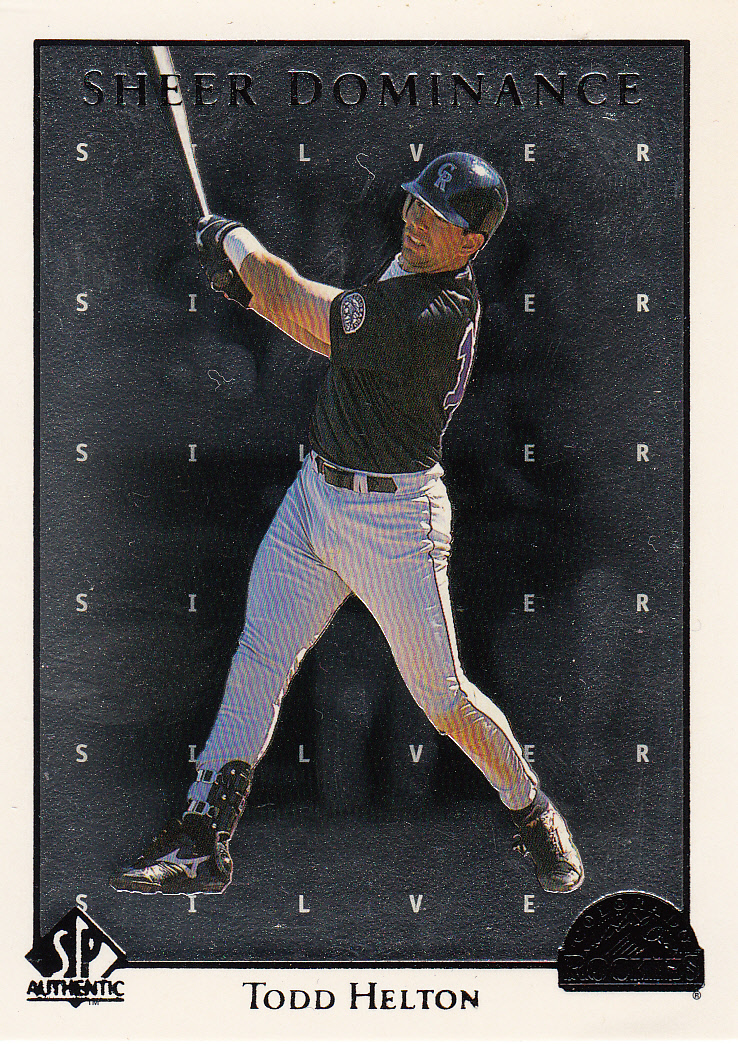
1998 SP Authentic Sheer Dominance Silver #SD27 Todd Helton
This shiny Todd Helton card doesn't have exactly the same treatment in the corner, although it does have a pretty bold-looking black Rockies team logo. Basically black foil, if there is such a thing. I assume that since this has "silver" lettering in the background repeated several times, that there are also Gold and maybe even Platinum parallels.

After a trip to Beckett, turns out the rarest of the three varieties is actually Titanium.

1999 Fleer Tradition Warning Track #123W Mike Lansing
I had to look this one up at Beckett, too. I see a fair bit of Fleer Tradition come across my desk, but I'd never heard of the Warning Track Collection before. It's just a one-per-pack parallel, so they can't be too scarce, but this is definitely a first for me.

Rockies 2B Mike Lansing has some great wraparound shades on this photo, but what I really like about this card is that the card number is different from the base set! Fleer added a "W" after the card number, clearly indicating that it's something unusual. I'd really love to see Topps do that, and the new-for-2016 "OD" prefix on Opening Day card numbers bodes well for this element finding its way back into the Hobby.

1998 Topps Stars Gold #131 Todd Helton /2299
I blogged about 1998 Topps Stars once before, and like Ellis Burks' card, this one has lots of texture on the front. Like that SP card above, this one comes in three different levels of scarcity, this time matching the Olympic medal metals—bronze, silver, and gold. There's also a pretty rare Gold Rainbow variety, much scarcer than this one-of-2,299 example.

There's even a trivia question on the back, mentioning Helton's QB days at the University of Tennessee, and asking which then-active American League first baseman was a kicker for the University of Nebraska. Unfortunately, we have to look at card #132 to find the answer. I know of absolutely no one who has completed 1998 Topps Stars, so I'll just have to Google that one.

Survey says...Darin Erstad. Actually I knew that at one point. My high school psychology teacher was a Cornhusker and asked this question in class one day, even giving us the clue that he was an Angel. I incorrectly guessed Chad Curtis. Sorry, class. I don't think we got to leave early that day.

Incidentally, if you own card #130 in this set and have been wracking your brain for two decades for the answer to whatever trivia question your card contains, the answer is Jim Sundberg.

2000 Topps Tek Pattern 2 #23-2 Larry Walker
And here's a set that answered a question no one asked (automotive journalists love that phrase), Topps Tek. I've ranted about the sheer insanity of fractured sets before, so I won't rehash that again. But any trade that's heavy on the crazy late-1990s basically turns into a research project. I've consulted Beckett and Google plenty so far in this post.

Topps Tek actually reeled it in a bit for 2000, offering only 20 possible background variations, compared to earlier years that had up to 90. Still, completing a set like this would be an exercise in madness. It reminds me a bit of those gigantic jigsaw puzzles seen toward the end of Citizen Kane.

1998 Topps Gold Label Class 1 #81 Todd Helton
My fellow supertrader threw in a few cards from another fractured set, 1998 Topps Gold Label. I've seen him pepper the cardsphere with Topps Gold Label, and I benefited too.

These always reminded me of 1993 Flair. Soft focus, really thick card stock, thin foil lettering. Pretty much the only difference is the rainbow finish.

1998 Topps Gold Label Class 2 Black Label #81 Todd Helton
Well, that, and the set's near incomprehensible numbering scheme.

Does this one look familiar to you? It's sort of the same card. But not. It's kind of like a parallel, but it isn't entirely so. It has the same card number (and the same back), but this is a "Class 2" version of Helton's card, offering us a different foil color and a different action shot (baserunning instead of fielding). But the "Black Label" makes it a parallel of Class 2 (a color actually found in all three classes), whereas Class 2 itself is more of a variation. And the Black Label only refers to the logo, not the player's name.

To sum up, it's definitely a parallel of something that is a quasi-parallel.

I don't know. It's late. I ought to hire a theoretical physicist to explain this thing.

Also, it took me a really long time to notice that the foreground shot (the smaller, post-swing photo) doesn't change between classes.

1998 Topps Gold Label Class 3 #81 Todd Helton
And let's go ahead and print up a third class while we're at it. Here we have a batting shot to go along with the mini-batting shot that was already there. And of course there are varying levels of scarcity to go along with all this. Topps was still fleshing this idea out in 1998. Within a couple years they actually realized it would be a good idea to label which Class you had on the back.

I know we all gripe about how many colored parallels there are these days, along with all sorts of things that make it hard to please us collectors, like recycled photos, general design elements, under-representation of our preferred team. But for me, the key question this: is it easy for me to understand what I am holding? Topps' photo variations and Bowman are key offenders here. On their own, photo variations are an OK concept, but unless you know the base set like the back of your hand, it's pretty tough to know whether you have a variation or just a common card. More often than not, they could probably just make the base set as a whole better by just using the variation as the primary photo. And don't even get me started on all those Bowman Chrome Prospect cards.

I know I said I wasn't going to rehash all the fractured set nonsense. But it's such a convoluted thing that I can't help but try to talk it out, even for my own understanding.

Regardless, they're nice-looking cards, and I more-or-less have a rainbow of these Helton cards thanks to this trade.

But the late 1990s were clearly a crazy time. Y2K was just around the corner.

On a final note, Opening Day is no longer around the corner! Every team has a game under its belt now, including the Rockies with a 4-hour marathon 10-5 win over Zack Greinke and the Diamondbacks. Not great for my Fantasy team, but Trevor Story is on pace for 324 home runs this year, after hitting two home runs in his first three Major League at bats!

And Happy Birthday, dad!

Sunday, March 20, 2016

The Trading Post #58: Mark Hoyle

Nowhere in the #SuperTraders rulebook does it say you have to write a blog. Mark Hoyle, easily the most active non-blogger in this community has the Red Sox slot, and he's obviously a regular at his local post office. This is the first time Mark and I have swapped cards, and he didn't waste any time getting to the good stuff.

2007 Topps Opening Day #33 Willy Taveras
2007 Opening Day was about as different as that brand ever got from Topps base. Of course, the Filmstrip Set had black borders that year, along with silver foil. This is at least the fourth time it's shown up on Infield Fly Rule, clearly indicating my preference for its design, though I did show a 2007 Topps Chrome once before.

2016 Opening Day has hit the shelves by now, and it's become a bit of a tradition for me to pick up a blaster at my local SuperTarget. Perhaps this week I'll have a few moments to pop over. Though I already know it's almost as similar to the base set as possible, meaning I'm more after those awesome insert cards that continue to hang on in Opening Day.

1999 Topps #52 Todd Helton
Unlike 2007 OD (might as well start calling it that, since "OD" is in the card numbers for 2016), 1999 Topps is a rare bird around here. It was a pretty small set, as Topps Base got pretty tiny in the years following the strike. It seems they'd whittle it down another 80 cards every year until a giant 790-card set returned in 2001 for their 50th Anniversary.

Anyway, this Helton card shows up in trade packages and dime boxes fairly frequently, and it's a great candidate for all the collectors with mini collections. A dugout shot, baseball equipment, a hatless player, the Topps Rookie Cup, a rain delay; this card has it all. Even an inverted wheelbarrow.

Seems to me he could take about three steps to his right and stay nice and dry, as pro ballplayers tend to get fancy shmancy luxuries like roofs on the dugouts. But then this card wouldn't be a hidden gem in a fairly underwhelming set.

1995 Upper Deck #176 Marvin Freeman
Another one you don't see too often around here is 1995 Upper Deck. Which is a shame, since it's awesome! Marvin Freeman signed with the Rockies at the end of the 1993 season, long before it was known that pitchers have a pretty rough time in the Mile High City. There was definitely a Wile E. Coyote effect in 1994, as he went an impressive 10-2 in the strike-shortened season. However, things didn't go as well the next two seasons, as the realities of pre-humidor Colorado baseball started to become clear. He owns the dubious distinction of committing the first-ever balk at Coors Field, and he was out of baseball by 1996.

1995 Upper Deck #172 Charlie Hayes
A few of Charlie Hayes' 1995 cards feature this odd contraption, mostly from Upper Deck. He is wearing his own batting helmet this time, but in the weeks leading up to the strike, Hayes was struck by a pitch that broke his jaw. He was out for several games before returning with this extra-protective face mask attached to his helmet. I can't blame the guy, as a pitch to the face is pretty much the scariest possible moment in baseball, perhaps second only to a pitcher getting a ball lined off his head.

Those two types of disturbing injuries seem to be happening with greater frequency, so it's good that the sport is at least giving players new options (especially pitchers) in protective headwear.

I got hit on the left elbow with a pitch in little league, and I chose to end my baseball career shortly after that. 11-year old kids tend not to have the best control. Of all the reasons why I never made the major leagues, being afraid of a pitched ball is definitely up there. I don't hold anything against Barry Bonds for all that armor he wore.

2015 Donruss #85 Justin Morneau
Mark is pretty well known for shipping vintage cards around, but since the Rockies don't really have any of those, the inaugural era will do just fine. However, there were a few recent cards, like Justin Morneau's from 2015 Donruss. In comparison to most of the cards so far, this one is just a bit thicker than I expected. I've seen the set before, but my fellow traders are still chipping away at the team set for me. Looking at the back, you could tell from orbit that it's a Donruss card. But the retro Donruss logo in the upper left makes it a bit more interesting than their overproduction sets.

And please allow me to belabor the point that it's not truly a logoless card, as Morneau wears Franklin batting gloves (just like I wore in little league), and a Majestic jersey.

1993 Pinnacle #238 David Nied
We'll turn back the clock a bit, all the way to the first Rockie picked in the expansion draft. The happy partly cloudy weather behind Nied accurately reflects the attitude around Denver when the Rockies first began play. Threatening storm clouds started appearing circa 1997, but in early 1993, Denver was thrilled that our time zone finally had a team!

The #1 overall expansion pick didn't develop into much, but according to Pinnacle, the Marlins had their eye on him too. Pinnacle also stressed the importance of "keeping the ball low" in Colorado, something we're still working on.

1995 Fleer Ultra Gold Medallion #155 Mike Kingery
Sharp-eyed readers will recognize this card, or one just like it. The base card came over in a gigantic box from Bo, but Mark managed to find the Gold Medallion parallel, which has an embossed gold seal in the upper corner. These were a hot ticket in 1995! I remember pulling a Gold Medallion insert card of Manny Ramirez, and I still know exactly where it is.

1995 Fleer Ultra Second Year Standouts Gold Medallion #11 Manny Ramirez
Manny was just a hard-charging newbie at the time, long before he made his millions and decided to spend a large part of his career on all sorts of antics and hijinks. I have no idea whether that helped or hurt this card's one-time $8.00 Beckett Hi value, but they still go for $2 or $3 on eBay.

1994 Select #70 Joe Girardi
Finally, a bunting Joe Girardi appears on a premium card, or rather just "Joe GI" (GI Joe?) due to a problem with the gold foil. The middle section between the two photos should have the outline of his last name spelled in gold foil. There are no other signs of damage to the card, so I am guessing Pinnacle must have run into some production problems. I've never seen this happen on Score Select before, but then again I have a grand total of about five cards from this set, so I have no idea whether this is common.

It was a single team bag, but there were plenty of interesting cards in it, including a reason to pull out some buried treasure from my 1995 Ultra pages. And whether there's a blog on the other end of it or not, thanks, Mark!