Showing posts with label 1994 Topps. Show all posts

Sunday, December 19, 2021

The Trading Post #166: Card Hemorrhage (Part 1: Rockies)

Trading volume is down quite a bit. Intuitively I knew that, but in preparing to write this post, I was surprised to see that I hadn't added anything new to The Trading Post page in nearly eleven months. Not that I've done much from my end either. Perish the thought of setting foot inside a post office unless absolutely necessary. But I have sent a few PWEs out, or at least I think I have. It's pretty much all a blur these days.

One blogger who's keeping that flame lit is Jay at Card Hemorrhage, winner of the most-difficult-to-spell blog superlative, stealing the crown from Highly Subjective and Completely Arbitrary. He's sent a couple stuffed PWEs my way in the past couple months, full of a wide range of familiar Rockies and unknown oddballs. We'll start things off with a familiar face from the Rockies, the player who joined Dinger in the making of this year's official team video holiday card.
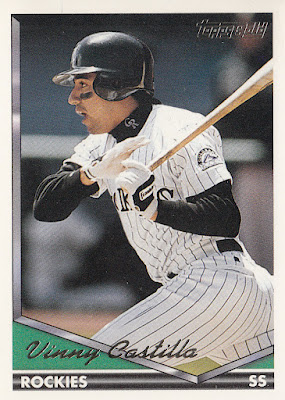
1994 Topps Gold #163 Vinny Castilla

Vinny Castilla was the cameo player in my previous post, but here he gets a parallel all his own. It's from 1994, the same year as my Hanukkah gift, and it's the Topps set I can most easily recognize at a glance. Longtime readers will know that 1994 Topps was the first factory set I ever bought, and a $50 expenditure at the young age of 10 is one that is seared into your memory for all time.

Even better, this is the Topps Gold variety, a one-per-pack parallel that felt like holding the actual metal in my hands back then. It hasn't really lost its luster after a quarter-century. Someday I might consider putting the whole 792-card set together, and I'm already about a third of the way there.
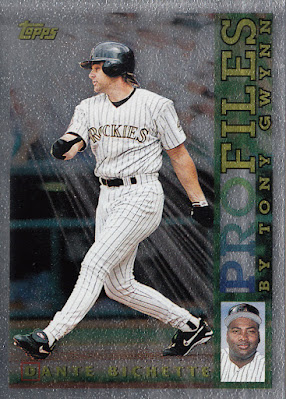
1996 Topps Profiles #NL-11 Dante Bichette

A couple years later and a lot shinier, Topps featured some of Castilla's teammates from the Blake Street Bombers squad in the Profiles insert set. Twenty players from each league were gathered for the set, and then Topps sought opinions about each National League player from Tony Gwynn. Kirby Puckett provided the commentary for AL players. Sadly, both of those Hall of Famers passed away far too young, but their keen insight on their fellow players (and likely fellow All-Stars more than a few times), is documented for all to see on this shiny Topps set.

In particular, Gwynn says about Bichette, 

"[I]t looks like confidence has made all the difference to him...Dante can put it out of any stadium...If he gets big numbers, they say it's because of [Coors] Field. If he doesn't, they say he can't hit. Well, he can hit, Period."

Tony Gwynn, arguably the greatest contact hitter in the expansion era, is certainly in a position to know. And that came a bit before we all really understood what a launching pad pre-humidor Coors was. He knew. But he also knew a great hitter when he saw one, regardless of the park. Hall of Fame voters are just now coming around to understand that, with Larry Walker finally entering the Hall of Fame and Todd Helton gaining some steam.
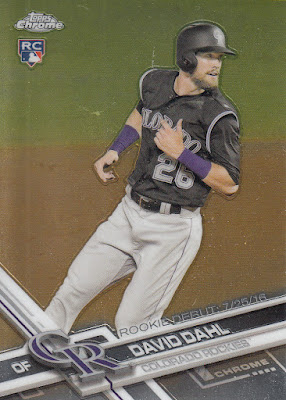
2017 Topps Chrome Update #HMT100 David Dahl RD

Shinier still was 2017 Topps Chrome Update, a Target exclusive. The card number has an "HMT" prefix, something I've seen before but still don't know what it stands for. Dahl, who will be reuniting with Jon Gray on the Texas Rangers next season (I'm hesitant to call it the 2022 season at this point, given the state of the current labor dispute), is pictured here running the bases as a Rockie. His card has both the Rookie Card logo and the specific date of his MLB debut, July 25th, 2016. The Rockies lost that one in extras, but as the card back tells us, it was the beginning of a record-tying 17-game hitting streak for Dahl.
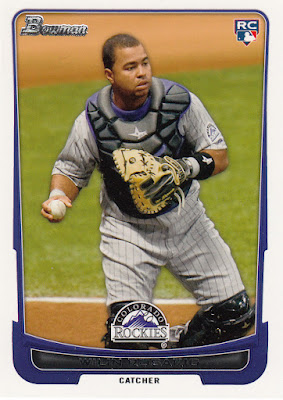
2012 Bowman #218 Wilin Rosario (RC)

2012 Bowman popped up again as it does from time to time. This one is another Rookie Card, picturing catcher Wilin Rosario behind the plate. A little over two years ago, the autographed black-bordered version of this card made an appearance here, and now I have the regular base card to go along with it.

Wilin Rosario was the everyday Rockies catcher for four seasons or so, and he was on a whole slew of cards at the time, but seemed to disappear rather rapidly. He wasn't a great hitter, but fans of cards showing catchers in defensive mode might find a few to their liking.
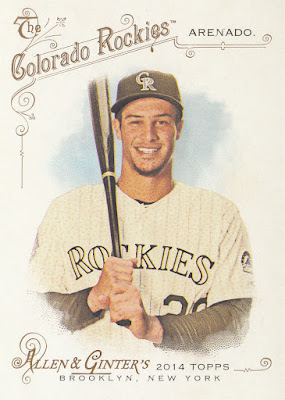
2014 Topps Allen and Ginter #314 Nolan Arenado SP

Jay included a couple 2014 Allen & Ginter cards, and this design is just different enough to make me think that I've never really seen it before. I do have a partially filled page in my 2014 binder, but the only record of it I can find in the blog archives was Anthony Bourdain's card, may he rest in peace.

A visibly younger Nolan Arenado entered the A&G checklist for the first time in '14, and the high card number of #314 puts this into short print territory. It's definitely a generous inclusion into this PWE.

The overall design looks similar to most A&G sets, but the one thing that really jumps out at me is the storybook fairy tale "The" preceding the "Colorado Rockies" team name. It gives it a feel of "Once upon a time in the land of 20th and Blake Street, Nolan Arenado played for The Colorado Rockies and slayed many dragons with his armory full of gold and platinum gloves."

Not all fairy tales have a happy ending, though, as we came to find out. At least not for fans of The Colorado Rockies.
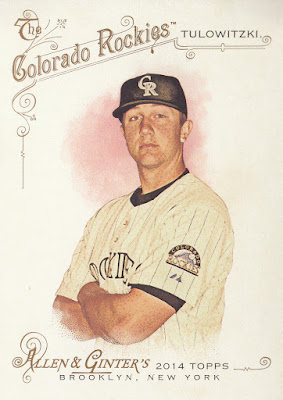
2014 Topps Allen and Ginter #104 Troy Tulowitzki

Don't give me that look, Tulo. Times have been hard.

At least Tulowitzki got his own storybook ending, hitting his final home run in the Major Leagues as a Yankee shortstop, playing right where Derek Jeter played all those years. Tulo idolized Jeter, which is why he wore #2 for almost his entire career.
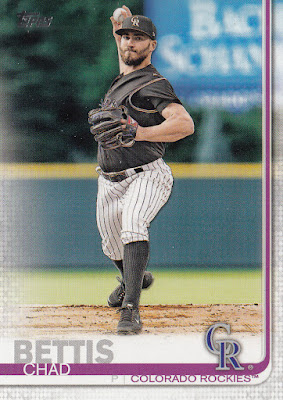
2019 Topps #74 Chad Bettis

Chad Bettis got a card in the 2019 Topps Series 1 checklist, and it's a very similar photo to this insert from Topps Update. This base card gives us a slightly different angle on a different pitch (his grip is slightly different), and we get a bit of an extra look at the Coors Field forest and advertising banners behind the center field wall. That blue banner is an ad for Bachus & Schanker, a local injury law firm that definitely makes the most of their marketing budget.

Chad Bettis announced his retirement in the summer of 2020, following a seven-season career with the Rockies. He finished with an even 31-31 record, although he had a rough 2019 season. He signed with the Yankees in 2020, but announced his retirement about a month before the pandemic-shortened season got underway. Topps didn't include him in any 2020 product, so this is effectively a sunset card. You'll just have to go online to read his 2019 stat line.
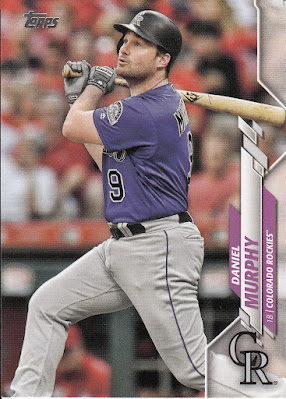
2020 Topps #116 Daniel Murphy

Daniel Murphy fared a bit better. He retired in February, deciding to make the shortened 2020 campaign his last. The fun-loving three-time All-Star was certainly enjoyable to watch during his brief time in Denver, although he put up a -1.0 fWAR during his two seasons here. At least Topps included him in the 2021 set, allowing Murphy fans to add a true sunset card to their collections.
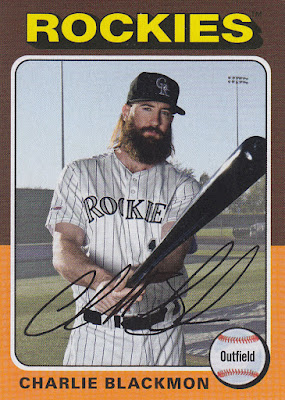
2019 Topps Archives #157 Charlie Blackmon

Charlie Blackmon is pretty much the only well-known Rockies position player left, at least among those who have reached free agency. Topps picked the iconic 1975 design for his card in 2019 Archives. Other than this Robin Roberts card, I completely skipped that set. I can't keep up with them all. 

Speaking of, did they ever release 2021 Big League?

In any case, Topps tried make this card somewhat period-correct, as though it were really released in 1975. I'm sure 1975 Topps superfans can tell me whether this is a legitimate color combination, or at least as close as it can be for the six current franchises that didn't exist then. But what caught my eye was the trivia question and cartoon on the back. The card asks "Which future Hall of Famer won the first Outstanding DH Award?"

First of all, I learned that there's such a thing as the Outstanding DH Award, which is now known as the Edgar Martínez Award. It's not league-official, and especially as a National League fan, I can't remember ever hearing about it. 2021's winner was AL MVP Shohei Ohtani. 

But the way they phrased this made it sound like it was a new thing and that they're referring to an active or recently-retired player destined for the Hall. David Ortiz maybe, or an early and bold prediction on Ohtani. But no, that award has been in place since 1973, the first year of the DH. The recipient of the inaugural DH Award was Orlando Cepeda, who reached the Hall of Fame in 1999. In that sense, Cepeda was a future Hall of Famer when this design hit shelves, but obviously not at any point during Charlie Blackmon's adulthood.

The 1975 design overall will be a good segue into Part 2, which included plenty of vintage. It was a stuffed PWE, believe me.


Friday, January 22, 2021

Hammerin' Hank

When Al Kaline died in April 2020, I wrote these words: "Given the current state of the world, these kinds of posts might sadly become a bit more common in the months ahead." 

Sadly, that prediction has continued to prove all too true, and far too many times since then. The number of baseball greats who have passed on since Don Larsen died on New Year's Day 2020 is truly staggering. Kaline, Seaver, Brock, Gibson, Ford, Morgan, Niekro. And those are just the Hall-of-Famers. Jimmy Wynn, Dick Allen, Larsen, Johnny Antonelli, fan favorites at least, and maybe even borderline Hall-of-Famers.

Hell of a lineup, though.

2021 has given us no reprieve, as we've lost Dodger greats Tommy Lasorda and Don Sutton, and it's only the third full week of January.

And today, I woke up to the news that Henry Aaron died at 86.

1994 Topps #715 Hank Aaron 715 HR

We know him for much more than his most famous moment, when he hit his 715th home run on April 8th, 1974 off of Al Downing, breaking Babe Ruth's home run record. Vin Scully had the call that day. His 4th inning shot was the culmination of a long marathon of chasing Ruth's record, a period in his career when he both guaranteed his place as an all-time baseball great and suffered awful hatred and racism for doing so.

For the occasion of the 20th anniversary of this feat, Topps gave him card #715 in the 1994 set, which is easily one of my favorite cards released that year. As I've mentioned before, it was the first complete set I ever bought, twenty-seven years ago. And what's really interesting to think about is that only twenty-seven years separated Jackie Robinson's debut and Hank Aaron's record-breaking home run. It really isn't that much time.

Aaron went on to wrap up his career with the Brewers a couple years after this, finishing with 2,297 RBI which remains the best in history, 6,856 total bases which remains the best in history, 755 home runs, and 3,771 hits. A Reddit user today pointed out that even if Aaron never hit a single home run, he'd still have over 3,000 hits, practically guaranteeing a spot in the Hall of Fame. 

A stat like that puts him right up there with an all-time hockey great, Wayne Gretzky. Gretzky had so many assists in his career that even if he never scored a single goal, he'd still be the all-time NHL points leader. Sure enough, Aaron finds himself as #5 all-time in position player bWAR, with an incredible 143.1.

He truly was a legend.

And he's a legend in my baseball card collection, too.

Let's go back to 1994, shall we? I was ten years old, and frequently found myself in the card aisle at my local Wal-Mart. I had been collecting for a little over a year, and had kind of had my fill of the 1991 Topps, 1992 Fleer, and 1993 Fleer Ultra that seemed to perpetually be available. I had a year of collecting under my belt, plus that fancy 1994 Topps Factory set. Right around then, Topps released the 1994 Archives '54 set, one of my dad's favorites since it took him back to his own childhood. Wal-Mart had this product for sale, and I had enough money from my weekly allowance to buy a pack or two. 

Pack selection was a very important thing when buying a whole box was entirely out of the question. I must admit that I wasn't above the strategy of pressing the translucent cellophane against the top card to try to see what was inside. To this day, I've never tried bending, weighing, or otherwise manhandling a pack, cardinal sins in the card aisle. But I do realize the cellophane trick does stray somewhere into the neighborhood of pack searching.

Judge ten-year-old me as you will, but I was able to discern a card inside one particular pack of Archives '54.

1994 Topps Archives '54 #62 Eddie Robinson

That was this card. Eddie Robinson, a New York Yankee. I didn't really know him, but I could see he was a Yankee, and being the son of a Yankee fan, this was the pack I picked. 

Eddie Robinson, by the way, has outlived all these guys, as he recently celebrated his 100th birthday. He's the oldest living MLB player. A four-time All-Star, he won a World Series with the 1948 Cleveland Indians. He was on site to watch Cleveland play in the 2016 World Series.

I don't remember which other cards were inside this pack, but I did find something special. Really special.

1994 Topps Archives '54 Gold #128 Hank Aaron (AU)

A gold foil parallel of Hank Aaron's 1994 Archives '54 card, signed on-card in the lower right.

It is the crown jewel of my collection.

I've never shown this card on the blog before, but I did share it many years ago as part of Nachos Grande's Better Know a Blogger series, so longtime followers might have seen it once or twice.

I can unequivocally say that this Hank Aaron autograph is the greatest pull of my life. It will never be topped. Pulling a card like this from a pack you bought at Wal-Mart at the age of ten is an amazing experience. This was a Golden Ticket, and I felt just like Charlie Bucket. I can't imagine anything I could realistically pull out of a pack ever again that would dethrone the Home Run King.

A Hank Aaron autograph!

I still have the pack wrapper. 1:1,263 odds.

RIP, Henry Aaron. You'll always be #1 in my collection.


Thursday, December 17, 2020

ToppsGelt

As another year's Hanukkah winds to a close, it's about that time for your occasional education on Jewish culture here at Infield Fly Rule. It's certainly nothing as in-depth as my full eight-night Stadium Club extravaganza from 2018, but there's still cause for celebration. We all know the mail hasn't been especially speedy this year, but I did get a Hanukkah card delivered from my mom, and inside was yet another Eight Men Out need.

1994 Topps Gold #395 Bill Brennan

As longtime readers may know, I've gradually been collecting the Topps Gold checklist replacement cards from 1992-1994 Topps. I have a full set of the six 1993 cards, completed last year. I don't think I have any of the 1992s, but with the above Bill Brennan card, I'm well on my way to having the '94 set as well. For those not in the know, Topps figured that getting a one-per-pack Gold parallel of a plain old checklist would be disappointing, so they picked a few extra players that didn't make it into the regular base set and gave them gold-only cards.

In a rather inattentive error, I actually had this card on the list twice, so Mom must have figured I really wanted it. It ended up being Bill Brennan's last Major League card. He had numerous minor league issues, and a few major-brand MLB cards following his 1988 debut, including an appearance in the famed 1989 Upper Deck set, but his career never took off. He appeared in four games for the '88 Dodgers, so he probably has a World Series ring somewhere. His career didn't progress beyond the Minors until a final, brief stint with the Cubs in 1993, as pictured here in a Studio-esque posed shot.

On the back, Topps has this listed as Brennan's Rookie Card. Donruss, Score, and Upper Deck all gave him cards in 1989, but Topps didn't get around to it until after his career ended. That makes it one of the rare examples of a Rookie Card and a Sunset Card all in one.

And since this is a Gold card, I thought I'd make a little Hanukkah pun and call it ToppsGelt. Gelt is a Yiddish word meaning "money", and in the context of Hanukkah, it refers to the little golden foil-wrapped chocolate coins that are given as small gifts. They're a favorite item to gamble with while playing Dreidel. I didn't buy any this year, but getting a relatively rare overproduction-era card is a great substitute.

Thanks for reading and Happy Holidays!


Saturday, June 30, 2018

The Travels of Adam

In the four and a half years since I started this blog, I haven't missed a month. Here it is June 30th, and this is my first post in the month of June, just barely keeping my streak intact. I have barely kept up with the Cardsphere since late April, and I'm sure I've missed quite a bit.

I did see Nick mention yesterday that Bob Walk The Plank is calling it quits, which hits particularly close to home for me, since that particular Pirates blogger and I started right around the same time, in January 2014. He's done zillions more posts than I have, but it's always tough to see another blog decide to cease operations. Despite my relative absence around here lately, I still intend to keep this blog going. I like writing; in fact hardly anything puts me in a state of "flow" more than this. Unfortunately, "baseball card blogger" isn't a job title that will pay the bills, as much as I'd like to live in that world.

Yet despite all its frustrations, my day job affords me the opportunities and the resources to see a bit of the world. Come along for the ride and I'll tell you what I've been up to the past couple of months while ignoring my blogger feed.

As I mentioned last month, I took a trip to London, England in early May. It was a great trip, and I saw some sights I'd wanted to see for quite some time, and also flew on a Boeing 747 for the first time, which was one of the reasons I took the trip in the first place. By now, I mainly recall the fond memories like world-class art museums, awesome corner pubs, tons of history, beautiful parks, outdoor food markets, cheddar & onion crisps, contactless payments nearly everywhere, usable public transit, and lots more. The general travel annoyances of jet lag, walking so far my legs and feet hurt, and generally being sandwiched in like a sardine in the Tube and in Economy class on said 747 are slipping out of mind.

However, one less forgettable issue I encountered within about five minutes of venturing out into the city was losing my wallet somewhere near Victoria Station. Once I stopped kicking myself, ordering replacement cards and ID online was a cinch, which were all waiting for me when I got back stateside. Mercifully, I had the foresight to squirrel away another credit card, my Oyster transit card, and a couple banknotes in a separate wallet that became my lifeline, and is part of the reason I discovered the prevalence of contactless payments in the UK.

£120 evaporated into thin air, which is a bummer, but I'd say the biggest loss of all was probably my Wallet Card. It was a 1994 Topps Gold Joe Girardi, and it had been all over the place, including Vienna, Sacramento, and of course my home city of Denver. Interestingly, that particular card was sent by The Card Papoy, who mans the French outpost of the Cardsphere. I guess that Girardi card really wanted to be near the 0° longitude line (which I saw while visiting Greenwich).

1994 Topps #372 Joe Girardi
Fortunately, my girlfriend recognized my plight, and gave me a replacement just a few weeks ago. There's Mr. Girardi in his inaugural-season Rockies gear in Mile High Stadium, pictured on the 1994 Topps design. Longtime readers will recognize that as the first factory set I ever purchased, so this card has a lot of meaning to me, gold or not.

That explains a week or so in May, but that still leaves June. Well, work has been crazy the past couple months, but they believe I'm enough of a top performer to award me with a second President's Club award. The first award took me to Vienna, and this time I was headed to Orlando, Florida in mid-June. I happen to have friends and family in central Florida, so I extended the trip a few days before the company event started.

The first time I visited Florida in 2013, I was there for an old friend's wedding. She still lives there, and I got to meet her four-year old daughter. The next day, we went to Acme Superstore, which is first and foremost a comic book store, but also has aisles upon aisles of pop culture memorabilia. Star Wars, Mario, Hot Wheels, you name it. There were a few baseball cards, including a 1962 Topps Gaylord Perry rookie card, but I didn't pull the trigger on it.

1999 Pokemon Fossil Unlimited #52 Omanyte C
One thing I did get for myself was this Pokémon card, the first one in my collection. Like many people in the summer of 2016, I played Pokémon Go, a great opportunity to get out and about and explore my local parks. This little critter Omanyte, which is based on the extinct ammonite (a sort of nautilus squid thing), inexplicably became my favorite little Pokémon. I set it as my "buddy" when they added that feature to the app, and couldn't pass this card up when I ran across it.

After visiting friends and family, the four-night company event began in Lake Buena Vista. Similar to the Vienna trip, there were various daily activities to choose from, concluding with a dinner each night. It all went pretty well, other than flipping my kayak over in a creek following an inadvertent collision. One evening took us to dinner at a Universal Studios soundstage, followed by a rather empty theme park to explore. I have a lot of friends and family who are into Harry Potter, so naturally my guest and I spent some time in Diagon Alley.

Harry Potter Chocolate Frog Cards Gilderoy Lockhart (s17)
One can't go to Diagon Alley without getting a chocolate frog, and inside those chocolate frog boxes you'll find a pentagon-shaped lenticular card like the above. In addition to a pretty decent 5 oz. chunk of solid chocolate, I pulled Gilderoy Lockhart's card, the Defence Against the Dark Arts teacher from Harry Potter and the Chamber of Secrets, portrayed in the film by Kenneth Branagh.

It's hard to find a complete list of these, but I think there are only seven or eight to be found at the Universal parks. This isn't something that Beckett has cataloged yet, and it'll be tricky to find a spot to store it. There's a little "s17" in the corner, which may refer to its release year.

So that's why I haven't been around much. "Work Hard, Play Hard" has definitely been the name of the game lately. That doesn't leave a lot of time for blogging, and has put me even further behind on trade posts from Nachos Grande, A Penny Sleeve For Your Thoughts, blog reader Chris, and my annual Opening Day blaster. The year's flying by (in fact the baseball season just hit the halfway point), but I'm still around.

Thanks, as always, for reading.


Sunday, January 14, 2018

The Trading Post #110: Summer of '74

If you're not following Summer of '74, a newcomer to the blog community, head on over and take a look. Matt and I have already swapped cards once, and a 1994 Topps-focused post he did in October caught my eye. He showed a bunch of base cards from an unopened box of Series 2, and offered the one-per-pack Topps Gold parallels, which I happily claimed. It and its 1993 predecessor were the first parallel sets I chased, and I enjoy them just as much today.

There's lots of mid-1990s Topps goodness to be found over on Matt's blog, including Tuesday's post about 1995 Topps. There were lots of clouds involved. But in 1994, before the strike, Topps was still sticking with pretty traditional photographs. They dabbled with images on the back in 1992 and 1993, with stadiums and headshots, respectively. But in 1994, they finally followed Upper Deck's lead and gave us action shots on the back, too.

1994 Topps Gold #669 Tim Wakefield
Tim Wakefield's front image in 1994 Topps is more interesting than the back. Before he began his long tenure with the Red Sox, he spent two seasons on the Pittsburgh Pirates. It's an unfamiliar uniform, because Wakefield was getting lots of national exposure when the Red Sox were regularly appearing in high-profile playoff series, often against the Yankees. And he's known for more than just giving up the Aaron Boone home run. He took the victory in Game 5 of the 2004 ALCS, a 14-inning marathon that kept the Red Sox alive and enabled them to finally break their curse.

I've been watching a lot of sports documentaries this off-season, including many episodes of ESPN's 30 for 30. The other night, I saw the Four Days in October episode, chronicling that improbable comeback that the Red Sox made while being down 3-0 to the defending pennant winners. Wakefield didn't have a huge role to play that year, but he won his ring nonetheless. He is, on the other hand, a prime figure in the Knuckleball documentary, his signature pitch. I feel that Topps' photography on this card is appropriate, the slow shutter speed blurring Wakefield's hand and the ball, adding to the mystery and unpredictability of the knuckleball pitch.

1994 Topps Gold #625 Charlie Hough
Charlie Hough threw it too, and we can see the grip much more clearly. It's another unfamiliar uniform, as he spent most of his career with the Dodgers and Rangers, squeezed onto the back in the tiniest of fonts. But he was a Marlin in 1993 and 1994, their equivalent of Bryn Smith, another veteran hurler who kicked off the Rockies' inaugural home opener. As I've said before, I know many other fans never knew of this period in Hough's career, but given when I started collecting, seeing him in the Marlins' early turquoise colors looks a lot more normal to me than to longtime Dodgers and Rangers fans.

Sadly, this was Hough's final Topps card. The shrunken 1995 set didn't have room for him, let alone another line in his career that spanned a quarter-century. It's a sunset card and an unfamiliar uniform all wrapped up in one, along with a highly unusual pitch that only two current players use.

1994 Topps Gold #460 Orel Hershiser
Orel Hershiser had a much more conventional pitching style, and thanks to 1989 Donruss, we know he can juggle. He could actually hit, too, earning the elusive pitcher's Silver Slugger award in 1993. The sentence on the back tells us he was near the .404 Major League record for batting average by a pitcher before settling at a still-impressive .356. His 1988 season has a lot of red on it, the same year he pitched a record 59 consecutive scoreless innings. That helped his season statistics climb as high as 23 wins, 15 complete games, and 8 shutouts, on his way to the NL Cy Young award, not to mention a World Series ring. Surprisingly, none of these players are in the Hall of Fame, but Hough and Hershiser had a decent shot.

By the way, if Topps did then what they do now, just giving us five years of stats, Hershiser's amazing 1988 season would have scrolled off the screen by the time his 1994 card was printed.

1994 Topps Gold #470 Rafael Palmeiro
Rafael Palmeiro holds the dubious distinction of being the first All-Star MLB player suspended for using steroids. Yet, at 53, he's talking about making a comeback. If it does happen, I hope it ends up being more than just a publicity stunt. But it would be interesting to see such a giant gap in his statistics if he gets a 2019 Topps card.

As you can see, these Topps Gold cards didn't survive almost 25 years in a pack unscathed. Most are fine, but a handful, like this one, show clear signs of being stuck together. It's not too bad, and Matt told me as much when we were talking specifics. It's clear enough that it's possible to see the number 22 on his right batting glove, meaning he might have borrowed it from teammate Will Clark. But it looks like he's wearing the same one on the card back in a home jersey, and I doubt he made a regular thing of it. The Cuban superstar could surely afford his own batting accessories.

1994 Topps Gold #612 Jim Thome
About the only sure-fire Hall of Famer in this illustrious group so far is Jim Thome. His 612 home runs are likely to buy him a ticket into Cooperstown any day now. But in 1994, he had yet to play a full season, and was just getting his career going. The back of this moderately damaged card still has minor league stats going back to 1989, and mentions his 1993 MVP award in the Triple-A International League

Coincidentally, just like Palmeiro, Jim Thome wore #25 for most of his career. And his batting gloves match.

1994 Topps Gold #690 Mo Vaughn
I can't think of Mo Vaughn without remembering him tackling George Bell as he charged Aaron Sele on the mound. Sele was clearly throwing at Bell, who was having none of it. But as he, um, went to the mound to have a word with the opposing pitcher, in comes Mo Vaughn like a Mack truck and body slams Bell like a bowling pin.

Tempers were hot in 1993. That clip took place just a month or so after the legendary Nolan Ryan / Robin Ventura brawl, and I clearly remember the benches clearing not once, but twice at my first Major League game on June 15th, 1993 between the Rockies and Dodgers.

Years later, during another Dodgers visit to Denver, none other than Jeff Kent was hit by a pitch and both teams rapidly ended up on the field. That game, July 4th, 2005 was a fireworks game, and I'm sure that many fans in attendance just wanted the extra-innings affair to conclude so their kids could see the pyrotechnics. I enjoyed that part, sure, but I'm sure I was in the minority of fans who were excited about those final two nail-biting innings.

1994 Topps Gold #397 Tim Salmon
I haven't said much about the design. 1994 Topps never climbs very high on the Topps set countdowns, but it always holds a special place in my heart. Lots of people seem not to like the home plate shape that makes up the photo frame, but it reminds me of the baseline frames that UD frequently used in their first few sets. And it gives us that lovely patch of green at the bottom, set behind the player's name in a script font. In Topps Gold, that's much easier to read in 1994 than in 1993. And once in a while, the Topps Rookie Cup graces a card with its presence.

Tim Salmon was the 1993 American League Rookie of the Year, sharing the honor with Mike Piazza on the NL side. The first fishy Angels star hit a couple more home runs in 1993 than noted slugger Mo Vaughn. And one fateful day that year, he'd play a game in Baltimore.

1994 Topps Gold #477 Arthur Rhodes
Arthur Rhodes was the starter for the Baltimore Orioles on April 17, 1993. The Rockies and Marlins were just infants, but elsewhere in the league, Rhodes had faced the Angels before, early in his 20-year career that lasted until 2011. Tim Salmon was getting his first taste of the Big Leagues, nearly being nabbed by the lefty on a pickoff attempt, but making it to second on an error. He'd walk twice that day, first in the third, and again in the ninth by the late Todd Frohwirth. Following the Orioles' third error of that day, Salmon made it to third base, which brought up the the Angels' own third baseman, Rene Gonzalez.

With Salmon at third and Gary Gaetti at second, Rene Gonzales hit one weakly toward the third base side.

1994 Topps Gold #664 Jeff Tackett
And that resulted in a play at the plate. Salmon was out, but the Angels still had the lead, and they'd hold on in the bottom of the ninth to win it.

Gary Gaetti was on third base when all this was happening, and he had his own play at the plate card in 1993 Topps. The Angels were playing lots of small ball in this era, apparently. There were seven stolen bases in this game, over half by Chad Curtis. They were then known as the California Angels, but they had a brand new logo for the 1993 season. Also visible on Jeff Tackett's left sleeve is a small commemorative patch, marking the year the Orioles hosted the All-Star Game in their shiny new retro park, Oriole Park at Camden Yards.

Topps must have been really proud of this card. In the 1993 factory set, they included a 9-card pack of 1994 preproduction cards. The colors were a little different, and as I recall they changed one photograph selection, but it's more or less accurate. In that set, you could find major stars like Nolan Ryan, Kenny Lofton, Juan Gonzalez, and also this Jeff Tackett card. The official version added his 1993 stats, and removed the Studio-like paragraph about Jeff's hobbies and family, replacing it with the inning he pitched in Detroit on August 11th, 1993, and his cameo in the movie Dave, which Topps tells us was a TV show.

TV shows and movies have been elevated to a similar plane in 2018, but in 1993, not so much.

Also, Tackett seems to have grown an inch in the 1993-94 offseason. His preproduction card had him at only 6'1".

1994 Topps Gold #586 Brent Gates
There were a few other cards that caught my eye, like this one showing a post-hustle Brent Gates giving a forearm bump to a fellow teammate. There's a tiny Minnesota Twins cameo in the lower right, but I can't tell who that is, nor the recipient of said forearm bump. That might be a coach or batboy on the left, and Gates may have just slid into home, which could identify the unknown Twin as catcher Brian Harper.

The green patch that's already on 1994 Topps goes particularly well with the A's color coding. Some of the color choices are a little odd, like yellow for the Red Sox lettering. But the green and yellow works well, even if the shades are ever so slightly different from the actual photo.

1994 Topps Gold #784 Gabe White / Rondell White
I often had a tough time deciding where to put these two-player cards when alphabetizing them by team. Would I use the player on the right or left? Was that consistent with the top or bottom on the card back? What if the right and left varied from front to back? Would a featured Rockie take precedence even if he was in a less-preferred location? Four-player cards were even harder. These were all very important decisions to make when organizing my first-ever factory set.

These cards are now quite rare, so it doesn't come up as much. And every so often, I go through my old factory sets and organize them by the players who ended up making more of an impact. Rey Ordonez over three guys you've never heard of. That sort of thing.

But I always appreciated this Expos card for giving me two guys with the last name "White". Either way, it would fit. Gabe White had an 11-year career, including two as a Rockie, and his only postseason appearance was with the 2003 Yankees. Rondell White had an even longer career at 15 years, making it to the postseason twice, and the All-Star Game once, in 2003. During that Midsummer Classic on the South Side of Chicago, he pinch hit for Barry Bonds and promptly grounded into a double play on the first pitch he saw from Mark Mulder.

1994 Topps Gold #155 Todd Stottlemyre
Last up is Todd Stottlemyre, a Blue Jays pitcher that was one of the first American League players I saw on TV. There was no interleague play in 1993, my first year watching the sport. So other than that All-Star Game in Baltimore, where the announcers bantered about nothing while Andres Galarraga had the first-ever Rockies All-Star at bat (and was flirting with a .400 average), I didn't really see any American League play until the postseason. A couple names stick out in particular, Wilson Alvarez and Todd Stottlemyre. Their two teams battled it out for the AL pennant that year, with the Blue Jays beating the White Sox. I probably didn't see Game 1 or Game 2, as Game 1 was on a school night, and Game 2 was a Wednesday day game. Early in 4th grade, I was unlikely to see either of those.

But Wilson Alvarez started Friday night's Game 3, and Stottlemyre in Game 4 the next day. It was likely my first taste of AL baseball, the Designated Hitter, and names I'd only seen on the occasional card instead of on TV regularly. It was also the only World Series I'd see until 1995 for obvious reasons. Todd Stottlemyre started Game 4 of the 1993 World Series, but thanks to a 15-14 roller coaster, did not remain the pitcher of record for long. By now, though, we all know that Joe Carter came through with a historic home run in Game 6, helping Stottlemyre and the rest of his Blue Jay teammates earn their second ring in as many years.

Thanks to Matt for sharing these 1994 parallels! Clearly this set is a special one to me. To a card collector, there's nothing quite like your first factory set, and more broadly, to a baseball fan, there's nothing quite like your first season.


Saturday, April 29, 2017

The Trading Post #97: Nachos Grande

I've been pretty out of the Cardsphere loop lately. I entirely skipped the 30-day Card Challenge, for example, although I suppose I could do it all in one go, like Night Owl and Dime Boxes did this weekend. In fact, this is only my third post in April, my lowest monthly total since...well, February. Between watching half my fantasy team go on the DL in the first month (Bumgarner, Sanchez, Beltre, others, and now Cespedes), and keeping an eye on the Rockies' textbook April hot streak, I haven't had a lot of time for blogging. The weather's been getting nicer too, and I took a pretty strenuous hike last weekend with some friends, but since this weekend has brought us our annual spring snowstorm, what better time to pick my virtual pen back up?

Fortunately, I've had plenty of potential blog post topics, such as a trade sent by Nachos Grande long before the season started.

2013 Topps Heritage #164 Dexter Fowler
Dexter Fowler was a fan favorite around here, spending time with Houston, Chicago (of course winning the World Series last year), and now St. Louis. I was about to say that he's really made the rounds in the National League, but then I realized Houston moved to the AL. I remember, really, I do.

But back when 1964 took its turn in the Topps Heritage set, Fowler was spending his final season as a Rockie. This retro-themed shot of a hatless Fowler in the dugout offers a pretty intimate look at the day-to-day job of a ballplayer. The action shots are always a crowd-pleaser, but hanging out in the dugout while the other part of the batting order is taking its turn is roughly as common as playing the field. Many of them find interesting ways to pass the time, such as (Buster Posey's good friend) Hunter Pence coming up with personalized handshakes for each of his teammates.

2012 Elite Extra Edition #91 Tom Murphy
The injury bug has bitten the Rockies, too. Their shiny new free agent, Ian Desmond, has yet to play in a game this year. David Dahl and Jon Gray are on the DL, and CarGo narrowly missed a broken hand during an unfortunate foul ball last week. Catcher Tom Murphy is down as well, the subject of this red foil card from Donruss Elite. He's been called up to the big leagues twice, but his potential is still yet to be fully realized. For now, that means most of his cards are in the Donruss Elite and Bowman sorts of brands. But if he becomes the star catcher he's expected to be, we should be seeing a lot more cards of him.

I'm sure that's just a batting glove in his back pocket, but it looks slightly like he has a duck tail.

Anyway, Mark Reynolds and Tony Wolters have been filling in nicely in the Rockies' lineup, good enough to keep them in first place. Because they just won this weekend's series in Arizona, they've held on to first place into the month of May, barely, despite the absolute destruction that the Washington Nationals visited upon them this past week. But they've bounced back nicely with an exciting come-from-behind win and will go for the sweep tomorrow.

1994 Bowman's Best #R72 Ellis Burks
Bowman's Best did shiny red cards better than just about anyone. Ellis Burks, who had just joined the Rockies when this card was printed, was already an established power hitter. He even had eight grand slams to his name before becoming a founding member of the Blake Street Bombers, tacking on even more before his retirement in 2004.

Topps knew they had a hit on their hands with the production of shiny cards like this, a set that appeared after the seminal 1993 Finest set. I would like to know what the design in the upper left is supposed to be. It looks a bit like the NFL shield. But maybe it's just some sort of home plate thing.

Standard practice for close to two decades over at Bowman was to use red colors for veteran players, and blue colors for rookies.

1994 Bowman's Best #B11 John Burke
Fortunately for our exploration of this design, Chris was kind enough to include both. They look really good side-by-side, especially since the design elements are a mirror image. Burke's card is noted as a "Blue Chip", though Burke only went 4-6 in two seasons with the Rockies, his only time spent in the Majors. Burke was more of a speculative small-cap than a blue chip, but others in this set went on to do great things, such as Shawn Green, Jorge Posada, Derek Jeter, and Chipper Jones, to name a few.

I can only imagine what a green card from this set would have looked like. Throw in a yellow with that and you can make the Microsoft logo.

1994 Topps #780 Jason Bates / John Burke
Burke showed up again along with Jason Bates on the Rockies' Coming Attractions card in 1994 Topps. This movie theater-themed subset caught my eye, as I can still recognize the first factory set I ever bought in a split second. Jason Bates, who found a bit more success with the Rockies than Burke, is called out as a "switch-hitting shortstop with power." Burke, on the other hand, was at that time the career leader in strikeouts as a Florida Gator. Besides those one-sentence tidbits, this card gives us a rarely-glimpsed bit of info: the scout who signed the player. Randy Johnson (no relation to the Big Unit) signed Bates, and Bob Gebhard, the first General Manager of the Rockies, signed Burke.

I'm surprised that doesn't make it onto Bowman cards. It would be perfect for a prospect-heavy set like that, and might give hope to fans and collectors who want to be part of baseball but aren't good enough to play.

2014 Topps #237 Michael Cuddyer / Chris Johnson / Freddie Freeman LL
When it comes to League Leader cards, the players are much more likely to have found success than a pair of prospects. Michael Cuddyer won the NL batting title in 2013, one of many times that trophy has been brought to Denver. Rounding out the top three are two Braves. Chris Johnson hit .321 in 2013, but hasn't had a stellar career since. He broke a bone in Triple-A a few weeks ago, and was released by the Indians in 2015. The likelihood of him making a comeback is looking slimmer by the day.

Freddie Freeman, on the other hand, the second runner up to the 2013 batting title, is still performing well as a Brave. He went deep on Friday with a go-ahead two-run shot, and is finding a nice home at SunTrust Park, the Braves' shiny new stadium.

2014 Topps #20 Charlie Blackmon
I often remark on how different Todd Helton looks without his goatee. But that's nothing compared to Charlie Blackmon without his lumberjack beard. He has a little bit of scruff on this 2014 Topps card, but he looks like a completely different person. He's just as capable in center field as Fowler was, beard or no. And it's a Coors Field card, worthy of a spot in my Frankenset. This 2014 set does make me miss the previously ubiquitous silver foil and white borders that were once so familiar.

But what's still familiar is great trading partners, a Rockies team that is hot in April (though winning all these one-run games is a little weird), and shiny Topps cards from all eras of the Colorado Rockies.


Tuesday, April 26, 2016

The Trading Post #63: Cooperstown Exit 3:16

Like Andy at Ain't Nobody Got Time for Cardboard, Brett at Cooperstown Exit 3:16 is a newcomer to the Cardsphere. He represents the Nationals in the #SuperTraders group, and though he didn't have a blog when the group was conceived, he started one up just a couple months ago. Already he's making his presence known in the community.

2015 Topps Archives #38 Carlos Gonzalez
Brett started off the package with a few cards from Topps Archives, including this 1957-themed CarGo card. Like most Archives cards, this has a distinct smooth matte surface, definitely not one of the glossy cards we've been seeing for a couple decades, but smoother and higher-quality than just standard cardboard.

This is definitely a photograph of Gonzalez, but somehow it looks ever so slightly painted, though nowhere near a Gypsy Queen card. Perhaps it's the unusual surface that gives it a different look.

2014 Topps #290 Chad Bettis (RC)
Of course, Topps base cards usually find their way into these trade packages, and though I don't often feature them, I've always liked this 2014 Rookie Card of Chad Bettis. Bettis has been a bright spot in the Rockies' short season, with a perfect 2-0 record so far. Tyler Chatwood has as many wins, but also has two losses and got off to a rough start last Saturday against the Dodgers.

By now, this design is very familiar to me. 2014 marks the year that Infield Fly Rule debuted, and I was highly active on Topps Bunt that year. "The Wave Set" (or was that 2010?) wasn't universally loved, but the sets I spend the most time with tend to be my favorites. Whether one causes the other, I can't say, but I'll be able to place this one in the correct pile with barely a glance.

1994 Score Samples #8 Andres Galarraga
1994 Score is also an easily recognizable set, partially because they're the only ones to ever use a dark blue border like this, but also because it fit easily into my budget as a ten-year-old. And there were Rockies cards in it, like this Galarraga, a card I could almost reproduce from memory. I'd probably miss the batting glove he's holding in his left hand, but I'd know this card anywhere. 

Except, of course, for the large black "SAMPLE" lettering, which appears front and back. Never saw one of those before. These pop up on occasion, though more often on Leaf/Donruss products, and occasionally Topps. But Pinnacle/Score was in the preview game too, providing cards for dealers to display. They're a relic from a time when the industry was hot, and the real thing had to be kept under lock and key.

Call it a Beta version, to use a modern tech term. I rarely see significant changes from a preview to a final release, but there are occasionally subtle differences. The card back of this sample card feels rougher than a standard 1994 Score card from the actual print run. 1994 Topps Pre-Production cards had the same basic design as the final product, but the fonts on the back and the background colors on both sides were changed.

1994 Topps #180 George Brett
We all know how awesome George Brett's card from 1994 Topps is, and that's the second time I've used this scan. But the Pre-Production example is rather different.

1994 Topps Pre-Production #397 George Brett
It's clearly the same photo, but cropped much differently. Making a card horizontal is often nice, but doing so here takes away the legendary status of this card. The action is still there, but the ambiance of Kauffman Stadium is completely lost, along with the information we need to specifically date this photo. If Topps went with this version, I doubt we'd still be talking about it today. The lack of a nice green behind the player's name also makes the final version less appealing to my eye.

1995 Select Certified #68 Dante Bichette
The cards just keep getting shinier and glossier as this post evolves. Pinnacle made some really shiny cards in the mid- to late-90s. Some even seemed to have a mirror finish. This one reflects back a slightly distorted image (unlike the perfect reflection I saw in the blue paint of an Acura NSX many years ago), but it's an eye-catching specimen. The gold border around Bichette's outline accentuates it even more.

Rather than consolidated statistics, the reverse breaks out his performance by team in the strike-shortened 1994 season. That means we get a tiny logo of the other thirteen NL teams. Yes, this was before Interleague play, and before the Diamondbacks. Bichette loved to face the Cardinals that year, racking up 20 of his 95 RBIs, and 5 of his 27 home runs. 

2006 Artifacts AL/NL Artifacts Blue #NL-TH Todd Helton Jsy /325 (MEM)
The breadth of the Rockies existence was well-represented in this trade, concluding with a serial-numbered swatch relic of Todd Helton! It's a fairly rare solid purple (matching the uniforms the Rockies are wearing as I write this), though not matching Helton's photo on this Upper Deck card. As it's a UD relic, that means I get another tiny printed signature of Richard P. McWilliam on the back. And a nice blue serial number on the front.

You can see it quite clearly on this particular photo of Helton, but this Artifacts card also lists the player's uniform number, always a nice touch. It's one of the pieces of information cluttering up the "loincloth" on 1996 Donruss, but the fact that the Rockies retired #17 in Helton's honor makes it just a bit more special.

Thank you, Brett, and welcome to the Cardsphere!

Sunday, January 31, 2016

Antique Mall Mystery Pack: Marlins

That trip to the antique mall last year keeps on providing fresh material, and I haven't even opened two of the Mystery Packs yet, though I know they're for the Twins and the Expos. But for this round, we'll be taking a look at the Rockies' expansion counterpart, the Florida Marlins.

Yes, they're now called the Miami Marlins, partially because they haven't been the only team in Florida for close to twenty seasons, and partially because marketing got involved and decided they were in need of a re-brand. But all these cards are from the "Florida" era, and most from when their primary color was turquoise.

1994 Donruss Special Edition #5 Gary Sheffield
We see that color a little bit in their road uniforms, but there's more gold than turquoise on this card, thanks to baseball card trends of the time. Donruss wasn't quite fully on board with gold parallels, so this Special Edition set only had a hundred cards, fifty from each of the two series. Which is just as well, since the card number on the back is also done up in gold foil, making the it pretty tough to read. Hand-collating 660 of these would involve plenty of squinting.

It depends on the light, but sometimes these Special Edition cards look a little more copper than gold. But the giant Donruss logo provides plenty of area for the gold to look shiny and rainbowy. But more on copper later.

1994 Topps #20 Bryan Harvey
A common theme of these packs has been lots of 1994 Topps, and while this isn't quite the glamour shot we saw for a Giant, it's definitely a posed studio photo, along with some cartoony motion blur. Most of the card brands got into double or triple exposures and motion blur, but the flame thing that's happening here doesn't really reflect what it would actually look like if they did a long exposure.

1994 Topps #370 Benito Santiago
But there were plenty of great action photos in 1994 Topps, like this card of Benito Santiago, listed here as "Benny". I do recall various announcers referring to him by that nickname, but I heard his given name of "Benito" much more frequently. Maybe it's just one of those cases of Topps deciding what they wanted his name to be, sort of like their 1960s "Bob" Clemente cards.

Don't forget that cameo of current Mets coach Tim Teufel. You can't quite tell what the outcome of this play was, but thankfully we can date this card! The Marlins visited San Diego (Santiago's previous team) twice in 1993, and a quick look through the box scores leads us to June 6th, 1993, about a week before I attended my first-ever Major League game. The Marlins won that one, helped out by an outfield assist from Jeff Conine on this exact play. So though it doesn't quite look it, Santiago got his guy!

1994 Topps Gold #161 Darrell Whitmore
Darrell Whitmore had a short, three-season career with the Marlins, and I don't really recognize his name other than from his various inaugural Marlins cards. But this is the Topps Gold parallel, which I'll be able to add to a sizable stack of these one-per-pack cards, a good chunk of which I got on eBay several years ago.

1993 Leaf #384 Charlie Hough
Charlie Hough was definitely past his prime by the time the Marlins signed him, as he built just a 14-25 record in his final two seasons. The Marlins employed a strategy similar to the Rockies, as Colorado signed Bryn Smith in 1993 to wrap up his long career. Smith in purple and Hough in turquoise must look extremely odd to most collectors, but since I found so many of their cards in my first year of collecting, they don't look that unfamiliar to me.

Flip this card over and you'll see the same gold rainbow foil on the team logo that Leaf/Donruss used the following year on those Donruss Special Edition cards. The premium brands always get the cool stuff a little earlier. Sometimes decades earlier, as 2016 Topps is finally losing the borders and going with full-bleed printing.

25 years coming on that one.

1993 Pinnacle #562 Cris Carpenter
This is probably our best look yet at the retina-searing colors of the early Florida Marlins, especially against the black borders of 1993 Pinnacle. It even has the Expansion Draft logo, just like the Rockies cards you've seen before. And that means this Marlins card has a tiny bonus Rockies logo, which more than makes up for a little bit of damage on the left side of the card.

Cris Carpenter might sound like a familiar name, but this is not the same Chris Carpenter who won the Cy Young Award for the Cardinals in 2005. Different guy entirely, although both played for the Cardinals, confusingly.

2002 Upper Deck MVP #226 Brad Penny
As in the Mets pack, this black-and-copper 2002 Upper Deck MVP remains one of my favorites. It's always nice to see some specialty sets like this in a 50-cent pack filled mostly with overproduction cards. I guess that's the magic of antiquing.

The color coding works really well with this design, and I've found that the black background is pretty sturdy, unlike say, 1994 Score, or 1993 Pinnacle. Or 1971 Topps, for that matter.

1996 Upper Deck #339 Al Leiter
Upper Deck was still pushing the copper envelope in 1996, and it's in a bold bar at the bottom of every base card in this and the following year's set (other than the numerous subset cards, of course). They hadn't quite thought to tone it down until a few years had gone by for that 2002 MVP design. This is a fairly boring photo of Al Leiter, but 1996 was the year he pitched the first-ever no-hitter for the young Florida Marlins, which happened to be the first no-hitter pitched against the Colorado Rockies. Interesting and unlikely trivia fact, isn't it? Both expansion teams had their first taste of a no-hitter while facing each other.

1996 Upper Deck #338 Pat Rapp
Pat Rapp never threw a no-hitter; in fact he only had one winning season his whole career. But we can all appreciate a card of a pitcher at the plate, right? As with most pitchers, it looks like unfamiliar territory for him. His uniform number is 48, but the bat he is using is marked #11, the number of fellow pitcher Chris Hammond. Maybe he was just trying to break out of a slump by switching out the lumber.

1998 Ultra #295 Todd Zeile
But copper is Upper Deck's color, not the Marlins'. Fortunately, the raised green lettering found on other 1998 Ultra cards happens to match well with the Marlins' colors. even if it is obscuring the catcher in this photo, Tom Pagnozzi of the Cardinals. Though Walt Weiss beat him to it, Zeile was one of dozens of players to play for both the Marlins and the Rockies, but that was still a few years off when this card was printed, as was his two-inning pitching career.

2000 Upper Deck Hitter's Club #77 Julio Ramirez HS
I have never heard of Julio Ramirez, who "Hit The Show" in 1999, but didn't play in 2000. Nor have I heard of Upper Deck Hitter's Club, a small 90-card set entirely devoid of pitchers. It has a little bit of mint green foil, an unusual but pleasing color for a card. But that's what cards were like around the turn of the millennium. You can spend a couple decades building a collection and never know of the existence of a set like this.

Who knows what I'll unearth in the next Mystery Pack?