Sunday, January 15, 2023

This is all because of my Dad

As much as I've written about baseball cards over the years, I have to admit that my interest in collecting didn't start out of nowhere. It was something that was introduced to me and nurtured by my parents, particularly my dad. While mom is continuing to carry the torch these past few years, my dad is the one who kindled it.

It began when I was quite little. I got a pack of 1987 Topps, which lived in a prominent corner of my desk drawer for years. A few years later, a pack of 1990 Fleer went right on top of them. It wasn't much, but it was enough to forge some strong connections in my young brain. My collection exponentially grew when the Rockies began play in 1993, and I haven't looked back since.

All this to say that it should come as no surprise that my dad collected cards when he was a kid, too. He remembers the TV cabinet design of 1955 Bowman in particular, and also tells a story of flipping (and losing) some cards with cars on them, which I assume came from the 1961 Topps Sports Cars set. 

I can afford blasters and visits to the LCS on my own now, but in those early days of my collection, he was usually the one to drive me around to various card stores and mall card shows. My little sister often came along, and I remember one time we were given a few piles of cards by another card show attendee (mostly hockey and football, as I recall), who had no interest in "commons" and only was looking for the special "hits".

At the time, this was a truly inexplicable turn of events. Why would someone just...not want cards they had paid for? It made no sense.

In any case, my dad would occasionally take the opportunity to buy a few cards for himself. He stocked up on 1994 Topps Archives (based on the '54 set), and some nice shiny ones of his favorite Yankees here and there.

Anyway, that was all a long time ago. He has since retired and moved to Florida, but he did leave behind some possessions in a self-storage unit here in Colorado. He decided to let the contents go recently, and I cleaned it out last fall. Among many other family heirlooms, I found a binder full of baseball cards, as well as a couple other stacks tucked away in toploaders for safe keeping.

Despite being mere meters away from total incineration in the Marshall Fire, they all survived in fine condition. As I looked through the piles and pages, I recognized nearly all of them as coming from my perpetually overflowing duplicates box, which I invited him to raid many years ago to build his own collection.

Emphasis on "nearly".

I found close to five hundred cards, and I was virtually certain that all of them were already in my collection. But I did check just to be sure.

Four slipped through.

2003 Topps Opening Day Stickers #5 Josh Beckett

First up is a very young Josh Beckett, who had recently begun his career as a Florida Marlin. This card is a miniature, measuring a neat 3" x 2". The photo matches the full-size version in the main 2003 Opening Day set, but the card back is actually a scratch-off contest thing, which expired May 30th, 2003. I don't often keep that sort of stuff in my collection, especially when it's just an advertisement card on both sides. This one is a bit more like a real card, but I'm not surprised I tossed this one into the duplicates box. I guess my dad liked the mini size.

Beckett (the price guide, not to be confused with this player himself) says this is a sticker, part of a 72-card partial parallel set. It's unnumbered, so I have no idea how Beckett decided it is card #5. Maybe that comes from a long-forgotten sell sheet somewhere.

The back remains unscratched, and will perpetually live in a superposition of maybe once being a winning card and having much of its original value eroded by the passage of time.

2003 Topps Opening Day Stickers #11 Eric Chávez

Here's another card from the same set, featuring Eric Chávez of the Oakland A's. He's a player that shows up around here surprisingly often for a non-Rockie. His card back also remains unscratched.

I used to have quite a few of those early-'90s Panini stickers that were about this size. I let them go a long time ago, and can't say I really miss them. I'm not really a sticker guy. Despite what Beckett says, I'm not convinced these are actually stickers anyway, and I'd prefer not to wreck the paperboard to find out. But I'm glad these survived, especially now that I have binder pages that fit them.

1996 Select #124 Wally Joyner

This one's presence is far more baffling. Despite all the baseball we watched together in my childhood, I don't think my dad ever once uttered Wally Joyner's name. I doubt he had an affinity for this particular player. I have no choice but to assume he liked the gold foil mixed with the woodgrain look on the left-hand side of the card, perhaps a reminder of that '55 Bowman set he liked so much.

Fair enough, but where did he get it? I only have a page or two of 1996 Select in my own binders, and this card isn't among them, nor is any other Padre. I suppose he might have bought it on his own at a card show while he was keeping me company, but if so, why just this one? More likely this was a stowaway into my duplicates box. Maybe it stuck to another card.

I'm glad to have a new addition to my collection, but I find this disconcerting.

1997 Pinnacle Inside Club Edition #122 Mike Mussina

Even more curious is this Pinnacle parallel of Mike Mussina. The former Oriole later joined the Yankees, which is my dad's favorite team. So the player selection makes a little more sense to me, but I still don't know the provenance of the card itself. 

Well, since it's the Pinnacle Inside set, we know it came from a steel can. But I still don't know how Dad got hold of it.

Pinnacle was nearing the end in 1997 (probably at least in part because of canning baseball cards), but they were still printing shiny cards like this a year before their bankruptcy. I'm no expert on this set, but the foilboard finish did stand out to me. I have very little in my collection to compare it to, but the base cards just had a normal front. This one is the shiny Club Edition parallel, noted in vertical lettering on the card back.

This design actually reminds me a bit of 1994 Upper Deck. It doesn't show up well in the scan, but the proportions are about the same, and the one narrow monochrome photo squeezed onto the left size certainly has similarities to that UD set. Of course, there's no copper foil, something that UD seemingly cornered the market on.

So we know it's a parallel, but that only raises the question of why it was in my duplicates box at all? I don't have Mussina's base card from this set, so I don't see how I would have made that mistake of thinking this was a second base card. And of course I didn't have the Club Edition already (who would have two of these, anyway?), nor the die-cut Diamond Edition parallel.

Again, maybe he bought it on his own, but this project ultimately raised more questions than answers. 

In fact, finding these four cards that almost certainly came from my duplicates box makes me wonder whether absolutely everything in that 5,000-count box is truly a duplicate.

Only one way to find out.


Saturday, January 14, 2023

Another Year, Another Hanukkah

Sometimes I wonder how I used to have time to write forty posts a year. 2022 was by far my lowest post total since the inception of Infield Fly Rule, where I managed to get a mere nine posts done. I’m not even sure I can play the “quality over quantity” card, but I'll let you be the judge of that. It's not for lack of material, I assure you, as there are piles of cards continuing to grow, including a recent blaster of 2022 Stadium Club that had some nice parallels inside. 

I also see that Beckett has changed their site significantly since my last post.

In any case, I still have that Eight Men Out wishlist on my blog header, and it continues to pay dividends each holiday season, thanks to Mom. This year, she picked a couple going back to the very early days of the Colorado Rockies franchise.

1993 Triple Play #127 Mile High Stadium

When the Rockies joined Major League Baseball for the 1993 season, they didn't quite have a permanent home yet, though Coors Field was already under construction. They played their first two seasons at Mile High Stadium, home of the Denver Broncos, just a few exits down I-25. It has since been replaced by what is now known as Empower Field at Mile High, but while it was still standing, it saw millions and millions of fans filter through to see the first MLB team in the Mountain Time Zone.

Officially, 4,483,350 fans attended home Rockies games in the inaugural 1993 season, filling the cavernous Mile High Stadium to the brim. I counted for two of those. In fact, the team's per-game attendance was averaging even higher in 1994, but the strike had other ideas, cutting short our fan base's chance at beating its own record. The 1993 count still remains the single-season record across the big leagues.

Triple Play included a nighttime panorama shot of Mile High in the 1993 set, mentioning the stadium's past role as home to various Denver-area Minor League teams on the card back. The stadium was built in 1948, and the Denver Bears and later the Denver Zephyrs called it home.

I don't know the actual release date of 1993 Triple Play, but unless it was toward the end of the 1993 season, I would guess this photo is actually from a 1992 or earlier Zephyrs game. The individual player Rockies cards in this set used the old team logo, which tells me they produced it in the narrow window between the expansion draft and the start of the 1993 season.

Still, the place is pretty packed for a Minor League game. I did go to a couple Zephyrs games as a young child, and I don't remember it being so full. It might be that this is a fireworks game, as you can see the right field seats (also known as the "South Stands" in Broncos parlance) are empty, which was done for safety on the few fireworks nights the Rockies put on for their fans. I'm just guessing, though. There isn't enough detail in this print job to really tell.

In case you were curious, the Florida Marlins got a similar card in the 1993 Triple Play checklist, a very orange card of what was then called Joe Robbie Stadium. Though it has since been renamed many times over, the structure currently known as Hard Rock Stadium remains standing, and still plays host to Miami Dolphins home games.

Longtime Colorado residents still lament the loss of old Mile High, and the orange and blue seats that used to fill the stadium are now scattered across various basements and man caves throughout the Denver area. It's a bygone relic.

1998 Pacific Platinum Blue #425 John Flaherty /67

So, too, is the idea of pitchers running the bases. With the arrival of the Designated Hitter in both leagues, the opportunity for a pitcher to be involved in a play at the plate is now as rare as hen's teeth. That makes this 1998 Pacific card of Padres catcher John Flaherty all the more special, as Rockies starting pitcher Roger Bailey got a cameo while sliding into home. 

Even in 1998 when the DH was strictly an American League thing, that was a pretty rare play. Rare enough that it should be reasonably easy to pinpoint this card to an exact date.

In the 1997 season, Roger Bailey started two games in San Diego. That would have been at Qualcomm Stadium, as long as we're bringing up defunct ballparks. The first of those was on June 19th, 1997. After building a 5-3 lead, Bailey led off the 5th inning with a full-count walk. He advanced to second on an Eric Young sacrifice bunt, then tried to score on an Ellis Burks single. That's this play.

Out at the plate! Bailey was cut down by Greg Vaughn via an outfield assist, a four-time All-Star who concluded his career with a very short 22-game stint with the Colorado Rockies in 2003.

At first the result of this play struck me as an odd photo selection, then I remembered this is actually John Flaherty's card, not Bailey's. It's too bad he didn't stop at third, because the next batter was Hall of Famer Larry Walker, who easily drove in Burks with a double to right. In another universe, Pacific would have had to pick another photo for this card.

Roger Bailey's story is actually quite a sad one. He was a top prospect for the early Rockies, and appeared in many 1992 and 1993 Minor League sets as an amateur draftee. Most other card companies ignored him for a few years, but Topps put him in multiple sets as a Rockie during 1993. 

He debuted in 1995, appearing in the second-ever game at Coors Field. Over time, he worked his way into the rotation, and actually put up a respectable ERA in pre-humidor Coors. His 1997 season was his best yet, finishing with a 9-10 record, including two complete game shutouts. He was on track to be a key member of the Rockies rotation. 

Sadly, during spring training in 1998, Bailey was a riding in a car with fellow Rockies pitcher Mike Munoz when it was rear-ended. Just like that, his back was injured and he never recovered well enough to pitch again.

Pacific, ever the unappreciated innovator, was known for lots of colored foil parallels in their time. I have little idea which one is which, but there were lots of golds and silvers and blues and reds out there. In the 1998 base set, gold foil was the base variety, and then some of the parallels were silver. That seems backwards to me. But anyway, the foil on this one is a pale blue color, sort of the color of aquamarine.

I only had the base card on my list, which would have been fine. I knew upon first looking at this that the blue foil made this some kind of parallel, which is also fine, as my primary desire for this card was for the Roger Bailey cameo. But, not being an expert in 1998 Pacific, I had no idea until sitting down to write that this is actually the Platinum Blue variety, which had a stated print run of just 67 copies. 67! Way back in 1998!

There's no serial number on the card, so I had to find out about this by checking Beckett.

Yes, indeed it does make me wonder whether I have any other hidden gems in my few Pacific pages that are far more rare than I thought.

1998 was a weird year for cards.

It was also 25 years ago, which is deeply unsettling.

Happy New Year! 


Saturday, October 29, 2022

There Is NOW a Bird on the Field

I haven't been particularly interested in any 2022 product, beyond of course Stadium Club, whenever that hits shelves, and Opening Day. However, Topps has managed to extract some money from me by printing up a couple Topps NOW cards that caught my attention.

Early in this crazy 2022 Postseason, while the 111-win Dodgers were hosting the San Diego Padres, a member of the avian community decided to pay Dodger Stadium a visit.

2022 Topps NOW #1066 Goose On The Loose /2889

In the 8th inning of NLDS Game 2, a Greater White-fronted Goose, initially misidentified on the broadcast as a duck, took up a position in shallow right-center field. Play continued for a bit until the grounds crew managed to trap the exhausted animal in a recycling bin and carry it off the field.

This is right up my alley. I've become quite the avid birder these past couple years (in case you're wanting an explanation for my dramatic drop-off in posting frequency), so of course I bought the Topps NOW card showing the goose as it flew around the infield. I must admit a touch of envy, as the only photograph I've ever managed to capture of this species was far less sharp.

The goose became a mascot of sorts for the Padres during the remainder of their run in the Postseason. They managed to upend the Dodgers to eliminate one of several heavily-favored teams that had an early exit this season. Perhaps their feathered friend helped them out a bit.

All kidding aside, this poor goose was in all likelihood scared out of its wits. Mid-October is roughly the tail end of the fall migration season, and its journey south was probably disoriented and interrupted by the bright beacons of light at Dodger Stadium. Most bird migration happens at night, which is better for the birds to avoid predators and take advantage of cooler, calmer air. But our well-lit cityscapes play havoc on their migration paths.

This bird ended up being lucky, all things considered. A frightening but brief visit to Dodger Stadium is a lot better than flying into a window, which sadly is how up to a billion birds each year meet their untimely demise.

Fortunately, many cities in the busiest migration paths, or "flyways", have recently implemented initiatives to encourage businesses and residents to turn out the lights during the busiest times of migration season. This is also done at the 9/11 memorial in New York, where they turn off the upward-facing shafts of light for several minutes to allow disoriented birds to scatter and continue on their way.

Maybe playing Postseason games at 1:30pm on a Wednesday isn't so bad after all.

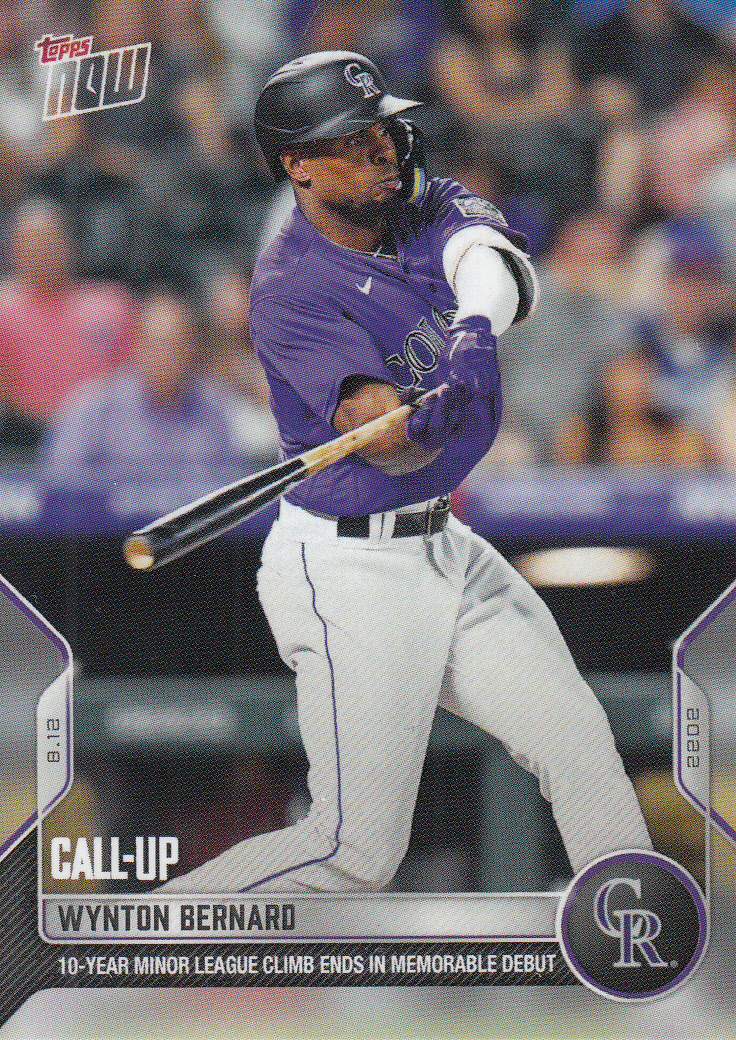
2022 Topps NOW #699 Wynton Bernard /787

I did pick up a second Topps NOW card this year, this one of longtime Minor League player Wynton Bernard, who finally got his long-awaited call up in mid-August. He had been toiling away in the minors for a decade before making his Big League debut at the age of 31.

The Athletic did a great story on him, detailing how he leaned on his mentors, including Ken Griffey, Jr., in his long, winding journey to The Show. His FaceTime call with his mother where he shared the good news was a bright spot in the social media world.

His debut game was August 12th, and he tallied his first hit (following a replay review), stolen base, and run that day. It was a real heartwarming highlight of the Rockies season, one in which they contributed mightily to the 111-win count of the Dodgers.

Topps didn't miss a beat, giving Bernard his first Major League card. Prior to that, he only had a few minor league cards dating back to 2014, although I'm not sure if Topps Now cards count as true Rookie Cards. The goose made an impression on oddball-loving collectors, earning a print run of 2,889, but only 787 collectors like myself picked up Wynton Bernard's quasi-Rookie Card.

So there you have it, those are the two most important highlights of the 2022 season according to Infield Fly Rule.


Saturday, August 27, 2022

The Trading Post #172: Dime Boxes (Part 1: My Picks)

As August draws to a close, we're getting pretty close to Nick's 11th Anniversary. But it's finally time for me to put my entry in for "latest blog post documenting Nick's 10th Anniversary".

Starting in December of last year, Nick at Dime Boxes did a series of generous giveaway posts for the first full decade of his excellent blog. I managed to get claims put in on three or four of his ten giveaways, but more often than not they were pretty picked over by the time I saw the post. No matter, I'm sure they all went to great homes across the blog community.

I ended up selecting a baker's dozen worth of cards from those pages, which arrived in the mail accompanied by a healthy-sized stack of Rockies hand-selected by Nick. That'll be part 2.

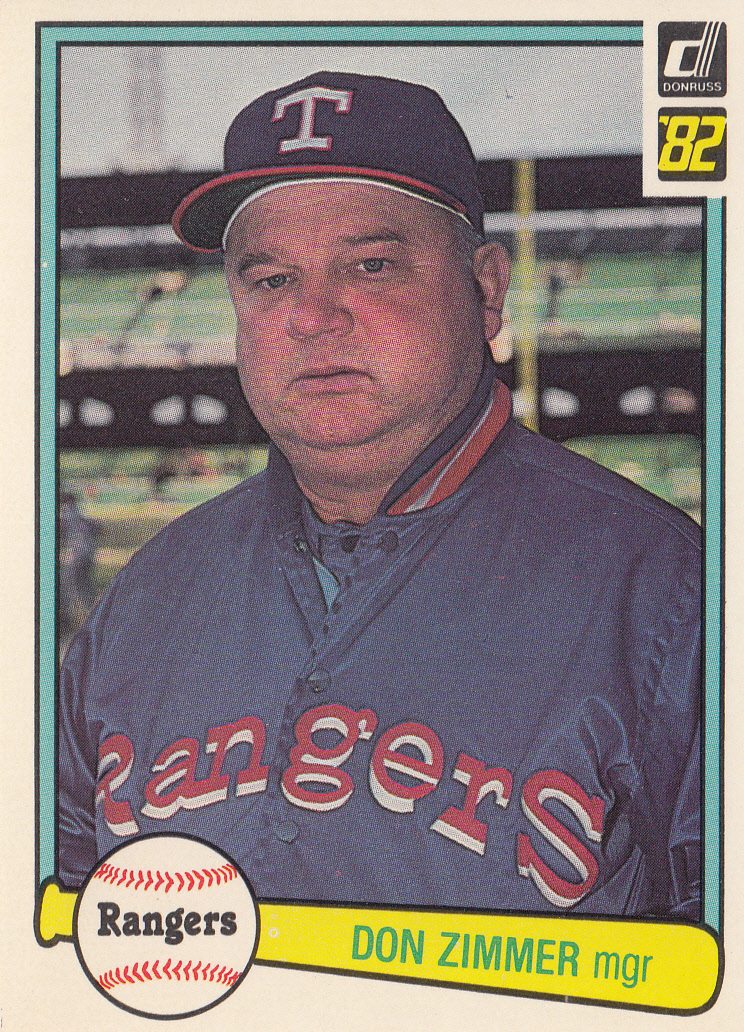
1982 Donruss #195 Don Zimmer MG

These cards won't be in chronological order, but we'll still be starting with the oldest card in the stack, one from 1982 Donruss. That was when Don Zimmer was managing the Texas Rangers. He actually wrapped up his playing career with that franchise, back when they were the second iteration of the Washington Senators. As their skipper, he had a 95-106 record. He had better results when he managed the Red Sox and Cubs, leading them both to winning records overall during his tenure.

As many times as I've seen the famous Bucky Dent home run from 1978, I never realized Don Zimmer was the manager of that unfortunate Red Sox team. But Donruss pointed it out on a lengthy write-up on the back, a wordy paragraph approaching what we once saw from Score.

Many of us remember Zimmer as Joe Torre's right-hand man during the late-'90s Yankees dynasty, and we got a little footage of him in ESPN's recent Derek Jeter miniseries The Captain. But not many remember him as a coach for the inaugural Colorado Rockies, where he appeared alongside manager Don Baylor in those early days at Mile High Stadium and Coors Field.

2015 Topps Archives #24 Cal Ripken Jr.

Rolling things back to very early in the Topps design library, here's a young-looking Cal Ripken, Jr. in 2015 Topps Archives, appearing on the 1957 design. I'll admit, I had to look that one up. Vintage, especially the more plain-looking designs, isn't always my strong suit. But 1992 vs. 1993 Fleer Ultra? I'm your guy.

We get partial career stats for Mr. Ripken on the card back, which has that not-quite-actual-cardboard smooth paper that Topps Archives is known for. The stats show his playing career between 1981 and 1996, but the final few seasons of his storied career are nowhere to be found, except of course in the overall totals. He played 3,001 career games, good for 10th all-time, although he was passed by Albert Pujols earlier this year, who is still going strong and trying to reach that 700 home run plateau before his inevitable retirement.

2016 Topps Bunt #24 Roberto Clemente

When Topps Bunt moved out of the digital app universe and took corporeal form in 2016, it included a mixture of current and retired players. I have about three pages of this set in my 2016 binder, and this Roberto Clemente will complement those other players nicely.

There's a little line on the card back suggesting that I "Collect and trade this card in the Topps Bunt app today!" Unfortunately, I only have this physical version of the Clemente card, and they've long since reached "Sold Out" status in the app. But by searching the app for the "Bunt Physical 16" set, I did discover that I still have a handful of digital cards of this set hiding in a dark virtual shoebox, including a Topaz parallel version of Brooks Robinson's digital card, with a global card count (effectively a serial number) of 440 and Rare classification.

The more traditional portion of the card back makes reference to Clemente's "electrifying defense in right field", and if you haven't seen that before, there are a few brief clips in this video.

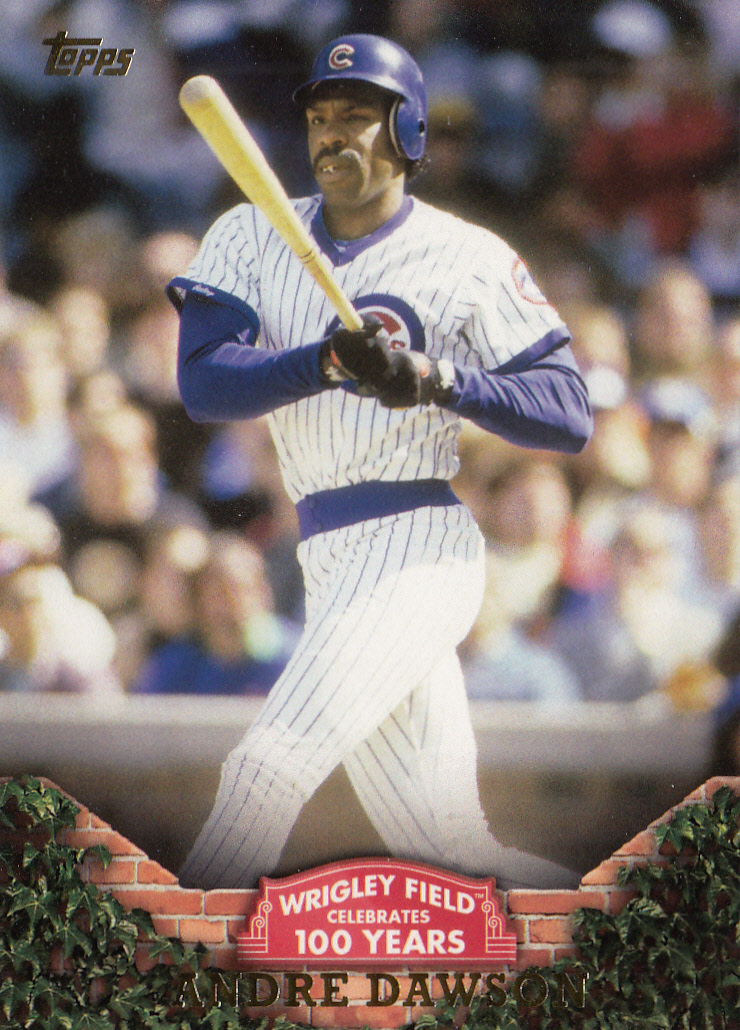
2016 Topps 100 Years at Wrigley Field #WRIG-11 Andre Dawson

This was totally unintentional, but somehow I ended up with a bunch of cards from NL Central teams. Well, of course there was no Central division during Clemente's days, nor Andre Dawson's Cubs tenure for that matter. But it was an odd coincidence.

This new-to-me insert set from 2016 Topps documents 100 years at Wrigley Field, which isn't entirely correct. The Cubs started playing there in 1916, yes, but the ballpark itself opened two years prior as the home park of the Chicago Whales of the ill-fated Federal League. 

Andre Dawson's time at Clark & Addison included an NL MVP award in 1987, which this card points out is the only MVP ever given to a player on a last-place team.

That particular fact reminds me of a story concerning Ralph Kiner, who led the NL in home runs in 1952 despite being on the dismal 42-112 Pirates. Apocryphally, he was told by Pirates management during contract negotiations, "We could have finished last without you."

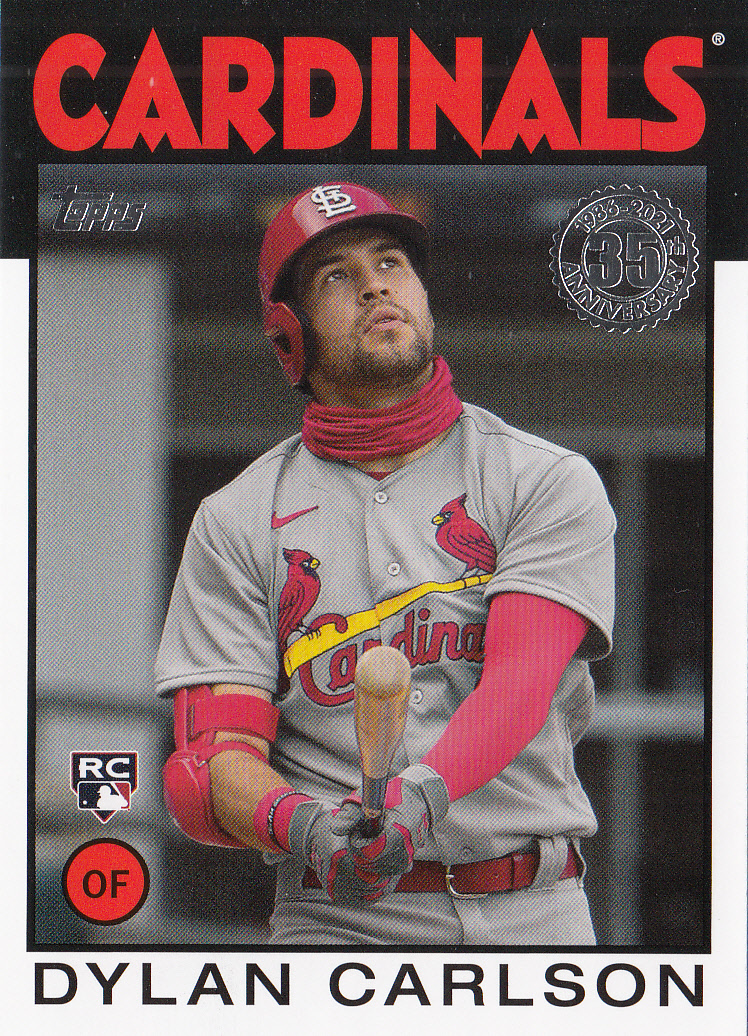
2021 Topps '86 Topps #86B-83 Dylan Carlson

In the spirit of anniversaries, Topps kept their 35th Anniversary series going in 2021, affixing the special silver seal to the 1986 design. Also gracing the design is the Rookie Card logo for Cardinals outfielder Dylan Carlson, who is seeing quite a show being put on by his teammates this season. 

The old veterans Pujols, Molina, and Wainwright are still making the highlight reels, Arenado is flashing the leather as usual, and there's talk of Paul Goldschmidt winning the Triple Crown, something that hasn't been done in the NL since his long ago Cardinal predecessor Joe Medwick won it in 1937.

1996 Stadium Club #299 Fernando Viña

1996 Stadium Club was one of the last sets I collected before I somewhat lost interest in baseball cards for a time, but I do recognize it well since little else went in front of it in the binders for several years. I'm still keeping the run of NL Central teams going, although 1996 puts us before Interleague Play began, and that catcher looks like a Texas Ranger to me, involved in an awkward play at the plate with Fernando Viña of the Brewers.

That would be explained by the fact that the Milwaukee Brewers were a member of the American League until switching leagues in 1998 to even things out with the Diamondbacks and Devil Rays expansion. 

Now that we finally have the Designated Hitter in the NL, the split between leagues is effectively meaningless. That new reality has led MLB to design a less divisional-heavy schedule for 2023, where all 30 teams will face each other for at least one series next season. I'll finally get to cross the Minnesota Twins off my list, the last team I haven't seen play.

Anyway, upon a closer look at this Stadium Club card, it actually looks more like a fight than a play at the plate. Viña appears to have his right hand formed into a fist, although I can't comment on the wisdom of getting into a fistfight with a player wearing a catcher's mask.

That catcher, by the way, is likely the Hall of Famer Iván "Pudge" Rodríguez, who is wearing a commemorative 1995 All-Star patch on his right sleeve. The Rangers showed off their year-old ballpark to the world then, although it was short-lived. It only opened in 1994, but the team has already replaced it with a Texas-sized enclosed stadium just across the street, which was the neutral "bubble" site of the World Series in 2020.

1994 Pinnacle Museum Collection #481 Tim Pugh /6500

Even when I'm picking images off a screen (and knowing how poorly most of our scanners do with shiny cards), I can recognize a shiny parallel when I see one, especially when it has this nifty Dufex technology that was exclusive to Pinnacle/Score at the time.

It's not serial numbered, but these Museum Collection parallels (not to be confused with the hyper-expensive Topps product of the same name) are known to have a print run of 6,500. There's also an Artist's Proof parallel that is even scarcer at just 1,000. Those print run ratios are approximately reflected in my collection. I have a single Artist's Proof, and this Tim Pugh card is my seventh Museum Collection. Unsurprisingly, five of those are Rockies, but somehow I've also ended up with two Cincinnati Reds and nothing else.

1999 Stadium Club Video Replay #VR2 Sammy Sosa

That covers all the NL Central teams, but we still have more to go in that division before we head further west.

When I selected this Stadium Club insert, I may or may not have realized that it was a lenticular motion card. But in any case, it's pretty cool. It's part of a tiny five-card insert set (40% Cubs by the way) called Video Replay, and it shows the motion of Sammy Sosa launching a baseball far into the distance. It's not quite as sharp as those Screenplays cards, which are nothing short of magic, but it's definitely an improvement over Sportflics. 

The video, such as it is, shows Sosa facing off a right-handed pitcher wearing #42, which should narrow down the number of possible plays considerably, but I came up empty. I investigated the rabbit hole for longer than I probably should have, but Sosa hit 609 career home runs, so it's like looking for a needle in a haystack. 

This card is from 1999, so I assume this is a video capture from 1998, and fewer and fewer players wore #42 after MLB retired it in 1997. José Lima is a candidate, and he served up numerous long balls to Slammin' Sammy throughout his career (more than any other pitcher besides Schilling, in fact), but that pitcher is clearly not José Lima. Nor is it Scott Karl, who is a lefty. My best guess was Jason Schmidt of the Pirates. Schmidt did give up a home run to Sosa during the 1998 home run race, but by then Schmidt had changed his uniform to #22. 

Maybe just a random fly ball from a prior season? It sure looks like a home run even in this low-res format, though. Possibly Spring Training? I don't know. Like I said, I investigated the rabbit hole. I don't like not knowing these things.

2021 Topps Fire #121 Nolan Arenado

Our last NL Central card is this Topps Fire card of Nolan Arenado, post-trade of course. You can tell because of that fire engine red jersey and helmet, which the Rockies don't wear.

I do have this card in the Bunt app, but the printed version has a proper card back. That card back tells us how Arenado rapidly made a splash with the Cardinals, hitting safely in his first nine games. That did one better than Roger Maris, who set the prior record in 1967.

Really, he's one of my all-time favorite players. It's just no fun seeing him on another team.

2019 Panini Titan #22 Nolan Arenado

But it's also not so fun anymore seeing cards of him on his original team, because we all know how that played out.

At least I have a space theme on this shiny Panini card to take the sting away a little. The set is called Titan, and it's a 25-card insert set found in 2019 Panini Chronicles. I can't tell you much else about this unlicensed set, but the card back does tell us that Arenado is "a titan straddling the hitting and fielding worlds".

I can tell you lots more about the space theme, though. That's supposed to be Saturn in the background, and Titan just so happens to be the largest moon of Saturn, as well as the second-largest moon in the solar system. It has a thick atmosphere of methane, and the Huygens space probe landed on it in 2005.

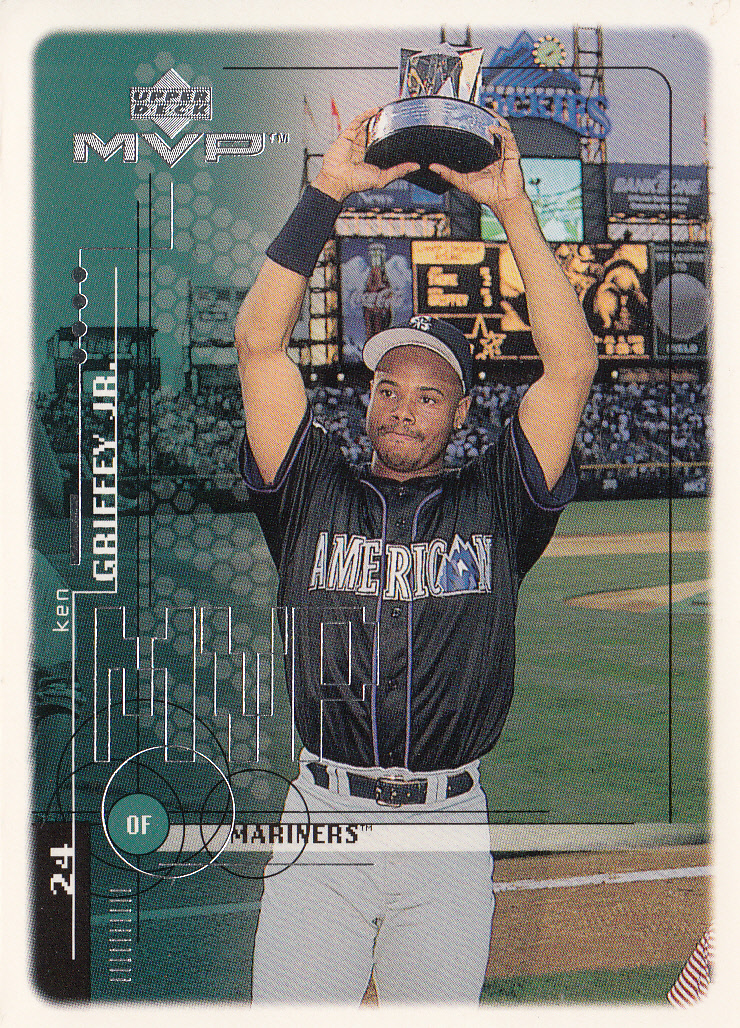
1999 Upper Deck MVP #190 Ken Griffey Jr.

It's rumored that some of the baseballs from the 1998 Home Run Derby even landed on Titan.

But seriously, Ken Griffey, Jr. did win the 1998 Derby at Coors Field, and he's pictured lifting the trophy on his 1999 Upper Deck MVP base card. This is a perfect candidate for my Coors Field frankenset, and one that I've had my eye on for some time.

I didn't get a chance to experience the All-Star festivities in 1998 (although I do remember a blimp hanging around town for the occasion), but I made the most of it when the All-Stars returned to Denver in 2021. The Home Run Derby trophy has changed a bit since '98, as has the Coors Field scoreboard and several of the corporations with ad space on it.

1992 Classic/Best #383 Bob Abreu

I don't usually go for Minor League or Bowman Prospect cards, but this 1992 Classic/Best set is one I've collected for a while. Surely they're not worth much, but I have early minor league cards of guys that went on to become huge stars or even Hall of Famers. Jim Edmonds, Shawn Green, Mike Piazza, Johnny Damon, and quite a few others. I can now add Bobby Abreu to the back pages of my 1992 binder, which is one I don't get a chance to see often enough.

This is more of a tenuous connection to the Rockies, but the Asheville Tourists were the Single-A affiliate of the Rockies until 2020. Prior to that, they were part of the Houston Astros' farm system, and following some shuffling among Rockies affiliates, they're back with the Astros again.

2008 Upper Deck Timeline #35 Roy Halladay

The final card I picked from Nick's giveaway is another color-coded Upper Deck beauty, Roy Halladay's card from the short-lived UD Timeline. To be fair, pretty much everything Upper Deck was printing at that time was short-lived, even the fantastic UD Masterpieces set.

Roy Halladay in particular caught my eye because he was from my home state of Colorado. He went to high school at Arvada West, quite near me and not far at all from a few good birdwatching sites. The Athletic ran a story a couple years ago about his high school championship game, where he faced off against Brad Lidge's Cherry Creek High School team. 

It's sad to talk about him in the past tense. But he was excellent all throughout his career, and as people all over Colorado know, long before he got to the Majors.

Congratulations to Nick on his first decade of blogging, and by now we know his second decade is already off to a solid start.