Thursday, June 23, 2022

Opening Day Is Upon Us (Part 2: Inserts)

Voting for the All-Star Game is well underway. If you haven't voted in the first round, you have about a week left to do that. I did submit a few ballots during the first couple days, and it's so much easier now than when I was a kid. I remember the old paper ballots, and I used to vote so many of them at once that the kitchen table would be blanketed in tiny white paper dots. Things are a bit more environmentally friendly now.

Meanwhile, as the season approaches its halfway point, I'm still over here writing about Opening Day. Specifically, the inserts and other goodies from a blaster of 2022 Opening Day that I got shipped from Target. 

I'll never be caught up again, will I?

And I'm sure I'll hold the record for the last post in the community about Nick's 10th Anniversary giveaway. Sorry, Nick.

2022 Topps Opening Day Mascots #M-19 Mariner Moose

As promised in Part 1, and as longtime readers probably predicted, I did pull a card of a very patriotic-looking Mariner Moose. I've still yet to see one of these gigantic animals in the wild, but that chance is ever-present in the great state of Colorado. I hope that my repeated luck in pulling Mariner Moose cards isn't negatively impacting my luck of seeing a real one, because I'd love to someday.

In the meantime, I'll rely on Topps to keep me in a steady supply of Mascot cards.

2022 Topps Opening Day Mascots #M-7 Dinger

It goes without saying that I've never seen a triceratops in the wild, either. But Dinger makes plenty of appearances on my mascot cards and in person at Coors Field, too. Here's a shot of him all dressed up to host the Purple Carpet show prior to the 2021 All-Star Game at Coors Field. I'm not sure exactly, but this is probably in front of the new McGregor Square building, just across 20th Street from Coors Field.

Hard to believe that was almost a year ago.

2022 Topps Opening Day Mascots #M-9 Orbit

The 2022 All-Star Game is being held in Los Angeles at Dodger Stadium. It was supposed to be there during 2020, but that of course was cancelled due to the pandemic.

There were lots of mascots on the concourse at Coors Field during the All-Star Game. I remember seeing Fredbird, the Phillie Phanatic, and of course Orbit. Though I'm not sure Orbit will be particularly welcome at Dodger Stadium considering the cheating scandal that happened during the 2017 World Series. As pictured on this card, maybe he's limbering up with squats to be able to escape angry fans.

And where's the 2023 game going to be held? That would be Seattle, giving our friend the Mariner Moose a real opportunity to shine.

2022 Topps Opening Day Opening Day #OD-2 Detroit Tigers

The other insert sets found in Opening Day are never as fun as Mascots, but they're still worth a look. Here's the redundantly named Opening Day set, a fifteen-card set featuring half of the MLB teams and their performance on Opening Day 2021. 

The Tigers, in particular, won their season opener in Detroit thanks to a home run from Miguel Cabrera. His turn at the plate began rather normally, but a sudden snow flurry rapidly picked up over the course of his at-bat, ending with the ball just clearing the right field fence.

The future Hall-of-Famer gave fans at Comerica Park memorable moments in two consecutive Aprils, as he got his 3,000th hit two months ago against the Rockies.

2022 Topps Opening Day Opening Day #OD-9 Kansas City Royals

I don't recall the Royals making the highlight reel that day, but they won their 2021 home opener in a 14-10 slugfest against the Rangers. The card back tells us that fan favorite Alex Gordon threw out the first pitch that day, all the way from his longtime station in left field.

I saw the Royals visit Coors Field in May, the 29th team I've seen play. I missed my chance at the Expos, but only the Minnesota Twins remain to be checked off.

2022 Topps Opening Day Bomb Squad #BS-10 Giancarlo Stanton

Nearly as plentiful as Mascots in this blaster were cards from the Bomb Squad insert set. This 25-card set features some of the game's best home run hitters, new and old. Giancarlo Stanton, one of many slugging Yankees, is frequently on the highlight reel for launching baseballs deep into the Bronx night. He is far off his league-leading pace of 59 from his 2017 season, his final as a Marlin, but he still has a respectable 14 so far in 2022. 

The #16 patch on his pinstriped sleeve honors Whitey Ford, who died in 2020.

2022 Topps Opening Day Bomb Squad #BS-7 Babe Ruth

Stanton traces his lineage as a slugging Yankee all the way back to the granddaddy of them all, George Herman "Babe" Ruth. Not much needs to be said about the Sultan of Swat, perhaps the greatest-known player to ever take the field. Nevertheless, the card back gives us plenty of unique statistics, starting off with his career total of 714. The Bambino also led the AL in homers twelve times, and two of those seasons were 35 ahead of the second-place finisher.

They didn't really call home runs "bombs" back in those days, but Ruth's colorful and alliterative nicknames like "The Colossus of Clout" more than make up for it.

2022 Topps Opening Day Bomb Squad #BS-16 Jim Thome

He might not be on the Mount Rushmore of baseball players like Ruth, but Jim Thome is in the Hall of Fame, and he has 612 home runs to thank for it, good for eighth all time. He's pictured here as a Phillie, but he spent most of his career with Cleveland. He was the first Phillie to compete in a Home Run Derby, and the card back also tells us that 17 of his homers came on a 3-0 count.

I seem to remember the baseball world getting into quite a kerfuffle last year when young stars like Fernando Tatís, Jr. and Yermín Mercedes took pitchers deep on 3-0 counts, apparently violating the sacred unwritten rules. I don't remember hearing much about that during any of Thome's 17 blasts.

2022 Topps Opening Day Triple Play #TPC-1A Mike Trout / B Shohei Ohtani / C Anthony Rendon

A trio of Angels (though not the Russian ones from 1993 Topps #633) make up this odd-looking insert card from the Triple Play subset. Mike Trout (who possesses a Ruth-esque nickname of "The Millville Meteor"), Shohei Ohtani, and Anthony Rendon all make appearances, and the card includes a perforation between each player. If you were to separate these, they would be slightly smaller than an Allen & Ginter tobacco-sized Mini. This design also includes the same divot on the top border we saw in 2008 Topps, which everyone disliked for encroaching on the photo.

There isn't much room on these card backs, but somehow Topps still left a ton of white space. Mike Trout's storied career is boiled down to eight All-Star Game selections, more than any other Angel.

Sadly, Anthony Rendon's season came to an end last week due to wrist surgery, but the Angels have added an exciting breakout star to their lineup in Taylor Ward, a five-season veteran who is finally finding his stride.

2022 Topps Opening Day Blue Foil #72 Gavin Sheets /2022

I didn't pull any cards from the exceptionally rare Walk This Way, Luck of the Irish, or Dugout Peeks insert sets, so we'll close with the only Blue Foil parallel I found, a Rookie Card of Gavin Sheets. No relation to former Brewers pitcher Ben Sheets, but he is the son of former Orioles outfielder Larry Sheets. I haven't heard much about him, as he only has 98 games under his belt, but he fits right in on a young White Sox team playing for the oldest manager in the game.

As is usual with Blue Foil parallels, their stated print run is equal to the calendar year, but there is no serial number to be found.

That about wraps up Opening Day, just in time for summer.


Friday, May 27, 2022

The Trading Post #170: The Angels, In Order

Due to inclement weather in our nation's capital, the Rockies have been rained out Friday night. But that's okay, because I still have a game to watch while writing this quick three-card post. The Colorado Avalanche were in St. Louis tonight for a Game 6 against the Blues, advancing to their first Conference Finals since 2002. 

Hockey isn't always at the top of my list of sports, but it's a fast-paced sport that is a delight to watch. It's a good contrast to the chess match that is baseball. Don't count on me getting hugely into hockey cards, though. Baseball remains the #1 sport in my heart.

It's amazing that the MLB season is already a quarter over. It feels like just yesterday when I went to Opening Day. That much of the season has zipped by since my last post. It's been about that long since I claimed three cards from a generous giveaway run by Tom over at The Angels, In Order. He hasn't been particularly active lately, nor have I, but he did pop up long enough to spread some cheer through the blog community.

2013 Topps Making Their Mark #MM-1 Yoenis Céspedes

The first of my three picks is this insert from 2013 Topps, showing the not-quite-retired Yoenis Céspedes. The Cuban-born outfielder hasn't played in the Majors since 2020, when he appeared in eight games during the shortened season before deciding to opt-out. He put together a solid career, mainly for the Mets and A's, and also won the Home Run Derby in two consecutive contests, putting him among Ken Griffey, Jr. and Pete Alonso as the only ones to accomplish that feat.

Long before sending exhibition-game moonshots into the midsummer night, Céspedes hit his first major league home run in early 2012, giving Topps plenty of material for the Making Their Mark insert set. Céspedes's first Major League home run actually happened in Tokyo, facing off against the Seattle Mariners during an overseas opener. It was officially part of the 2012 regular season, a tradition the teams repeated in 2019.

I haven't seen this insert set in years, but it was familiar enough for me to easily recognize it and give myself a chance to open the 2013 binder again. I haven't done that in a while.

2017 Honus Bonus Fantasy Baseball #52 Ryon Healy

Another green-colored selection was my first-ever Honus Bonus card. Among the oddest of all recent oddballs, this product briefly made a splash (maybe more of a gentle ripple) in 2017, never to be heard from again. The 500-card unlicensed set made the rounds back then, and still pops up from time to time on the more oddball-focused blogs around here.

If you're interested, there are some extremely affordable Honus Bonus 1/1s on eBay right now. I'm content to have just one example of this oddball in my collection, if only as a curiosity.

The green borders are about the only splash of color on this whole card, and that's the only clue that Ryon Healy was playing for the A's at the time. You have to flip the card over to check the team, which of course just says "Oakland", given the unlicensed nature of this set. The card back also has a small selection of 2016 stats, his uniform number which we clearly see on the front, and his position. The stats line omits hits, but we are given at-bats and batting average, leaving us to do the math ourselves. They did include his stolen base total (zero), as well as his OPS.

It's a strange one.

Also on the card back is a barcode and a scratch-off section, meant for playing Honus Bonus Fantasy Baseball online. The URL is long-dead, although there are some fossilized fragments remaining at archive.org.

Speaking of all this green, the Rockies unveiled their City Connect uniforms today, set to debut on-field on June 4th against the Braves. The mostly-green uniforms are patterned after the retro Colorado license plates, which were mostly green with white lettering. Even the typeface is the same. There are other Colorado-themed elements, such as the GPS coordinates of Coors Field, a double black diamond meant to represent a ski slope sign, and a few purple accents scattered throughout.

In fact, in taking a closer look, the yellow patch containing the GPS coordinates and the diamonds looks a bit like the annual stickers that go on the corner of a license plate.

I can't wait to see it appear on a card.

1998 Topps Stars Gold #58 Masato Yoshii /2299

Rolling things back to the late-'90s, our final collectible is a parallel of Masato Yoshii's Topps Stars card, serial numbered to 2,299. That print run identifies this as the Gold parallel. So does the gold lettering, of course. Even the regular base cards are serial numbered to 9,799, making these on the scarce side.

As you can see, Yoshii's first team in North America was the New York Mets, where he stayed for two seasons. Following that stint, he joined the Colorado Rockies for one season, becoming the first Japanese-born player to suit up for the Rockies.

The card back has a five-star player rating system for a variety of metrics, from the easily measurable "Velocity" to the highly intangible "Savvy". He rates two and five stars in those categories, respectively. Below that is a trivia question, asking us which Met was the team's first Rookie of the Year in 1967. We have to check the next card in the checklist to find the answer, but in case you're not one of the fewer than 10,000 owners of card #59 (I am not), I'll tell you that the answer is Tom Seaver.

The trivia answer that carries over from card #57 is "Fernando Valenzuela in 1981", which was obviously asking about that year's Rookie of the Year Dodger. Card #57 is Hideo Nomo, cleanly tying it all together. I don't have that card either, but maybe Night Owl has it hiding somewhere and can confirm for us.

Thanks to Tom for the giveaway and enjoy the next three-quarters of the MLB season!


Sunday, April 10, 2022

Opening Day Is Upon Us (Part 1: Base)

At long last, the 2022 MLB season has begun. The lockout, while it did delay Opening Day by a week or so, was ended early enough to salvage a full season. Baseball is back, though not without some notable changes.

The National League, nearly a half-century after the American League made the switch, is now using a Designated Hitter, although MLB carefully carved out some exceptions so as not to diminish Shohei Ohtani's unique strengths. The extra innings ghost runner rule is still intact. Playoffs have expanded to 12 teams, further eroding the value of playing a 162-game schedule. The TV streaming landscape continues to grow ever-more fragmented, and umpires are finally using the stadium PA system to explain reviewed calls. 

But in speaking with more casual baseball fans in my circle, the thing I've been asked about the most (once they learn that the lockout is over, that is), is the electronic pitch-calling system that a few teams tested during spring training. After what happened with the Astros in 2017, the system for catchers calling pitches was definitely due for an upgrade. Teams throughout the league now have the option of using the new PitchCom system, a button-operated device worn by the catcher that audibly communicates the selected pitch to up to five players over an encrypted radio channel. As baseball changes go, it's been pretty well-received.

The game has changed a lot in the past few years, not to mention in the past century.
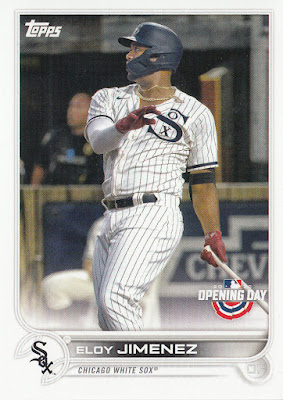
2022 Topps Opening Day #76 Eloy Jiménez

On the other hand, the game hasn't changed so much that it's lost its roots. The 1919-esque Field of Dreams game that took place last summer still has its place. And Topps picked a few photos from that evening's event for 2022 base cards (and thus the quasi-parallels of the Opening Day set). Eloy Jiménez, one of the stars of a young White Sox team, is pictured here in the throwback Sox uniforms worn by the team that night in Dyersville, Iowa. It's been jazzed up a little bit with modern touches like the Nike Swoosh, gold chains, and the helmet C-Flap, a piece of safety equipment that saved Francisco Lindor from a serious injury on Friday night.

As we approach Easter, it's worth telling an amusing story about Eloy Jiménez. Late in spring training last year, he suffered a tendon injury and was projected to miss several months. Of course that was unfortunate, but the White Sox tweeted about it in such a way (granted, on April Fools' Day) that made it sound like he had died. After plenty of misunderstanding among the fan base, everyone started joking "He is risen" upon his earlier-than-expected return last summer, which came in plenty of time for him to emerge like an apparition from the outfield corn in Iowa.
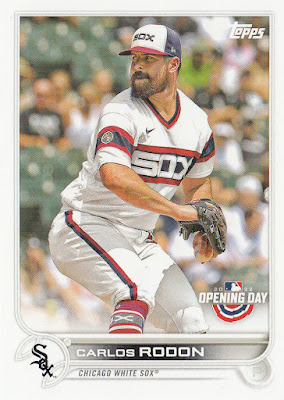
2022 Topps Opening Day #120 Carlos Rodón

In flipping through the surprisingly massive quantity of cards that came out of a single blaster (including not one, but two "Extra Packs"), I noticed just how many different uniforms the White Sox wore last year. Another throwback worn by pitcher Carlos Rodón is, um, thrown back but not as far, bringing us back to the early-mid 1980s. There sure is a lot of red on the sock for a team called the White Sox.

Rodón, who pitched a no-hitter just under one year ago, has an "MR" memorial patch on the right sleeve of his uniform, something we'll see lots of throughout this post. The MR initials are for Martyl Reinsdorf, wife of White Sox Chairman Jerry Reinsdorf. She passed away in June 2021.
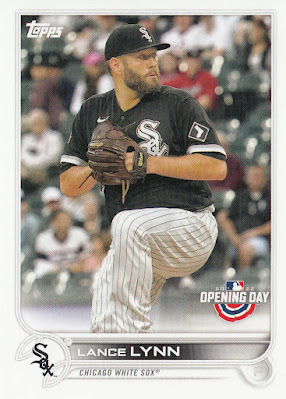
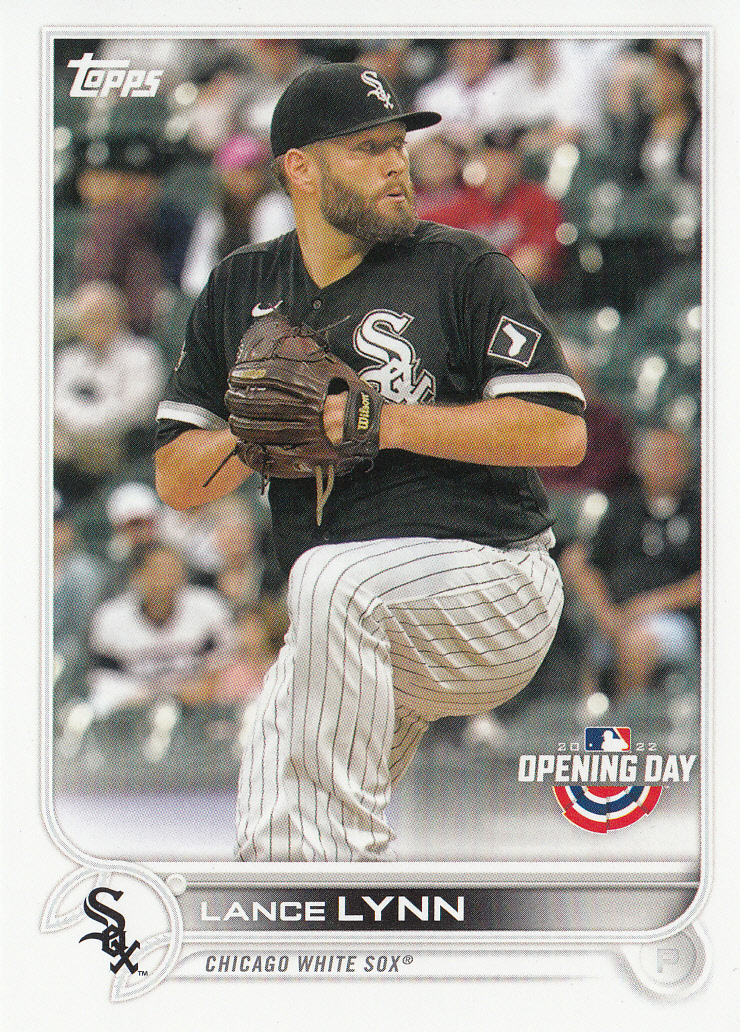
2022 Topps Opening Day #192 Lance Lynn

Of course, the White Sox often wore their normal black and white pinstriped uniforms too, but that's less interesting, so let's move on while pitcher Lance Lynn recovers from knee surgery.
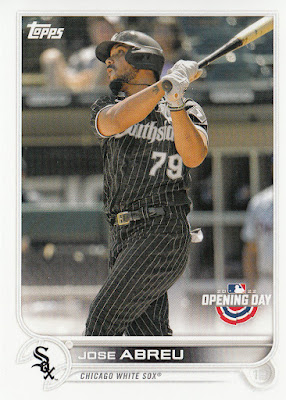
2022 Topps Opening Day #194 José Abreu

That brings us to José Abreu, the MVP veteran of the White Sox, sporting the team's special City Connect uniform. By the end of 2022, about half the teams will have partnered with Nike to create these unique City Connect uniforms, meant to "explore the personality, values, and customs that make each community and their residents unique", according to the press release. The White Sox, as you can see, have all-black uniforms with white pinstripes, and "Southside" lettering across the front, tying them into their particular area of Chicago.
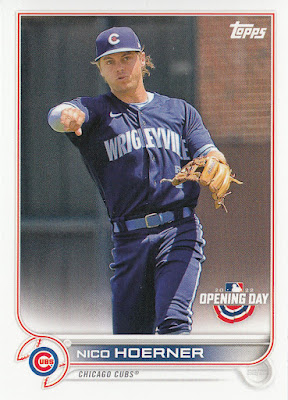
2022 Topps Opening Day #147 Nico Hoerner

Contrast that with their crosstown rivals, the Cubs, whose dark blue City Connect uniforms have "Wrigleyville" lettering. A mere eleven miles away up Lake Shore Drive, the Cubs have their own section of Chicago firmly locked up, and are next in line to play in Iowa for their own Field of Dreams game this August 11th.

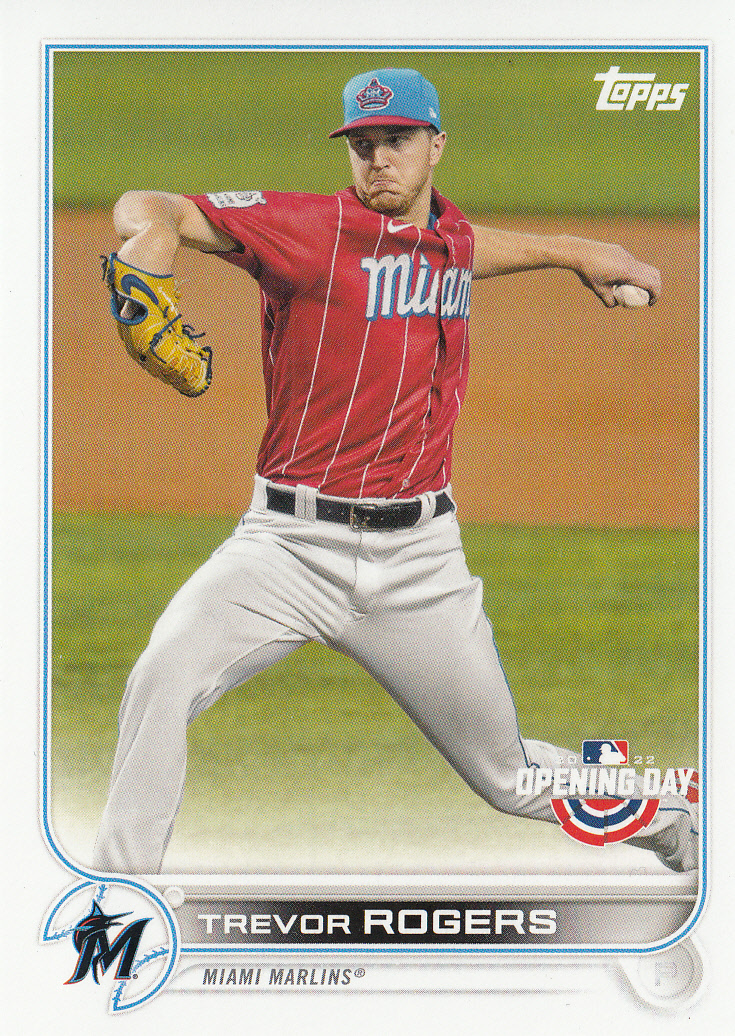
2022 Topps Opening Day #98 Trevor Rogers

The Marlins debuted their own City Connect uniforms in 2021, featuring "Miami" in script lettering on a red background, along with a blue cap. These are the colors once worn by a Cuban-based Minor League team, the Havana Sugar Kings. That team's history came to a sudden end around the time of the Cuban Revolution, although they eventually evolved into the franchise that is today's Triple-A Norfolk Tides.

Even the patch worn on Trevor Rogers's right sleeve is a near-replica of the original Sugar Kings logo, slightly altered to include the Marlins name. The Sugar Kings may not be around anymore, but the Cuban connection in Miami very much is.

I'll always have a fondness for the turquoise uniforms the Marlins debuted with in their inaugural 1993 season, but these are pretty cool.
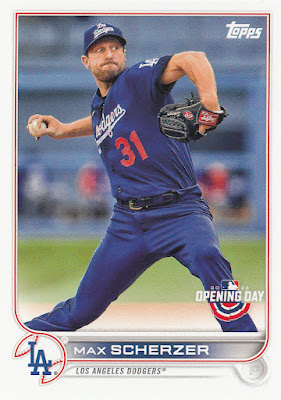
2022 Topps Opening Day #129 Max Scherzer

The Dodgers debuted their "Los Dodgers" jerseys in L.A. last summer, but this one wasn't as well-received among fans. It's a nice shade of blue, but isn't especially different from the team's usual uniform. Max Scherzer isn't even a Dodger anymore anyway. He's with the Mets now, and I find it surprising that neither New York team has been involved in this program yet. The Yankee pinstripes are timeless, but surely the Mets could come up with something.
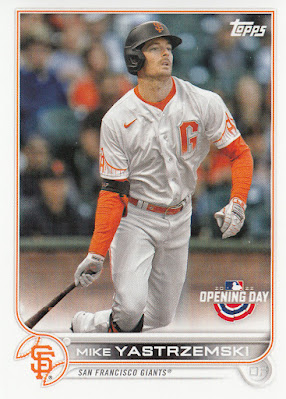
2022 Topps Opening Day #86 Mike Yastrzemski

Think of San Francisco, and you'll probably think of the Golden Gate Bridge. The designers of Mike Yastrzemski's alternate Giants uniform thought the same thing. They added what's meant to be a layer of fog on the all-white uniforms, and even a white gradient on the bottom of the "G", as though the logo is emerging from the fog the way the bridge towers do.

As a tech worker, the bridge design on the sleeves remind me of older Cisco logos.

The Red Sox and Diamondbacks got in on the City Connect fun last year, but I didn't find any such cards of theirs in this blaster. Several more teams this year, including the Rockies on June 4th, will have a new alternate jersey in the series with which to take the field.

I have to admit that these kind of flew under my radar last year. I had seen them on highlight reels, but didn't really put together how inspired and creative these were meant to be. I'm excited to see more teams have their City Connect jerseys unveiled throughout the season. I've made it a point to put this year's release dates on my calendar, since clearly I'm into it. I've spent eight cards talking about little else but uniforms, and there's more where that came from.
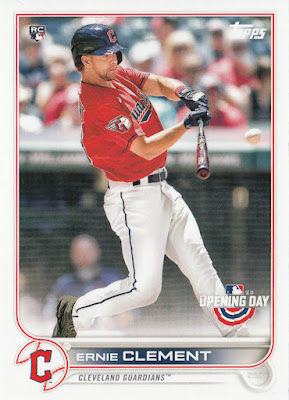
2022 Topps Opening Day #166 Ernie Clement (RC)

This is a Photoshop job, but it is our first look at Cleveland's new team name and logo, the Guardians. Unfortunately, they lost their first game under the new banner. 

I don't have much to say about rookie Ernie Clement, but I haven't said anything about the 2022 design yet, so here goes. 

I like it.

It doesn't seem quite as much like a Bowman design as I first thought. I particularly like how the red line around the outer border swoops around and curves through the stitches of the baseball design element in the lower left. The team name and especially the position are pretty tiny and hard to read, but the size of the player's name is a huge improvement over the 2021 set, as are the photographs. 

I do see how collectors are calling this the "wrench set" based on the lower design elements, but I don't see a wrench as vividly as I see the so-called sea turtle in 2013 Topps, at least not when the border is color-coded for a red team. Maybe it's a little more noticeable with a white border. The colored border carries over to the back, but the baseball stitch loop area is only halfway there. Where the other half would be is occupied by the card number.
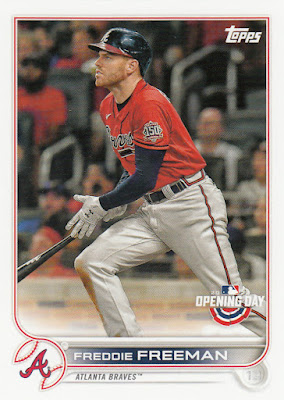
2022 Topps Opening Day #219 Freddie Freeman

Not counting something like Topps Update, the photos we get on baseball cards are typically one season behind. Printing technology has improved by leaps and bounds since I started collecting (really, go back and look at the photo quality on late-80s Donruss sets), but the constraints of creating, printing, and distributing baseball card sets have only gotten more challenging. We've only had Topps Now for a handful of years, and keep in mind you've never been able to buy that by the box.

I'm not expecting a current-year photo of Freddie Freeman on this card. That would be silly; the season is only a few days old. I'm just using that as a segue to point out the commemorative patch from 2021 on Freeman's sleeve, the 150th Anniversary of the Braves franchise. They can trace their lineage all the way back to 1871's Boston Red Stockings, which predated the National League itself by five years.

I happened to get a good look at Freeman on Friday when his new team, the Dodgers, visited Coors Field for Opening Day. Yes, some Opening Day tickets came my way this year, and it was a fun experience to be back at the ballpark, but the Dodgers sort of spoiled the fun. Their entire lineup is just one MVP after another, with some All-Stars peppered in there for good measure.

2022 Topps Opening Day #94 Adam Wainwright

Adam Wainwright's stellar career is likely drawing to a close this season, along with that of his longtime battery mate, Yadier Molina. That's probably just who is ready to catch the pitch that Waino is winding up for on this photo.

Many of the Hall of Fame legends we lost in the past couple years were honored with memorial patches during the 2021 season. Bob Gibson and his #45...
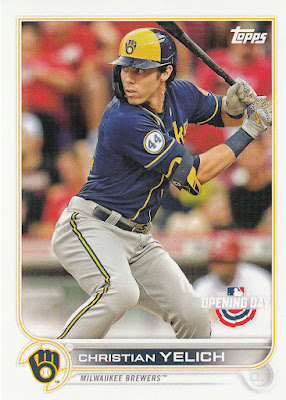
2022 Topps Opening Day #174 Christian Yelich

...Hank Aaron and his #44 (though he was only briefly a Brewer)...
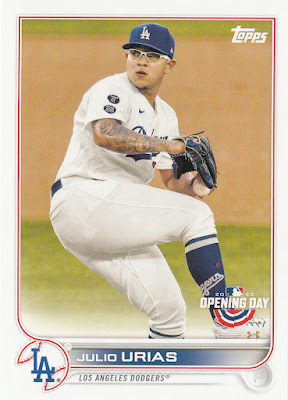
2022 Topps Opening Day #65 Julio Urías

...Tommy Lasorda's #2 and Don Sutton's #20...
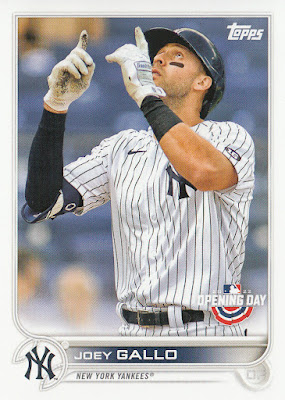
2022 Topps Opening Day #5 Joey Gallo

...Whitey Ford's #16...

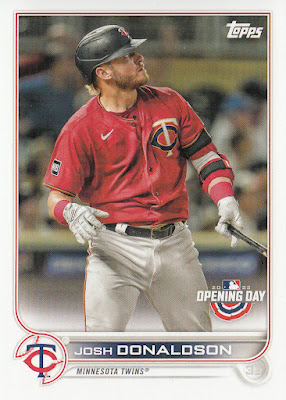
2022 Topps Opening Day #168 Josh Donaldson

...Mike Bell's initials, the bench coach of the Twins...
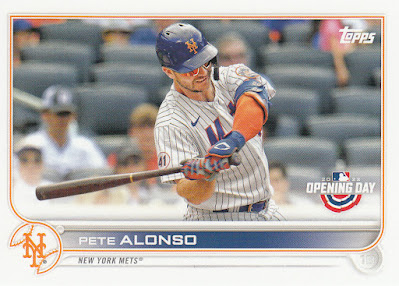
2022 Topps Opening Day #191 Pete Alonso

...and Tom Seaver's #41.

It's sad, that much loss. But it's always a nice gesture when teams honor their great legends. 

Seaver's number is being worn by Pete Alonso, one of the exciting young stars whose name isn't mentioned nearly as much as Tatís, Guerrero, Soto, Acuña, and others. He was the 2019 NL Rookie of the Year and has two consecutive wins at the Home Run Derby. Alonso, aka Polar Bear, is a few years older than those vibrant young players, but I think he's a bit underrated.

The card back mentions the whopping 74 home runs he hit at the 2021 Home Run Derby. He's likely to get plenty more great horizontal cards in future Topps sets if he keeps that up.
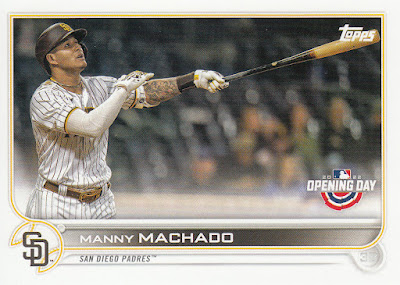
2022 Topps Opening Day #82 Manny Machado

I really am not a fan of Manny Machado, but I have to admit that this a fantastic card. The cropping and pose is great, and the "wrench" design works especially well in horizontal orientation. I even noticed the tiny white dot between the team logo and the player's name, which I didn't spot on the vertical cards.
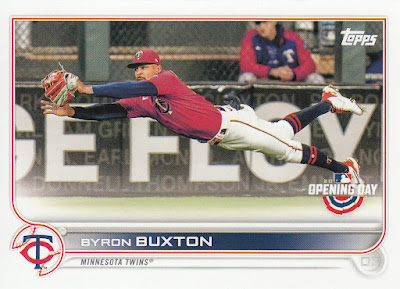
2022 Topps Opening Day #38 Byron Buxton

Many of the best defensive plays, which I have a special appreciation for thanks to my Nolan Arenado fandom, really can't be depicted any other way than horizontally. Byron Buxton, now a Twin for the next seven years, shows us exactly why. 

Home run robberies, on the other hand, would typically need a more traditional vertical orientation. 

We've been seeing cards like these for a long time, but I have to wonder what a collector from fifty years ago would think, someone who had just started seeing "In Action" photos appear on baseball cards. We look back fondly on various baserunning and play-at-the-plate cards from that era and still write about them today. Will we still be talking about Byron Buxton cards in the year 2072?

I can't promise this blog will go on that long, despite my best efforts.
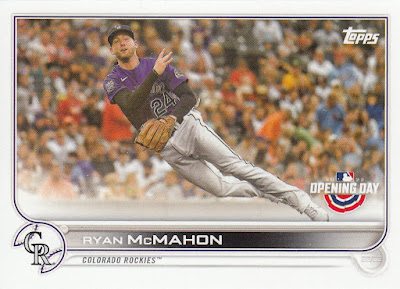
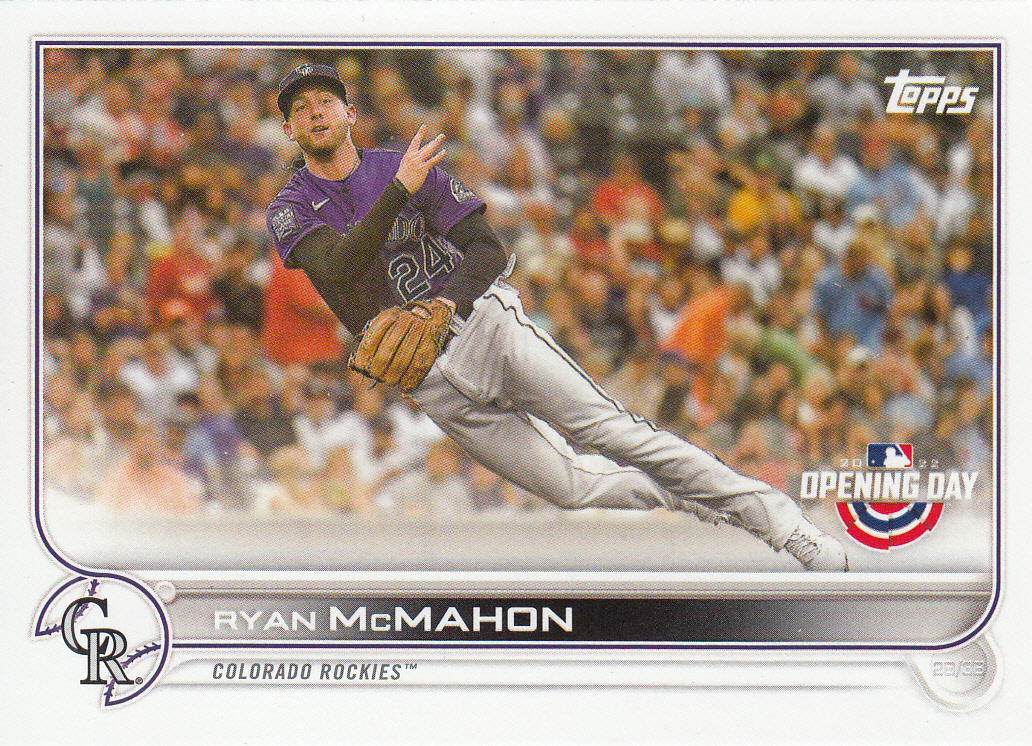
2022 Topps Opening Day #169 Ryan McMahon

Only a couple Rockies were present in this blaster, chock full of over 150 cards. Ryan McMahon was the first among them, and he's holding down the starting third baseman job for the Rockies even after the team signed Kris Bryant, who is now apparently a left fielder. I never expected this Stadium Club insert from several years ago would end up being related to an eventual Rockies player, but I'm glad I held onto it. Bryant had a chance to tie the game on Opening Day in the 9th inning, but foul tipped the last pitch for a strikeout.

Clearly he is the big news in Denver this year, other than Russell Wilson joining the Broncos, who traveled a couple miles east to throw out the first pitch on Opening Day. All I'm talking about is Bryant in relation to RyMac's card. But McMahon is growing into one of the fan favorites around here, and he had an RBI and a double in Saturday's night game. Perhaps the All-Star Game patch on his sleeve is a sign for the future of his career.
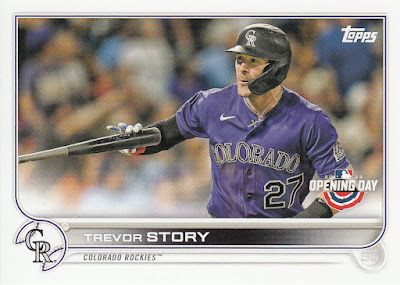
2022 Topps Opening Day #177 Trevor Story

Trevor Story, on the other hand, couldn't get out of here fast enough. He signed a deal with the Red Sox, and he's playing second base instead of his usual shortstop, a position that is currently occupied by Xander Bogaerts. As I understand it, the Rockies offered him more money than did Boston, but he still decided to venture out elsewhere.

Whatever happens now, at least us Rockies fans had six seasons of electrifying performance and monster home runs from Trevor Story to look back on. I don't know what it was, but somehow his homers just felt like they were bigger, even if they often traveled roughly the same distance as many others. He was a lot of fun to watch, and I wish him well.
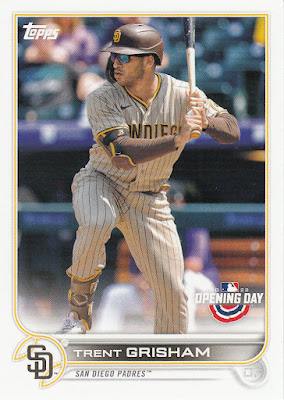
2022 Topps Opening Day #199 Trent Grisham

Trent Grisham is one of the very few players in the MLB who chooses not to wear batting gloves, but the main reason this Padres card caught my eye is that it's obviously a candidate for my Coors Field frankenset. That much purple, especially in and on the dugout, makes it hard to mistake for anything else. Plus, as a player in the NL West, he's much more likely to play in Coors Field during a road game.
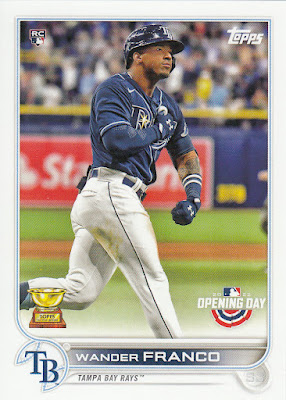
2022 Topps Opening Day #208 Wander Franco (RC)

And finally, this wouldn't be a proper post about a 2022 baseball card set if I didn't mention Wander Franco, this year's red-hot rookie whose cards are currently going for eye-popping prices. I'll end up with his Topps Series 1 rookie card later on once I buy the factory set, but the nearly-identical Opening Day version will hold me over until then.

The season is barely underway and I've already seen this card countless times, enough to notice that between the Topps Rookie Cup and the Opening Day logo, the design elements at all four corners of the photo are nicely symmetrical. That symmetry is slightly thrown off on his Series 1 base card since there's nothing in the lower right.

This post was twenty-two cards, possibly a record for me. And this is just part one. Come back later for the Mariner Moose (yes, I did get the Mariner Moose because of course I did) and the rest of the inserts in part two.


Sunday, March 27, 2022

The Trading Post #169: More From Roger

Roger knows he has an outlet for cards now. I visited my girlfriend one evening recently and she gave me a small stack of four cards that he set aside for me, pretty much out of the blue. Unlike the first cards I got from him, these were from about ten years into the history of the Rockies. The turn of the millennium, as we don't often call it. 

In any case, I wasn't doing much collecting circa 2000-2002, and it's unusual to run across cards from this comparative lull in the hobby. Pinnacle was a thing of the past, and it wasn't looking too good for the remaining survivors. The Rockies didn't have an especially memorable team during that time either, and 2000 was one of just two non-pandemic seasons in the team's history that I didn't attend a game in person.

2001 Topps Chrome Traded #T15 Andrés Galarraga

Andrés Galarraga had long since moved on from the Rockies by the time 2001 rolled around. Topps was deep in their period of experimenting with colored borders, and this 2001 Chrome example from the Traded set actually looks pretty good when given the shiny treatment. I didn't love the mustard-yellow 2002 borders, but this emerald green from 2001 was really nice. It does suffer from that annoying curl that has plagued Topps Chrome for decades, but it looks so good otherwise.

This card from the Traded set actually documents The Big Cat moving from Atlanta to the San Francisco Giants. 1997 was his last season with the Rockies, at which point Todd Helton took over at first base. Galarraga missed the 1999 season while battling lymphoma, but made it back to the Bigs for a few more seasons. Following this stint with the Giants, he returned to his original team, the Expos. Then it was back to San Francisco, then another battle with that insidious foe cancer, then a final appearance in the Majors with the Angels at the end of 2004.

He finished with 399 career home runs, falling just a hair short of 400 (and maybe a chance at lots more if not for his health issues). He was my favorite player as I grew into being a Rockies fan, and he's the guy whose batting stance I liked to emulate while playing little league.

2003 Donruss Champions #93 Juan Uribe

Prior to this, I had a grand total of six cards in my collection from 2003 Donruss Champions, so I certainly can't call myself an expert. In looking at the checklist, each team was grouped together by card number. The Rockies were #90-96, a mere seven cards. Coincidentally, seven matches the number of triples Juan Uribe hit in 2002 as the Rockies shortstop, somehow a decline from the eleven he put up in less than half a season during his rookie year of 2001. Baseball-Reference and the card back are in agreement on that number, which happened to be a tie for the NL lead in 2001.

The design of this set is a little cramped, taken up mostly by the giant National League logo, the shiny Donruss Champions logo, and the banner-like superlative that occupies the remaining space on the left-hand side. When you visit Coors Field, you'll find lots of banners like that suspended from the rafters over the concourse, documenting Silver Sluggers, lots of batting titles, a Rookie of the Year award, and so on. They didn't get quite as specific as Donruss Champions did, but the team does have at least a little bit of hardware to show for a quarter-century or so as part of Major League Baseball.

2002 Fleer Tradition Update #U46 René Reyes SP (RC)

I guess I was watching the Rockies with some regularity in the early 2000s, because I do remember the name René Reyes. His Major League career spanned part of two seasons with the Rockies for a total -0.6 bWAR. Nothing great, and he only slugged one triple, or "trifecta" as that Donruss card called it. But his Minor League career was promising enough to be included in this retro-themed Fleer Tradition set with "PROSPECT" billing.

Further investigation of his Baseball-Reference page reveals the only negative value I can recall seeing for OPS+. That's a ballpark-adjusted metric, where the average is normalized to 100. Barry Bonds was +263 in 2004. Reyes was -2. 

So, short print or not, you can see why his career didn't last.

2000 Bowman's Best Year by Year #YY8 Juan González / Larry Walker

The final card today is definitely new to my mental collecting encylopedia, and thus to my 2000 binder. I don't run across many inserts from this era, but here's one anyway from 2000 Bowman's Best. It's a two-player card featuring both Larry Walker and Juan González, who each made their debut in 1989. They're the subject of that year in the Year By Year insert set, which looks at players who debuted in the same season and followed a similar career arc. 

González and Walker, for example, both hailed from outside the USA. Their careers peaked in the mid-1990s, each winning MVP honors around that time. González won the AL award in 1996 and 1998, and we're told that Walker captured his first in 1997. That ended up being a bit optimistic on the part of Topps, as Walker only had the one MVP to his name, which remains the only MVP award in Rockies history.

The card itself is a refractor, slightly textured, and I'm pretty sure it's acetate, although there are no transparent elements to confirm that.

Thanks again to Roger for the collectibles (he also gave me an old Rockies Magazine that was fun to flip through), and these will have a good home in my collection!


Sunday, February 27, 2022

The Trading Post #168: Roger

I can't even remember the last time I did an in-person trade. Most likely it was when I was in middle school. But I had the chance to rekindle that activity around the holidays this year. 

Roger is an old family friend that my girlfriend has known forever. He and his wife Beth joined me, my girlfriend, and her sister to watch a late-season Broncos game on TV, which was the last game or two of the 2021 regular season. I can't quite place the exact week even though this was merely two months ago, but I did take the opportunity to give Roger a few cards from my collection. Roger is an avid card collector and often shares his extensive collection (including lots of graded vintage) on his Facebook page. He's one of the very few people in my immediate circle that speaks the language of card collecting.

I knew I wanted to surprise him with some cards for the holidays, but as nice as it is to chat with someone who knows about baseball cards, that does mean it's a bit tricky to put together an appropriate trade. I can't just come bearing a stack of recent Topps commons; that would simply shift duplicates I have seven or eight copies of into his stack of what is also likely seven or eight copies.

What to do?

I settled on a half-dozen or so duplicates from the oversized 1994 Fleer Extra Bases set. I originally got them from Julie at A Cracked Bat, one of the most entertaining blogs in this whole community. I haven't seen a post from her since October, so I hope she's well.

In any case, I felt reasonably confident that my extras from Fleer Extra Bases would be new to Roger's collection, and he certainly seemed to enjoy them. Many of us longtime Colorado residents remember all those early Rockies. Burks, Girardi, etc..., although I may have stumped him with Mark Thompson.

A couple weeks later my girlfriend gave me a stack of cards that Roger found for me in return. He knows I'm a Rockies fan (we've all been to a game together), and these cards from did not disappoint. Current Rockies, past Rockies, and even some yet-to-be Rockies. And football, to match the occasion.

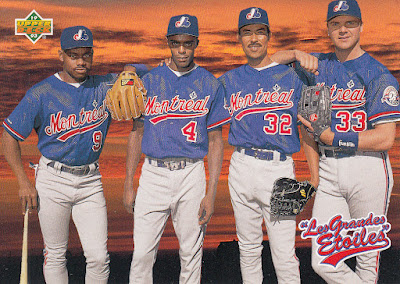
1993 Upper Deck #481 Marquis Grissom / Delino DeShields / Dennis Martínez / Larry Walker

1993 Upper Deck is one of the best sets to come out of the entire (first) overproduction era, and for good reason. This team card of the Montréal Expos shows four of the team's Big Stars ("Les Grandes Étoiles" in French on the card front), conveniently arranged according to height. From left to right, these players are Marquis Grissom, Delino DeShields, Dennis Martínez, and Larry Walker. Martínez is one of just a small handful of MLB players to hail from Nicaragua, and is also on the similarly short list of pitchers who have thrown a perfect game. None other than Marquis Grissom chased down the 27th out that afternoon in Los Angeles.

And of course Larry Walker is now a Hall-of-Famer. His #33 is retired in Coors Field, numerals that are prominently displayed on his attractive blue jersey. You can also see the 25th Anniversary patch the Expos wore in 1993. It's sad that they didn't make it to fifty, and that we didn't get to see how the 1994 Postseason would have played out. It's very possible that Larry Walker would have done better in Hall of Fame voting had he had the chance to display some heroics that year.

Here's hoping the 2022 season doesn't leave us with similar question marks.

1992 Stadium Club #256 Larry Walker

Here's another of a surprisingly acrobatic Larry Walker, this time a solo card from 1992 Stadium Club. This horizontal shot shows him in San Francisco's Candlestick Park, with Christy Mathewson's retired name banner in the background. Mathewson played in the days before uniform numbers, so just his name gets the special recognition. The Tigers gave Ty Cobb the same treatment on their wall of honor in left center at Comerica Park. 

Larry Walker would eventually have his number retired by a team that didn't exist when this photo was taken, during a ceremony that took place in a stadium that wasn't built yet.

1991 Topps #610 Andrés Galarraga

Few fans really think of this, but Andrés Galarraga and Larry Walker were teammates for three seasons on the Expos, long before they ever reached Blake Street Bomber status. Galarraga was even an All-Star in 1988, a fact I was surprised to learn when I thumbed through the All-Star subset in 1989 Topps at a young age. This posed shot makes for a great horizontal card, something we saw plenty of in 1991 Topps. 

I miss the Expos. I never had a chance to see them in person, at least not until they became the Washington Nationals. Maybe someday we'll have them back in some form, although it seems unrealistically hopeful to think about expansion when the current labor dispute appears to be quite serious.

1992 Topps Gold Winners #371 Dante Bichette

Moving on to a card that is new to my overall collection and not just a walk down memory lane, we come to former Brewer Dante Bichette. Like Galarraga, he was one of several players who had a rather unremarkable career going until he joined the Rockies. 

1992 marked the year Topps made the move away from traditional cardboard, as well as when they added their first photographs to the card back. Those photos showed a panorama of the team's home stadium, in this case County Stadium in Milwaukee. I ran across a photo on Reddit the other day showing Miller Park (now known as American Family Field) under construction right next to County Stadium, which you might enjoy seeing.

This is clearly a Topps Gold parallel, the first year of one of my all-time favorite parallel sets. Many of these were found as a one-per-pack parallel, but this particular card has a "Winner" stamp in the lower right. That's meant to differentiate it from a pack-pulled Gold card. Topps had a redemption program in place during 1992 where the reward was more Topps Gold cards, but unfortunately it was easily abused. Topps responded by including the Winner stamp on the redemption cards only, and they're generally more common than the normal Gold cards. This matches what I see in the ratio between the two types in my 1992 binder, but not dramatically so.

1991 Score #585 Joe Girardi

Early Score cards were known to have write-ups on the back that fell somewhere between pamphlets and novellas. Joe Girardi's 1991 Score card is no different, as it tells us all about how he became the starting catcher, his defensive and offensive accolades, how he beat up on the Giants in 1990, and that he blocks the plate well. The card front verifies that, as we can see an incoming Atlanta Brave baserunner (possibly Lonnie Smith) bearing down at motion-blurring speed.

We can also see a commemorative patch on Girardi's right sleeve, which is the All-Star game host patch the Cubbies wore during the 1990 season. 

1993 Upper Deck #706 Dale Murphy

Even casual fans likely know that all the above players once suited up for the Colorado Rockies. Maybe not Girardi; he's probably better known for his managerial career, but surely the rest. But not many know that Dale Murphy, one of the most well-loved Atlanta Braves players in history, was once a Rockie. It only lasted for 26 games in the early part of the 1993 season, but it really did happen. It was real enough for Murphy to make it into Series 2 of that magical 1993 Upper Deck set, and he even got a photo on the card back of him wearing that most desirable of '90s apparel, the Starter jacket.

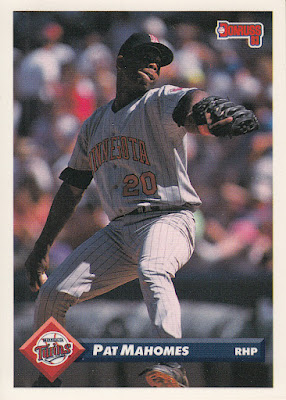
1993 Donruss #357 Pat Mahomes

Pat Mahomes never joined the Rockies, but he was a journeyman through 2003. Presumably, Roger included him in this stack because of the football connection. NFL fans all over recognize Patrick Mahomes of Kansas City as one of the game's superstars, but few know his dad spent about a decade as an MLB pitcher. 

After all these years, it's pretty surprising how little 1993 Donruss I have in my collection. It's not tiny; I'd say six or so full pages front and back, but for a major brand's base set from the first year I collected, it's positively scarce. I'm pleased to add this one to my collection. I would have preferred a better-exposed photograph, but Donruss was not great at that for a number of years.

2020 Donruss Retro '86 Signatures Red #84 Peter Lambert /99 (AU)

Roger gave me one card of a current Rockie, which is right-handed pitcher Peter Lambert. This one from 2020 Donruss is a parallel based on the 1986 Donruss set, and it includes a /99 serial number as well as a sticker autograph. The purple uniform, the dazzling red design, and the Coors Field forest almost made me forget the lack of MLB logos. It's a well-done card of a young player we all hope will turn into a solid member of the rotation.

Lambert did get a couple games in as a late-season call-up at the end of 2021, but he hasn't had much of a chance to make an impression on Rockies fans yet. He underwent Tommy John surgery in 2020, so hopefully 2022 will be a positive and injury-free season for him. Once the season starts, that is. We've blown well past the time when pitchers and catchers would have reported to Spring Training, with no real end in sight.

I'm not sure why there's a disconnect between the card number according to Beckett compared to the card back. This has "86S-PL" on the card back, so I don't know where #84 came from.

1977 Topps Football #100 O.J. Simpson AP

Finally, digging back into the archives that's more consistent with Roger's overall collection (at least with what he chooses to showcase on his Facebook page), here's O.J. Simpson's 1977 Topps football card, printed long before his second, much sadder, period of life.

I'm far from an expert on football cards, but I have learned that the annual Topps football releases used different designs than the familiar baseball sets. I can't be confident that's true for every year, but 1977 Topps baseball didn't look quite like this. Regardless, Topps didn't stray far from their signature ribbons and chevrons when choosing design elements. 

One of those banners on the top lists Simpson as a 1976 All-Pro, the NFL equivalent of an All-Star. There's also a little football graphic in the lower left noting that O.J. reached the 1,000-yard mark as a running back during the prior season. In fact, he made it well past that, with 1,503. Flipping the card over, we discover that he actually cracked the 2,000 yard mark once, which happened in 1973. 1,000 in a season is, you know, nice. Respectable. Maybe roughly equivalent to a 100-RBI baseball season. Not Hall-of-Fame material unless you string a ton of them together, but certainly enough to make you one of the most productive players on your team.

2,000 yards, on the other hand, is a different level. O.J. Simpson was the first to do it, and only seven others have done so since. Terrell Davis just got past that mark in the 1998 season, which is the same year the Broncos won their second Super Bowl. Some other names on that list are Eric Dickerson, Barry Sanders, and Adrian Peterson. Truly some of the greats.

I'll have to keep an eye out for more cards that Roger would like. This was a good trade, full of familiarity and also of surprises.


Sunday, January 23, 2022

The Trading Post #167: Card Hemorrhage (Part 2: Vintage)

I don't know what feels normal anymore. Back pain is normal. Uncertainly is normal. 

Writing a blog post with an NFL playoff game on in the background used to feel a lot more normal than it does right now. It's nice to still be able to bring that back every once in a while, although this blog is starting to take a back seat to other priorities. I did twenty-three posts in 2021, and while I still haven't missed a month, that is about half of what I was doing around 2017.

Not that I don't have enough material to cover, it's just that there is a lot that steals my attention these days. One example of that would be the Marshall Fire that tore through nearby Louisville, Colorado on December 30th. You may have seen it on the news, but unfortunately I got a much closer look at it. My home is still standing, but I was caught in a smoky highway closure as the fire was spreading, was easily within walking distance of a frightening view of the flames that night, and found myself alarmingly close to the outer areas of the evacuation zone.

Seeing your hometown on the national news for this kind of thing is pretty unsettling. Watching the news crews broadcast from an intersection you've driven through a couple thousand times is quite scary. Trying to go about your workday while not being particularly confident that your home will still be there in a few hours is a very unpleasant experience. Knowing the office building you haven't been to in nearly two years (for obvious reasons) is directly in the path of destruction makes it very personal. That survived, although so much nearby was lost. Two lives. Pets. Homes. Businesses.

So, that has given me a lot of emotions to work through, on top of everything else.

In any case, I was reminded of my collection a week or so ago when I got a direct message on Twitter asking about an old 2011 Topps Opening Day hit. A fellow Twitter user inquired as to whether I still had this Justin Germano autograph from a 2015 blog post, and seeing as how it didn't go up in flames last month (one concern among a thousand others I had that day), I was able to help out his autograph collection. It might have been worth a solid amount in better condition, but Topps quality control being what it is, I shipped it off for $7 and got confirmation yesterday that it arrived safely.

Following that, I still want to review some vintage cards I got from Jay at Card Hemorrhage, which made up the remainder of a shipment he sent my way toward the end of 2021.

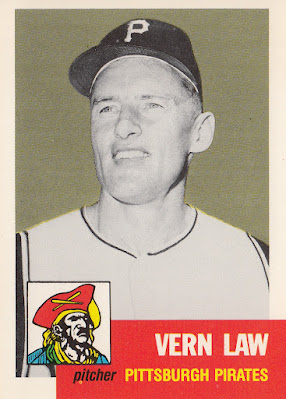
1991 Topps Archives '53 #324 Vern Law

Now, this isn't really a vintage card, even though it looks like a '53. Experts of these early Topps checklists (including our favorite Tim Wallach supercollector, who is nearing 1953 set completion) will know that Vern Law never made it into the original 1953 set. Neither did 56 other players who made up "The Cards That Never Were" subset at the end of the 1991 Topps Archives checklist.

Topps really took this theme seriously, writing a paragraph for the card back as though we were in early 1953 looking forward at the upcoming season. We're told, "This strong righthanded hurler rejoins the Pirates this year after spending the 1952 campaign in military service." 

Those who don't know the 274-card checklist of 1953 Topps by heart can use several other cues to place this subset as an revisionist augmentation to the set rather than a pure reproduction of the original. 

First, the images are black-and-white photographs rather than the full-color paintings we'd see on the originals. I have a mostly complete run of this set, and the only exception I could find was Hank Aaron's card #317. He did get a color painting, but it's not nearly up to the more lifelike standard found in the originals. The next clue is the background. It's usually a one of a few plain solid colors like this, or sometimes it might overlay a faint black-and-white background.

On the back, you could just check whether the card number is #281 or above. There's no red-colored facsimile signature behind the write-up like you'd see on an original. And finally, the card back will have "The Cards That Never Were" printed on the very bottom.

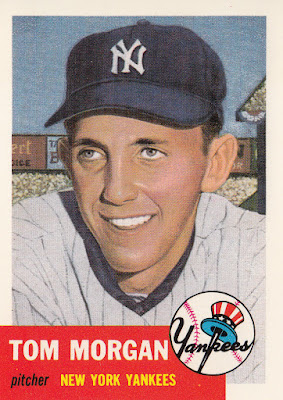
1991 Topps Archives '53 #132 Tom Morgan

Here's a reproduction of an original '53, and the difference is quite obvious. The colors are vibrant, and there's even some festive little bunting in the background on the facade of the stadium. 

This card is more of a review of Tom Morgan's 1952 season, as he served in the military during 1953, which the card back mentions. He was back in (baseball) action in 1954, wrapping up his career with the Los Angeles Angels in 1963.

I don't know anyone who would call a 1991 card from the heart of the overproduction era "vintage", although one has to wonder. As disconcerting as this fact is, that was thirty-one years ago. And when I really got my collection going in 1993, I'd have to find something from 1962 to have something as old then as this is right now.

But still, 1991 is not vintage.

Is it?

Or is "vintage" an ever-receding landmark in the rearview mirror, something that became fixed in place at some point, an idea that somehow manages never to keep pace with our world that's rapidly becoming more and more unpredictable?

Maybe let's just not think about that.

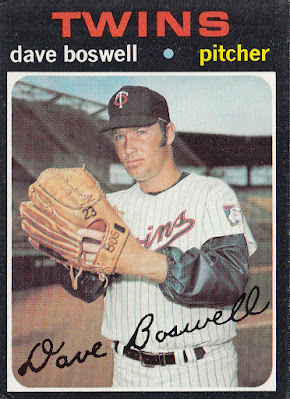
1971 Topps #675 Dave Boswell

Here's 1971. This is vintage.

This shouldn't be very surprising, but when I go through cards from this long ago, there are a lot of names I don't know. Tons. Dave Boswell is among them. 

He's pictured here as a Twin, which is where he spent his career from 1964-1970. However, the Twins released him in early 1971. He appeared in a handful of games for the 1971 Tigers and Orioles, but that was the end of his career. It was also the end of the line for his Topps issues, meaning this is his sunset card. He appeared in a few oddball sets after that, but Topps never documented either of his final pair of teams.

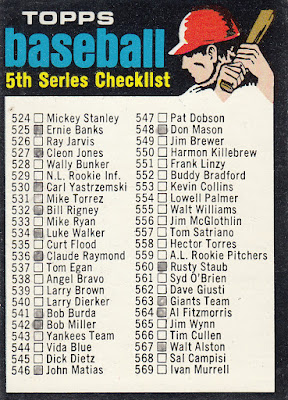
1971 Topps #499 Checklist 5

Jay threw in a checklist from 1971, and it's stops just a little short of including Dave Boswell's card #675, ending at #643. Whoever had this before me had a long way to go before completing the black-bordered 1971 set, but they certainly had a few of the big names checked off. Hall-of-Famers like Ernie Banks, Carl Yastrzemski, Roberto Clemente, and quite a few others. It's marked in pencil, and it looks like #531 Mike Torrez was possibly erased. Maybe part of a trade?

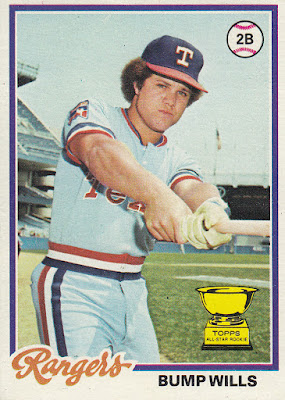
1978 Topps #23 Bump Wills

Fast forwarding a few years to 1978, perhaps a bit closer to that blurry vintage/modern dividing line, we come to "Bump" Wills, the son of Dodger great Maury Wills.

Wills's true Rookie Card is a four-player card from 1977. This is his first solo card. He finished third in 1977 AL Rookie of the Year voting, losing out to Eddie Murray, but he did earn himself a Topps All-Star Rookie cup, clearly shown on the lower right of the card. It's a nice addition to this posed photo, taken inside the newly-renovated (old) Yankee Stadium.

1967 Topps #76 Jim Barbieri (RC)

Jim Barbieri is another name I don't know, but this 1967 card was the oldest one in this shipment, so up it goes on the blog. The posed photo looks similar to Bump Wills's card, but this checks the box for the always-trusty bat barrel shot.

The card back says that Barbieri threw out the ceremonial first pitch in the 1954 World Series, the very same World Series where Willie Mays gave us "The Catch" in Game 1, so it's very likely that this Dodgers rookie was on hand to witness that legendary defensive play as a thirteen-year-old. The card doesn't specify for which game Barbieri got the honors, but I'll go ahead and believe it was Game 1, because why not? Maybe the ceremonial first pitch used to be exclusive to Game 1 back then, anyway.

Barbieri's career spanned all of thirty-nine regular-season games in 1966, so this Topps card ends up being a combo Rookie Card and Sunset Card. 

There was a 40th game before his career truly ended, though. Apparently no stranger to Game 1 of the World Series, he appeared as a pinch-hitter for the Dodgers in the '66 Fall Classic. He struck out swinging in the 4th inning and that was that.

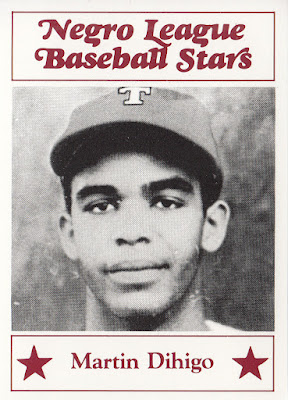
1986 Negro League Fritsch #19 Martín Dihigo

Jay included a few oddball cards focused on Negro League stars, including Cuban-born Hall-of-Famer Martín Dihigo, "a talented second baseman who was a superior hitter". And despite what you might think from this grainy black-and-white photo, he wasn't a 19th century contemporary of Cy Young or Old Hoss Radbourn. Dihigo played and managed right up through the mid-1940s.

Sadly, by and large, oddballs like this release from Larry Fritsch Cards are about all that's out there for many Hall-of-Famers who played only in the Negro Leagues. Players like Dihigo, Oscar Charleston, Turkey Stearnes, and many others have been as ignored by the card industry as by pre-1947 Major League Baseball itself. For example, Dave Boswell has 28 search results on Beckett. Martín Dihigo has 26. Only one of them is in the Hall of Fame.

Perhaps now that the various Negro Leagues have finally been recognized as Major Leagues, that will start to change. Maybe there would be numerous legal difficulties Topps/Fanatics would encounter if they tried, but I'd buy a retro-themed Negro Leagues set if it were on the market.

Just saying, if there's room for the thousandth Dustin May card, maybe there's room for some Hall-of-Famers that remain far too obscure.

1991 Swell Baseball Greats #9 Joe Black

Another oddball came from the Swell Baseball Greats set, a 1991 release from a brand of the Philadelphia Chewing Gum Corporation. Joe Black, pictured here as a Brooklyn Dodger, joined the National League in 1952, winning Rookie of the Year honors thanks to a 15-4 record. He kept playing through 1957. He got his start with the Baltimore Elite Giants, playing for them from 1943-48.

We'll keep the World Series history going with a fact from the card back, which is that he was the first Black pitcher to win a World Series game. That happened in 1952 versus the Dodgers' crosstown rivals, the Yankees. It was a seven-game battle, as were most of the matchups that decade between the Yankees and Dodgers.

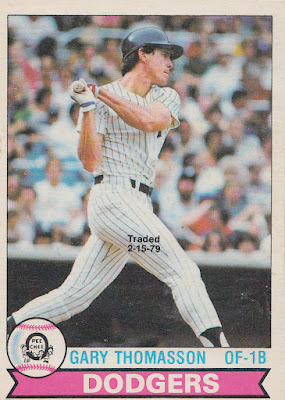
1979 O-Pee-Chee #202 Gary Thomasson

To close, we'll head north of the border. This looks quite like a 1979 Topps card, but look closely inside the little baseball element and you'll see a fun O-Pee-Chee logo! The Canadian brand that licensed and distributed Topps sets for years throughout Canada actually made some noticeable changes to Gary Thomasson's 1979 Topps card.

In the USA set, Topps simply pictured and listed Gary Thomasson as a Yankee, but by the time O-Pee-Chee got around to it, they had time to switch the listed team to the Dodgers, as well as provide the date that Thomasson was traded. The Dodgers acquired Thomasson for catcher Brad Gulden, who bounced around the league until 1986.

I learn a lot when I get stacks of vintage cards. So many of these guys I've never heard of, but there's always a wealth of knowledge to uncover, from small offseason trades to World Series history.