Sunday, February 27, 2022

The Trading Post #168: Roger

I can't even remember the last time I did an in-person trade. Most likely it was when I was in middle school. But I had the chance to rekindle that activity around the holidays this year. 

Roger is an old family friend that my girlfriend has known forever. He and his wife Beth joined me, my girlfriend, and her sister to watch a late-season Broncos game on TV, which was the last game or two of the 2021 regular season. I can't quite place the exact week even though this was merely two months ago, but I did take the opportunity to give Roger a few cards from my collection. Roger is an avid card collector and often shares his extensive collection (including lots of graded vintage) on his Facebook page. He's one of the very few people in my immediate circle that speaks the language of card collecting.

I knew I wanted to surprise him with some cards for the holidays, but as nice as it is to chat with someone who knows about baseball cards, that does mean it's a bit tricky to put together an appropriate trade. I can't just come bearing a stack of recent Topps commons; that would simply shift duplicates I have seven or eight copies of into his stack of what is also likely seven or eight copies.

What to do?

I settled on a half-dozen or so duplicates from the oversized 1994 Fleer Extra Bases set. I originally got them from Julie at A Cracked Bat, one of the most entertaining blogs in this whole community. I haven't seen a post from her since October, so I hope she's well.

In any case, I felt reasonably confident that my extras from Fleer Extra Bases would be new to Roger's collection, and he certainly seemed to enjoy them. Many of us longtime Colorado residents remember all those early Rockies. Burks, Girardi, etc..., although I may have stumped him with Mark Thompson.

A couple weeks later my girlfriend gave me a stack of cards that Roger found for me in return. He knows I'm a Rockies fan (we've all been to a game together), and these cards from did not disappoint. Current Rockies, past Rockies, and even some yet-to-be Rockies. And football, to match the occasion.
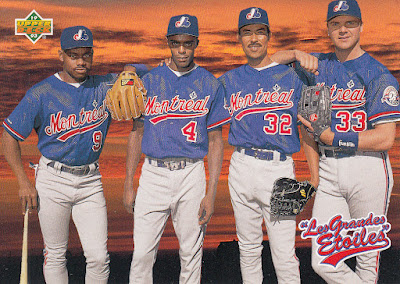
1993 Upper Deck #481 Marquis Grissom / Delino DeShields / Dennis Martínez / Larry Walker

1993 Upper Deck is one of the best sets to come out of the entire (first) overproduction era, and for good reason. This team card of the Montréal Expos shows four of the team's Big Stars ("Les Grandes Étoiles" in French on the card front), conveniently arranged according to height. From left to right, these players are Marquis Grissom, Delino DeShields, Dennis Martínez, and Larry Walker. Martínez is one of just a small handful of MLB players to hail from Nicaragua, and is also on the similarly short list of pitchers who have thrown a perfect game. None other than Marquis Grissom chased down the 27th out that afternoon in Los Angeles.

And of course Larry Walker is now a Hall-of-Famer. His #33 is retired in Coors Field, numerals that are prominently displayed on his attractive blue jersey. You can also see the 25th Anniversary patch the Expos wore in 1993. It's sad that they didn't make it to fifty, and that we didn't get to see how the 1994 Postseason would have played out. It's very possible that Larry Walker would have done better in Hall of Fame voting had he had the chance to display some heroics that year.

Here's hoping the 2022 season doesn't leave us with similar question marks.

1992 Stadium Club #256 Larry Walker

Here's another of a surprisingly acrobatic Larry Walker, this time a solo card from 1992 Stadium Club. This horizontal shot shows him in San Francisco's Candlestick Park, with Christy Mathewson's retired name banner in the background. Mathewson played in the days before uniform numbers, so just his name gets the special recognition. The Tigers gave Ty Cobb the same treatment on their wall of honor in left center at Comerica Park. 

Larry Walker would eventually have his number retired by a team that didn't exist when this photo was taken, during a ceremony that took place in a stadium that wasn't built yet.

1991 Topps #610 Andrés Galarraga

Few fans really think of this, but Andrés Galarraga and Larry Walker were teammates for three seasons on the Expos, long before they ever reached Blake Street Bomber status. Galarraga was even an All-Star in 1988, a fact I was surprised to learn when I thumbed through the All-Star subset in 1989 Topps at a young age. This posed shot makes for a great horizontal card, something we saw plenty of in 1991 Topps. 

I miss the Expos. I never had a chance to see them in person, at least not until they became the Washington Nationals. Maybe someday we'll have them back in some form, although it seems unrealistically hopeful to think about expansion when the current labor dispute appears to be quite serious.

1992 Topps Gold Winners #371 Dante Bichette

Moving on to a card that is new to my overall collection and not just a walk down memory lane, we come to former Brewer Dante Bichette. Like Galarraga, he was one of several players who had a rather unremarkable career going until he joined the Rockies. 

1992 marked the year Topps made the move away from traditional cardboard, as well as when they added their first photographs to the card back. Those photos showed a panorama of the team's home stadium, in this case County Stadium in Milwaukee. I ran across a photo on Reddit the other day showing Miller Park (now known as American Family Field) under construction right next to County Stadium, which you might enjoy seeing.

This is clearly a Topps Gold parallel, the first year of one of my all-time favorite parallel sets. Many of these were found as a one-per-pack parallel, but this particular card has a "Winner" stamp in the lower right. That's meant to differentiate it from a pack-pulled Gold card. Topps had a redemption program in place during 1992 where the reward was more Topps Gold cards, but unfortunately it was easily abused. Topps responded by including the Winner stamp on the redemption cards only, and they're generally more common than the normal Gold cards. This matches what I see in the ratio between the two types in my 1992 binder, but not dramatically so.

1991 Score #585 Joe Girardi

Early Score cards were known to have write-ups on the back that fell somewhere between pamphlets and novellas. Joe Girardi's 1991 Score card is no different, as it tells us all about how he became the starting catcher, his defensive and offensive accolades, how he beat up on the Giants in 1990, and that he blocks the plate well. The card front verifies that, as we can see an incoming Atlanta Brave baserunner (possibly Lonnie Smith) bearing down at motion-blurring speed.

We can also see a commemorative patch on Girardi's right sleeve, which is the All-Star game host patch the Cubbies wore during the 1990 season. 

1993 Upper Deck #706 Dale Murphy

Even casual fans likely know that all the above players once suited up for the Colorado Rockies. Maybe not Girardi; he's probably better known for his managerial career, but surely the rest. But not many know that Dale Murphy, one of the most well-loved Atlanta Braves players in history, was once a Rockie. It only lasted for 26 games in the early part of the 1993 season, but it really did happen. It was real enough for Murphy to make it into Series 2 of that magical 1993 Upper Deck set, and he even got a photo on the card back of him wearing that most desirable of '90s apparel, the Starter jacket.
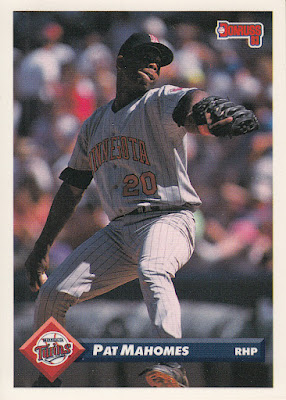
1993 Donruss #357 Pat Mahomes

Pat Mahomes never joined the Rockies, but he was a journeyman through 2003. Presumably, Roger included him in this stack because of the football connection. NFL fans all over recognize Patrick Mahomes of Kansas City as one of the game's superstars, but few know his dad spent about a decade as an MLB pitcher. 

After all these years, it's pretty surprising how little 1993 Donruss I have in my collection. It's not tiny; I'd say six or so full pages front and back, but for a major brand's base set from the first year I collected, it's positively scarce. I'm pleased to add this one to my collection. I would have preferred a better-exposed photograph, but Donruss was not great at that for a number of years.

2020 Donruss Retro '86 Signatures Red #84 Peter Lambert /99 (AU)

Roger gave me one card of a current Rockie, which is right-handed pitcher Peter Lambert. This one from 2020 Donruss is a parallel based on the 1986 Donruss set, and it includes a /99 serial number as well as a sticker autograph. The purple uniform, the dazzling red design, and the Coors Field forest almost made me forget the lack of MLB logos. It's a well-done card of a young player we all hope will turn into a solid member of the rotation.

Lambert did get a couple games in as a late-season call-up at the end of 2021, but he hasn't had much of a chance to make an impression on Rockies fans yet. He underwent Tommy John surgery in 2020, so hopefully 2022 will be a positive and injury-free season for him. Once the season starts, that is. We've blown well past the time when pitchers and catchers would have reported to Spring Training, with no real end in sight.

I'm not sure why there's a disconnect between the card number according to Beckett compared to the card back. This has "86S-PL" on the card back, so I don't know where #84 came from.

1977 Topps Football #100 O.J. Simpson AP

Finally, digging back into the archives that's more consistent with Roger's overall collection (at least with what he chooses to showcase on his Facebook page), here's O.J. Simpson's 1977 Topps football card, printed long before his second, much sadder, period of life.

I'm far from an expert on football cards, but I have learned that the annual Topps football releases used different designs than the familiar baseball sets. I can't be confident that's true for every year, but 1977 Topps baseball didn't look quite like this. Regardless, Topps didn't stray far from their signature ribbons and chevrons when choosing design elements. 

One of those banners on the top lists Simpson as a 1976 All-Pro, the NFL equivalent of an All-Star. There's also a little football graphic in the lower left noting that O.J. reached the 1,000-yard mark as a running back during the prior season. In fact, he made it well past that, with 1,503. Flipping the card over, we discover that he actually cracked the 2,000 yard mark once, which happened in 1973. 1,000 in a season is, you know, nice. Respectable. Maybe roughly equivalent to a 100-RBI baseball season. Not Hall-of-Fame material unless you string a ton of them together, but certainly enough to make you one of the most productive players on your team.

2,000 yards, on the other hand, is a different level. O.J. Simpson was the first to do it, and only seven others have done so since. Terrell Davis just got past that mark in the 1998 season, which is the same year the Broncos won their second Super Bowl. Some other names on that list are Eric Dickerson, Barry Sanders, and Adrian Peterson. Truly some of the greats.

I'll have to keep an eye out for more cards that Roger would like. This was a good trade, full of familiarity and also of surprises.

Sunday, January 23, 2022

The Trading Post #167: Card Hemorrhage (Part 2: Vintage)

I don't know what feels normal anymore. Back pain is normal. Uncertainly is normal. 

Writing a blog post with an NFL playoff game on in the background used to feel a lot more normal than it does right now. It's nice to still be able to bring that back every once in a while, although this blog is starting to take a back seat to other priorities. I did twenty-three posts in 2021, and while I still haven't missed a month, that is about half of what I was doing around 2017.

Not that I don't have enough material to cover, it's just that there is a lot that steals my attention these days. One example of that would be the Marshall Fire that tore through nearby Louisville, Colorado on December 30th. You may have seen it on the news, but unfortunately I got a much closer look at it. My home is still standing, but I was caught in a smoky highway closure as the fire was spreading, was easily within walking distance of a frightening view of the flames that night, and found myself alarmingly close to the outer areas of the evacuation zone.

Seeing your hometown on the national news for this kind of thing is pretty unsettling. Watching the news crews broadcast from an intersection you've driven through a couple thousand times is quite scary. Trying to go about your workday while not being particularly confident that your home will still be there in a few hours is a very unpleasant experience. Knowing the office building you haven't been to in nearly two years (for obvious reasons) is directly in the path of destruction makes it very personal. That survived, although so much nearby was lost. Two lives. Pets. Homes. Businesses.

So, that has given me a lot of emotions to work through, on top of everything else.

In any case, I was reminded of my collection a week or so ago when I got a direct message on Twitter asking about an old 2011 Topps Opening Day hit. A fellow Twitter user inquired as to whether I still had this Justin Germano autograph from a 2015 blog post, and seeing as how it didn't go up in flames last month (one concern among a thousand others I had that day), I was able to help out his autograph collection. It might have been worth a solid amount in better condition, but Topps quality control being what it is, I shipped it off for $7 and got confirmation yesterday that it arrived safely.

Following that, I still want to review some vintage cards I got from Jay at Card Hemorrhage, which made up the remainder of a shipment he sent my way toward the end of 2021.

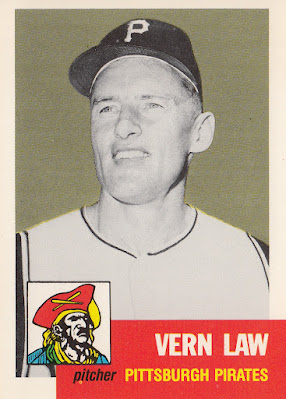
1991 Topps Archives '53 #324 Vern Law

Now, this isn't really a vintage card, even though it looks like a '53. Experts of these early Topps checklists (including our favorite Tim Wallach supercollector, who is nearing 1953 set completion) will know that Vern Law never made it into the original 1953 set. Neither did 56 other players who made up "The Cards That Never Were" subset at the end of the 1991 Topps Archives checklist.

Topps really took this theme seriously, writing a paragraph for the card back as though we were in early 1953 looking forward at the upcoming season. We're told, "This strong righthanded hurler rejoins the Pirates this year after spending the 1952 campaign in military service." 

Those who don't know the 274-card checklist of 1953 Topps by heart can use several other cues to place this subset as an revisionist augmentation to the set rather than a pure reproduction of the original. 

First, the images are black-and-white photographs rather than the full-color paintings we'd see on the originals. I have a mostly complete run of this set, and the only exception I could find was Hank Aaron's card #317. He did get a color painting, but it's not nearly up to the more lifelike standard found in the originals. The next clue is the background. It's usually a one of a few plain solid colors like this, or sometimes it might overlay a faint black-and-white background.

On the back, you could just check whether the card number is #281 or above. There's no red-colored facsimile signature behind the write-up like you'd see on an original. And finally, the card back will have "The Cards That Never Were" printed on the very bottom.

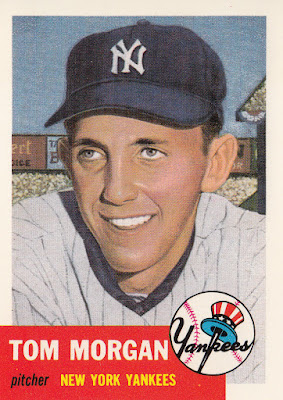
1991 Topps Archives '53 #132 Tom Morgan

Here's a reproduction of an original '53, and the difference is quite obvious. The colors are vibrant, and there's even some festive little bunting in the background on the facade of the stadium. 

This card is more of a review of Tom Morgan's 1952 season, as he served in the military during 1953, which the card back mentions. He was back in (baseball) action in 1954, wrapping up his career with the Los Angeles Angels in 1963.

I don't know anyone who would call a 1991 card from the heart of the overproduction era "vintage", although one has to wonder. As disconcerting as this fact is, that was thirty-one years ago. And when I really got my collection going in 1993, I'd have to find something from 1962 to have something as old then as this is right now.

But still, 1991 is not vintage.

Is it?

Or is "vintage" an ever-receding landmark in the rearview mirror, something that became fixed in place at some point, an idea that somehow manages never to keep pace with our world that's rapidly becoming more and more unpredictable?

Maybe let's just not think about that.

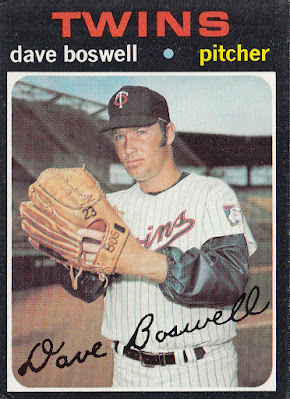
1971 Topps #675 Dave Boswell

Here's 1971. This is vintage.

This shouldn't be very surprising, but when I go through cards from this long ago, there are a lot of names I don't know. Tons. Dave Boswell is among them. 

He's pictured here as a Twin, which is where he spent his career from 1964-1970. However, the Twins released him in early 1971. He appeared in a handful of games for the 1971 Tigers and Orioles, but that was the end of his career. It was also the end of the line for his Topps issues, meaning this is his sunset card. He appeared in a few oddball sets after that, but Topps never documented either of his final pair of teams.

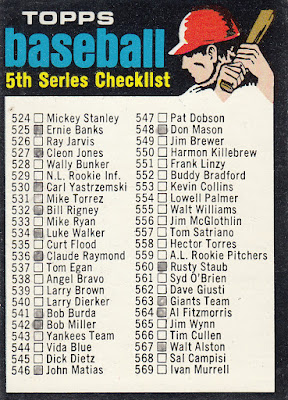
1971 Topps #499 Checklist 5

Jay threw in a checklist from 1971, and it's stops just a little short of including Dave Boswell's card #675, ending at #643. Whoever had this before me had a long way to go before completing the black-bordered 1971 set, but they certainly had a few of the big names checked off. Hall-of-Famers like Ernie Banks, Carl Yastrzemski, Roberto Clemente, and quite a few others. It's marked in pencil, and it looks like #531 Mike Torrez was possibly erased. Maybe part of a trade?

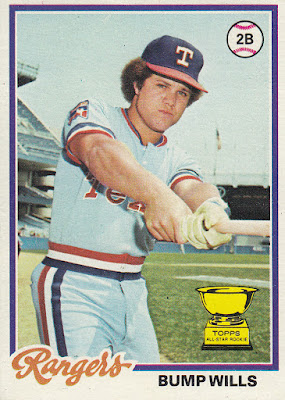
1978 Topps #23 Bump Wills

Fast forwarding a few years to 1978, perhaps a bit closer to that blurry vintage/modern dividing line, we come to "Bump" Wills, the son of Dodger great Maury Wills.

Wills's true Rookie Card is a four-player card from 1977. This is his first solo card. He finished third in 1977 AL Rookie of the Year voting, losing out to Eddie Murray, but he did earn himself a Topps All-Star Rookie cup, clearly shown on the lower right of the card. It's a nice addition to this posed photo, taken inside the newly-renovated (old) Yankee Stadium.

1967 Topps #76 Jim Barbieri (RC)

Jim Barbieri is another name I don't know, but this 1967 card was the oldest one in this shipment, so up it goes on the blog. The posed photo looks similar to Bump Wills's card, but this checks the box for the always-trusty bat barrel shot.

The card back says that Barbieri threw out the ceremonial first pitch in the 1954 World Series, the very same World Series where Willie Mays gave us "The Catch" in Game 1, so it's very likely that this Dodgers rookie was on hand to witness that legendary defensive play as a thirteen-year-old. The card doesn't specify for which game Barbieri got the honors, but I'll go ahead and believe it was Game 1, because why not? Maybe the ceremonial first pitch used to be exclusive to Game 1 back then, anyway.

Barbieri's career spanned all of thirty-nine regular-season games in 1966, so this Topps card ends up being a combo Rookie Card and Sunset Card. 

There was a 40th game before his career truly ended, though. Apparently no stranger to Game 1 of the World Series, he appeared as a pinch-hitter for the Dodgers in the '66 Fall Classic. He struck out swinging in the 4th inning and that was that.

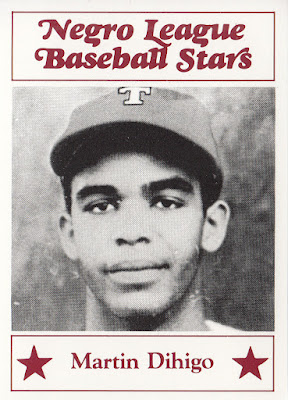
1986 Negro League Fritsch #19 Martín Dihigo

Jay included a few oddball cards focused on Negro League stars, including Cuban-born Hall-of-Famer Martín Dihigo, "a talented second baseman who was a superior hitter". And despite what you might think from this grainy black-and-white photo, he wasn't a 19th century contemporary of Cy Young or Old Hoss Radbourn. Dihigo played and managed right up through the mid-1940s.

Sadly, by and large, oddballs like this release from Larry Fritsch Cards are about all that's out there for many Hall-of-Famers who played only in the Negro Leagues. Players like Dihigo, Oscar Charleston, Turkey Stearnes, and many others have been as ignored by the card industry as by pre-1947 Major League Baseball itself. For example, Dave Boswell has 28 search results on Beckett. Martín Dihigo has 26. Only one of them is in the Hall of Fame.

Perhaps now that the various Negro Leagues have finally been recognized as Major Leagues, that will start to change. Maybe there would be numerous legal difficulties Topps/Fanatics would encounter if they tried, but I'd buy a retro-themed Negro Leagues set if it were on the market.

Just saying, if there's room for the thousandth Dustin May card, maybe there's room for some Hall-of-Famers that remain far too obscure.

1991 Swell Baseball Greats #9 Joe Black

Another oddball came from the Swell Baseball Greats set, a 1991 release from a brand of the Philadelphia Chewing Gum Corporation. Joe Black, pictured here as a Brooklyn Dodger, joined the National League in 1952, winning Rookie of the Year honors thanks to a 15-4 record. He kept playing through 1957. He got his start with the Baltimore Elite Giants, playing for them from 1943-48.

We'll keep the World Series history going with a fact from the card back, which is that he was the first Black pitcher to win a World Series game. That happened in 1952 versus the Dodgers' crosstown rivals, the Yankees. It was a seven-game battle, as were most of the matchups that decade between the Yankees and Dodgers.

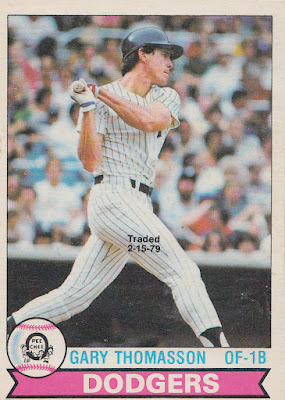
1979 O-Pee-Chee #202 Gary Thomasson

To close, we'll head north of the border. This looks quite like a 1979 Topps card, but look closely inside the little baseball element and you'll see a fun O-Pee-Chee logo! The Canadian brand that licensed and distributed Topps sets for years throughout Canada actually made some noticeable changes to Gary Thomasson's 1979 Topps card.

In the USA set, Topps simply pictured and listed Gary Thomasson as a Yankee, but by the time O-Pee-Chee got around to it, they had time to switch the listed team to the Dodgers, as well as provide the date that Thomasson was traded. The Dodgers acquired Thomasson for catcher Brad Gulden, who bounced around the league until 1986.

I learn a lot when I get stacks of vintage cards. So many of these guys I've never heard of, but there's always a wealth of knowledge to uncover, from small offseason trades to World Series history.


Sunday, December 19, 2021

The Trading Post #166: Card Hemorrhage (Part 1: Rockies)

Trading volume is down quite a bit. Intuitively I knew that, but in preparing to write this post, I was surprised to see that I hadn't added anything new to The Trading Post page in nearly eleven months. Not that I've done much from my end either. Perish the thought of setting foot inside a post office unless absolutely necessary. But I have sent a few PWEs out, or at least I think I have. It's pretty much all a blur these days.

One blogger who's keeping that flame lit is Jay at Card Hemorrhage, winner of the most-difficult-to-spell blog superlative, stealing the crown from Highly Subjective and Completely Arbitrary. He's sent a couple stuffed PWEs my way in the past couple months, full of a wide range of familiar Rockies and unknown oddballs. We'll start things off with a familiar face from the Rockies, the player who joined Dinger in the making of this year's official team video holiday card.

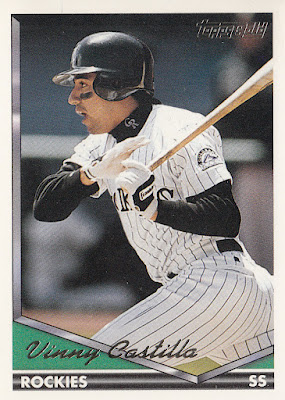
1994 Topps Gold #163 Vinny Castilla

Vinny Castilla was the cameo player in my previous post, but here he gets a parallel all his own. It's from 1994, the same year as my Hanukkah gift, and it's the Topps set I can most easily recognize at a glance. Longtime readers will know that 1994 Topps was the first factory set I ever bought, and a $50 expenditure at the young age of 10 is one that is seared into your memory for all time.

Even better, this is the Topps Gold variety, a one-per-pack parallel that felt like holding the actual metal in my hands back then. It hasn't really lost its luster after a quarter-century. Someday I might consider putting the whole 792-card set together, and I'm already about a third of the way there.

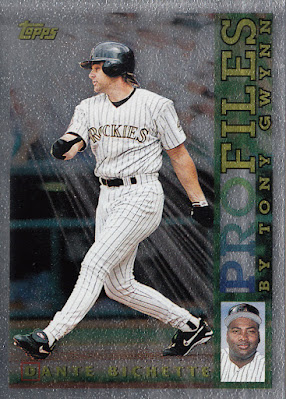
1996 Topps Profiles #NL-11 Dante Bichette

A couple years later and a lot shinier, Topps featured some of Castilla's teammates from the Blake Street Bombers squad in the Profiles insert set. Twenty players from each league were gathered for the set, and then Topps sought opinions about each National League player from Tony Gwynn. Kirby Puckett provided the commentary for AL players. Sadly, both of those Hall of Famers passed away far too young, but their keen insight on their fellow players (and likely fellow All-Stars more than a few times), is documented for all to see on this shiny Topps set.

In particular, Gwynn says about Bichette, 

"[I]t looks like confidence has made all the difference to him...Dante can put it out of any stadium...If he gets big numbers, they say it's because of [Coors] Field. If he doesn't, they say he can't hit. Well, he can hit, Period."

Tony Gwynn, arguably the greatest contact hitter in the expansion era, is certainly in a position to know. And that came a bit before we all really understood what a launching pad pre-humidor Coors was. He knew. But he also knew a great hitter when he saw one, regardless of the park. Hall of Fame voters are just now coming around to understand that, with Larry Walker finally entering the Hall of Fame and Todd Helton gaining some steam.

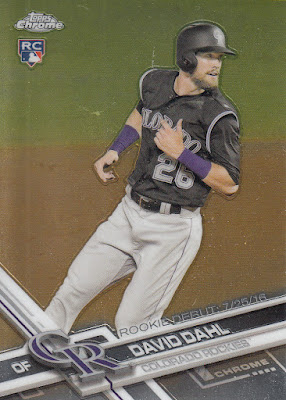
2017 Topps Chrome Update #HMT100 David Dahl RD

Shinier still was 2017 Topps Chrome Update, a Target exclusive. The card number has an "HMT" prefix, something I've seen before but still don't know what it stands for. Dahl, who will be reuniting with Jon Gray on the Texas Rangers next season (I'm hesitant to call it the 2022 season at this point, given the state of the current labor dispute), is pictured here running the bases as a Rockie. His card has both the Rookie Card logo and the specific date of his MLB debut, July 25th, 2016. The Rockies lost that one in extras, but as the card back tells us, it was the beginning of a record-tying 17-game hitting streak for Dahl.

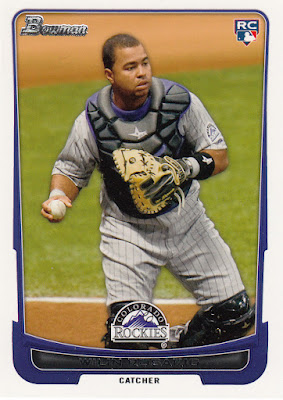
2012 Bowman #218 Wilin Rosario (RC)

2012 Bowman popped up again as it does from time to time. This one is another Rookie Card, picturing catcher Wilin Rosario behind the plate. A little over two years ago, the autographed black-bordered version of this card made an appearance here, and now I have the regular base card to go along with it.

Wilin Rosario was the everyday Rockies catcher for four seasons or so, and he was on a whole slew of cards at the time, but seemed to disappear rather rapidly. He wasn't a great hitter, but fans of cards showing catchers in defensive mode might find a few to their liking.

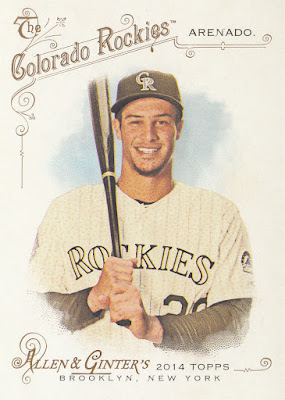
2014 Topps Allen and Ginter #314 Nolan Arenado SP

Jay included a couple 2014 Allen & Ginter cards, and this design is just different enough to make me think that I've never really seen it before. I do have a partially filled page in my 2014 binder, but the only record of it I can find in the blog archives was Anthony Bourdain's card, may he rest in peace.

A visibly younger Nolan Arenado entered the A&G checklist for the first time in '14, and the high card number of #314 puts this into short print territory. It's definitely a generous inclusion into this PWE.

The overall design looks similar to most A&G sets, but the one thing that really jumps out at me is the storybook fairy tale "The" preceding the "Colorado Rockies" team name. It gives it a feel of "Once upon a time in the land of 20th and Blake Street, Nolan Arenado played for The Colorado Rockies and slayed many dragons with his armory full of gold and platinum gloves."

Not all fairy tales have a happy ending, though, as we came to find out. At least not for fans of The Colorado Rockies.

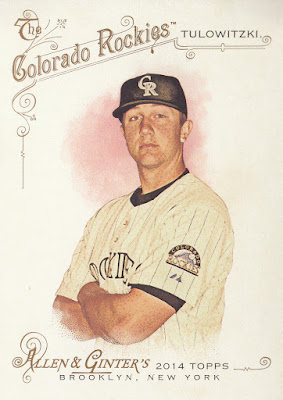
2014 Topps Allen and Ginter #104 Troy Tulowitzki

Don't give me that look, Tulo. Times have been hard.

At least Tulowitzki got his own storybook ending, hitting his final home run in the Major Leagues as a Yankee shortstop, playing right where Derek Jeter played all those years. Tulo idolized Jeter, which is why he wore #2 for almost his entire career.

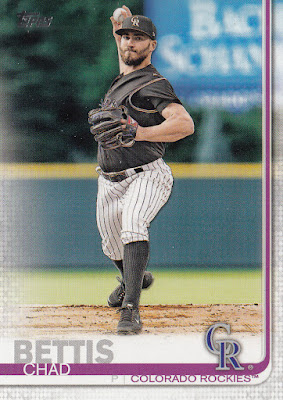
2019 Topps #74 Chad Bettis

Chad Bettis got a card in the 2019 Topps Series 1 checklist, and it's a very similar photo to this insert from Topps Update. This base card gives us a slightly different angle on a different pitch (his grip is slightly different), and we get a bit of an extra look at the Coors Field forest and advertising banners behind the center field wall. That blue banner is an ad for Bachus & Schanker, a local injury law firm that definitely makes the most of their marketing budget.

Chad Bettis announced his retirement in the summer of 2020, following a seven-season career with the Rockies. He finished with an even 31-31 record, although he had a rough 2019 season. He signed with the Yankees in 2020, but announced his retirement about a month before the pandemic-shortened season got underway. Topps didn't include him in any 2020 product, so this is effectively a sunset card. You'll just have to go online to read his 2019 stat line.

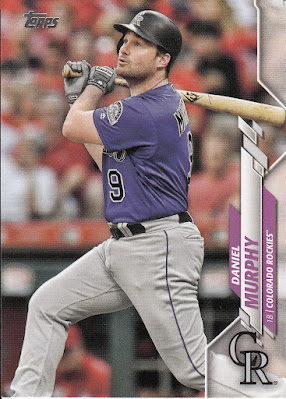
2020 Topps #116 Daniel Murphy

Daniel Murphy fared a bit better. He retired in February, deciding to make the shortened 2020 campaign his last. The fun-loving three-time All-Star was certainly enjoyable to watch during his brief time in Denver, although he put up a -1.0 fWAR during his two seasons here. At least Topps included him in the 2021 set, allowing Murphy fans to add a true sunset card to their collections.

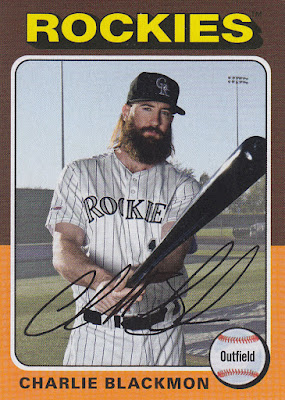
2019 Topps Archives #157 Charlie Blackmon

Charlie Blackmon is pretty much the only well-known Rockies position player left, at least among those who have reached free agency. Topps picked the iconic 1975 design for his card in 2019 Archives. Other than this Robin Roberts card, I completely skipped that set. I can't keep up with them all. 

Speaking of, did they ever release 2021 Big League?

In any case, Topps tried make this card somewhat period-correct, as though it were really released in 1975. I'm sure 1975 Topps superfans can tell me whether this is a legitimate color combination, or at least as close as it can be for the six current franchises that didn't exist then. But what caught my eye was the trivia question and cartoon on the back. The card asks "Which future Hall of Famer won the first Outstanding DH Award?"

First of all, I learned that there's such a thing as the Outstanding DH Award, which is now known as the Edgar Martínez Award. It's not league-official, and especially as a National League fan, I can't remember ever hearing about it. 2021's winner was AL MVP Shohei Ohtani. 

But the way they phrased this made it sound like it was a new thing and that they're referring to an active or recently-retired player destined for the Hall. David Ortiz maybe, or an early and bold prediction on Ohtani. But no, that award has been in place since 1973, the first year of the DH. The recipient of the inaugural DH Award was Orlando Cepeda, who reached the Hall of Fame in 1999. In that sense, Cepeda was a future Hall of Famer when this design hit shelves, but obviously not at any point during Charlie Blackmon's adulthood.

The 1975 design overall will be a good segue into Part 2, which included plenty of vintage. It was a stuffed PWE, believe me.


Sunday, November 28, 2021

It's Early This Year

There have been the slightest of dustings in parts of town, but as of today, Denver has yet to record its first measurable snowfall of the winter. We've blown past the prior early 1930s record of November 21st, and there's nothing in the forecast that shows any sign of this changing soon.

So with Thanksgiving over and December looming, the fact that Hanukkah starts at sundown tonight (Sunday) caught me a bit off guard. I do have potatoes on hand for the appropriate seasonal treat, but it just doesn't feel like I'm quite ready for the holiday to appear so early this year.

Mom, on the other hand, had this all squared away and ready for takeoff. As usual, she found a card from my Eight Men Out want list and presented it to me inside a greeting card. 

I know she always worries about whether she got me "the right card". Frankly, the fact that she frequently takes the time to check my specific want list in the first place is plenty generous all on its own. And getting baseball cards in general is no small feat in this supply-constrained era.

So is it "the right card"?

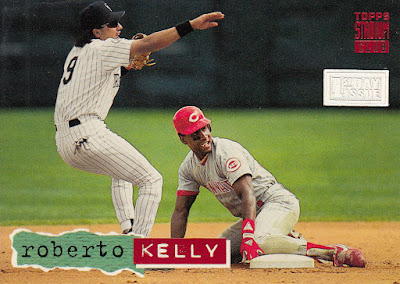
1994 Stadium Club First Day Issue #372 Roberto Kelly /2,000

Well, technically no, but (and I told her this), it's way better. All I did was put an overproduction-era Stadium Club card on the list, and she goes and finds me a First Day Issue parallel. They're quite scarce for the era, having a stated print run of 2,000. They aren't serial numbered, but as overproduction-era parallels go, this is a needle in a haystack. In checking my 1994 binder, this is is the fifth one I've been able to add to the collection after all these years, and it remains one of my favorite parallels of the entire era.

My main motivation for wanting this card was the cameo. That's Vinny Castilla on the left, covering second base in an inaugural-year Mile High Stadium. I did see the Reds play the Rockies in 1993, but that was the final home game of the season. Unfortunately, Roberto Kelly, the main subject of this card, suffered a separated shoulder in mid-July and missed the rest of the season. That would mean this photo couldn't have been from a game I attended, but that does at least narrow it down to one particular series in June.

Roberto Kelly and his Reds had back-and-forth slugfests that week with the young Rockies, and I believe this photo is from the third and final game of the series, a 15-5 blowout win for Colorado. In the top of the 4th on June 23rd, 1993, Kelly stole 2nd base with Chris Sabo at the plate. Castilla was playing short that day, and it looks like Kelly beat the throw quite easily. There might not have been a throw at all, actually. The speedy center fielder stole third base a few pitches later, but was stranded there.

Interestingly, the card back mentions that Kelly, a two-time All-Star, stole third base nine times in his injury-shortened 1993 season, but doesn't quite manage to tell us that one of those SBs came mere moments after this photo was snapped. 

That's the value I'm adding here at Infield Fly Rule.

That's all to report for today, a quick one-card post (thanks, Mom!) and the weather forecast. Thank you for stopping by!


Saturday, November 6, 2021

Two Years of Change

Two years and two days ago, I spent $28 at a Local Card Shop in Aurora, Colo. It was my first visit to All C's Collectibles, one of the few LCS survivors that had somehow flown under my radar all these years. They also specialize in comics, but as a lifelong baseball fan, I stayed on the periphery of the store where most of the MLB-related goodies were to be found.

I spent most of my time and money going through a discount box, picking out anything shiny or Stadium Club that I could find, including a pair of cards of a player who has stolen the spotlight the past couple days.

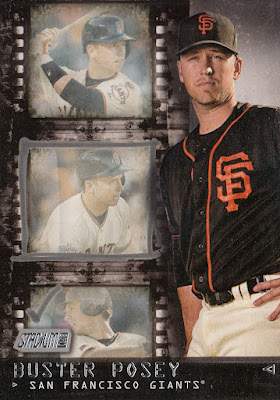
2016 Stadium Club Contact Sheet #CS-8 Buster Posey

As you have likely heard by now, Buster Posey announced his retirement. Spending his entire career as a catcher for San Francisco, he won three World Series with the Giants, as well as a Rookie of the Year award, an MVP award, and seven All-Star selections. Twelve seasons might seem like a relatively short career, but catcher is a grueling position, and the broken leg he suffered in 2011 led to the current rules we have around blocking the plate and the sliding lane.

Still, at just 34, he's not the only one to step away from his sport when he probably had some good years left. Andrew Luck of the Indianapolis Colts comes to mind, and there's speculation that Posey just made a tremendous amount of money as an early investor in BodyArmor, a sports drink brand that Coca-Cola just acquired for $5.6 billion.

Back in 2016, Posey found himself in numerous Stadium Club insert sets. I picked up this one from the 10-card photography-themed Contact Sheet set, which I've seen before (I'm at 50% completion!). One of the filmstrip photos of Posey shows the "LON" memorial patch the Giants wore in 2015 for Lon Simmons, the team's longtime broadcaster. The card back mentions his two grand slams in late June 2015, and if you're curious whether he hit either of those against the Rockies, he did not. They were divisional, though, as they came against the Dodgers and then the Padres.

Now is probably a good time to share the highlight of his final MLB hit, a two-out double in Game 5 of the NLDS against the Dodgers.

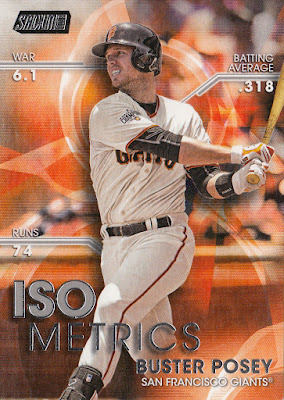
2016 Stadium Club ISOmetrics #I-24 Buster Posey

Elsewhere in the 2016 Stadium Club master set, Posey was included in the 25-card ISOmetrics insert set, heavily color coded for a Giants player. I've seen this set a couple times too, although I'm far from completing it. 

The season-specific stats Topps highlighted on the card front here are pretty representative of his overall career. His batting average dipped a bit since 2015, as is true for the entire league. 74 runs scored isn't even a career high for him, but is quite excellent for a catcher. And 6.1 WAR in a season is also excellent, although neither Fangraphs nor Baseball-Reference list 6.1 for his 2015 WAR. That complex calculation has evolved over time, and varies depending on whom you ask, so I won't say it's an error. For all I know, Topps has their own WAR calculation.

Posey's fWAR for 2021 was 4.9, ranking among the highest WARs any player has ever put up in the final season of their career, and many players near the top of that list were involved in the 1919 Black Sox scandal.

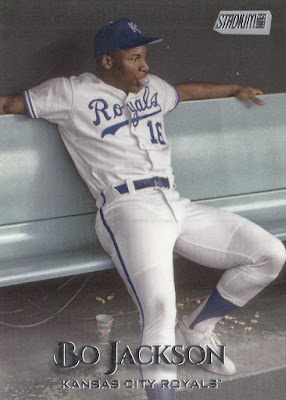
2019 Stadium Club #178 Bo Jackson

Moving forward a few years in the history of Stadium Club, I found a couple base cards from 2019. First was a relaxed Bo Jackson at the height of his baseball career with the Royals, casually blowing a bubble in the dugout.

Bo Jackson's career will always be one of the great what-ifs in baseball lore. Without getting into the gory details, a freak injury he suffered in an NFL game led to the need for a hip replacement, ending his football career and impacting his MLB career. He attempted a comeback, but it was not to be. It's a real shame, because he could have been one of the all-time greats.

Buck O'Neil used to tell a story about a particular sound he heard once in a great while, a crack of the bat unlike any other. "Like a stick of dynamite going off," he said. In a lifetime around the game of baseball, he said he heard it three times. First from Babe Ruth. Second from Josh Gibson. And finally from Bo Jackson.

Joe Posnanski tells it better than I could ever dream to.

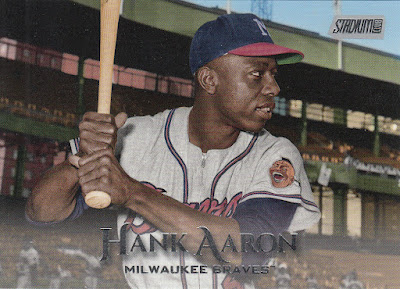
2019 Stadium Club #54 Hank Aaron

The last Stadium Club card I picked was of Braves legend Hank Aaron, who sadly passed away earlier this year. The Atlanta Braves were able to win the 2021 World Series in six games over the Astros, a fitting tribute to one of the greatest players of all time. The Braves won 88 regular season games this year, 44 before the All-Star Break, and 44 after. We also find ourselves in the 44th week of the year, which Vin Scully pointed out on Twitter.

And of course, Hammerin' Hank's uniform number was 44, which we saw mowed into the outfield grass at Truist Park.

This particular photo was from when the Braves were playing in Milwaukee, as you can tell by the letter M on Aaron's cap. That narrows this down to some point between 1954 and 1965, before the Braves departed for Atlanta in 1966. It would be another 20 years past that before they finally got rid of that logo on Aaron's left sleeve.

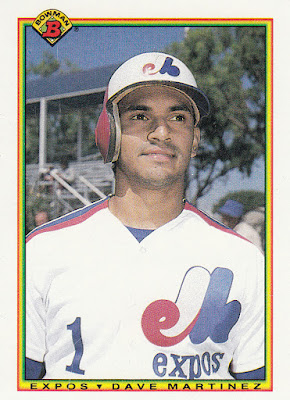
1990 Bowman #121 Dave Martinez

We'll come back to the discount box in a bit, but first I wanted to cover a few other affordable collectibles I found scattered throughout the store. First was a factory set of 1990 Bowman, priced at around $5 or $6. I'll never turn down a complete set for those prices. 

1990 was the year Bowman mercifully decided to get with the times and go with standard card dimensions, abandoning the 1950s-era size that won't fit in 9-pocket pages. It's a simple design, not deviating much from the 1989 design other than adding the player's name and team at the bottom in lieu of a facsimile signature.

It wasn't a particularly remarkable purchase otherwise except for one thing. This shopping trip was less than a week after the Nationals won Game 7 of the 2019 World Series. Then, as now, the team was managed by Dave Martinez, who once played for the Montreal Expos. The Nationals franchise, of course, was once known as the Expos, but that wasn't the weird part. The weird part was that there was one particular card facing the other direction inside the box. As best I could tell the set was still factory sealed, but somehow, after all those years, I found one card in the middle facing the wrong way, against the slight curl of the rest of the cards.

Dave Martinez.

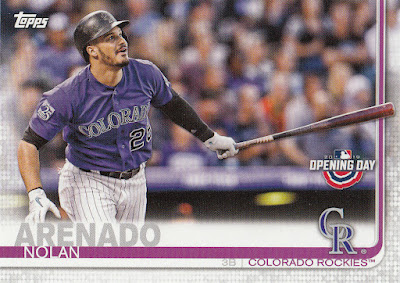
2019 Topps Opening Day #31 Nolan Arenado

I found some current packs toward the front of the store, and I selected one from 2019 Opening Day. I always enjoy the set no matter how far we are from the actual occasion. And I've enjoyed several variations of this well-cropped horizontal photo of Nolan Arenado the past couple years, even though it is significantly less festive than last time I saw it.

Little did I know at the time Nolan wasn't going to be playing for the Rockies by the time I got this post up. It's basically a foregone conclusion that Trevor Story won't be coming back, and the latest news is that Jon Gray isn't likely to reach a deal either, even though he's the only one of the three who actually wants to remain with the team.

At least Charlie Blackmon will be around for another year.

1998 Pinnacle Inside #109 Tony Clark

Although none of that may end up mattering much anyway, because MLB is hurtling headlong towards another labor dispute. I only mention it here because former Tiger Tony Clark is now the executive director of the MLB Player's Association, so his name will likely be in the news plenty this offseason.

Shortly before their bankruptcy, Pinnacle released the Inside brand for a second year. This slightly blurry photo of Tony Clark is flanked by a few of his 1997 stats, much in the same style as Buster Posey's ISOmetrics card. I got a whole pack of these, and I still have the can they came in.

Yes, the can. Like a can of tomatoes.

Pinnacle was out there. So was Pacific. The hobby is poorer without them around.

Now, back to the discount box.

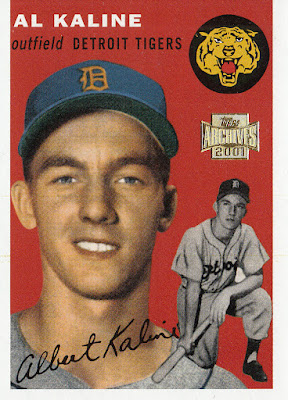
2001 Topps Archives #245 Al Kaline 54

By now, we've probably had our fill of Topps reprints, but in 2001, Topps Archives was pretty exciting. This isn't quite as alluring as the refractor-finish Archives Reserve set that year, but it's printed on actual cardboard and is surprisingly thick. In other words, it's a reprint that has the general look and feel of the original card, gold foil seal notwithstanding. Also the '54s were slightly larger than the standard size we know today. Just like '89 Bowman and Topps Big, which were my first exposure to the 3 3/4" x 2 5/8" size.

Sadly, like Henry Aaron, Al Kaline is no longer with us. He passed away on April 6th, 2020, and I wrote a tribute post at the time. But back in 1954, he was a young rookie, destined for great things. He didn't make it into the 1953 set, so this '54 is his Rookie Card. It would definitely cost a few hundred bucks to get a relatively nice original, so I'm happy with a $1 reprint.

For now.

2019 Topps '84 Topps #T84-30 Frank Thomas

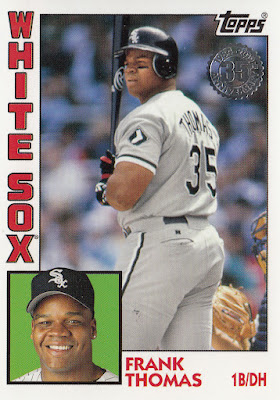
Frank Thomas didn't get a ton of Postseason playing time during his Hall of Fame career, but he's a regular fixture on the broadcast team now, right next to David Ortiz and Álex Rodríguez. Topps gave him a card in their 1984-themed 35th Anniversary set in 2019, and this time The Big Hurt is holding an actual baseball bat, not that famed piece of rebar.

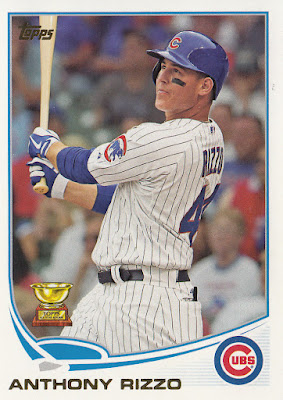
2017 Topps Update All Rookie Cup #ARC-21 Anthony Rizzo

But as an example of reprints getting a bit out of hand, here's a 2017 card of Anthony Rizzo, a mere four years after the original came out. The gold foil clearly differentiates it from the actual 2013 base card it replicates, but Topps still saw fit to include the word "REPRINT" on the card back to avoid any confusion.

The card itself is from a 50-card insert set found in 2017 Topps Update, which focused on the history of the Topps Rookie Cup. Rizzo did get one on his card in 2013, and he shares the checklist with players new and old. Buster Posey, Stephen Strasburg, Lou Brock, and many more. The card back has large images of the two Topps Rookie Cup versions found on cards throughout the years, and an explanation of Rizzo's 2012 season that earned him one.

I'm sure this is the 1990s kid in me talking, but I have to say I like the gold foil on the 2013 design more than the silver foil Topps originally used. Not that you could tell either way from the scan.

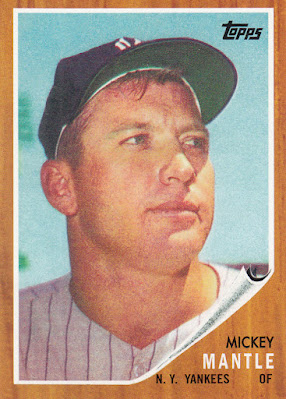
2010 Topps Cards Your Mom Threw Out #CMT-11 Mickey Mantle

Reprints do have their place, and for the longest time I relied on them to learn the vintage designs and keep some of my dad's idols in my collection. I eventually remedied that, but I still enjoy the 1962 Mickey Mantle in whatever form it takes. 

This one is from the famous 2010 "Cards Your Mom Threw Out" insert set, something Topps put out with absolute confidence during the first year of their monopoly. It spanned 174 cards across three series, and features some of the most iconic Topps cards of all time, starting with the '52 Mantle at card #CMT-1.

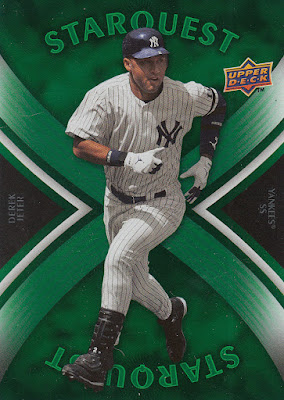
2008 Upper Deck First Edition StarQuest #SQ-9 Derek Jeter

Even as we get further away from a time where Upper Deck had a presence on the baseball side of the Hobby, I still can't get enough of these green Starquest cards. It's such a pleasing shade of emerald and they will practically jump out of any discount box right into my hand.

Derek Jeter was officially inducted into the Baseball Hall of Fame just a couple months ago, but the actual vote that put him there was about to get underway a mere two weeks after I visited All C's. No one was surprised that he was a first-ballot member, but the identity of the lone voter who left him off their ballot remains a mystery, and ensured that his longtime teammate Mariano Rivera would be the only unanimous inductee for the foreseeable future.

By the way, Derek Jeter has another connection to this post. He is the star player depicted on my can of 1998 Pinnacle Inside. I opened it on the bottom for display purposes, and a smiling Jeter in a warm-up jacket is pictured on the front.

I mean, it's a cylinder, so there technically isn't a "front" of the can, so to speak, but nearer the seam on the "back", there's a nutrition facts-looking label called "Product Facts". The serving size is 10 cards, and there is 1 serving per container. The pack odds are given, and we are promised that we're getting 100% of our % Daily Value of Collectability (sic), Top Players, Inside Info, and Cool Inserts.

Pinnacle very accurately and loudly proclaims that the Inside '98 set is "THE ONLY BASEBALL CARD IN A CAN!" It really was unique but it takes up so much space to package, ship, and store cards that way. It isn't particularly kid-friendly, either. Pinnacle was sure to stamp on the top of the can to "Open with adult supervision". I managed to do it without leaving a sharp edge, but this product was a lawsuit waiting to happen.

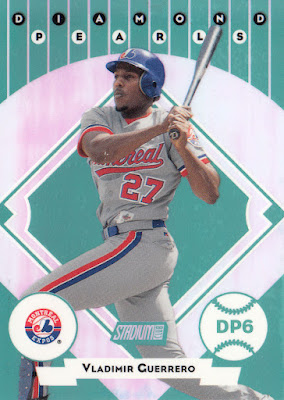
2001 Stadium Club Diamond Pearls #DP6 Vladimir Guerrero

After his son wrapped up his rookie season in 2019, I found a card of Vladimir Guerrero, Sr. He was part of the 20-card Diamond Pearls insert set from 2001 Stadium Club, the set that tends to have stickier cards than perhaps any other. This one doesn't seem too bad, but the surface does look a little bumpy to me. Maybe even slightly blistered.

In any case, this card became accidentally relevant during the 2021 Postseason, thanks to Joc Pederson's unique fashion choice of a string of pearls. He's quite the character, and he now finds himself on a short list of players who won the World Series in two consecutive years with different teams.

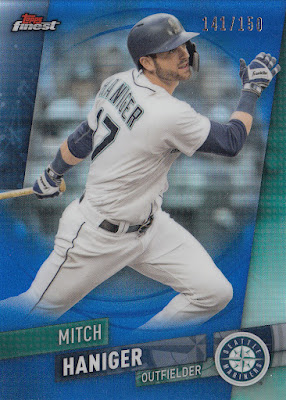
2019 Finest Blue Refractors #57 Mitch Haniger /150

I've never opened a box of Topps Finest, but I seem to have no trouble finding the occasional gem from the expensive set, like this beautiful Blue Refractor numbered to /150.

Alas, despite all this talk of the Postseason and the World Series, the Mariners haven't quite been able to sneak in for twenty years, though they got tantalizingly close this year. Outfielder Mitch Haniger has been one of their stars, and even has an All-Star appearance to his name. 

The card back tells us about his highlights on June 12th, 2018 against the Angels. Topps got the details...sort of accurate? Haniger did have a home run and an outfield assist that day, but they got the innings all wrong and they incorrectly imply that Haniger's homer was of the walkoff variety.

Incidentally, if you've ever been curious about how to pronounce my last name, it's pretty similar to Haniger. I have a couple extra consonants in there, but that's the general sound. It rhymes with Gallagher.

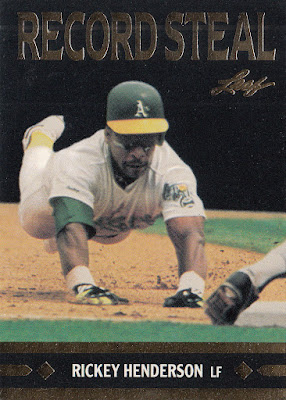
1991 Leaf Gold Rookies #BC26 Rickey Henderson DP

Finally, I couldn't pass up any early '90s insert with this much gold foil. Leaf really pulled out all the stops for this bonus card. Believe it or not, it's actually the final card of a 26-card insert set called Gold Rookies. Lots of prospects fill out that checklist, like Ryan Klesko, Mike Mussina, and Mo Vaughn.

Sharp-eyed readers will notice that Rickey Henderson, was not, in fact, a rookie in 1991. Nor was Nolan Ryan, who is also in this checklist. But Leaf decided that honoring Rickey Henderson's record-breaking 939th stolen base and Nolan Ryan's 7th no-hitter were worth disrupting the overall theme of a Rookies set. I can't say I disagree.

A well-stocked LCS, especially one that's been in town for so long, always has surprises. Including some fresh, sealed 1998 air.

Tuesday, October 26, 2021

The World's Champions (Part 2: Minis and non-Baseball)

The stage is set. 

2021 Topps Allen and Ginter Mini Black Border #149 Ian Anderson

For the 2021 World Series, the Atlanta Braves will be facing the Houston Astros, beginning Tuesday night. Former Astro (and Ray) Charlie Morton will be taking the mound for the Braves in Game 1, but we can expect that rookie Ian Anderson will toe the rubber at some point during this best-of-7 series.

We're all familiar with how Allen & Ginter has all the numbers written out on the card backs, but when it comes to a Rookie Card, like this one, it's not quite so eye-crossing. Games: Eighty. Wins: Seventeen. That's easy to digest at a glance, although Three Hundred Seventy Seven and Two Thirds career innings pitched still needs a second look to really understand. And when it comes to advanced stats, A&G must be the only place in history where a pitcher has a WHIP of "One Point Twenty Three".

Anderson's Black Bordered Mini parallel leads off Part 2 of this Allen & Ginter blaster, a card I had once set aside for its parallel-ness but not necessarily for any expectation it would be relevant for the World Series.

2021 Topps Allen and Ginter Mini #316 Yu Darvish

In fact, even as late as the All-Star Break, it certainly looked like the San Diego Padres would be well on their way to a Postseason berth. They experienced quite an epic collapse, and will have to try again next year, although they did finally get their first no-hitter in franchise history. Yu Darvish is in a good place, teammates with veteran talent and one of the most exciting young players in the game, but he remains in a tough division. Time will tell whether he'll ever get to play in the World Series again, or if he'll fall just millimeters short like his two near-perfect games.

2021 Topps Allen and Ginter Mini A&G Back #30 Rickey Henderson

Throughout his long career, Rickey Henderson managed to get much closer to those elusive milestones. Of course, he became the career leader by a tremendous margin in Stolen Bases, and also got to hoist the Commissioner's Trophy twice. That first one, as pictured on this A&G parallel, came with the Oakland Athletics in 1989, and then again in 1993 with the Blue Jays.

We're long past the days of Rickey Henderson swiping bases left and right, but it's been good to see the Stolen Base (or Caught Stealing) make an occasional clutch appearance throughout this year's Postseason.

2021 Topps Allen and Ginter Mini A&G Back #30 Rickey Henderson (Reverse)

It may not look like a parallel, but longtime A&G collectors know that back variations can come into play. Because, you know, there aren't enough ways to turn the front into a parallel.

2021 Topps Allen and Ginter Mini A&G Back #110 Daulton Varsho

Daulton Varsho's rookie card has the same back variation, although his Diamondbacks finished tied for the worst record in the league. There's definitely no postseason magic in the forecast for Arizona's near future. The RC logo blends into the overall brownish-gold design, and it looks a little busy on this narrow-cut mini. These tobacco-style cards measure a very precise 2 11/16" by 1 1/2".

Daulton Varsho is part of the current crop of second-generation Major Leaguers along with Tatis, Guerrero, Bichette, and so on. He's the son of former National Leaguer Gary Varsho, whom I mainly remember as a Pirate. Gary signed with the Phillies for his final season in 1995, teaming up with catcher Darren Daulton. You'd be correct in assuming that his late former teammate is his son's namesake.

2021 Topps Allen and Ginter Mini Rookie Design Variations #MRD-1 Casey Mize

It doesn't seem like that long, but Allen & Ginter has been with us since 2006. Not counting the original 19th century product, of course. But that's long enough for Topps to bring back the original 2006 design as a 20-card insert set. Casey Mize of the Tigers led it off with card #1, reminding us of how minimal this brand used to look. And more colorful, somehow, at least as far as the Rookie Card logo goes. 

For the most part, this was a rookie-heavy batch of Minis. Several appearances of the Rookie Card logo are going to be scattered across the page once I get these in a binder. And I'm sure we can expect to see at least some of these guys in the league for a long time to come.

But compared to the last Mini I found, they're all younger. So much younger.

2021 Topps Allen and Ginter Mini Far Far Away #FFA-2 Caldwell 5

Eleven million years younger, to be approximate.

We keep coming back to A&G for all the fun non-baseball topics, and this blaster delivered as promised. Here's an image of the spiral galaxy Caldwell 5, discovered in 1892, not long after the original release of the Allen & Ginter set in 1887.

Part of the Far Far Away insert set available only in the mini size, this is one of fifteen cards that are cut far too small to truly display these wondrous celestial objects. This particular galaxy, as we're told on the card back, is known as "The Hidden Galaxy" due to all the cosmic dust obscuring its view. Fortunately, we have a new space telescope scheduled to launch before the end of the year, and its capabilities should help reveal Caldwell 5 a bit more thanks to its infrared-sensitive instruments.

2021 Topps Allen and Ginter #206 Sarah Spain

Returning back to the familiar 3.5" x 2.5" size, I did find a couple of non-baseball full-size cards. First is Sarah Spain, an ESPN host and reporter. I don't watch a whole lot of ESPN's news shows, so I can't say I'm familiar with her. I still watch a good deal of their other programming (such as Monday Night Football when I wrote most of this), along with their excellent 30 for 30 series. But for sports news, I get that mostly from The Athletic and now Joe Posnanski's Substack page, since he's no longer writing for them.

2021 Topps Allen and Ginter #249 Rose Lavelle

The other non-baseball but still sports-related card is of Rose Lavelle, a member of Team USA women's soccer, as well as an athlete in the National Women's Soccer League (NWSL). She helped the national team to its 2019 Women's World Cup championship, and earned a bronze medal at the Tokyo Olympics. 

A&G has included a few other members of the dominant US Women's Soccer team over the years, including early stars Mia Hamm and Michelle Akers, along with more recent members like Megan Rapinoe and Carli Lloyd.

Our final few cards are from a variety of nature and wildlife-heavy insert sets, something that is right up my alley these days.

2021 Topps Allen and Ginter Birds of a Feather #BOF-8 Green-Wing Macaw

Birds of a Feather is a ten-card insert set of birds. Beautiful, feathery, colorful, mostly tropical birds. And anyone who knows me well knows that I love birds. These are far from your backyard sparrows and wrens; you'd quite literally have to travel to the other side of the world to see them in the wild. Fortunately, Topps brought them a little closer with this insert set, and it's certainly a set where I'd consider chasing down the other nine.

This one is a Green-wing Macaw, also known as a Red-and-Green Macaw. It's a parrot native to South America, and is among the most intelligent birds found in the world. Lego enthusiasts will probably recognize this as the Parrot part, although that could possibly be a similar-looking Scarlet Macaw (also found in this insert set).

2021 Topps Allen and Ginter Rallying Back #RB-7 White Rhino

Ten more animals are found in the Rallying Back insert set, a collection of endangered or threatened species. The White Rhino is featured on card #7, or more specifically the Southern White Rhino subspecies. Poaching and hunting decimated its population last century, but protections put in place have allowed the species to recover to around 20,000 individuals. 

No mention is made of the much unluckier Northern White Rhino subspecies, which is down to a mere two female individuals left in captivity. None are known in the wild. Not doing much better is the more distantly-related Black Rhino, which has a few thousand individuals remaining among several subspecies.

There are success stories in this insert set, like the bald eagle which has rebounded to well over 100,000 individuals, and humpback whales, which currently number around 80,000. But sadly, the state of the animal kingdom is far from secure.

2021 Topps Allen and Ginter Deep Sea Shiver #DSS-15 Silvertip Shark

Sixteen more cards dive into the shadowy world of sharks, and near the end of the checklist is this fearsome-looking Silvertip Shark. Maxing out at about ten feet long, they generally live in shallow waters along continental or island shelves. They're apex predators and are clearly not to be trifled with. Unless, of course, you're a confident little Remora fish that likes to hitch a ride, which we can see on the shark's left pectoral fin.

Like most sharks, this is a species that is viviparous, meaning it gives live birth. Most other fish and a few shark species lay eggs, scientifically known as oviparous.

2021 Topps Allen and Ginter Arboreal Appreciation #AA-13 Holly

Moving over to a different kingdom on the tree of life, we'll wrap up this blaster with the alliteratively named Arboreal Appreciation. It's fifteen cards depicting various trees, something I'm quite a bit less familiar with than birds. I'm learning, though. 

We all know the Holly plant from its festive association with Christmas, thought that's just one or two species among hundreds. The bright red berries you're accustomed to seeing in Christmas wreaths are actually known to be rather toxic, perhaps fatally so for children and pets. Contrast this with another Christmastime plant, the poinsettia, whose alleged toxicity is merely an urban myth.

A&G may have given us a fairly similar-looking set every year for a decade and a half, but the variety found in the non-baseball topics is truly limitless. Next year I hope to see a set showcasing the great variety of crustaceans in the ocean.

It's also worth noting in light of the Fanatics deal that Topps could very much keep the spirit of this set going after their MLB license expires.

Thank you for reading, and enjoy the World Series!